
Could you spot a subtle safety violation during a brief fifteen-minute facility tour? Most parents in our community feel a heavy weight of responsibility when evaluating local childcare, often worrying that they might overlook a hidden hazard or misunderstand complex provincial regulations. We've developed this daycare safety checklist St. Albert families can rely on to simplify the process and ensure every centre meets the highest standards for security and care. It's our mission to help you find a space that is as nurturing as it is secure.
You'll discover the essential Alberta Health Services requirements and learn how recent 2026 updates to the Early Learning and Child Care Act affect your child's daily safety. We provide a clear mental framework for assessing staff certifications and facility maintenance so you can walk into any tour with total confidence. This guide breaks down everything from staff-to-child ratios to the latest certification levels required by the provincial government. By the end, you'll have the knowledge of a seasoned advocate, ensuring your child's early learning environment is a stable and joyful place to grow.
Key Takeaways
- Identify the specific differences between Alberta provincial licensing and St. Albert municipal requirements to ensure your childcare provider meets every legal standard.
- Use our detailed daycare safety checklist St. Albert families can bring on tours to evaluate indoor hazards, secure entry points, and visitor management systems.
- Evaluate outdoor security by checking for high-quality perimeter fencing and safe fall zone materials like poured-in-place rubber or rubber mulch.
- Learn how to verify staff qualifications by understanding the Alberta ECE certification levels and confirming that First Aid training is current and childcare-focused.
- Understand how a "nurturing safety" approach provides a more holistic and secure environment than simply meeting the minimum provincial licensing requirements.
Understanding the Daycare Safety Checklist in St. Albert
Safety in a childcare setting is more than just a feeling of comfort. In Alberta, it's a strictly regulated status defined by the Early Learning and Child Care Act. When you use a daycare safety checklist St. Albert parents should look for, you're essentially verifying that a centre meets hundreds of micro-requirements designed to protect your child's physical and emotional well-being. Alberta Health Services (AHS) plays a vital role here. They conduct unannounced inspections to ensure sanitation, food safety, and environmental health standards remain high throughout the year. For 2026, we view safety as a "living" concept. This means that a secure environment isn't a one-time achievement but a daily commitment to evolving provincial standards and new safety technologies.
The Role of the Alberta Child Care Licensing Act
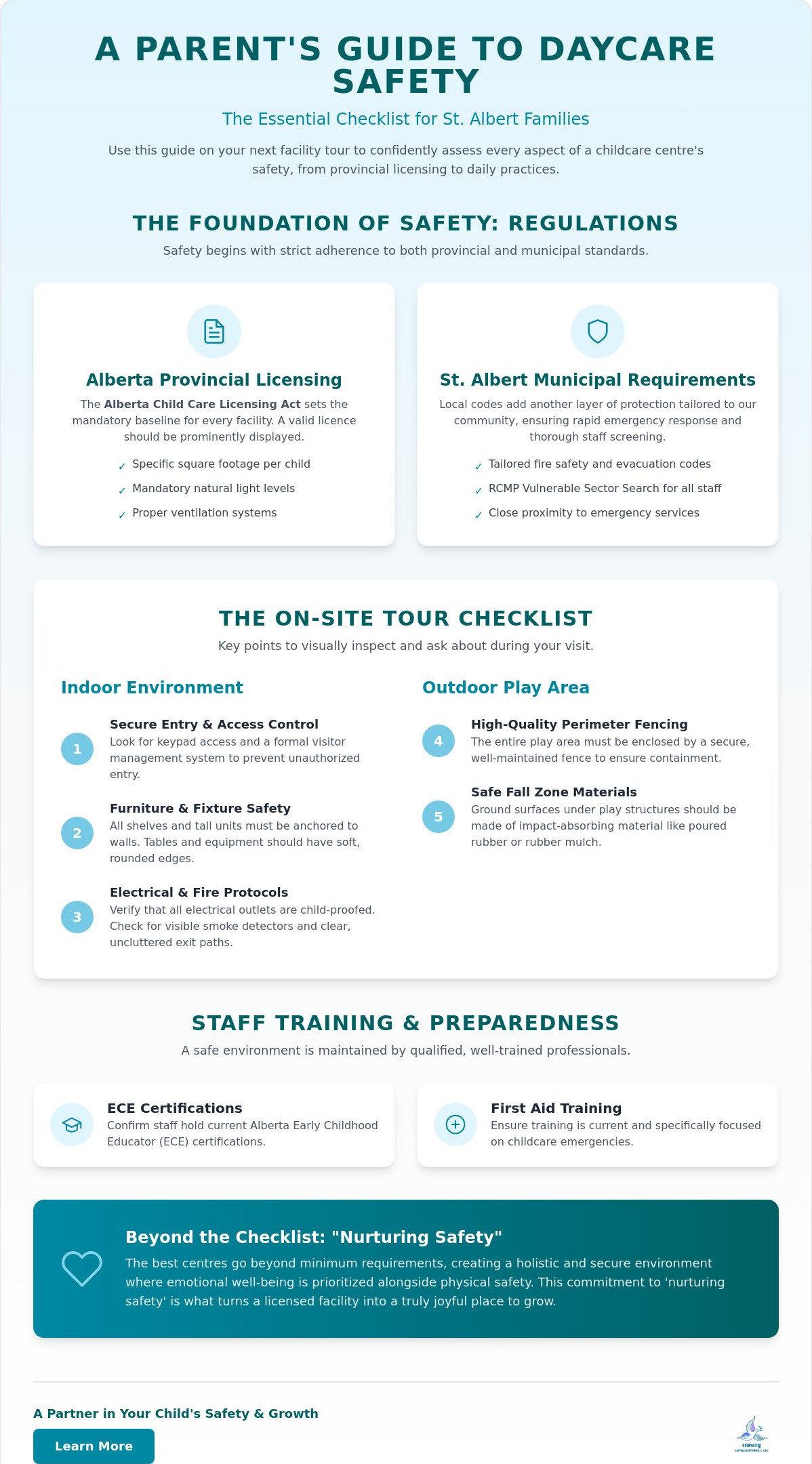
The Alberta Child Care Licensing Act sets the baseline for every facility. This includes specific requirements for square footage per child, natural light levels, and proper ventilation systems. Licensing is the first step on your checklist because it proves the facility has passed rigorous provincial scrutiny. In St. Albert, you'll find the licensing status of any centre prominently displayed near the entrance. This transparency allows you to verify that the program is in good standing before you even begin your tour. Gaining a better perspective on understanding childcare options helps you realize why these provincial benchmarks are so critical. They ensure that the physical environment supports holistic growth rather than just providing a place for simple supervision.
St. Albert Local Safety Nuances
While provincial rules provide the framework, St. Albert has its own municipal safety layers. Local fire safety codes are tailored to our specific commercial and residential zones. These codes ensure that evacuation routes and fire suppression systems are optimized for our local building types. Additionally, all staff members must undergo thorough RCMP clearances. This includes a Vulnerable Sector Search, which is a standard requirement throughout Alberta but is processed through our local St. Albert detachment. Proximity to emergency services is another local factor to consider. A well-located centre ensures that first responders can reach the facility within minutes. This adds an extra layer of security for parents who want to know that help is always close by.
Understanding these layers of protection is the first step toward peace of mind. By combining provincial law with local St. Albert vigilance, you create a safety net that allows your child to explore and learn without unnecessary risk. As we move into 2026, the focus has shifted toward even greater transparency and accountability for providers. This ensures that every child in our community has access to a space that is not only licensed but truly dedicated to their protection and joy.
The Essential Indoor Safety Checklist for Local Parents
The indoor environment is where your child spends the majority of their day, making its physical security a top priority on any daycare safety checklist St. Albert families utilize. Evaluating entry points is critical for peace of mind. Look for secure, keypad-access doors and a rigorous visitor management system that tracks every person entering the building. This prevents unauthorized access and ensures that only registered guardians can pick up children. Beyond the doors, every piece of furniture must be scrutinized. High bookshelves and storage units should have secure anchor points to prevent tipping. Tables and play structures ought to feature soft, rounded edges to minimize the risk of injury during active play.
A comprehensive daycare safety checklist St. Albert providers follow should also include strict adherence to electrical and fire safety protocols. Every outlet must have a child-proof cover, and smoke detectors should be tested regularly with visible maintenance logs. Exit paths must remain clear of clutter, with glow-in-the-dark signage that is easy for both adults and children to follow. These physical requirements are outlined in Alberta's official daycare safety standards, which serve as the mandatory foundation for all licensed facilities in our province. When you tour licensed childcare services in our community, these details should be immediately apparent as part of their daily operations.
Classroom Layout and Hazard Prevention
A well-designed classroom prioritizes clear lines of sight. Educators need to monitor every child from any position in the room, which helps eliminate blind spots where accidents could occur. In toddler-specific areas, the absence of small parts or potential choking hazards is non-negotiable. Toys should be organized in low, sturdy bins to prevent tripping and to encourage children to participate in keeping their space tidy and safe. This organized approach reflects a stable and professional environment where hazards are managed proactively.
Health and Hygiene Standards
Sanitation stations must be AHS-compliant, featuring dedicated hand-washing sinks separate from food preparation areas. Diapering stations require non-porous surfaces that can be easily disinfected between uses to maintain a healthy environment. It's also essential to verify that the facility has a dedicated, isolated space for children who become ill during the day. This prevents the spread of germs to the rest of the group. Providers must also follow AHS food safety guidelines for snacks, ensuring that all food is stored and prepared in a way that minimizes the risk of cross-contamination or allergic reactions.
Outdoor Play and Community Security Standards
Outdoor play is essential for a child's development, but it requires a different set of security protocols than the indoor classroom. A comprehensive daycare safety checklist St. Albert parents use must account for the unique challenges of our local environment. Security begins at the perimeter. A high-quality fence acts as the primary barrier against unauthorized access, ensuring that children remain in a protected zone while they explore. Beyond the fence, the ground beneath play structures is just as important as the structures themselves. Alberta Health Services requires specific fall surfacing depths, typically at least 6 inches, to absorb impact. Common materials include pea gravel, rubber mulch, or poured-in-place rubber. Each has its benefits, but the key is consistent maintenance to ensure the material hasn't shifted or compacted over time.
Regular inspections are mandatory for any reputable provider. Educators should look for rust on metal components, splinters on wooden structures, and loose bolts that could snag clothing. In St. Albert, we also face weather extremes. This means checking for ice patches in the winter and ensuring adequate sun shade during our bright summer months. A stable and organized centre will have a clear plan for these environmental factors, reflecting their role as a knowledgeable advocate for your child's well-being.
Evaluating the Outdoor Play Area
The physical structure of the play area provides the first line of defence. You should confirm that the fence height meets the Alberta provincial standard of at least 1.2 metres. It's equally important to check that all gates are self-closing and equipped with child-proof latches that are out of reach for small hands. Age-segregated play equipment is another hallmark of a safe centre. This ensures that toddlers aren't accidentally injured by the more vigorous play of older children, allowing every age group to develop at their own pace in a secure and nurturing setting.
Security During Transitions
Safety isn't just about the equipment; it's about the process. You should ask how staff organize the movement of children from classrooms to the yard. Reliable St. Albert educators use strict headcount procedures before leaving the building and immediately upon entering the play area. This constant verification ensures that no child is ever left unattended during transitions. During the height of an Alberta summer, these protocols extend to health safety. This includes mandatory sun safety measures like hat requirements and frequent hydration breaks to keep children comfortable and safe under the sun.
Evaluating Staff Training and Emergency Preparedness
While physical barriers provide a vital foundation, the true heart of a secure environment lies in the expertise and vigilance of the educators. This requirement for highly trained, compassionate caregivers is a universal need for families, whether they are vetting local childcare or seeking professional home care services Santa Rosa CA to support an aging relative. This human element is a crucial pillar of any daycare safety checklist St. Albert families use to vet potential centres. In Alberta, staff certification is categorized into three distinct levels. Level 1 educators have foundational training, while a Level 3 Program Supervisor has completed a comprehensive diploma or degree in early childhood education. It's essential to confirm that a centre has a high concentration of Level 2 and Level 3 staff, especially during peak hours. Beyond their degrees, every educator must maintain current, childcare-specific First Aid and CPR certifications. These aren't just one-time courses; they require regular recertification to ensure life-saving skills remain sharp and effective.
Emergency preparedness in St. Albert also involves a rigorous schedule of drills. A stable facility doesn't just have a plan on paper; they practice it. This includes monthly fire drills, as well as lockdown and tornado protocols tailored to our local climate and geography. Staff-to-child ratios are the final technical piece of this puzzle. These ratios are designed to ensure that in an emergency, every child can be accounted for and moved to safety quickly. For families seeking quality childcare that prioritizes these high standards, verifying staff credentials and drill logs should be a top priority during your tour.
The Human Element of Safety
Professional educators realize that safety extends beyond physical protection to include emotional security. Children need a stable, nurturing presence to feel comfortable enough to explore and learn. Consistent staffing is vital here, as it allows children to build deep bonds of trust with their caregivers. In Alberta, the legal ratio for infants under 19 months is one staff member for every four children, while preschoolers aged three to four and a half years require a ratio of one to eight. Exceeding these minimums is often a sign of a centre that truly values the well-being and individual attention of every child in their care.
Communication Protocols for Parents
Modern St. Albert centres now utilize digital check-in and check-out systems to enhance facility security and streamline communication. These platforms provide an electronic paper trail of who dropped off and picked up your child each day. Transparency is also key when it comes to incidents. You should ask how the centre notifies parents of minor injuries or unusual events. A professional facility will have a clear, written evacuation plan and a redundant system for emergency contacts. This ensures that even if one communication method fails, you'll always be kept informed about your child's status and the centre's operations.
Choosing a Partner in Safety: Why Trinity Early Learning & OSC?
Selecting the right environment for your child is one of the most significant decisions a family can make. At Trinity Early Learning & OSC, we recognize that you need more than just a facility; you need a partner who views security through a lens of compassion and professionalism. Our family-run St. Albert centre prioritizes a "nurturing safety" model. This approach ensures that while every technical requirement of the daycare safety checklist St. Albert parents expect is met, it is delivered within a warm, community-focused atmosphere. We believe that a child who feels emotionally secure is better prepared to engage with their surroundings and reach their full developmental potential.
Our commitment to excellence means we consistently strive to exceed the Alberta Child Care Licensing standards. We don't view provincial regulations as a final goal but as the minimum foundation for our operations. A key part of maintaining these high standards in 2026 is our integration of the provincial Affordability Grant. By utilizing this grant, we ensure that high-quality, safe, and licensed care remains accessible to our local families. This financial support allows us to invest in premium safety equipment, high-quality play materials, and the ongoing professional development of our dedicated team of educators.
Our Approach to Holistic Safety
We maintain a culture of vigilance through regular internal safety audits that go beyond annual provincial inspections. These audits allow us to identify and address potential issues before they become hazards, ensuring our classrooms remain organized and secure. Our educators are trained to foster an environment where growth and security coexist. You can learn more about our specific operational benchmarks in our guide to licensed daycare St. Albert services. By carefully organizing our classrooms, we create clear paths for movement and unobstructed lines of sight that facilitate constant supervision.
Enrolling Your Child with Confidence
When you prepare for your first tour at Trinity, we encourage you to bring your daycare safety checklist St. Albert notes and plenty of questions. You should look for the daily safety logs, meet our certified educators, and observe how our staff interacts with the children during transitions. For a deeper look at how to evaluate if a facility is the right fit for your family's needs, please review our guide on early learning center St. Albert options. We invite you to contact us today to book a safety-focused tour and realize your child’s potential in a space designed for their protection and joy.
Securing Your Child's Brightest Future in St. Albert
Ensuring your child's safety is a continuous journey that combines rigorous provincial standards with local vigilance. By utilizing a comprehensive daycare safety checklist St. Albert families can navigate the complexities of facility licensing and staff certifications with absolute clarity. We've explored how secure entry points, age-appropriate play zones, and current emergency protocols create a stable environment where children can thrive. Every detail matters when it comes to protecting the joy and well-being of our youngest community members.
At Trinity Early Learning & OSC, we're proud to be a family-owned and community-focused provider. We are fully licensed by the Government of Alberta and staffed by certified ECE professionals who are dedicated to your child's holistic growth. We invite you to Book a Tour to See Our Safety Standards in Action and experience our nurturing environment firsthand. Choosing the right childcare provider is about finding a partner you can trust. We're here to provide that peace of mind as your child begins their early learning adventure in our secure and stable facility.
Frequently Asked Questions
What are the legal staff-to-child ratios for daycares in Alberta?
Alberta law mandates specific ratios to ensure every child receives adequate supervision and care. For infants under 19 months, the ratio is one staff member for every four children. For toddlers aged 19 months to three years, the requirement is one to six. Preschoolers aged three to four and a half years require a one to eight ratio. These standards are foundational for maintaining a secure and responsive environment for all age groups.
How can I verify if a St. Albert daycare is currently licensed?
You can verify a facility's status by using the Alberta Child Care Lookup tool on the provincial government website. This digital resource provides current information on licensing and any recent inspection findings. Additionally, every licensed centre in St. Albert must display its physical license in a prominent location near the main entrance. Checking these records is a vital step in your daycare safety checklist St. Albert research.
Do St. Albert daycares require specific fire safety inspections?
St. Albert daycares must pass annual fire safety inspections conducted by St. Albert Fire Services. These inspections verify that smoke detectors, fire extinguishers, and sprinkler systems are fully operational. They also ensure that all exit paths are clear and that the facility adheres to the Alberta Fire Code. This local municipal oversight adds a critical layer of protection for children and staff within our community.
What happens if a daycare fails an AHS safety inspection?
If a facility fails an Alberta Health Services inspection, they're issued a formal notice of non-compliance that outlines the required corrective actions. AHS inspectors will then conduct follow-up visits to ensure the issues are resolved within a specific timeframe. If the safety concerns remain unaddressed or pose an immediate risk to children, the facility's license may be suspended or revoked entirely to ensure child safety.
Is a background check mandatory for all childcare staff in Alberta?
A clear Criminal Record Check including a Vulnerable Sector Search is mandatory for every person working in a licensed Alberta childcare program. These checks must be completed before an educator begins their role and are typically updated every three years. This requirement ensures that all staff members have been thoroughly vetted by the RCMP or local police to maintain a safe and stable environment for your family.
How do I report a safety concern at a daycare in St. Albert?
You should first discuss any concerns directly with the program supervisor or owner. If the issue isn't resolved, you can report it to the Edmonton Region Child Care Licensing Office. They investigate all formal complaints to ensure providers are adhering to provincial safety standards. This process is designed to be transparent and helpful, acting as a safeguard for all families using local childcare services in our city.
What safety equipment should I look for in a preschool classroom?
A secure preschool classroom should feature child-proof outlet covers and heavy furniture that's securely anchored to the walls. You should also look for visible First Aid kits and clearly marked fire extinguishers. Using a daycare safety checklist St. Albert parents trust will help you identify these items quickly. Ensure that all toys are in good repair and that the classroom layout allows for unobstructed supervision at all times.
Can I see the emergency evacuation plan before enrolling my child?
You have the right to review a facility's emergency evacuation and lockdown plans before you decide to enroll. A professional provider will have these procedures documented and should be happy to explain how they handle various scenarios. Reviewing these documents helps you understand how the staff will protect your child during an unexpected event. It's a standard part of any thorough evaluation process for new families in our community.


