

What if the hours between the school bell and the end of your workday could be a source of growth rather than a source of worry? You want to know your child is in a space that's not just supervised, but truly safe and enriching. It's completely natural to feel overwhelmed by the choice between a casual neighbourhood arrangement and formal licensed out of school care Alberta programs, especially when you're also balancing the family budget.
We believe every parent deserves peace of mind and every child deserves a supportive environment. This guide will provide the clarity you need by explaining Alberta's strict safety regulations and the specific financial supports available to your family. You'll learn how to verify a provider's credentials, understand the 2026 updates to the Early Childhood Educator Workforce Supports Program, and follow the exact steps to secure provincial grants that make high-quality care accessible.
Key Takeaways
- Understand the rigorous safety standards and mandatory staff background checks that define high-quality licensed out of school care Alberta programs.
- Discover the essential differences between professional centres and informal care to ensure your child enjoys a stable and enriching environment.
- Learn how to access provincial affordability grants and income-based subsidies to significantly reduce your monthly childcare expenses.
- Gain a practical checklist for verifying a provider’s licensing history and evaluating staff interactions during your facility tours.
Defining Licensed Out of School Care (OSC) in Alberta
Choosing the right environment for your child after the school day ends is a significant decision. In Alberta, "Out of School Care" (OSC) refers specifically to programs designed for children from Kindergarten through Grade 6. These programs provide a vital bridge between the classroom and home. When you choose licensed out of school care Alberta, you're selecting a provider that has undergone a rigorous vetting process to ensure they meet high provincial standards.
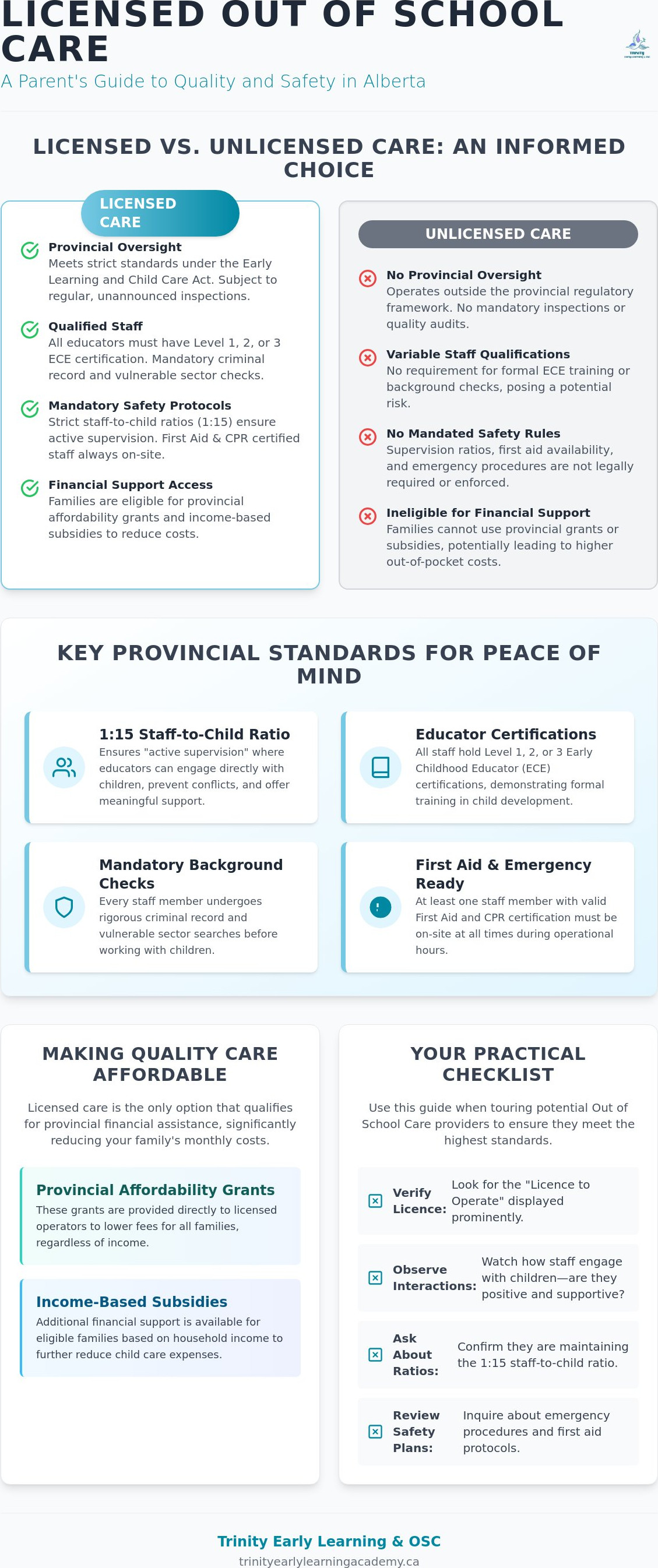
A provincial licence is more than an administrative formality; it's a badge of quality and safety. Programs must adhere to the Early Learning and Child Care Act, which dictates everything from staff qualifications to physical space requirements. To ensure these standards never slip, licensed providers are subject to regular, unannounced inspections by provincial authorities. This oversight provides a layer of security that unlicensed arrangements simply cannot offer. While looking at the broader landscape of Child care in Canada, it's clear that Alberta's regulatory framework is designed to prioritize the holistic development and physical safety of every child.
It's helpful to distinguish between the two main types of licensed care. Facility-based OSC programs are typically located in schools or dedicated community centres. These are structured environments with multiple staff members and dedicated activity zones. Conversely, licensed family day home agencies oversee individual providers who offer care in a private residence. Both options must comply with provincial regulations, but the facility-based model often provides more stability through backup staffing and consistent operational hours.
What Qualifies as a Licensed Program?
To obtain and keep a licence, a program must meet strict physical and professional criteria. Every centre must provide a specific amount of usable floor space for each child to ensure they have room to move, play, and learn comfortably. Safety features such as secure entryways and appropriate fire exits are non-negotiable. Staffing is another critical pillar. All staff members must hold certification as Level 1, 2, or 3 Early Childhood Educators. These designations reflect specific hours of post-secondary training in child development, ensuring that the people guiding your child understand their emotional and social needs. Additionally, centres must maintain detailed administrative records, including emergency contact information and daily attendance logs, to ensure every child is accounted for at all times.
The Role of the Alberta Child Care Licensing Act
The Act serves as a protective shield for families. It establishes enforceable health and safety standards that every provider must follow, covering everything from nutrition and hygiene to supervision and discipline. You should always see the "Licence to Operate" clearly displayed in a prominent area of the centre. This document confirms the provider is currently in good standing with the province. The Early Learning and Child Care Act serves as the legal foundation for quality care in 2026, ensuring that provincial standards evolve alongside the needs of modern families. By choosing a program that operates under this legislation, you're partnering with a team committed to professional excellence and transparent care.
Key Provincial Standards for Licensed OSC Programs
Every licensed out of school care Alberta program operates under a rigorous set of guidelines designed to protect your child's well-being. These aren't just suggestions; they're legal requirements that ensure consistency across the province. By adhering to Alberta's licensed facility-based programs standards, providers create a stable foundation where children transition smoothly from their school day into a nurturing after-school environment.
Safety begins with the people in the room. Every staff member must undergo thorough criminal record checks and vulnerable sector searches before they're permitted to work with children. This vetting process is mandatory and ongoing, providing a critical layer of security for your family. Additionally, if the program provides snacks or meals, they must follow specific nutrition and health standards to ensure children receive balanced, healthy fuel for their afternoon activities.
Safety and Supervision Ratios
The province mandates a maximum 1:15 staff-to-child ratio for school-aged children. While this number might seem like a simple administrative rule, it serves a deep developmental purpose. This ratio allows for "active supervision," where educators stay close enough to engage with children, spot potential conflicts before they escalate, and prevent issues like bullying. It's about being present, not just watching from a distance. In addition, at least one staff member with valid First Aid and CPR certification must be on-site at all times. This ensures the team is prepared for any emergency, giving you the confidence that your child is in capable, trained hands.
Educational and Developmental Programming
Quality care goes far beyond basic supervision. Licensed programs are expected to offer diverse activities that support physical, social, and emotional growth. Many centres utilize the Alberta Flight Framework to guide their curriculum, viewing children as capable and curious learners. This approach ensures that the time spent after school is productive and enriching. It transforms the afternoon from a waiting period into a time of active discovery.
A well-designed program balances structured learning with the much-needed opportunity for free play and rest. After a long day in the classroom, children need space to decompress. Programs must also be inclusive, ensuring children with diverse needs are fully supported through adapted activities and specialized care plans. If you're looking for a program that prioritizes these high standards, exploring quality childcare in your community is the first step toward a stress-free afternoon routine.
Licensed vs. Unlicensed Care: Making an Informed Choice
Choosing between an informal neighbourhood arrangement and a professional centre is a choice between personal convenience and guaranteed provincial standards. While unlicensed care might seem flexible, it lacks the essential oversight that defines licensed out of school care Alberta. One of the most significant practical differences is financial accessibility. Access to provincial government funding, such as affordability grants and income-based subsidies, is exclusively tied to a provider's licensed status. This makes professional care a more sustainable and affordable choice for many families.
Licensed centres provide a level of professional stability that informal arrangements simply cannot match. These facilities operate with a team of educators rather than relying on a single individual. This structure ensures that if one staff member is unwell, the centre remains open and your daily routine stays intact. Professional facilities also carry comprehensive liability insurance designed specifically for childcare environments, offering a significantly higher level of protection than a standard homeowner's policy. By selecting a regulated environment, you're choosing a system built on reliability and transparency.
The Risks of Unregulated Childcare
Unlicensed care, often called informal babysitting, is legally limited to a maximum of six children. However, these settings are not subject to mandatory fire safety inspections or provincial health standards. There is no requirement for the provider to prove their home meets specific safety codes for children or that they maintain a sanitary environment. Perhaps most importantly, unlicensed settings don't require mandatory background checks or vulnerable sector searches for every adult living in the household. In contrast, Alberta's standards for licensed childcare mandate that every person with access to children is thoroughly vetted. Choosing unregulated care also creates a "single point of failure" where a provider's personal illness can leave you without childcare at a moment's notice.
The Value of Professional Accountability
When you select quality childcare in St. Albert, you're partnering with a team that values transparency. Professional centres employ a multi-disciplinary group of educators, which means your child benefits from a variety of teaching styles and developmental expertise. This team-based approach allows for better supervision and more creative programming than any single provider could offer alone. Accountability is the primary product of a licence, serving as a formal promise that the centre will consistently meet provincial expectations. This professional framework ensures that the care your child receives is not just adequate, but exceptional and reliable.
Navigating Alberta Childcare Subsidies and Affordability Grants
Financial peace of mind is a vital part of the childcare equation. Alberta's current funding model is designed to make licensed out of school care Alberta more accessible by providing two distinct layers of support: affordability grants and income-based subsidies. These programs work together to lower out-of-pocket costs, ensuring that professional childcare remains a viable option for modern families. By choosing a licensed provider, you gain access to these provincial funds which are often paid directly to the centre to reduce your monthly invoice.
Beyond standard grants, families may also access specialized support. For instance, an additional $100 per month is available per child for families requiring four or more extended hours of care in a month from an approved program. There are also specific supports for children with disabilities to ensure inclusive care is financially sustainable for every family. You can manage and track all your applications through the Alberta Childcare Family Portal, a centralized digital tool that simplifies the administrative side of childcare management.
The Childcare Affordability Grant
The Affordability Grant is a cornerstone of the federal-provincial agreement. It's applied automatically by your centre, meaning you don't need to fill out a separate application for this specific reduction. For families with children in Kindergarten, this grant significantly lowers fees to a predictable flat rate. As of April 2025, full-time Kindergarten care in a licensed program results in a parent fee of $326.25 per month for 100 or more hours. For children in Grades 1 through 6, the grant continues to provide relief, though the specific amounts differ based on the age group and the hours of care provided. For a deeper look at how these savings apply to your family, visit our Daycare Affordability Grant Alberta guide.
Applying for the Provincial Subsidy
While the grant is automatic, the provincial subsidy is income-tested. Families with a gross household income of $90,000 or less are eligible for additional monthly subsidies for children in Kindergarten through Grade 6. To apply, you'll need to create a MyAlberta Digital ID and submit your application through the official provincial website. You must provide your most recent Notice of Assessment from the CRA and proof of your current employment or school enrolment. It's vital to track your expiry dates carefully. Renewing your subsidy at least two months before it expires prevents unexpected payment gaps and ensures your child's spot remains secure. If you're ready to secure a spot for your child, consider enrolling in our affordability grant daycare program today.
Choosing a Quality OSC Provider in St. Albert
Finding a local provider who aligns with your family's values is the final step in this journey. In St. Albert, parents have several options, but the most reliable way to start is by using the provincial 'Child Care Lookup' tool. This digital resource allows you to verify the history of any licensed out of school care Alberta program, ensuring they have a consistent record of compliance with provincial safety standards. Looking at past inspection reports gives you a transparent view of a centre's commitment to quality before you even step through the door.
Once you've narrowed down your list, scheduling an in-person tour is essential. A high-quality centre should feel warm, organized, and welcoming. Pay close attention to the emotional atmosphere and observe how staff members interact with the children. Are the educators actively engaged in activities, or are they simply monitoring the room from a distance? Clear, respectful communication between educators and students is a hallmark of a nurturing environment. You should also ask about the OSC program's balance of rest and play to ensure your child has the necessary time to unwind after a structured school day.
Questions to Ask During Your Visit
When you meet with a potential provider, come prepared with specific questions that address your child's daily experience. Start by asking how they handle the transition from school to the OSC centre. A seamless hand-off is vital for your child's sense of security. It's also helpful to ask about their philosophy on conflict resolution, particularly for older children in Grades 4 through 6 who require more sophisticated social guidance. Finally, ask how the after school care activities are adapted for different age groups. A Grade 1 student and a Grade 6 student have very different developmental needs, and a quality program will offer varied options that challenge and interest both.
The Trinity Early Learning & OSC Difference
At Trinity Early Learning & OSC, we take our role as a "Trusted Nurturer" seriously. We're committed to maintaining the highest licensed standards in St. Albert, providing a stable and professional environment where your child can thrive. Our team understands the practical needs of modern families, which is why we fully integrate the provincial Affordability Grant into our fee structure. This ensure that high-quality, licensed out of school care Alberta remains accessible and affordable for our local community. We believe in transparent communication and invite you to become an active part of our centre's life. We would love to show you our space and introduce you to our dedicated team of educators. We invite you to tour our facility and meet our nurturing team to see how we can support your child's growth and joy after the school bell rings.
Empowering Your Child's After-School Journey
Choosing a professional environment for your child provides a sense of security that benefits the entire family. By prioritizing licensed out of school care Alberta, you ensure your child is supported by certified Early Childhood Educators who understand their unique developmental needs. You also unlock essential financial supports, including provincial affordability grants and income-based subsidies, which make high-quality programming more accessible than ever before.
At Trinity Early Learning & OSC, we're proud to be fully licensed and regularly inspected by the Province of Alberta. Our dedicated team is committed to providing a nurturing space where safety and joy go hand in hand. We're also fully approved for all provincial funding programs to help reduce your monthly costs. Secure your child's spot in our licensed St. Albert OSC program today and experience the peace of mind that comes from professional, compassionate care. We look forward to welcoming your family into our community.
Frequently Asked Questions
What is the difference between licensed and approved out of school care in Alberta?
Licensed programs are facility-based centres that meet provincial regulations directly through the Early Learning and Child Care Act. Approved care refers to individual family day homes that operate under the oversight and standards of a licensed agency. Both forms of care are regulated and eligible for provincial funding, ensuring high standards of safety and professional accountability for your family.
How many children can an unlicensed provider care for in Alberta?
An unlicensed provider in Alberta can care for a maximum of six children at any one time. This total must include the provider's own children who are also present in the home. If a provider cares for seven or more children, they're legally required to hold a provincial licence to ensure proper safety, space, and supervision standards are met.
Can I get a subsidy for out of school care if I work from home?
Yes, you can qualify for a subsidy while working from home. Eligibility for licensed out of school care Alberta subsidies is based on your household income and your "reason for care," which includes employment, self-employment, or attending school. As long as your gross household income is $90,000 or less for school-aged children, you're encouraged to apply through the provincial portal.
Is the Alberta Affordability Grant available for after-school care?
The Affordability Grant is specifically available for children in Kindergarten who are enrolled in licensed programs. This grant is paid directly to the provider to lower the flat-rate fee for parents. For children in Grades 1 through 6, the grant doesn't apply; instead, families manage costs through the income-based provincial subsidy program if they earn $90,000 or less annually.
What happens if a licensed OSC program fails an inspection?
If a program fails to meet provincial standards, a licensing officer issues a non-compliance report that the centre must address within a specific timeframe. In more serious or repeated cases, the province may issue a probationary licence or even a stop order. These measures ensure that child safety remains the absolute priority and that providers remain accountable to Alberta's rigorous standards.
Are staff in licensed OSC programs required to have first aid training?
Every licensed program is required to have at least one staff member on-site at all times who holds a valid First Aid with a childcare component and CPR certification. This requirement ensures that the team is prepared to handle medical emergencies or minor injuries promptly and professionally. Most high-quality centres encourage all staff members to maintain these vital certifications.
How do I find a list of licensed out of school care providers in St. Albert?
You can find a complete list of licensed out of school care Alberta providers by using the provincial Child Care Lookup tool on the Alberta.ca website. This tool allows you to filter results by your specific postal code or city. It also provides a transparent history of any recent inspections or non-compliance issues for each centre in the St. Albert area.
Does the government subsidy cover the full cost of out of school care?
The provincial subsidy rarely covers the entire cost of childcare. It's designed to reduce the financial burden based on your household income and the number of hours your child spends in the program each month. Most families should expect to pay a remaining "parent fee" after the subsidy and any applicable affordability grants have been applied to the invoice.


