

What if the hours between the school bell and the dinner table became the most enriching part of your child's day, rather than just a gap to be filled? For many parents, the search for quality after school care St. Albert can feel like a logistical puzzle, often clouded by the guilt of long work hours or the worry that children are spending too much time in front of a screen. You want to know your child is in a safe, licensed environment where they're not just waiting for you, but actively growing.
We understand that finding a program that balances social development with academic support is your top priority. This guide will help you identify high-quality care that turns idle time into a developmental bridge, ensuring your child receives the homework help they need so your evenings are preserved for family connection. We'll also clarify the 2026 Alberta childcare grant updates and explain how to access the affordability funding that makes a licensed child care centre more accessible for families in our community. By the end of this article, you'll feel confident in choosing a space that supports your child's joy and your family's schedule.
Key Takeaways
- Understand how Out of School Care (OSC) serves as a vital bridge between the academic day and home life for children aged 6 to 12.
- Learn how to evaluate the best after school care St. Albert has to offer by prioritizing low staff-to-child ratios and safe transportation logistics.
- Discover the benefits of "unstructured structured" play in fostering essential social-emotional growth and creative expression during the afternoon hours.
- Navigate the 2026 Alberta childcare funding landscape, including the differences between universal Affordability Grants and income-based subsidies.
- Recognize the importance of a dedicated centre environment that provides a nurturing "home away from home" for your child’s comfort and stability.
What to Expect from Licensed After School Care in St. Albert
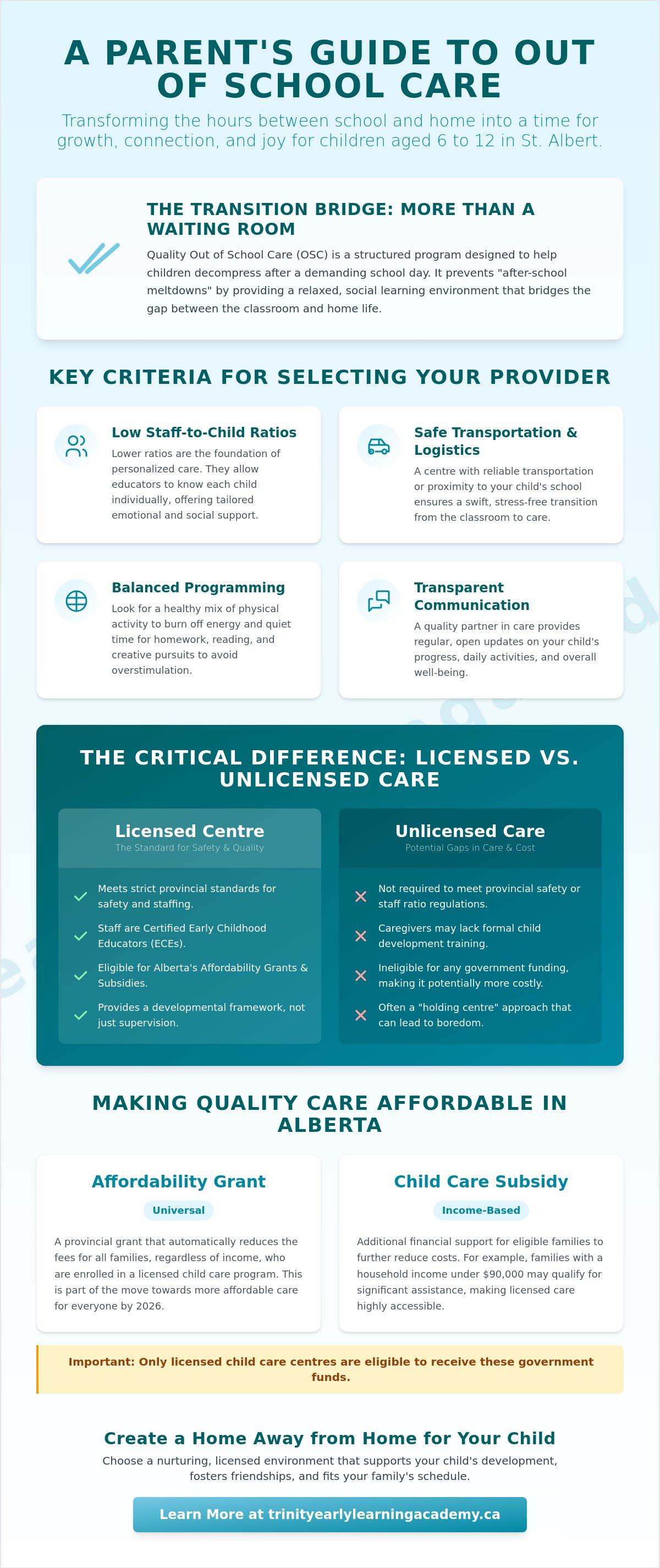
Quality after school care St. Albert is much more than just a place for your child to wait for a ride home. Out of School Care (OSC) is a structured, intentional program specifically designed for children aged 6 to 12. It serves as a vital Transition Bridge. This concept recognizes that children are often mentally exhausted after a long day of academic rigor. They need a space that allows them to shift from the strict demands of the classroom into a more relaxed, social learning environment. This shift helps prevent the "after-school meltdowns" many parents witness at the end of the workday.
Choosing a professional OSC program over a casual babysitting arrangement provides your child with a consistent routine and a community of peers. While a babysitter offers supervision, a professional centre provides a developmental framework. This ensures that the hours between 3:00 PM and 6:00 PM are used to foster independence and social skills. Engaging in a supervised after-school activity allows children to explore interests that they might not have time for during the regular school day, all within a safe and nurturing environment.
The Difference Between Supervision and Development
A common pitfall in childcare is the "holding centre" approach. When a program only focuses on keeping children in a room until their parents arrive, it often leads to boredom and behavioral challenges. Children need stimulation that matches their developmental stage. Professional centres like Trinity focus on holistic growth during these afternoon hours. Our Early Childhood Educators (ECEs) don't just watch the children; they facilitate peer interactions and support emotional well-being. This specialized attention helps children navigate social complexities and build confidence in a way that casual supervision cannot match.
For families who feel their children might benefit from even more specialized emotional support as they transition into their teenage years, services like Thrive Teen Therapy Alberta provide dedicated mental health resources throughout the province.
Licensed vs. Unlicensed OSC Programs in Alberta
In Alberta, the Early Learning and Child Care Act requires any program caring for seven or more children to be licensed. This license is a guarantee that the provider meets strict provincial standards for safety, staffing ratios, and physical space requirements. Licensing isn't just about safety; it's also the primary requirement for financial accessibility. Only licensed providers can access the Alberta Child Care Grant and provincial subsidies. If your family income is under $90,000, you may be eligible for subsidies that significantly reduce the cost of after school care St. Albert. When touring a potential centre, always look for these licensing markers:
- A current provincial license prominently displayed near the entrance.
- Staff-to-child ratios that comply with provincial regulations for mixed-age groups.
- Clearly defined emergency protocols and health standards.
- Certified Early Childhood Educators who lead the daily programming.
By choosing a licensed program, you ensure your child is in a regulated environment that prioritizes their safety and development while also making high-quality care more affordable for your family.
Essential Criteria for Selecting an After School Care Provider
Selecting the right after school care St. Albert involves more than just finding an available spot. It requires a careful evaluation of how a program fits into your family's daily rhythm and your child's personality. Proximity to your child's school is the first logistical hurdle. A centre that offers reliable transportation or is located within a short distance ensures that the transition from the classroom is swift and stress-free. Beyond location, you should assess the staff-to-child ratios. Lower ratios are not just a regulatory requirement; they are the foundation for personalized attention. When educators have the time to truly know each child, they can better support their unique emotional and social needs. If you are looking for a program that prioritizes these standards, you might consider visiting Trinity Early Learning & OSC to see how these criteria are put into practice daily.
A high-quality program also maintains a healthy balance between physical activity and quiet time. Children often spend their school day sitting at desks, so they need opportunities to burn off energy through active play. However, they also require calm spaces for reading or reflection to avoid overstimulation. Communication is another vital pillar. You should look for a centre that values transparency and provides regular updates on your child's progress and daily experiences. This open dialogue ensures that you remain an active participant in your child's afternoon journey.
Safety Standards and Staff Qualifications
Your peace of mind depends on knowing your child is in a secure environment. All staff members in a reputable Out of School Care (OSC) program must hold current First Aid and CPR certifications. It is also essential that every educator has undergone a thorough background check and a vulnerable sector screening. The physical facility itself should be a sanctuary. This includes secure entry points that prevent unauthorized access, clean and well-maintained rooms, and age-appropriate equipment that meets modern safety standards. These rigorous measures are often a requirement for providers participating in the Alberta Child Care Grant Funding Program, which links high safety standards with financial accessibility.
Curriculum and Activity Diversity
An engaging program avoids the "busy work" trap by offering a diverse curriculum that stimulates the school-age brain. A mix of STEM projects, creative arts, and supervised free play allows children to explore different facets of their identity. For older children, choice-based programming is particularly effective. Giving them the autonomy to choose their activities fosters independence and keeps them invested in the program. You can tell a program is truly engaging if the children are eager to participate rather than simply waiting for the clock to run down. Look for evidence of planned projects that challenge their thinking and encourage collaboration with their peers. This intentional approach ensures that after school care St. Albert becomes a highlight of their day rather than just a necessity.
The Impact of After School Programs on Child Development
High-quality after school care St. Albert serves as a powerful catalyst for a child's personal growth, moving far beyond basic supervision. When children transition from the formal classroom to an Out of School Care (OSC) environment, they enter a space specifically designed to foster social-emotional learning (SEL). This setting allows them to practice vital life skills, such as empathy and self-regulation, in a relaxed yet guided atmosphere. By interacting with a diverse group of peers, children learn to navigate various social dynamics that they might not encounter during the structured school day. These experiences are essential for building the confidence they need to succeed both inside and outside the classroom.
One of the most valuable aspects of a professional OSC program is the concept of "unstructured structured" time. This involves providing a safe, supervised environment where children have the freedom to choose their own activities and engage in creative play. This type of supervised free play is essential for developing problem-solving skills and sparking original thought. Whether they are building complex structures with blocks or collaborating on a group game, children are learning how to innovate and work together. These developmental benefits are a hallmark of licensed facilities, which are also the only programs eligible for the Alberta Child Care Subsidy Program for families who meet the provincial income requirements.
Fostering Social-Emotional Skills
Multi-age groupings in after school care St. Albert play a significant role in developing mentorship and empathy. Older children often take on leadership roles, guiding younger peers through activities, while younger children benefit from having positive role models close to their own age. Early Childhood Educators (ECEs) act as knowledgeable facilitators during these interactions, helping children resolve conflicts and practice effective teamwork during group projects. In 2026, consistent after-school peer groups provide the stable social foundation children need to develop a profound sense of belonging and community identity. This sense of connection is further strengthened through local field trips and community-based learning opportunities that help children feel more rooted in their St. Albert neighbourhood.
Academic Support and Executive Function
While OSC is not a second school day, it provides a crucial bridge for academic support. Many programs offer a designated "quiet zone" where children can focus on homework or reading without the distractions of a busy household. This low-pressure academic environment prevents school burnout by offering help when needed while still allowing the child to take ownership of their work. Following a consistent daily routine in an OSC setting also helps children build essential executive function skills, such as time management and organization. By learning to balance their responsibilities with their desire for play, children develop a sense of autonomy that serves them well as they grow older.
Managing the Costs: Alberta Child Care Grants for OSC
The 2026 financial landscape for childcare in Alberta focuses on accessibility and significant fee reductions. Through the Canada-Alberta Early Learning and Child Care Agreement, the provincial goal remains an average of $10-a-day care for licensed programs. For families seeking after school care St. Albert, this means that professional, regulated environments are often more affordable than unlicensed alternatives. Trinity Early Learning & OSC utilizes all available provincial grants to ensure that high-quality programming is accessible to our community's families. These grants are applied directly to your monthly tuition, reducing the immediate financial burden on your household.
There are two primary ways to lower your costs. The first is the universal Affordability Grant, which is available to all families in licensed care regardless of income. The second is the Alberta Child Care Subsidy Program, which provides additional support to families with a gross annual income under $90,000. While the subsidy requires a personal application, the Affordability Grant is handled entirely by the centre. If you are ready to explore your options and see how these grants apply to your family, contact Trinity Early Learning & OSC today to discuss our current availability and enrolment steps.
Understanding the Affordability Grant for School-Age Children
The Affordability Grant is a flat-rate reduction that applies to children in Grades 1 through 6. It's important to realize that the grant amount varies based on your care schedule. For example, the funding level for "Before and After" care differs from the amount allocated for "After Only" care. You don't need to apply for this funding yourself. Your licensed centre applies for the grant on your behalf and deducts the amount from your invoice before you ever see it. This automatic process ensures that every family benefits from provincial funding without extra paperwork.
Simplifying the Enrolment Process
Securing a spot in a quality program requires a bit of forward planning. As of April 2026, provincial regulations have limited the expansion of affordability funding for new spaces, which means popular locations fill up quickly. We recommend starting your search in March for a September start date. To complete your registration, you'll typically need to provide several documents:
- Up-to-date immunization records for your child.
- Detailed emergency contact information and authorized pick-up lists.
- Relevant medical alerts or allergy information.
- A completed registration form and any required deposits.
By preparing these documents early and understanding the grant system, you can navigate the logistical side of after school care St. Albert with confidence and ease.
Creating a Home Away from Home at Trinity Early Learning & OSC
Trinity Early Learning & OSC is designed to be a stable sanctuary for your child. While many options for after school care St. Albert are forced to operate in shared spaces like school gyms, our program provides a dedicated centre environment. This distinction is vital for a child's sense of belonging. A permanent space allows for a more personalized atmosphere where children can display their artwork, keep their personal belongings secure, and feel truly at home. Our philosophy combines high-level professionalism with the nurturing warmth that only a family-run business can provide. We believe that stability in the environment leads to stability in a child's emotional development.
Our staff members are more than just supervisors; they are Knowledgeable Advocates for your child’s well-being. This persona means we take a proactive role in understanding each child's unique personality and developmental needs. We act as a bridge between the school and the home, ensuring that the values you hold as a family are respected and reinforced during the afternoon hours. This commitment to being a compassionate partner is what differentiates our community from larger, more clinical childcare settings in St. Albert. We prioritize building deep, lasting relationships with every family we serve.
Our Holistic Approach to Out of School Care
We recognize that the hours after school are a delicate time for children. They are often mentally fatigued but still possess a physical need for movement and social connection. Our holistic approach balances the need for quiet rest with the desire for engaging play. We provide dedicated zones for different energy levels, ensuring that a child who needs to finish a book can do so in peace while others participate in a group art project. You can learn more about our nurturing childcare philosophy to see how we integrate these developmental principles into our daily schedule. From community exploration walks to creative arts, every activity is designed to spark joy and foster independence in after school care St. Albert.
How to Join the Trinity Community in St. Albert
Joining our community begins with a transparent and helpful conversation. We understand that choosing a provider is a significant decision for your family, and we are here to act as your guide through the logistical and emotional aspects of the process. We encourage all interested parents to book a personal tour of our facility. Seeing our nurturing environment in person allows you to witness the calm, organized, and joyful atmosphere we maintain daily. We are committed to open communication and family partnership, ensuring you always feel informed about your child's progress. Please contact Trinity Early Learning & OSC for enrolment details and to learn more about our current availability for the 2026 school year.
Empowering Your Child’s Afternoon Journey
Choosing the right after school care St. Albert is a significant step toward creating a balanced and joyful schedule for your family. By selecting a licensed program, you gain the peace of mind that comes with rigorous provincial safety standards and the practical advantage of provincial funding. You've discovered how a professional environment serves as a developmental bridge, fostering social-emotional skills while providing the homework support that preserves your evenings for family connection. This intentional approach ensures that your child’s time away from home is both productive and restorative.
Trinity Early Learning & OSC is proud to be a dedicated St. Albert family-run facility that prioritizes these values. As a licensed provider by the Province of Alberta and an active Affordability Grant participant, we offer the stable, nurturing environment your child needs to grow with confidence. Our team acts as a knowledgeable advocate for your child's well-being, ensuring every afternoon is spent in a space that feels like a true home away from home.
Secure your child’s spot at Trinity Early Learning & OSC today and join a community that treats your child’s afternoon as an opportunity for growth and discovery. We look forward to welcoming your family and supporting your child's success.
Frequently Asked Questions
Is after school care in St. Albert eligible for the Alberta Child Care Grant?
Yes, licensed after school care St. Albert is eligible for the Alberta Child Care Grant and provincial subsidies. Families with a gross annual income under $90,000 can access additional funding to reduce their monthly fees. The universal Affordability Grant is applied directly by your chosen centre, while the income-based subsidy requires a separate application through the provincial government website. This dual funding system makes professional care more accessible for local families.
Can my child get help with their homework during after school care?
Children receive dedicated support with their homework during their time in a professional OSC program. Educators provide a quiet space where students can focus on their assignments without the distractions often found in a busy household. While staff don't provide intensive private tutoring, they're available to guide children through challenging problems and ensure they develop consistent study habits. This support helps preserve your evenings for quality family time at home.
What happens if my child’s school has an early dismissal or a PD day?
Most licensed centres provide full-day care on PD days and during early dismissal periods to accommodate the schedules of working parents. It’s best to check with your specific provider about their holiday calendar and any additional fees associated with full-day care. These non-school days often feature special field trips or themed activities that keep children engaged and active when their regular classrooms are closed for teacher development.
How much does after school care typically cost in St. Albert in 2026?
Childcare costs in 2026 are heavily influenced by the Canada-Alberta Early Learning and Child Care Agreement, which aims for an average of $10-a-day care. Because your final tuition depends on your eligibility for income-based subsidies and your specific care schedule, you should contact your provider for a personalized quote. Licensed care remains the most cost-effective option for families because it qualifies for provincial Affordability Grants that reduce out-of-pocket expenses.
What is the staff-to-child ratio for out of school care in Alberta?
The standard staff-to-child ratio for out of school care in Alberta is generally one staff member for every 15 children. These regulations ensure that each child receives adequate supervision and personalized attention throughout the afternoon hours. Licensed centres must strictly adhere to these provincial standards to maintain their operating status. This ratio allows educators to facilitate safe group projects while still monitoring the individual needs of every child in the program.
Do after school programs in St. Albert provide snacks or meals?
Nutritious snacks are typically provided by after-school programs to ensure children have the energy they need after their school day ends. Most centres follow provincial health guidelines to offer balanced options that include fruits, vegetables, and whole grains. If your child has specific dietary restrictions or allergies, it’s vital to communicate these during the registration process. This allows the staff to prepare safe alternatives and maintain a healthy environment for everyone.
How do I know if a daycare or OSC program is properly licensed?
You can verify a program’s status by looking for a current provincial licence prominently displayed near the entrance of the facility. Additionally, the Government of Alberta maintains an online childcare lookup tool where parents can search for licensed providers by name or city. Choosing a licensed program is the only way to ensure the facility meets provincial safety, staffing, and health requirements while remaining eligible for government affordability funding.
What age range is eligible for out of school care at Trinity?
Trinity Early Learning & OSC provides high-quality after school care St. Albert for children aged 6 to 12. This age range allows us to create peer groups that are developmentally compatible and socially engaging for elementary and junior high students. By focusing on these specific years, our educators can tailor their "unstructured structured" play and academic support to meet the unique social and emotional needs of school-aged children as they grow.


