
What helps a four-year-old build social skills? Learning milestones for 4 year olds include more than what a child can do alone: pretend play, conversation, and taking turns with others all offer chances to practise. Children develop at different rates, so a milestone is a guide, not a deadline.
It’s natural to wonder whether your child’s skills are developing as expected and how to encourage them without pressure. Everyday moments can support social growth: play together, name feelings, and make room for your child’s ideas. Four-year-olds may begin to express emotions in words and practise sharing and taking turns with friends.
This article explains what to expect in movement, imaginative play, social skills, and language. According to the Government of Alberta, most children by age 4 use sentences of 5 to 6 words. You’ll also find practical ways to encourage interaction and learn when a developmental concern is worth discussing with a health care provider.
Key Takeaways
- Use everyday play and conversations to help your child practise cooperation, express feelings, and build confidence with others.
- Look at gross and fine motor skills together, from hopping and balancing to drawing and handling small objects.
- Offer pretend-play ideas and active play that let your child explore, make choices, and learn through practice.
- Notice how your child communicates and follows directions, and discuss developmental concerns with a health care provider.
How can I help increase my preschool child’s social ability?
Typical milestones for 4-year-olds include sharing and taking turns, expressing some feelings in words, and using sentences. Children reach skills at different times; the difference between one child’s pace and another’s can be normal.
Emotional and social development
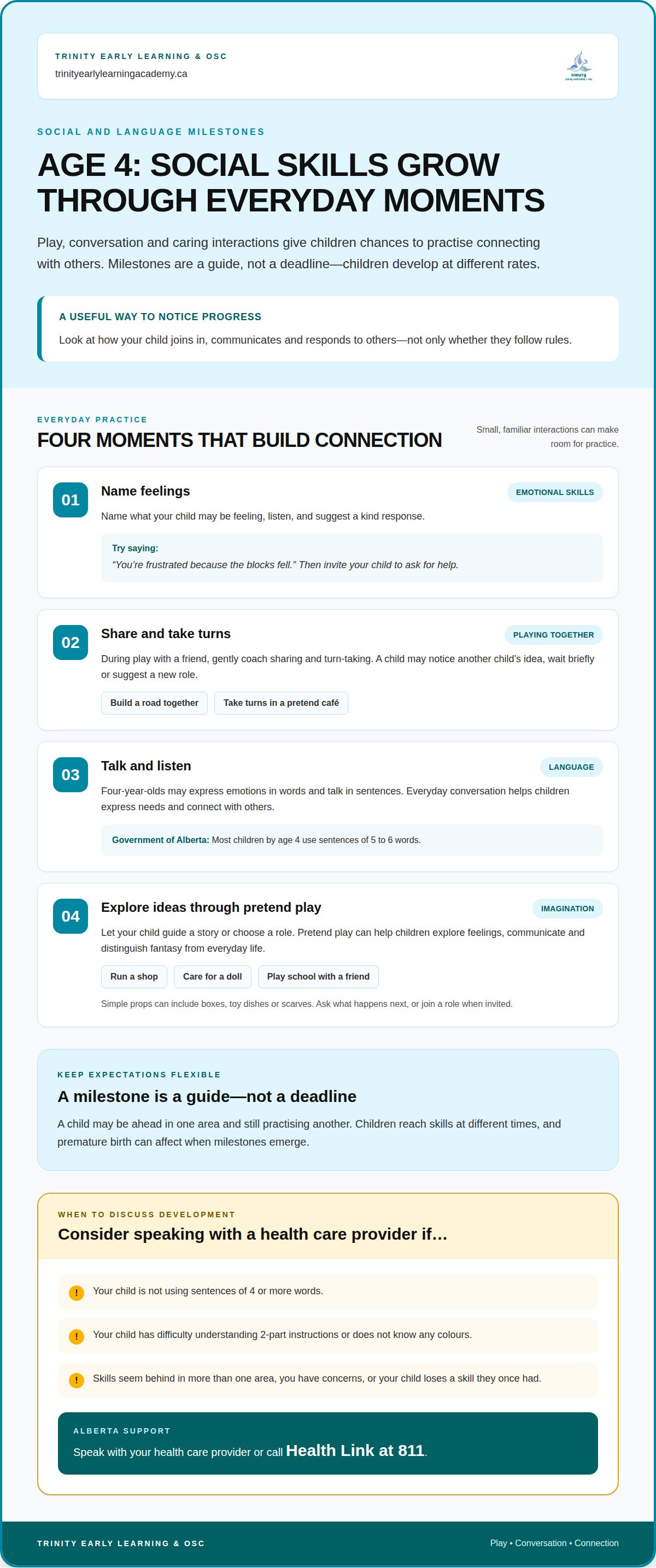
Social and emotional development involves understanding feelings and relating to others. Practise caring interactions during daily routines: name a feeling, listen, and suggest a kind response. For example, say, “You’re frustrated because the blocks fell,” then invite your child to ask for help. During play with a friend, gently coach turn-taking and sharing. Pretend stories can also help children explore feelings and distinguish fantasy from reality.
Typical developmental milestones
A developmental milestone is a skill children commonly gain around a certain age. At 4, a child may share and take turns with friends, express emotions verbally, and talk in sentences of 4 or more words. These skills develop at different times, and a child may be ahead in one area and still practising another. Premature birth can also affect when milestones emerge.
Cognitive development involves learning, thinking, remembering, and solving problems. Encourage it with simple choices and games: ask your child to sort toys by colour or predict what might happen next in a story. Games with rules can practise attention and flexible thinking. Ask your child to explain how they solved a small problem, such as finding a missing puzzle piece.
Language gives children tools to express needs and connect with others. At age 4, not using sentences of 4 or more words, difficulty understanding 2-part instructions, or not knowing any colours are reasons to consult a child and family health nurse or GP. Speak with a doctor if you have concerns, if skills seem behind in more than one area, or if your child loses a skill they once had. In Alberta, call Health Link at 811 or speak with your health care provider; families can also explore specialized pediatric speech and occupational therapy through providers such as Autism & Brain Institute.
Gross motor skills
Gross motor skills are large-muscle movements used for balance and travel. At age 4, many children can hop, catch a large ball, and stand on one foot. Some can balance for up to 4 seconds. Offer safe chances to practise, such as hopping between floor markers or walking downstairs while holding a rail. These activities help children coordinate movement and adjust their balance.
Fine motor skills are small-muscle movements used for careful hand and finger tasks. Many 4-year-olds hold a crayon between their fingers and thumb, rather than in a fist. They may draw a person with 3 or more body parts, use a fork, and unbutton larger buttons. Drawing, play dough, and picking up small toys give children practice. Parents can demonstrate a task, then let the child try at their own pace.
Self-care skills are everyday actions children practise to help care for themselves. At age 4, many children can use a fork and unbutton bigger buttons. Encourage participation in simple routines, such as holding a spoon, choosing clothes, or helping pull on a loose jacket. These tasks combine hand control, sequencing, and thinking. It’s normal for a child to need support with a task while learning its steps.
Gross and fine motor skills develop alongside one another, but they involve different movements. Help your child understand the difference by trying one large-muscle activity, then one hand task: toss a large ball, then draw a circle with a crayon. Notice how your child moves and express encouragement about effort, not speed. For families considering a preschool environment, daily opportunities to move and create can support skill practice.
Imaginative play
Imaginative play lets children explore ideas by pretending, creating roles, and inventing stories. At age 4, it can build on familiar people, places, and routines.
Pretend-play scenarios
Pretend play means acting out situations or characters. A four-year-old may pretend to run a shop, care for a doll, or play school with a friend. Offer simple props, such as boxes, toy dishes, or scarves, and let your child guide the story. Ask what happens next, or join a role when invited. These exchanges can help children express feelings and explore new ideas. Talk about what is pretend and what is real to help your child distinguish fantasy from everyday life.
Physical activity uses the body and supports active play. Make room for movement throughout the day with a ball, dancing, or an outdoor pretend adventure. Try a “delivery route” that involves walking around objects, stepping over a cushion, and carrying a soft toy. Stairs can become part of a make-believe journey, with an adult nearby. Adapt activities to your child’s abilities and surroundings.
Learning through play
Learning through play means building skills while exploring, experimenting, and interacting. Milestones can emerge as children make choices, solve small problems, and communicate. For example, building a pretend bus route invites your child to plan stops and describe where passengers are going. Join the game to model new words without taking over.
Play can also help children practise social routines before using them elsewhere. In a pretend café, take turns ordering, serving, and asking for help. Offer a few materials, then follow your child’s interests. By 5 years, children may be able to jump rope, but each play activity can be adapted to the child’s current skills.
Social and language milestones at age 4
Social skills are abilities children use to connect, cooperate, and respond to others. As you consider learning milestones for 4 year olds, notice how a preschooler joins shared activities. During a simple game, such as building a road together, your child may notice another child’s idea, wait briefly, or suggest a new role. These moments show how children participate, not just whether they follow rules.
Language is the system children use to understand and share meaning. According to the Government of Alberta, most children by age 4 use sentences of 5 to 6 words. Children may describe an event, ask questions, and explain what they need. For example, “I built a tall tower today” shares an action and adds detail. Learning milestones for 4 year olds can help frame what you notice in these everyday conversations.
Communication includes spoken words, listening, gestures, and conversational turns. By age 4, many children can follow directions with 2 or 3 steps. They may understand what happens next in a familiar story. Pause after reading and ask, “What do you think the bear will do?” Give your child time to answer, then add a word or detail to extend the exchange.
Make conversation part of ordinary routines. At pickup, ask one clear question about a game, friend, or favourite part of the day. During play, describe actions and feelings, then invite your child to respond. If your child has trouble communicating, note examples across settings and discuss concerns with a health care provider. Explore preschool support for everyday chances to practise language and social interaction.
Trinity Early Learning & OSC
Trinity Early Learning & OSC offers licensed daycare services, Affordability Grant Daycare, childcare, and out of school care. For families considering an early learning setting, these options can be a practical next step alongside the milestones covered in this guide. Developmental milestones help parents notice emerging skills, not judge a child against a strict timetable. A care conversation can start with what your child enjoys, what they are practising, and what support matters to your family.
Before choosing care, think about your child’s everyday experience. Consider whether they enjoy group play, prefer quieter activities, or are learning to express their needs. Sharing these observations can help clarify what you want from a childcare setting. You can also describe routines that help your child feel settled, such as a familiar goodbye or a quiet transition between activities. These details connect your child’s needs with your family’s priorities, without turning milestones into a pass-or-fail test.
Childcare and preschool programming may suit families seeking care during the preschool years. Kindergarten care and out-of-school care support children around school attendance. Discuss developmental questions with a health care provider; childcare is not a replacement for medical advice. If you are weighing care options, explain what your child is learning and what your family needs. Contact Trinity Early Learning & OSC to discuss care in St. Albert.
Choose a supportive next step
Use learning milestones for four-year-olds as a starting point for noticing what your child enjoys and where they are growing. Jotting down a new interest, a challenge, or a skill your child is practising can help you have a more focused conversation about their needs. You can also consider what kind of daily setting would support your family as your child continues learning and connecting with others.
If you’re exploring childcare, share what matters most to your family and what helps your child feel comfortable. Trinity Early Learning & OSC can be part of that conversation. Contact Trinity Early Learning & OSC to discuss your childcare needs.
Every child develops at their own pace. With caring guidance and opportunities to learn, your child can continue building skills with confidence.
Frequently Asked Questions
What are children doing at 4-5 years?
Between ages 4 and 5, children may become more independent in play and early learning. They may count 10 or more objects, name at least four colours, and follow more complex directions. Some can remember their address or understand left and right. Getting enough sleep can support children’s growth and wellbeing.
What can my 4- to 5-year-old child do at this age?
A child aged 4 to 5 may practise practical tasks alongside learning and play. For example, they may do up buttons, use child-safe scissors, and write their first name and some letters. Invite your child to help with a simple task, such as fastening a large button or cutting paper with supervision. These activities let you notice which steps they manage independently.
What social and emotional milestones are common at age 4?
At age 4, children may begin putting emotions into words, such as saying they feel worried or excited. Learning to manage a strong feeling takes practice. You can acknowledge the emotion, name what may have caused it, and offer a calm next step, such as taking a pause together. By age 5, children typically have more control over behaviour and emotions and fewer tantrums.
What physical and motor skills do 4-year-olds typically develop?
Four-year-olds may develop balance, coordination, and hand control through everyday activities. Some can walk downstairs independently, while children aged 4 to 5 are developing the ability to go down steps using alternating feet, sometimes holding a rail. They may also draw a circle, cut with child-safe scissors, or draw a person with at least three body parts. These abilities emerge at different times.
What cognitive and early learning skills are expected at age 4?
At age 4, children may practise early counting, colour naming, and remembering information. Try placing a small group of objects on the table and inviting your child to count them, or ask them to sort toys by colour. Children aged 4 to 5 may count 10 or more objects and name at least four colours. Everyday games can reveal how they approach a new task.
When should parents talk to a doctor about delayed milestones at age 4?
Talk with a doctor or child and family health nurse if your child loses a skill, seems behind in more than one area, or has difficulty with key communication tasks. At age 4, concerns include not using sentences of 4 or more words, difficulty understanding 2-part instructions, or not knowing any colours. In Alberta, parents can call Health Link at 811 or speak with their health care provider.


