

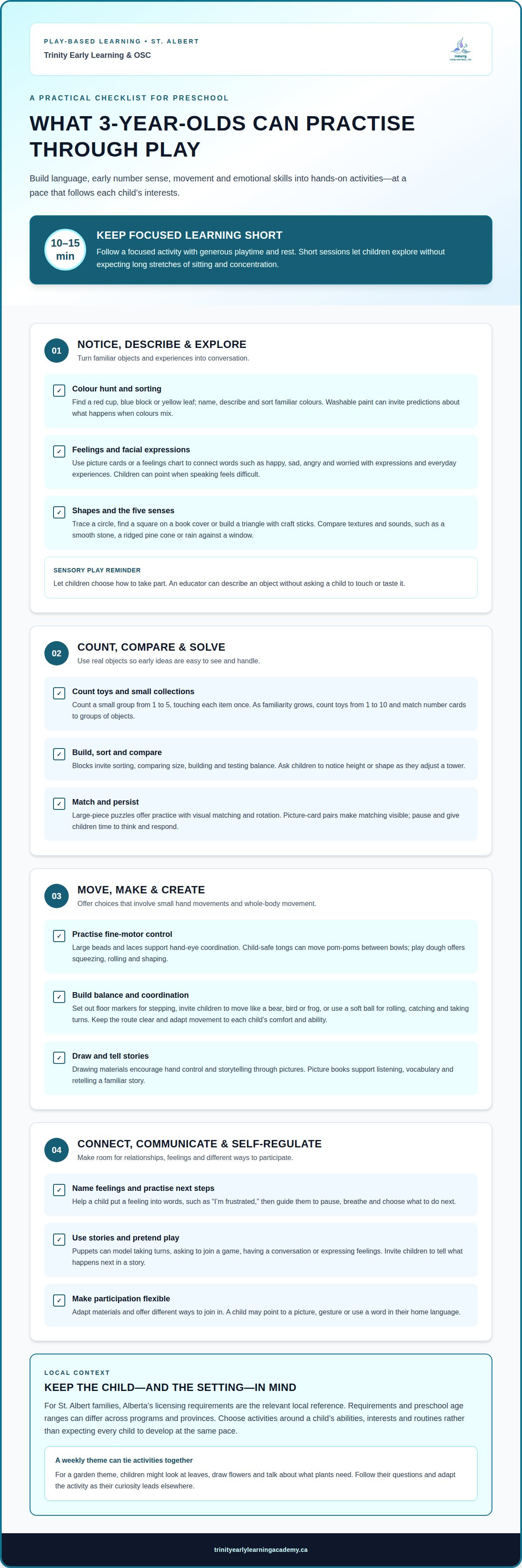
A strong daycare curriculum for 3-year-olds doesn’t depend on long lessons. Keep focused learning sessions to 10-15 minutes, then make room for generous playtime and rest. This gives children time to explore ideas without expecting them to sit and concentrate for long stretches.
It’s natural to wonder what a three-year-old should be learning in preschool. A balanced program can support early counting and motor skills alongside emotional growth, including expressing feelings, developing empathy and practising self-regulation. In this article, you’ll find practical activities for these skills and learn how hands-on, play-based learning can fit into a child’s day. The goal is a clear picture of what young children can practise, with flexibility for their interests and pace.
Key Takeaways
- Use a changing weekly theme to connect stories, play and everyday discoveries.
- Turn colours, shapes and the five senses into simple opportunities for children to notice and describe what they experience.
- Build early number skills by counting real objects and recognizing numerals during play.
- Choose activities that strengthen both small hand movements and larger body movements, while following the child’s interest.
Preschool developmental learning areas
In Canada, daycare curricula and educator requirements vary by province and territory. For St. Albert families, Alberta’s licensing requirements are the relevant local reference; preschool age ranges can also differ between programs. A three-year-old’s learning activities should reflect their abilities, interests and routines, rather than assume every child develops at the same pace.
A balanced preschool curriculum combines structure with flexibility and hands-on, play-based learning. A weekly theme can connect stories, conversation, art and discovery. A “garden” theme, for example, might involve looking at leaves, drawing flowers and talking about what plants need. Follow children’s questions and adapt the activity when their curiosity leads elsewhere.
Play-based learning can include child-led exploration and educator-guided activities. Blocks, pretend play, sensory materials and picture books let children explore ideas as adults introduce new words or invite them to solve a simple problem.
- Picture books: Support listening, vocabulary and retelling a familiar story.
- Blocks: Invite sorting, comparing, building and describing size or shape.
- Puppets: Give children a playful way to practise conversation and feelings.
- Drawing materials: Encourage hand control and storytelling through pictures.
For language, early literacy and numeracy, read aloud, name objects and invite children to tell what happens next. Count toys from 1 to 10, point out numerals, or match pairs of picture cards. Short exchanges during play make these ideas part of an activity, not a separate test.
Support social-emotional development by naming feelings, modelling empathy and practising self-regulation. An educator might help a child say, “I’m frustrated,” then guide them to pause, breathe and choose what to do next. Puppets can model taking turns or asking to join a game.
To include children with different abilities, languages and cultural backgrounds, educators can adapt materials, offer different ways to participate and use familiar songs, stories or objects from children’s lives. A child might point to a picture, gesture or use a word in their home language to take part in a group activity.
Daycare curriculum and educator requirements differ across Canadian provinces and territories. For families in St. Albert, Alberta’s licensing requirements are the relevant local reference.
Educator requirements vary by province and territory. In St. Albert, educators must meet the requirements under Alberta’s licensing rules.
Colours, feelings, shapes and the five senses
A colour hunt turns familiar surroundings into a language activity. Invite children to find a red cup, a blue block or a yellow leaf, then describe what they notice. Sorting objects by colour introduces a simple patterning challenge. Children can also mix washable paints and predict what might happen when two colours meet.
Feelings activities help children connect words with facial expressions and everyday experiences. Show picture cards with happy, sad, angry or worried faces. Ask a child to choose a card for a puppet and describe what might help. A feelings chart also gives children a quiet way to point when speaking feels difficult.
Shapes are easier to recognize when children handle and compare real objects. Trace a circle on paper, find a square on a book cover or build a triangle with craft sticks. Sensory play adds another layer: children can notice what they see, hear, smell, taste and feel. They might compare a smooth stone with a ridged pine cone or listen to rain against a window.
- Colour cards: Help children match, name and sort familiar colours.
- Washable crayons: Encourage drawing shapes and describing marks.
- Play dough: Supports squeezing, rolling and shaping hands-on creations.
- Picture books: Prompt discussion about faces, colours and shapes.
- Safe natural objects: Offer textures and sounds to explore with supervision.
Keep sensory activities simple and let children choose how to participate. An educator can describe an object without asking a child to touch or taste it. This respects different preferences while building vocabulary through observation and conversation.
These activities can also bring learning into a school-age child’s day. Families looking for care beyond preschool hours can explore out of school care as a related option.
Motor skills and cognitive development
Movement and thinking develop together through familiar play. Building a block tower involves grasping, balancing and planning. If the tower falls, rebuilding gives a child a chance to solve a problem and persist. Offer blocks in different sizes so children can compare, stack and adjust their designs.
Fine-motor activities help children develop control for everyday tasks. Large beads and laces support hand-eye coordination, while child-safe tongs let children move pom-poms between bowls. Play dough offers another useful activity: rolling it into a ball or pressing it flat exercises small hand movements and invites creative choices.
Gross-motor play gives children space to practise balance and coordination. Set out floor markers for stepping or invite children to move like a bear, bird or frog. A soft ball supports rolling, catching and taking turns. Keep the route clear and adapt movements to each child’s comfort and ability.
Early maths can grow from practical objects rather than worksheets. Invite children to count a small collection from 1 to 5, touching each item once. As familiarity grows, counting from 1 to 10 and recognizing numerals can be introduced through matching number cards to groups of toys. Pause to let children think and respond.
- Wooden blocks: Encourage building, comparing height and testing balance.
- Large-piece puzzles: Practise visual matching, rotation and persistence.
- Counting bears or counters: Make one-to-one counting and sorting visible.
- Child-safe tongs: Build grip control while moving soft objects.
- Floor markers: Support movement games and simple follow-the-path activities.
Keep each challenge clear and manageable. Ask a child to find two matching shapes, for example, then add another piece if they’re ready. Notice the strategy, not just the result: turning a puzzle piece or recounting objects are useful thinking skills in action.
Short, focused learning sessions
Three-year-olds learn through brief, active experiences, not long stretches of instruction. A focused activity can last 10-15 minutes, with playtime and rest balanced throughout the day. This gives children space to try an idea, move on and return to it later.
A typical daycare day may move from arrival and free play to a short group gathering, activity choices, meals, outdoor play and rest. Educators can offer a focused activity within this routine, then give children time to explore materials or interact with one another. The order can shift to suit children’s energy and daily needs.
Begin with one clear invitation, such as matching picture cards or sorting large buttons by colour. A visual timer can help children understand when the activity will end. A picture schedule shows what comes next, while a familiar clean-up song signals a transition without abrupt instructions.
Some curriculum guidance suggests children sustain attention for 5-10 minutes before beginning a planned activity. Treat that as a starting point, not a test. If a child loses interest, shorten the task or offer a choice, such as sorting two colours instead of several. If engagement continues, allow time for exploration.
- Visual timer: Makes a short activity’s beginning and end visible.
- Picture schedule: Shows the sequence of play, meals and rest.
- Sorting baskets: Support hands-on matching and classification.
- Story cards: Invite children to arrange pictures and describe what happens.
Focused learning works best when adults watch for children’s cues. A child who turns away may need to move, while a child who repeats an action may be exploring cause and effect. Offer a brief prompt, then pause to let the child respond. This keeps the experience purposeful without taking over the play.
For families seeking a setting where play and planned learning can fit into a child’s day, explore licensed daycare services.
The page recommends balancing short, focused learning bursts with generous playtime and rest in a 3-year-old's daily routine. It also recommends short, focused curriculum lessons of 15-20 minutes for 3-year-olds, while leaving room for play and rest.
Trinity Early Learning & OSC
Trinity Early Learning & OSC is a licensed daycare in St. Albert, offering childcare and preschool programming for local families. If you’re considering early learning for your three-year-old, the activities and developmental areas in this guide can help you identify what matters to your family, from play-based learning to opportunities for movement, language and emotional growth.
Trinity offers affordability grant funding to help make childcare more accessible for local families. Its preschool programming and childcare provide a St. Albert option for parents seeking an early learning setting. Families can explore the programs, pre-register online or book a tour.
Take the next step with confidence
Choosing a daycare curriculum for three-year-olds also means finding a setting that suits your family. Consider what helps your child settle into new routines, which activities spark their interest and what you’d like educators to know about them. These details can guide a practical conversation about care and early learning.
Trinity Early Learning & OSC offers licensed daycare, childcare and Affordability Grant Daycare. If you’re ready to discuss your family’s needs, contact Trinity Early Learning & OSC. A thoughtful next step can help you feel more prepared as your child continues learning and growing.
Frequently Asked Questions
What Should a 3-Year-Old Learn in Preschool?
A three-year-old can practise communicating needs, making choices and solving simple problems through everyday play. During pretend grocery shopping, for example, a child might choose an item, take turns as the cashier and decide where it belongs. Preschool learning should give children chances to explore at their own pace, rather than expect everyone to produce the same result.
What should a daycare curriculum for 3-year-olds include?
A daycare curriculum for three-year-olds should offer varied ways to explore, participate and return to an idea. After a story about animals, for example, children might draw an animal, act out its movement or look through another book. A thoughtful plan also allows for transitions, quiet activities and children who prefer to watch before joining in.
What are age-appropriate learning goals for 3-year-olds in Canada?
Age-appropriate goals focus on participation and growing independence, not identical performance. A child might practise putting away their coat, choosing between two activities or following a familiar direction during cleanup. Families in Canada should consider their child’s experiences, abilities and home language, rather than treating one activity as a pass-or-fail test.
How can parents assess whether a daycare curriculum is suitable for their 3-year-old?
Look for a clear connection between activities and your child’s interests, comfort and preferred ways of participating. If your child loves vehicles, for example, notice whether they can explore that interest through books, pretend play or building. A suitable approach also leaves room for quieter participation and changing interests. In St. Albert, consider whether the program’s daily learning reflects your family’s priorities.


