

A preschool’s value isn’t measured by cost alone. Families considering preschool programs in Sturgeon Heights also want to know which age groups a program serves, what children do each day, and how its approach supports their development.
It’s reasonable to look for a program that suits your child and your family’s needs. This guide explains what to consider about preschool costs, age groups and how play-based learning and purposeful activities can support early learning.
Children’s preschool experiences may include creative play and activities that encourage curiosity and social growth. Understanding both the practical details and the learning approach can help you make an informed decision for your family.
Key Takeaways
- Compare preschool options by the age group they serve and how their daily activities support children’s development.
- Look for play-based and project-based experiences that encourage curiosity, creativity, and social growth.
- Understand which program details can affect the cost, including the schedule and the care your family needs.
- Consider how a preschool’s philosophy and values shape children’s learning, relationships, and sense of belonging.
Learning through play and project-based activities
Play-based learning turns ordinary materials into chances to investigate, create and communicate. For example, children building a cardboard bridge can test balance, compare lengths, negotiate roles and explain what changed. A project gives those activities a shared purpose, while educators can follow children’s questions and introduce new materials or vocabulary. This approach differs from relying only on worksheets or adult-led instruction. To compare preschool programs in Sturgeon Heights, look at how activities encourage children to explore ideas, make choices and share what they discover.
Outdoor classrooms can include a schoolyard, garden, nearby green space or nature trail. A simple leaf collection, for instance, invites children to notice colour, shape and texture before sorting what they find. Outdoor learning connects observation with movement and conversation. It can also give a project a real setting, such as using sticks and stones to plan a small structure. Alberta curriculum conversations can include how play and outdoor experiences build curiosity, communication and early problem-solving, without reducing learning to a worksheet.
A “Play and Learn” session might include arrival, open-ended play, a group activity and time outside, depending on the program’s schedule. A calendar can help families see how these parts fit together. Outdoor play offers fresh settings for movement, noticing seasonal changes and practising cooperation. Weather, clothing and the available outdoor space all shape the experience.
For families in St. Albert, programs serving Sturgeon Heights may use different sites and service areas. Each address matters for understanding where children spend their day and which outdoor spaces they can access. Applications and waitlists also follow each program’s process; age, preferred start date and schedule needs help define the request. Transportation, meals, accessibility supports and language options are program-specific details that shape a child’s routine. Sturgeon Public Schools considers Alberta Health Services and private-agency assessment results when reviewing Pre-K qualification, which is separate from choosing play activities.
Child Care Nursery School ages and activities
A name such as “Child Care Nursery School” doesn’t necessarily tell you a program’s age range. Check the stated entry ages and eligibility criteria, then consider whether the daily routine suits your child’s experience with group care. Readiness can involve practical skills such as following a short direction, joining a group activity or asking an adult for help. These examples can guide a conversation about starting school, but no single skill should be treated as a requirement.
Everyday activities can help children practise skills through familiar routines. A story circle supports listening and taking turns, while sorting objects encourages children to notice differences. Pretend play, puzzles, songs and art offer ways to express ideas and build relationships. Activities vary by program, so ask how educators connect them to children’s interests, such as extending a story through drawing or conversation. This can show what learning looks like beyond a list of materials.
When comparing programs, consider educators’ training and experience, child-to-educator ratios, and safety procedures for supervision, arrivals, illness and emergencies. Look at these details alongside the age group and daily routine to understand the care your child will receive.
Start by considering your child’s age and the shape of the school day. Look for a balance of quiet choices, group participation and movement. A child who enjoys books might engage with story discussions, while a child who likes building may be drawn to blocks. These examples can help you assess fit, but they don’t define a child’s ability or predict progress. Consistent routines can also make transitions between play, meals and rest easier to anticipate, where those activities are part of the schedule.
For local families, a preschool learning environment is one option to consider when comparing early learning and quality childcare. Focus on the age group, activity plan and how the program describes supervision. Those practical details help connect a child’s interests with a setting’s daily experience, while giving families a clearer basis for understanding the move toward school.
Program cost
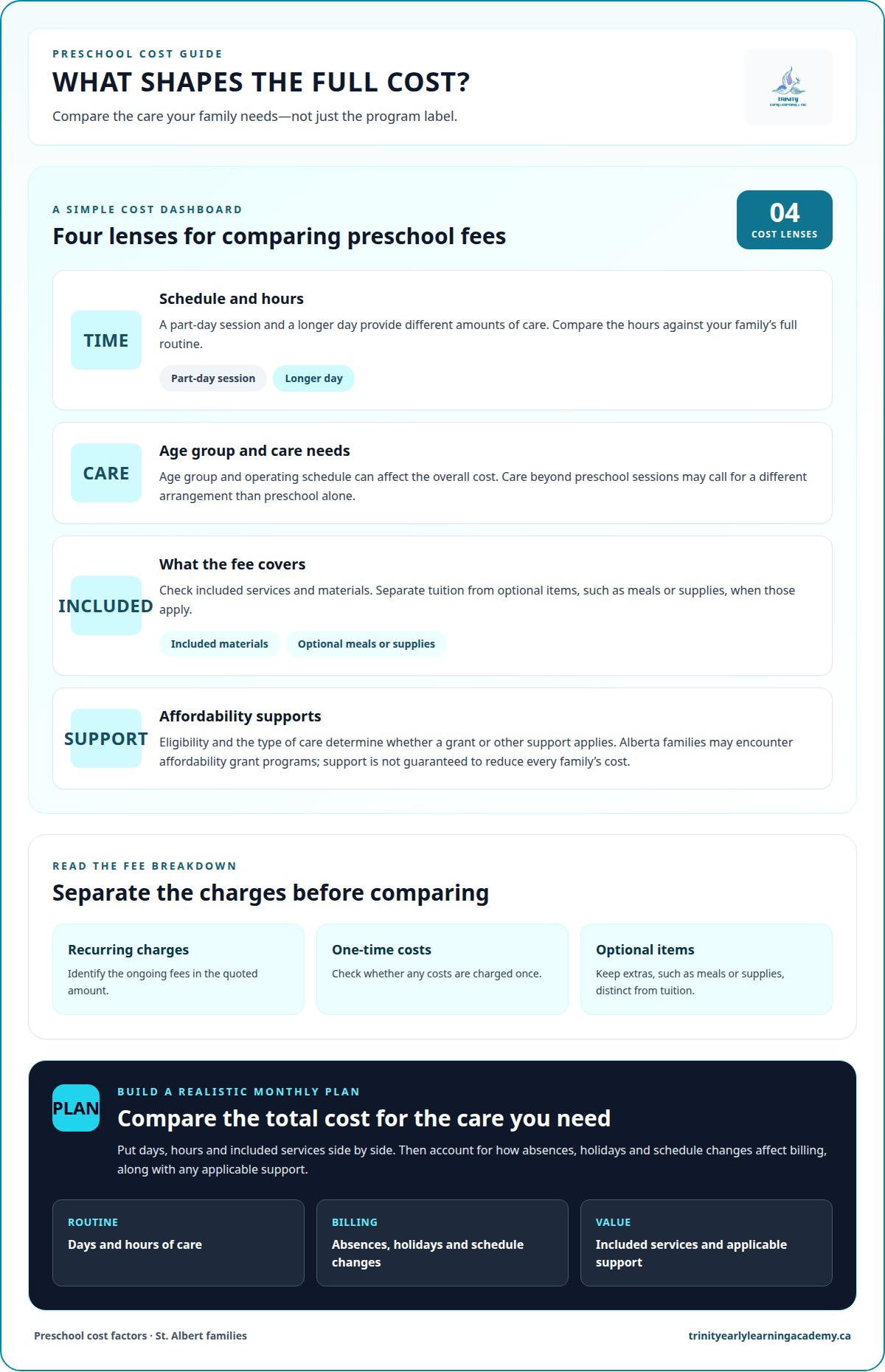
Preschool costs depend on the schedule and what the program includes. A part-day session and a longer day provide different amounts of care, so compare the hours when considering fees. Age group, operating schedule and included materials can also affect the overall cost. A family needing care beyond preschool sessions may need a different arrangement from one seeking preschool alone. Plan around the full routine, not just the program label.
Ask for a clear breakdown of recurring charges and any one-time costs. Separate tuition from optional items, such as meals or supplies, when those apply. Confirm how absences, holidays and changes to a child’s schedule affect billing. These details help turn a quoted amount into a realistic monthly plan. A simple table comparing days, hours and included services can make differences easier to see without focusing on one headline figure.
Affordability supports may also affect a family’s out-of-pocket cost. Eligibility and the type of care determine whether a grant or other support applies, so include that question in the budgeting process. In Alberta, families may encounter affordability grant programs as part of childcare planning. Build a mental budget using the fee, schedule and any applicable support, rather than assuming every family pays the same amount. Do not treat support as a guaranteed reduction unless the program’s terms show it applies.
Preschool costs vary by program and family circumstances. When comparing preschool programs in Sturgeon Heights, consider the schedule, hours of care, age group, included services and any applicable affordability support together. A lower fee may cover fewer hours, while a longer schedule may better match work commitments. Compare the total cost for the care your family needs, along with the routine and activities that matter to your child.
Program philosophy and values
A preschool’s approach shapes decisions throughout the day, including how educators plan activities, respond to questions and support relationships. In a child-led activity, for example, children might choose between blocks, books or drawing. Educators can build on their choices by asking what they notice and offering related materials. A more structured activity might begin with a shared story or group task. The daily practice matters more than the label.
Look at how a program’s stated values show up in everyday moments. If cooperation matters, children might practise sharing materials during a group project. If independence is a priority, the routine may encourage them to put away their art supplies. These examples make broad ideas easier to assess and show how guidance, transitions and play fit together. A clear philosophy should be reflected in children’s activities and interactions.
Emotional well-being and belonging are also worth considering. Predictable arrival routines, for instance, help children know what happens when they enter the room. Educators can acknowledge feelings, support turn-taking and help children find words during disagreements. These interactions reveal how a program approaches relationships. Also consider whether it makes room for different interests, abilities and ways of communicating.
To assess whether a program suits your child, connect its values to everyday examples. Ask how activities encourage curiosity, how educators support participation and what helps children manage transitions. Then consider whether those practices match your child’s temperament and your family’s priorities. A philosophy is most useful when it informs the daily experience, from choosing an activity to resolving a conflict.
Explore preschool learning options as you consider which educational approach fits your family’s priorities.
Trinity Early Learning & OSC: Preschool
Trinity Early Learning & OSC offers preschool for families considering early learning in St. Albert. Its preschool and licensed daycare services give families options to consider when planning a child’s care and learning. Affordability Grant Daycare is also among its offerings, supporting families looking into childcare affordability.
As you weigh activities, age groups, schedules and program values, consider what suits your child and your family’s routine. Trinity Early Learning & OSC offers preschool programming, childcare and out-of-school care in St. Albert. You can pre-register online or book a tour to learn more about the centre.
Take the next step with confidence
Choosing a preschool is also a chance to consider what will make the transition into group learning feel right for your child. When exploring preschool programs in Sturgeon Heights, think about the daily routine your family needs and the kind of environment where your child can feel comfortable participating. These priorities can guide a thoughtful conversation about the next stage of care.
Trinity Early Learning & OSC offers Preschool, Licensed Daycare Services, Affordability Grant Daycare and Childcare. These options give families a place to begin when considering early learning and care together. Your questions about your child’s needs and family routine can help shape that discussion.
For a welcoming next step, contact Trinity Early Learning & OSC to talk about its preschool and childcare offerings. A considered choice can help your family move forward with greater clarity and confidence.
Frequently Asked Questions
Which preschools and early childhood programs serve St. Albert?
Trinity Early Learning & OSC is a licensed daycare in St. Albert, Alberta, offering preschool programming and childcare. Consider these services in light of your child’s needs and the care schedule your family requires. Keep the location in mind when comparing program information, since similarly named communities can refer to different places.
What ages and eligibility requirements do St. Albert preschool programs accept?
Age eligibility depends on each program’s stated age group and enrolment criteria. When making an inquiry, have your child’s birth date, intended start period and any learning or support needs in mind. Pre-K qualification and childcare enrolment are separate processes, so clarify whether you’re asking about a school-system program or a preschool care setting.
What are the preschool program hours, schedules, and start dates?
Trinity Early Learning & OSC operates Monday-Friday 06:30 a.m. - 05:30 p.m.; Saturday and Sunday are Closed. Those are the centre’s operating hours, not a stated preschool session schedule. Preschool days and start dates depend on the enrolment arrangement. Families can use the online pre-registration option or book a tour to discuss how the program schedule fits their routine.
What are the tuition, registration fees, and subsidy options for local preschools?
Tuition and registration charges depend on the program and care arrangement. Trinity Early Learning & OSC is approved for affordability grant funding, which helps lower childcare costs. The support available depends on the applicable grant terms. Consider your care schedule and any eligible support together when planning your childcare budget.
Are licensed childcare or preschool spaces available in St. Albert, and how can families check?
Trinity Early Learning & OSC is a licensed daycare in St. Albert and offers preschool and childcare. Current space availability can change, so use its online pre-registration option or book a tour to discuss enrolment. The centre is at 200, 398 St Albert Trail, St. Albert, AB T8N 5J9, Canada. Families can call 780-569-0197 with questions about the registration process.
How do preschool programs in Sturgeon Heights compare by curriculum and activities?
Preschool programs may use play-based and project-based activities such as building, art, stories, puzzles, songs and outdoor exploration. Compare how each program follows children’s interests, encourages curiosity and communication, and supports social growth.


