What if the secret to your child’s success in Kindergarten isn't more flashcards, but a more intentional approach to their daily routine? Many parents feel a sense of urgency as they look for a structured preschool program in Alberta, worrying that their little ones might fall behind without a rigid academic start. You want your child to be ready for the classroom, but you also want them to experience the joy of discovery through play. It's completely natural to feel overwhelmed by the choice between traditional academics and the provincial "Flight" curriculum.
We're here to help you bridge that gap and find a path that feels right for your family. This guide explains how a structured environment actually supports Alberta's play-based standards to prepare your child for the transition to Kindergarten. You'll gain a clear understanding of provincial licensing, see exactly what a typical daily schedule looks like, and learn how to access the affordability grant. By the end, you'll have the confidence to choose a St. Albert provider that offers the stability and nurturing care your child deserves.
Key Takeaways
- Learn the difference between rigid academics and the predictable routines that define a high-quality structured preschool program in Alberta.
- Understand how intentional learning blocks and Circle Time foster social-emotional growth while preparing children for a classroom environment.
- Discover how Alberta’s "Flight" framework balances child-led discovery with the professional guidance of certified educators.
- Identify the essential signs of a well-organized classroom during your tour, including visible daily schedules and staff qualification standards.
- Find out how the Alberta Affordability Grant makes licensed, high-standard preschool care accessible for St. Albert families.
What Defines a Structured Preschool Program in Alberta?
A structured preschool program in Alberta is an intentional learning environment designed to support a child's holistic growth. It isn't a collection of desks where children sit in silence. Instead, it's a space led by certified Early Childhood Educators (ECEs) who understand that Early childhood education is about building a foundation for life. These professionals use their expertise to create a flow that feels natural to a child while ensuring every activity has a developmental purpose. In our province, these programs are governed by the Early Learning and Care Act. This legislation ensures that licensed centres meet strict safety and quality standards, giving parents the peace of mind they need when choosing a provider.
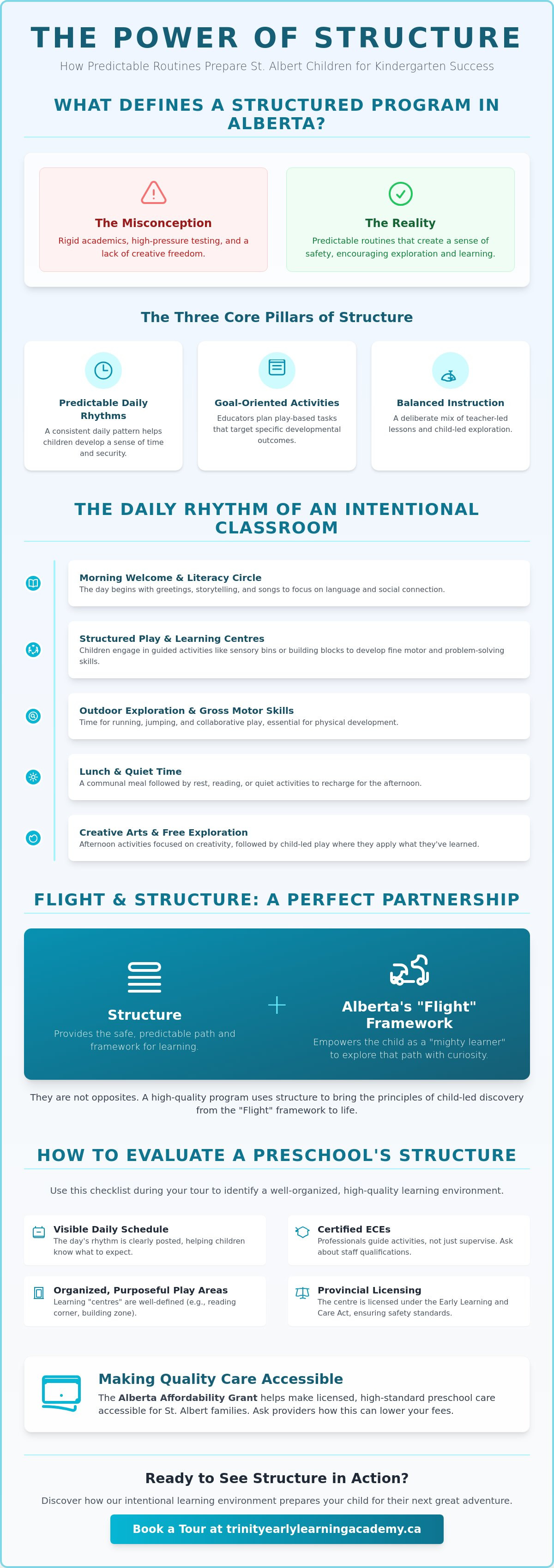
Many parents worry that "structure" means rigid academics or high-pressure testing. The reality is quite the opposite. In a high-quality structured preschool program Alberta families can trust, structure refers to predictable routines rather than strict drills. When a child knows what to expect next, they feel safe. This sense of security is the cornerstone of emotional regulation. A child who feels secure is much more likely to explore, take risks in their learning, and interact positively with their peers.
The Core Pillars of Alberta Preschool Structure
The best programs focus on three essential pillars to create a stable environment:
- Predictable Daily Rhythms: Unlike chaotic environments where activities happen at random, a structured day follows a consistent pattern. This helps children develop a sense of time and responsibility.
- Goal-Oriented Activities: Educators plan tasks that look like play but focus on specific outcomes. For example, a water table activity might be used to develop fine motor skills and early scientific reasoning.
- The Balance of Instruction: There is a deliberate mix of teacher-led moments, such as storytelling or group lessons, and child-led exploration where children apply what they've learned in their own way.
Why Structure Matters for Kindergarten Readiness
Transitioning to Grade 1 is a significant milestone. A structured environment helps children develop "executive function" skills, which include the ability to follow multi-step directions, share materials, and focus on a task until it's finished. By following a regular routine in preschool, children aren't shocked by the expectations of the elementary school system. They've already practiced the social and cognitive habits needed to thrive in a larger classroom. Kindergarten readiness is the culmination of social, emotional, and cognitive stability.
The Daily Rhythm: Inside an Intentional Learning Environment
When you step into a structured preschool program Alberta educators lead, you'll notice a distinct sense of calm and purpose. This isn't accidental. It's the result of an intentional daily rhythm that organizes the day into predictable blocks of time. Unlike a standard daycare where the day might feel like a series of loosely connected events, a structured program uses these blocks to create a narrative for the child's learning. Each block serves a specific developmental goal, whether it's building cognitive stamina or fostering social connections.
A vital part of this rhythm is "Circle Time." This gathering isn't just about singing songs; it's a cornerstone for social-emotional development. During this time, children practice listening, taking turns, and recognizing the emotions of their peers. This aligns with the principles found in Flight: Alberta's Early Learning and Care Framework, which emphasizes the child as a "mighty learner" within a social context. Educators use this time to introduce the day's themes, helping children feel prepared and confident for the hours ahead.
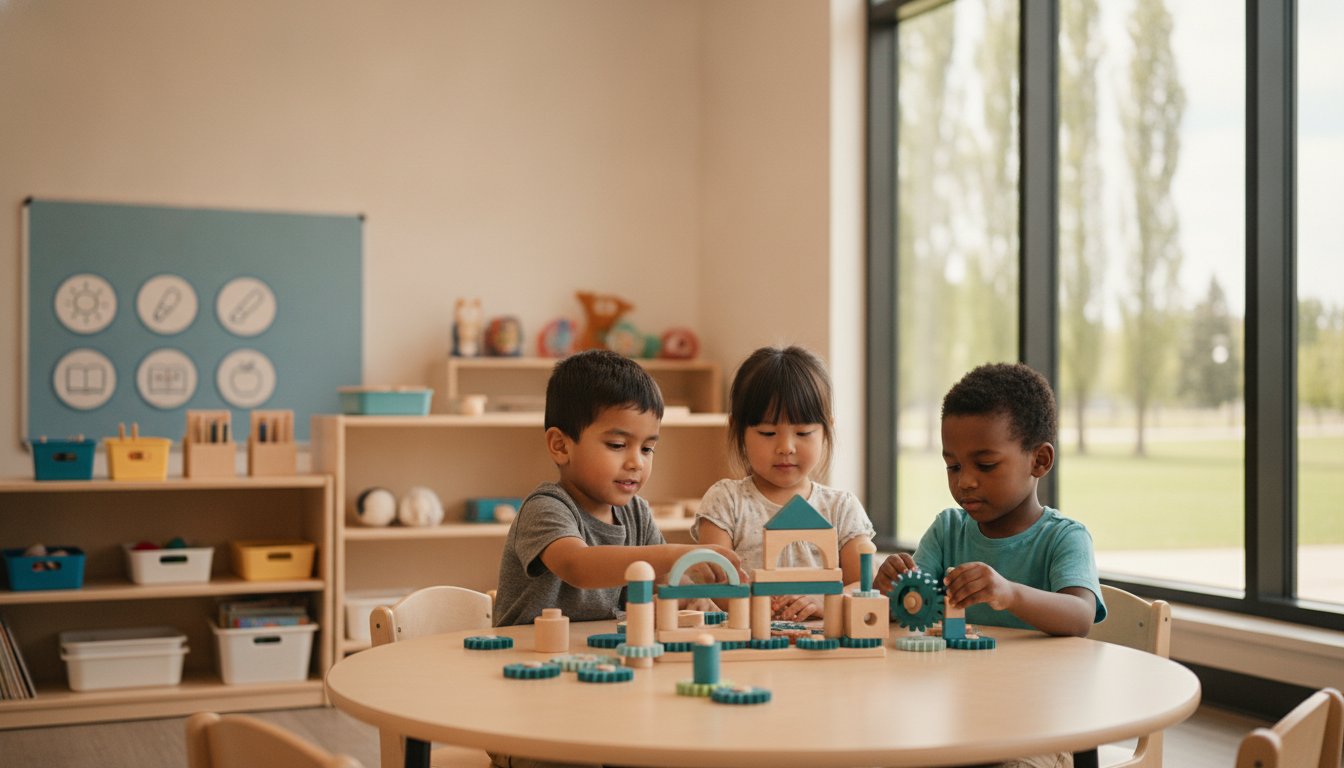
It’s also important to distinguish between "Structured Play" and "Unsupervised Play." In a structured environment, play is guided. An educator might set up a sensory bin with specific tools to encourage fine motor development or problem-solving. While the child chooses how to interact with the materials, the educator is there to "scaffold" the experience, asking open-ended questions that prompt deeper thinking. This ensures that play remains a powerful tool for learning rather than just a way to pass the time.
Sample Schedule of a Structured Preschool Day
- Morning Welcome and Literacy Circle: The day begins with a warm greeting and a focus on language through storytelling and phonics games. This sets a positive tone for the entire morning.
- Guided Discovery Blocks: Children rotate through themed stations like science, art, or sensory play. These blocks allow them to explore specific concepts in small, manageable groups.
- Outdoor Exploration: Physical activity is integrated into the routine, allowing children to develop gross motor skills while exploring the natural world in a safe, supervised way.
Teacher-Led vs. Child-Initiated Activities
The magic of a high-quality program lies in the balance between teacher-led instruction and child-initiated exploration. Educators in St. Albert often maintain a 1:8 or 1:10 ratio, which allows them to closely observe each child. By watching how a child plays, an educator can introduce new concepts at exactly the right moment. This "scaffolding" technique ensures that the child is always challenged but never overwhelmed. If you're looking for an environment that masters this balance, you might consider how licensed childcare providers in your area structure their classrooms to support these individual needs.
Finally, a truly structured program pays close attention to transition periods. Moving from lunch to nap time or from the playground back to the classroom can be stressful for young children. By using consistent cues, such as a specific song or a visual timer, educators help children navigate these changes with ease. These small but significant details are what transform a busy room into a nurturing learning community where every child can thrive.
Flight vs. Structure: Navigating Alberta’s Curriculum Framework
When parents explore options for a structured preschool program Alberta offers, they often encounter the term "Flight." This refers to Flight: Alberta’s Early Learning and Care Framework. It is the provincial guide for providing high-quality childcare, but it is frequently misunderstood. A common misconception is that a play-based framework like Flight lacks order or educational goals. In reality, Flight is a sophisticated lens that helps educators view children as "mighty learners." It doesn't replace structure; it gives that structure a deeper, more intentional meaning.
A truly organized program uses Flight to ensure that every part of the daily routine supports a child's development. Educators use "documentation" to make this learning visible. This might include photos, transcribed conversations, or portfolios of work that track how a child is meeting developmental milestones. Instead of just checking off a list of facts memorized, documentation shows how a child is learning to think, solve problems, and collaborate with others. This creates a transparent record of growth that parents can easily follow.
The Four Core Dispositions of Flight
The Flight framework focuses on four core developmental dispositions. These aren't just abstract ideas; they're the foundation of every weekly lesson plan in a well-organized centre:
- Wellbeing: Focusing on physical health and emotional safety within the routine.
- Communication: Encouraging children to express themselves through language, art, and movement.
- Strong Communities: Helping children find their place within the group and develop a sense of belonging.
- Global Awareness: Teaching children about the world around them and their responsibility to others.
These goals are integrated through "responsive care." This means that while the schedule is consistent, the educator remains flexible enough to respond to the specific interests or emotional needs of the children in the moment.
Integrating Literacy and Numeracy Naturally
Structure doesn't have to mean sitting at a desk with a workbook. In an intentional Early learning program Alberta families choose, literacy and numeracy are woven into the fabric of the day. Counting happens naturally as children distribute snacks or build towers in the block centre. Letter sounds are introduced during story time or through interactive games that encourage phonetic awareness. This shift from rote memorization to conceptual understanding ensures that children don't just know the "what," but also the "why." By the time they reach Kindergarten, they've developed a genuine love for learning that serves them far better than simple repetition ever could.
How to Evaluate a Preschool’s Structure During a Tour
Entering a childcare centre for the first time can be an emotional experience for any parent. You're looking for a place where your child feels at home, but you also need a space that operates with professional precision. Start by looking at the walls. A structured preschool program Alberta families can rely on will always have its daily schedule posted clearly at eye level. You should also see "documentation" boards. These are photos, drawings, and notes that show exactly what the children have been learning through their play. If the walls are bare or cluttered with random papers, it might indicate a lack of intentional planning.
Observe the energy of the classroom as you walk through. There is a significant difference between a "purposeful hum" and pure chaos. In a structured environment, children move between activities with confidence because they understand the expectations of the room. Don't forget to check for the centre's license and most recent inspection report. Effective June 1, 2026, all licensed facilities in Alberta are required to post notices of high-risk or potentially criminal incidents within one business day. This level of transparency is a hallmark of a well-run, professional program that prioritizes safety and accountability.
Essential Questions for the Program Director
The director's answers will reveal the true philosophy of the centre. Ask about staff qualifications and turnover rates. High staff retention is a strong indicator of a stable, supportive environment. During your conversation, consider asking these specific questions:
- "How do you balance child-led play with your daily schedule?"
- "What is your approach to guiding children through transitions between activities?"
- "How do you communicate my child’s developmental milestones and daily progress to me?"
Physical Environment and Learning Centres
The layout of the room tells you everything you need to know about a centre's commitment to structure. A high-quality structured preschool program Alberta will be divided into clear learning centres. You should see a quiet corner for reading, a rug for building blocks, and a designated area for sensory play. These zones help children understand what behaviour is expected in different parts of the room. Materials should be organized and easily accessible. When a child can find and put away their own supplies, it fosters a sense of independence and order. A clean, well-organized centre isn't just about aesthetics; it reflects a structured philosophy that values the child's experience.
Finding the right fit for your family requires seeing these standards in person. If you're looking for a provider that balances these high standards with a nurturing touch, we invite you to book a tour at Trinity Early Learning Academy to see our organized and engaging classrooms in action.
Trinity Early Learning: St. Albert’s Home for Structured Care
Choosing a provider is about more than just finding an open space. It's about finding a partner in your child's growth. At Trinity Early Learning & OSC, we're dedicated to providing a high-quality structured preschool program Alberta parents can trust to prepare their children for the future. Our St. Albert location combines professional standards with the warmth of a family-run atmosphere. We believe that a child’s first educational experience should feel safe, supportive, and predictable. Our educators use the Flight framework to create intentional learning moments that are both engaging and effective for every child in our care.
Our curriculum is designed to be both comprehensive and compassionate. We don't believe in high-pressure environments. Instead, we focus on creating a stable environment where children can explore their interests under the guidance of certified professionals. This approach allows us to maintain a high level of quality childcare while ensuring that the emotional well-being of the child remains our top priority. By balancing structured routines with responsive care, we help children develop a genuine love for learning that will stay with them long after they leave our centre.
Our Approach to Kindergarten Readiness
Preparing for the transition to the local St. Albert Public or Catholic school systems requires a balanced approach. We focus on social skills and emotional regulation alongside foundational literacy and numeracy. This ensures your child enters Grade 1 with the confidence to navigate a larger classroom and follow complex instructions. Our educators work closely with families to ensure each child meets their developmental milestones at their own pace. Trinity follows all Alberta licensing standards for health and safety to maintain the highest level of care for our families.
Accessibility and the Affordability Grant
We understand that financial accessibility is a major priority for modern families. Our centre utilizes the Alberta Affordability Grant to significantly reduce tuition costs for parents. This provincial funding is designed to make licensed, high-standard care more accessible for everyone in our community. We handle the administrative complexities of the grant so you can focus on your child's development. Our enrollment process is simple and transparent, helping you secure your spot without unnecessary stress or confusion. We're here to act as your guide through the logistical aspects of childcare and early education.
Your child's journey toward school success begins with a single step. If you're looking for a nurturing environment that prioritizes both growth and joy, we're ready to welcome you. We invite you to book a tour at our St. Albert centre today to meet our team and see how our structured program can benefit your family.
Empowering Your Child’s Educational Journey
Selecting the right start for your child is one of the most important decisions you'll make as a parent. A high-quality structured preschool program Alberta families choose provides more than just a daily schedule; it offers a secure foundation where intentional learning and joyful play coexist. By understanding how the Flight framework supports developmental milestones, you can move forward with clarity and peace of mind. You don't have to navigate these complex choices alone.
At Trinity Early Learning Academy, we're proud to be licensed by Alberta Children’s Services and to participate in the Federal-Provincial Affordability Grant. Our commitment to your family extends beyond the preschool years through our dedicated Out of School Care (OSC) services, providing stable and nurturing support as your child grows. We invite you to experience our community-focused atmosphere firsthand and see our professional standards in action.
Join the Trinity Early Learning Community in St. Albert
We look forward to partnering with you to ensure your child feels safe, valued, and fully prepared for the exciting transition to Kindergarten.
Frequently Asked Questions
Is a structured preschool program better than a play-based one?
Neither approach is inherently better, but a structured preschool program Alberta educators lead often integrates the best of both worlds. While a purely play-based program is child-led, a structured environment uses "intentional play" to ensure specific developmental goals are met. This balance provides the predictable routine children need to feel safe while still allowing them the freedom to explore their interests through hands-on activities.
At what age should a child start a structured preschool program in Alberta?
Most children in Alberta begin a preschool program between the ages of 3 and 4. Starting at this age allows them enough time to develop the social-emotional skills and classroom stamina required for a successful transition to Kindergarten. Educators focus on helping these young learners follow simple routines and interact positively with their peers in a group setting.
How does the Alberta Affordability Grant apply to preschool programs?
The Alberta Affordability Grant is a provincial initiative that provides funding directly to licensed childcare providers to reduce monthly fees for parents. If you choose a licensed structured preschool program Alberta families can access, the grant is automatically applied to your tuition. This program is part of the federal-provincial agreement aimed at making high-quality early learning more accessible for all families across the province.
What is the difference between a preschool and a daycare in St. Albert?
The primary difference typically lies in the daily schedule and the hours of operation. Preschool programs often focus on specific educational blocks and may run for half-days or specific days of the week. Daycare centres usually offer full-day care and include broader services. Many modern centres in St. Albert now offer both, ensuring that the structured learning of a preschool is available within a full-day childcare setting.
Can a structured program accommodate children with different learning styles?
Yes, a high-quality structured program is designed to be flexible enough to support visual, auditory, and kinesthetic learners. Because educators maintain small ratios, such as 1:8 or 1:10, they can provide individualized attention. They use "scaffolding" to adjust the difficulty of tasks based on each child's unique needs, ensuring that every student feels challenged and supported throughout the day.
How do I know if my child is ready for a structured learning environment?
Your child might be ready if they show curiosity about group activities and can follow simple, two-step directions. Readiness is less about academic knowledge and more about social-emotional maturity. If your child is beginning to show interest in playing with others and can handle brief transitions between activities, they'll likely thrive in an environment that offers a predictable daily rhythm.
What qualifications do teachers in Alberta structured preschools have?
Educators in licensed Alberta programs must hold valid Early Childhood Educator (ECE) certification, which is divided into three levels based on their post-secondary education. The province also supports ongoing professional development through the Early Childhood Educator Workforce Supports Program. This ensures that the staff members caring for your child are knowledgeable about the latest developmental research and safety standards.
Does a structured program mean my child will have homework?
No, a structured preschool program does not involve traditional homework or academic drills. The "structure" refers to the organization of the day and the intentionality behind the activities. Children learn through guided discovery and social interaction rather than worksheets. The goal is to foster a love for learning and a sense of order, not to burden young children with after-school assignments.


