

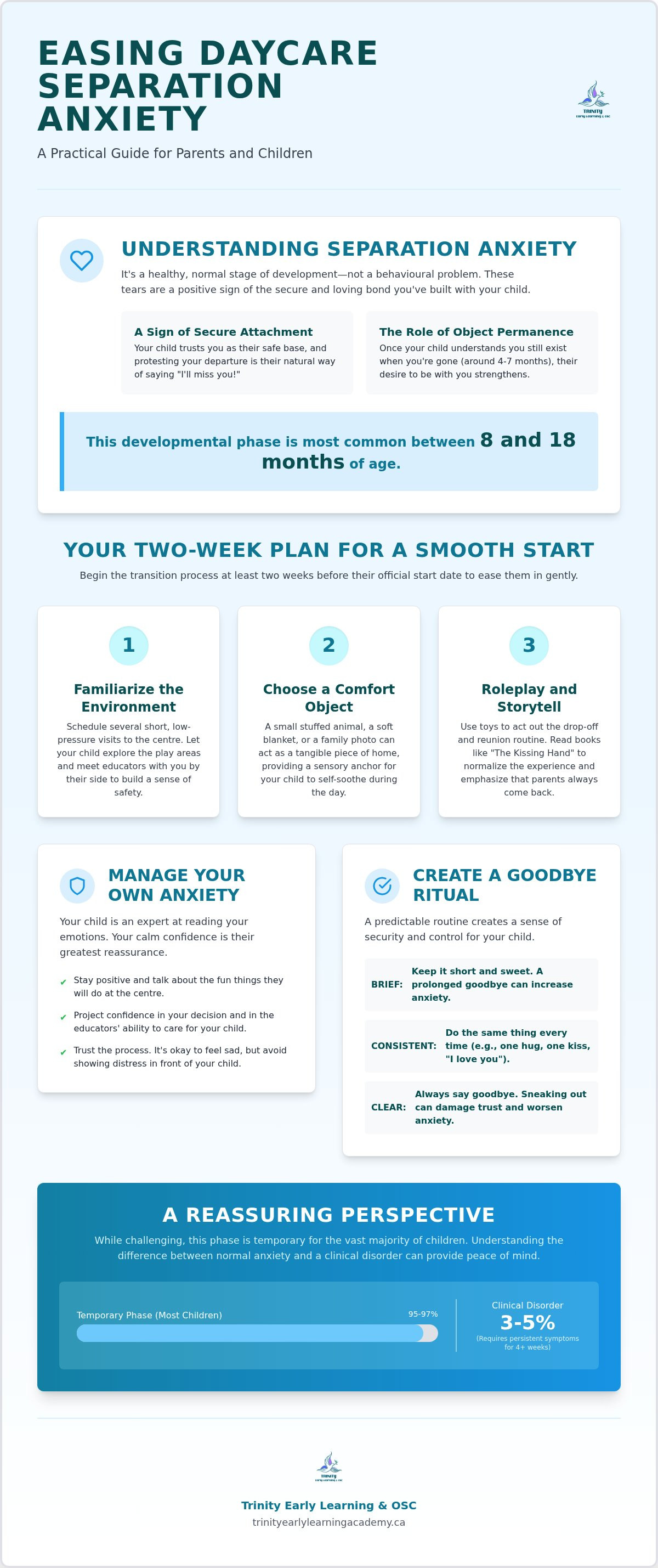
Imagine it’s Monday morning and you’re standing at the classroom door while your little one clings to your leg with tears in their eyes. It’s a moment that can make even the most composed parent feel a heavy wave of guilt and uncertainty. You want to feel confident that your child is safe and happy, but the morning routine often feels like a chaotic struggle. If you’re searching for daycare separation anxiety tips, you’re not alone. Most children experience this developmental milestone between 8 and 18 months, and it’s a natural part of their emotional growth.
We understand that leaving your child in someone else's care is a significant transition for the whole family. You deserve peace of mind during your workday, knowing your child is thriving in a licensed and supportive centre. This article provides practical, heart-centred strategies to ease this transition and foster a sense of security. We’ll explore how to build a strong partnership with your childcare provider, establish calming routines, and use attachment-based play to ensure a confident goodbye for both you and your child.
Key Takeaways
- Understand that separation anxiety is a healthy developmental milestone rooted in secure attachment and the concept of object permanence.
- Start the transition process at least two weeks early by scheduling short visits to the centre to help your child build familiarity with the environment.
- Implement practical daycare separation anxiety tips such as creating a consistent and brief goodbye ritual to build trust without lingering.
- Learn to manage your own "parental separation anxiety" to ensure your child doesn't pick up on stress signals during the morning drop-off.
- Discover how a licensed childcare provider uses a nurturing approach to integrate social-emotional support into your child's daily routine.
What is Daycare Separation Anxiety? Understanding the Developmental Roots
Seeing your child upset during a morning drop-off is undeniably difficult, but these tears are often a positive indicator of your bond. This behaviour shows that your child has formed a secure attachment to you, which is a vital foundation for their future emotional health. Separation anxiety is a natural developmental phase rather than a permanent personality trait. While you're likely searching for daycare separation anxiety tips to make your mornings more manageable, understanding the "why" behind the protest can provide much-needed perspective during this transition.
The Science of Object Permanence
The root of this anxiety often lies in a cognitive milestone called object permanence. This is the understanding that people and objects continue to exist even when they are out of sight. Before this concept develops, a baby might not realize you've actually gone anywhere; however, once they grasp that you still exist somewhere else, they naturally want to be with you. This shift typically begins between 4 and 7 months of age. Introducing your child to a licensed childcare environment during this early window can sometimes lead to a smoother transition, as the "protest" response isn't yet fully linked to your absence. By the time they reach 8 to 18 months, this cognitive awareness is in full bloom, making drop-offs more emotionally charged.
Why Daycare Transitions Trigger These Responses
A professional daycare centre is a vibrant, sensory-rich environment that differs significantly from the quiet, predictable rhythms of home. Your child is suddenly navigating new sounds, different smells, and many unfamiliar faces. This disruption of their "predictable world" can feel overwhelming. Their nervous system treats the separation as a significant event, triggering a survival-based response to keep their primary caregiver close.
It's helpful to recognize that most children will move through this phase by the time they are three years old. However, it's important to distinguish between typical transition stress and Separation anxiety disorder. While normal anxiety is a temporary part of growing up, the clinical disorder involves more severe, persistent symptoms that last for at least four weeks. Research indicates that this disorder affects approximately 3 to 5 percent of children. For the vast majority of families, utilizing consistent daycare separation anxiety tips and partnering with a nurturing provider will help your child realize that their new environment is a safe, stable, and joyful place to be.
Practical Steps to Prepare Your Toddler Before Their First Day
Preparation for a new environment starts long before you reach the front door. We recommend beginning the transition process at least two weeks before your child's official start date. This gradual approach allows your child’s nervous system to adjust to the idea of change without feeling overwhelmed. One of the most effective daycare separation anxiety tips involves "exposure therapy," which simply means taking your child for short, low-pressure visits to our St. Albert centre. These visits allow them to explore the play areas and meet their educators while you are still present, building a sense of safety and familiarity.
Choosing a "comfort object" is another vital step in easing transitions for your child. Whether it is a small stuffed animal, a soft blanket, or even a family photo, having a tangible piece of home provides a sensory anchor during the day. This item serves as a bridge between the security of home and the new experiences at the centre. It acts as a transitional tool that helps your child self-soothe when they feel a wave of missing you.
Roleplay and Storytelling at Home
Children often process big emotions through play. You can use stuffed animals to act out the entire sequence of the day, from the morning drop-off to the afternoon reunion. Emphasize the narrative that "Mommy and Daddy always come back." Reading Canadian children’s books together, such as "The Kissing Hand" or stories about new adventures found at your local Alberta library, can also help normalize the experience. These stories give your child the vocabulary to express their feelings and help them realize they aren't alone in their journey. Playful rehearsals make the real event feel less daunting and more like a familiar story.
Mirroring the Daycare Routine
Consistency between home and your chosen early learning centre St. Albert is a powerful tool for reducing physiological stress. When a child's internal clock matches the centre’s schedule, they feel more secure. Try to align your child’s lunch times and quiet hours with the daycare curriculum. You can also start introducing the concept of "teachers" or "educators" in daily conversation to build a positive association. If you are looking for a supportive environment that prioritizes this holistic growth, consider exploring our licensed childcare programs to see how we partner with families during these important milestones.
Creating a Consistent Goodbye Routine to Ease Morning Transitions
The transition from the car to the classroom is often the peak of emotional intensity for both you and your child. Establishing a predictable goodbye routine is one of the most effective daycare separation anxiety tips because it provides a sense of control in an otherwise uncertain moment. Consistency tells your child's nervous system exactly what to expect, which lowers their overall stress levels. By following a set sequence of events, you transform a potentially chaotic departure into a stable ritual that signals safety and trust.
One of the most important components of this routine is the "Never Sneak Out" policy. While it might be tempting to slip away while your child is distracted by a toy, this often backfires by creating long-term anxiety. If a child turns around and discovers you have vanished, they may become hyper-vigilant, fearing you could disappear at any moment. Always say goodbye clearly. Additionally, communicate your return in child-friendly terms. Since young children don't yet grasp the concept of "4:00 PM," use daily markers such as "I will be back to pick you up right after your afternoon snack."
The Anatomy of a Perfect Drop-Off
A successful drop-off begins with a "Short and Sweet" approach. Lingering or returning for multiple hugs can inadvertently signal to your child that the environment is unsafe or that you are hesitant to leave them. Follow a simple, step-by-step sequence:
- Unbuckle the car seat while talking calmly about the fun activities planned for the day.
- Walk into the centre together, allowing them to carry their comfort object.
- Perform your "Goodbye Ritual," such as a special high-five, a secret handshake, or a wave through the designated "goodbye window."
- Hand your child off to their educator with a smile and a confident posture.
What to Do When the Tears Start
It’s natural to feel a tug at your heartstrings if your child begins to cry. In these moments, it is vital to validate their feelings without "rescuing" them from the situation. You might say, "I see that you're sad, and it's okay to miss me. You are safe here with your teacher." Once you have said your goodbye, follow through with your departure. Trust the professional staff at your licensed daycare St. Albert to provide the necessary soothing and engagement. Most educators observe the "Three-Minute Rule," where the vast majority of children settle into play within minutes of their parent leaving the building. Experienced staff are trained to redirect that energy into social-emotional learning and stimulating activities.
Coping Strategies for Parents: Managing Your Own Separation Stress
While much of the focus is often on the child’s experience, parental separation anxiety is a valid and deeply felt emotional state. It is common to feel a sense of guilt or worry when you walk away from the classroom. You might find yourself checking your phone constantly or feeling a lingering sense of unease throughout the morning. Recognizing that these feelings are a natural extension of your protective instincts is the first step toward managing them. Transitioning to a new routine is a major life event for the entire family, not just your little one.
Your child’s nervous system is highly tuned to your emotional state. They look to you for "social cues" to determine if a new situation is safe. If you are feeling high levels of distress, your child may pick up on these stress signals, which can inadvertently heighten their own fears. Using daycare separation anxiety tips like practicing a calm, confident departure helps regulate both your emotions and theirs. Reframing the narrative from "leaving my child" to "providing my child with a community for social-emotional growth" can significantly shift your perspective and reduce your internal tension.
Self-care during the first week is essential for your own well-being. Plan a specific "post-drop-off treat" for yourself, such as a favourite coffee or a quick call with a supportive friend, to mark the successful completion of the morning routine. These small rewards create a positive association with the transition for you as well.
Regulating Your Own Nervous System
Maintaining a "calm face" is a powerful tool, even when you feel emotional inside. You can use box breathing techniques during the car ride to the centre to lower your heart rate and settle your mind. This involves breathing in for four seconds, holding for four, exhaling for four, and holding again. If you find yourself worrying about the environment itself, reviewing the daycare safety checklist St. Albert can provide objective reassurance. Knowing the specific safety protocols and standards in place allows you to trust the environment when your emotions feel overwhelming.
Building Trust with the Educators
Open and transparent communication with staff is the most effective way to reduce parent anxiety. Don't hesitate to ask for a "settling-in" update or a quick photo during the first few days to see your child engaged in play. Understanding the professional training of Early Childhood Educators (ECEs) in Alberta also helps build confidence. These professionals are trained in developmental milestones and emotional regulation, making them expert partners in your child’s care. If you have questions about how we support families through these big emotions, please contact our nurturing team to discuss our transition protocols.
How Trinity Early Learning & OSC Supports a Smooth Transition in St. Albert
At Trinity Early Learning & OSC, we adopt a "Trusted Nurturer" approach to ensure every family feels welcomed and secure from their very first visit. We recognize that implementing daycare separation anxiety tips is most effective when supported by a professional team that understands the nuances of early development. Our early childhood education St. Albert curriculum is specifically designed to integrate social-emotional support into daily activities. This ensures that your child isn't just supervised, but is actively learning how to navigate their feelings in a safe, structured environment.
Choosing a licensed centre provides parents with a unique level of peace of mind. In Alberta, licensed facilities must adhere to strict provincial standards, including specific staff-to-child ratios and at least two unannounced inspections annually. These regulations ensure a high standard of safety and quality that family-based care might not always provide. By utilizing the daycare affordability grant Alberta, families can access this high-calibre care while focusing their energy on their child's growth rather than financial stress. This support system allows us to maintain the stability and excellence your child deserves during their formative years.
A Community-Focused Learning Environment
Our St. Albert facility is more than just a building; it is a community-focused space where children feel they belong. We partner closely with parents to develop individualized transition plans that respect each child's unique temperament. Whether your child is entering our preschool program or transitioning into out-of-school care (OSC), we provide a consistent environment that fosters long-term stability. This continuity helps reduce the frequency of new anxieties as your child grows and moves through different stages of their education.
Your Partner in Early Childhood Development
We invite you to tour our facility and meet our dedicated team of educators to see our philosophy in action. It is our goal to act as your "village," providing the professional expertise and emotional warmth needed to make these early transitions successful. You don't have to navigate the complexities of childcare alone. Our staff are here to guide you through every step, from the initial registration to the first confident wave at the door. Contact Trinity Early Learning & OSC today to discuss your child’s transition.
Building Confidence for Your Child's Next Chapter
Navigating the transition to a new environment is a significant journey for both you and your child. By understanding the developmental roots of your child's feelings and applying practical daycare separation anxiety tips, you can transform morning drop-offs into moments of growth and security. Remember that a consistent goodbye routine and a calm, confident presence are your most powerful tools. These strategies don't just ease the immediate stress; they build a foundation of trust that will serve your child throughout their early education.
At Trinity Early Learning & OSC, we are committed to being your partner in this process. As a St. Albert family-owned centre, we provide licensed and accredited care that prioritizes your child's holistic development. Our programs are affordability grant eligible, ensuring that high-quality childcare remains accessible for your family. We invite you to see our nurturing environment firsthand and meet the educators who will support your child’s transition.
Book a Tour at Our St. Albert Learning Centre today to learn how we can help your child thrive. You are doing a wonderful job, and with the right support, a tear-free goodbye is within reach.
Frequently Asked Questions
How long does daycare separation anxiety typically last?
Most children move through the acute phase of separation anxiety within two to four weeks as they adjust to their new environment. While the first few days are often the most intense, the frequency and duration of tears usually decrease once the child realizes the routine is predictable and safe. Consistency in your drop-off schedule is the most effective way to help this transition period pass more quickly.
Is it okay to "sneak away" if my child is playing happily?
You should never sneak away from your child, as this can damage the foundation of trust you have built. If a child realizes you have vanished without a goodbye, they may become hyper-vigilant and more anxious during future drop-offs. Using reliable daycare separation anxiety tips like a brief, honest goodbye ensures your child feels secure and understands that you will always return at the end of the day.
My child didn’t cry the first day, but is crying now. Is this normal?
Delayed crying is a very common occurrence often called the "honeymoon phase" ending. During the first few days, the novelty of new toys and peers might provide a distraction from the separation. Once the child realizes that daycare is a permanent part of their weekly schedule, they may begin to protest as they process the change in their routine.
What should I pack in my child’s "comfort kit" for daycare?
A comfort kit should include a small family photograph, a favourite stuffed animal, or a soft blanket that smells like home. These items serve as "transitional objects" that provide a sensory link to the security of your house. Having a tangible piece of home helps your child self-soothe during quiet moments or nap times at the centre.
How can I help my child if they are starting daycare at a later age, like 2 or 3?
Older toddlers benefit from verbal preparation and being involved in the transition process. You can empower them by letting them pick out their own backpack or help pack their lunch for the day. Roleplaying the drop-off sequence with their toys can also help them visualize the day and feel more in control of the upcoming change.
What if my child cries for the entire time they are at daycare?
It is extremely rare for a child to cry for their entire stay; most crying is intermittent and occurs during specific transitions like drop-off or meal times. Our educators are trained to use redirection and engaging sensory activities to help children settle into play. We provide regular updates to parents so you can feel confident that your child is finding moments of joy throughout their day.
Does the Alberta Affordability Grant cover transition days or part-time care?
The Alberta Affordability Grant provides a universal flat-rate reduction that applies to both full-time and part-time licensed care for children up to kindergarten age. This funding is applied directly to your monthly invoice, making quality childcare more accessible for families. This financial support allows you to focus on your child's emotional well-being and successful transition rather than the cost of care.
How do St. Albert licensed daycares handle extreme separation anxiety?
Licensed facilities in St. Albert manage extreme anxiety through individualized transition plans and adherence to provincial staff-to-child ratios. For children aged 3 to 4.5 years, the ratio is one staff member for every eight children, which ensures your child receives the dedicated attention they need. Educators use attachment-based techniques and close communication with parents to support children who require extra time to feel safe in the centre.


