
What if your toddler's most challenging tantrums were actually the most important building blocks for their future resilience? It's natural to feel overwhelmed when big emotions collide with a busy schedule, leaving you to wonder if your child is meeting their social-emotional milestones. You aren't alone in searching for meaningful, screen-free emotional development activities for toddlers that foster a sense of security and growth. We understand that every parent wants a calmer home environment and the confidence that their child is building the vital skills needed to thrive in a community setting.
In this guide, you'll discover practical, research-backed activities to nurture your toddler's emotional intelligence and social skills at home and in daycare. We'll explore how play-based learning and intentional co-regulation can transform daily routines into opportunities for connection. By focusing on the latest 2026 trends in social-emotional learning, this article helps you support your child's holistic development while providing clarity on choosing a high-quality, licensed childcare centre in St. Albert. You'll gain the tools to help your child manage frustration and build lasting confidence.
Key Takeaways
- Understand why prioritizing emotional intelligence (EQ) is just as critical as academic milestones for your child's long-term success and resilience.
- Master simple emotional development activities for toddlers, such as the 'Feeling Faces' mirror game, to help your child identify and express their feelings at home.
- Learn how licensed daycare environments in St. Albert utilize structured peer interaction and active listening to build empathy and essential social skills.
- Discover the 'Name It to Tame It' technique to validate your child's emotions and effectively manage big feelings while maintaining a calm home environment.
- Realize the benefits of a play-based curriculum that prioritizes emotional safety and creates a secure foundation for your child's transition to preschool.
What is Emotional Development in Toddlers and Why Does it Matter?
Emotional development is the intricate process where your child learns to identify, express, and manage their feelings while building meaningful relationships with those around them. While traditional education often focuses on academic milestones, 2026 parents are increasingly prioritizing a high Emotional Quotient (EQ) over the simple memorization of ABCs. This shift reflects a deeper understanding that a child who can navigate their own emotions is better equipped for life's challenges. Incorporating intentional emotional development activities for toddlers into your daily routine provides the groundwork for this essential growth.
Throughout the different stages of child development, toddlers reach specific social-emotional milestones that signal their growing maturity. You might notice your child beginning to show empathy when a peer is upset, or perhaps they're starting to use simple words to name their feelings rather than relying solely on physical outbursts. Another key indicator is parallel play, where toddlers play near each other without necessarily interacting. These behaviours are not just phases; they're the fundamental building blocks of social competence in the Alberta school system.
The Difference Between Self-Regulation and Co-Regulation
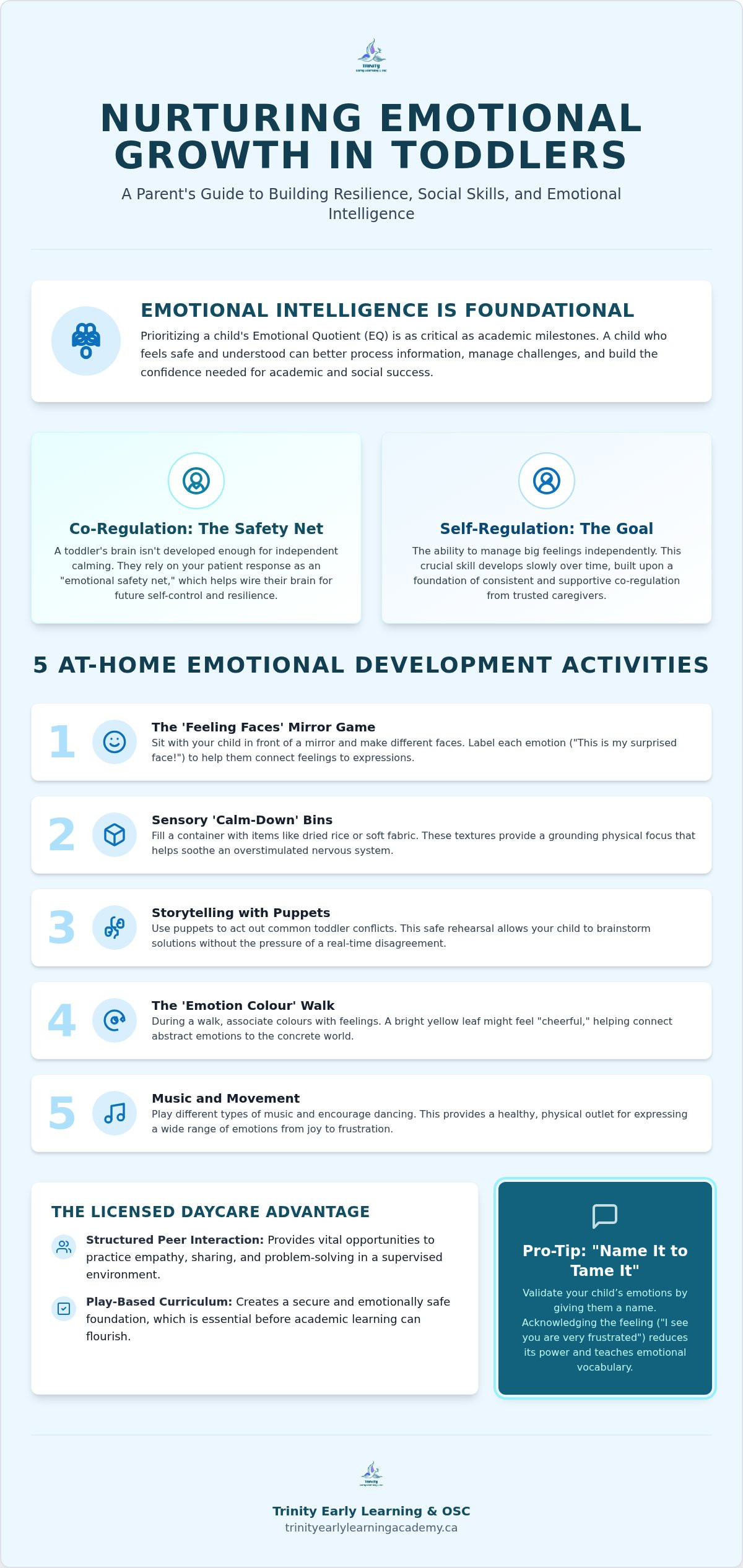
Many parents feel frustrated when their toddler cannot "just calm down" during a meltdown. It's vital to understand that a toddler's brain isn't yet physically capable of independent self-regulation. Their prefrontal cortex, the area responsible for logic and emotional control, is still under construction. Instead, they rely on co-regulation. Your patient reaction to a tantrum literally helps shape their brain's emotional centre. Co-regulation is a collaborative emotional safety net that allows your child to feel secure enough to eventually learn to manage big feelings on their own.
Why Emotional Health is the Foundation of Early Learning
A child who feels emotionally overwhelmed cannot effectively process new information. When a toddler feels safe, supported, and understood, their brain "unlocks," allowing them to focus on language acquisition and logical reasoning. This is why high-quality preschool programs in St. Albert prioritize emotional stability as the first step in their curriculum. By engaging in consistent emotional development activities for toddlers, you ensure your child enters the classroom with the confidence and focus needed for academic success. This emotional foundation leads to better social outcomes and long-term well-being as they grow within our community.
5 Toddler Emotional Development Activities at Home
Nurturing your child's emotional intelligence doesn't require a formal classroom setting. It begins in the comfort of your living room through intentional play. Engaging in emotional development activities for toddlers allows you to model empathy and patience in a low-stress environment. These simple games help children translate abstract feelings into concrete understanding, providing them with the tools they need to navigate the toddler social-emotional development milestones they encounter daily.
- The 'Feeling Faces' Mirror Game: Sit with your child in front of a mirror and take turns making different expressions. Label each one clearly, such as "This is my surprised face!" This activity helps toddlers recognize the physical cues of emotions in themselves and others.
- Sensory 'Calm-Down' Bins: Fill a container with materials like dried rice, smooth river stones, or soft silk scraps. When your child feels overwhelmed, these textures provide a grounding physical focus that helps soothe a taxed nervous system.
- Storytelling with Puppets: Use puppets to act out common toddler conflicts, like wanting the same block. Rehearsing these scenarios safely allows your child to brainstorm solutions without the pressure of a real-time disagreement.
- The 'Emotion Colour' Walk: During a stroll through your St. Albert neighbourhood, associate colours in nature with feelings. You might suggest that a bright yellow leaf feels "cheerful" or a grey stone feels "calm."
- Music and Movement: Play 'Freeze Dance' to help your child practice impulse control. The act of stopping their body when the music ends is a powerful exercise in managing physical responses to external cues.
While these home-based emotional development activities for toddlers are incredibly effective, they are even more powerful when reinforced in a social setting. Many parents find that enrolling their child in quality childcare provides the consistent peer interaction needed to turn these individual lessons into lifelong habits.
Using Books to Build an Emotional Vocabulary
Reading together is a perfect time to expand your child's emotional lexicon. In 2026, many new children's titles focus on diverse emotional experiences beyond just "happy" or "sad"; they explore nuances like frustration or anticipation. During storytime, pause to ask, "How do you think the character feels right now?" This simple question turns a passive activity into an active learning moment that builds empathy without feeling like a lesson.
Sensory Play: A Tool for Emotional Grounding
Messy play is more than just a cleanup challenge. It helps toddlers realize they can handle unexpected sensations, which builds their internal resilience. Simple DIY ideas like homemade playdough, water tables, or kinetic sand offer endless opportunities for exploration. Rhythmic sensory input like kneading dough or pouring water naturally regulates a toddler's heart rate by engaging the parasympathetic nervous system. This grounding effect makes sensory play a vital tool for emotional health.
How Licensed Daycare Centres Support Social-Emotional Growth
While home activities provide a vital foundation, the structured peer environment of a licensed daycare serves as a social laboratory for young children. In this setting, your child moves beyond individual play to navigate the complexities of group dynamics. Professional educators facilitate emotional development activities for toddlers that are difficult to replicate at home, such as group problem solving and collaborative play. This social immersion helps children develop a sense of belonging and community, which are essential components of healthy emotional growth.
A key advantage of professional care is the use of active listening by trained staff. When a toddler experiences a "big feeling," an educator doesn't simply redirect the behaviour; they validate the emotion first. By getting down to the child's eye level and mirroring their feelings with phrases like, "I see that you're feeling frustrated because the tower fell," they teach the child that their internal world is understood and safe. This validation is a core tenet of early childhood education in St. Albert, ensuring that every interaction builds the child's confidence and emotional vocabulary.
Consistent routines also play a vital role in reducing separation anxiety and fostering emotional stability. When a child knows exactly what to expect, from snack time to outdoor play, their stress levels remain low. This predictability allows them to focus their energy on learning and social interaction rather than worrying about what comes next. Within Alberta's "Flight" curriculum framework, these routines are designed to prioritize citizenship and identity, helping toddlers see themselves as valued members of their peer group.
Peer Interaction and Social Problem Solving
In a group setting, "mine!" is a frequent refrain. Rather than forcing a child to share, professional educators facilitate turn-taking. They help children recognize the needs of their peers, which is the beginning of empathy. Seeing a friend model emotional regulation, like taking a deep breath before trying a puzzle again, provides a powerful example that toddlers are eager to mimic. These organic moments are the most effective emotional development activities for toddlers because they happen in real time with real social consequences.
The Safety of a Licensed Environment
The stability of a licensed environment is directly linked to a child's emotional well-being. Alberta's strict licensing standards ensure that centres maintain appropriate staff-to-child ratios, such as one staff member for every eight children aged three to four and a half years. These ratios allow educators to be emotionally responsive and present for every child. For a detailed look at what to look for in a facility, you can review our daycare safety checklist St. Albert. A safe, regulated environment ensures that children feel secure enough to explore their emotions and take social risks.
Managing Big Emotions: Tips for St. Albert Parents
When your child is in the middle of a meltdown, it can be difficult to remember that they aren't trying to be difficult. They are simply overwhelmed by a world they cannot yet control. Managing these moments requires a shift from discipline to connection. By using the 'Name It to Tame It' technique, you help your child bridge the gap between their emotional right brain and logical left brain. Before you attempt to correct their behaviour, validate their feeling by saying, "I can see you're feeling very frustrated that we have to leave the park." This simple act of recognition often de-escalates the situation faster than any lecture could.
Another effective strategy is creating a 'Peace Corner' at home. Unlike a traditional time-out, which can feel like a rejection, a Peace Corner is a positive, soft space designed for reflection and sensory grounding. It might include plush cushions, a few favourite books, or a calming jar. This space teaches your child that it's okay to feel big emotions and that they have a safe place to go until they feel ready to rejoin the family. Integrating these emotional development activities for toddlers into your home life creates a consistent support system for your child's growing EQ.
Consistency across different environments is equally important. Your child will feel most secure when the expectations at home align with the routines of their licensed daycare in St. Albert. When parents and educators use similar language and techniques, the child learns that their emotional safety net is everywhere. If you're looking for a partner in this journey, we invite you to explore our licensed childcare programs to see how we support emotional milestones every day.
Handling Tantrums with Compassion
Tantrums are a normal sign of a developing brain rather than a reflection of "bad" parenting or a "bad" child. When an outburst occurs, try the 'Wait and Breathe' method. Instead of reacting with your own frustration, take three deep breaths to maintain your own calm. Once the storm has passed, focus on reconnection. A hug or a quiet moment together reinforces that your love is not dependent on their mood, which is a vital lesson in emotional security. These small moments are actually powerful emotional development activities for toddlers that build lifelong resilience.
Preparing for Transitions and Changes
Toddlers often struggle with transitions because they feel a lack of control over their schedule. Using visual schedules with simple pictures can help them anticipate what comes next, giving them a sense of agency. Tools like the 'Two-Minute Warning' provide a respectful heads-up before an activity ends. Maintaining a predictable schedule reduces toddler cortisol levels by eliminating the stress of the unknown. When a child knows that snack time always follows outdoor play, they can relax into their environment and focus on social growth.
Nurturing the Whole Child at Trinity Early Learning & OSC
At Trinity Early Learning & OSC, our philosophy is rooted in the belief that every "big feeling" is a vital learning opportunity rather than a disruption. We understand that emotional intelligence is the true bridge to kindergarten readiness. While academic skills are important, a child's ability to navigate social complexities and manage their internal world determines their long-term success in the classroom. Our educators facilitate professional emotional development activities for toddlers that prepare them for the cooperative nature of grade school, ensuring they enter the Alberta education system with confidence and resilience.
Our St. Albert facility is intentionally designed to promote emotional safety and exploration. From quiet, cozy corners for self-reflection to open areas that encourage collaborative play, every square inch of our centre supports a child's holistic growth. We recognize that emotional needs evolve as children grow. This is why we provide a seamless transition into our out of school care in St. Albert, where older children continue to receive the mentorship and emotional support they need to thrive in a community setting.
Professional Educators as Emotional Guides
Our staff members are more than caregivers; they are trained emotional guides who prioritize respectful, nurturing communication. Each educator undergoes specific training to support social-emotional milestones, ensuring that your child is met with patience and expertise during every interaction. We believe in a transparent partnership with families. We regularly share emotional milestones and successes with you, providing a consistent loop of support between our centre and your home. This collaborative approach ensures that the emotional development activities for toddlers we practice in our classrooms are reinforced by the people who matter most to them.
Affordable Excellence in St. Albert
We are committed to ensuring that every child in our community has access to high-quality emotional support and professional care. As a licensed provider, we help families navigate the financial aspects of early education to make our services accessible. The Daycare Affordability Grant Alberta provides significant support for St. Albert families, reducing the monthly cost of professional childcare and preschool. By choosing a licensed, grant-supported centre, you are investing in a stable and nurturing environment that treats your child's emotional well-being with the highest standards of professionalism. Join the Trinity family today and discover a partner who is as invested in your child's joy and growth as you are.
Building a Brighter Emotional Future for Your Toddler
Prioritizing your child's emotional intelligence is one of the most impactful decisions you can make for their long-term success. You now have the tools to transform challenging tantrums into moments of connection through co-regulation and intentional play. By consistently integrating emotional development activities for toddlers into your daily life, you're helping your child build the resilience and empathy they need to thrive in a community setting. Whether you're practicing "Feeling Faces" at home or relying on the structured support of a professional environment, every small step contributes to their holistic growth.
At Trinity Early Learning & OSC, we're dedicated to being your partner in this journey. Our licensed and accredited St. Albert childcare facility offers a play-based curriculum focused on the whole child. Our experienced educators are specifically trained in early childhood development to provide the nurturing guidance your toddler deserves. We invite you to see our compassionate approach firsthand and explore how we can support your family's needs.
Book a Tour at Trinity Early Learning & OSC to See Our Nurturing Environment in Action!
You're doing an incredible job navigating these complex early years. With the right support and a steady focus on emotional safety, your child will continue to grow into a confident and capable individual.
Frequently Asked Questions
What are the first signs of emotional development in toddlers?
The first signs often include showing affection to familiar people, acting shy or anxious around strangers, and imitating the actions of others. You might also notice your child beginning to realize they are a separate person from you, which often leads to the first expressions of independence. These behaviours indicate that your toddler is starting to understand social connections and their own identity within their world.
How can I help my 2-year-old deal with frustration?
Helping a 2-year-old requires staying calm yourself to provide a stable model for co-regulation. When your child is struggling with a task, offer physical comfort like a hug or a gentle hand on their shoulder. Use simple, reassuring language to acknowledge their struggle before offering a small amount of help. This approach teaches them that frustration is a temporary feeling they can move through with your support and patience.
Is parallel play a normal part of emotional development?
Parallel play is a completely normal and essential stage where toddlers play side by side without directly interacting. This behaviour allows children to observe their peers and learn social cues from a safe distance. It serves as a vital bridge to more complex cooperative play later on. By playing near others, your toddler is practicing being part of a social group while still maintaining their own personal space and focus.
When should I be concerned about my toddler's emotional outbursts?
You should consider seeking extra support if outbursts are frequent, unusually intense, or last for long periods without the child being able to calm down. If your child's behaviour consistently prevents them from participating in daily activities or involves hurting themselves or others, it's wise to consult a paediatrician. Professional guidance can help determine if these reactions are typical or if your child needs specific strategies to help them regulate their emotions.
How does daycare help with a child's social-emotional skills?
Licensed daycare provides a unique environment where children can practice social skills under the guidance of trained educators. Professionals facilitate specific emotional development activities for toddlers that encourage sharing, empathy, and conflict resolution. Being part of a consistent peer group allows children to see emotional regulation modelled by others their own age. This community setting helps toddlers realize they are part of a larger social structure beyond their immediate family.
What are some simple ways to teach empathy to a toddler?
Teaching empathy starts with modelling kind behaviour in your own daily interactions. Point out the feelings of others in real life or in storybooks to help your child recognize emotional cues. For example, if another child is crying at the park, you might say, "Your friend looks sad because they fell down; maybe we can wave hello." Encouraging small acts of kindness, like offering a toy to a sibling, helps your child practice caring for others.
Can emotional development activities help with sleep or eating habits?
Targeted emotional development activities for toddlers can indeed lead to better sleep and eating habits by lowering a child's overall stress levels. When a toddler feels emotionally secure and understood, their nervous system is better able to relax. This state of calm makes it significantly easier for them to transition to quiet times, settle for naps, or focus on a meal without the distraction of lingering big feelings or anxiety from their day.
Why is naming emotions so important for young children?
Naming emotions is critical because it gives your child a sense of control over their internal experiences. When a toddler has a specific word for a feeling, that emotion becomes a concept they can understand rather than just an overwhelming physical sensation. This vocabulary allows them to communicate their needs more effectively as they grow. It's the first step toward moving from physical outbursts to verbal expression and eventual self-regulation in their later preschool years.


