

You’ve finished the morning rush, but as you stand at the door of your St. Albert daycare, your toddler clings to your leg and the tears start to flow. It’s a gut-wrenching moment that leaves many parents feeling like they’ve failed before their workday even begins. You likely worry about your child's emotional well-being all morning, and that lingering stress makes it nearly impossible to stay focused or productive. Managing separation anxiety at daycare drop-off is one of the most challenging hurdles for modern families, yet research shows it's a normal developmental stage affecting up to 12% of preschool children.
We understand that you want a transition that feels supportive rather than traumatic. This guide will help you transform those stressful goodbyes into moments of connection and confidence for the whole family. We’ll explore practical, heart-centred strategies to create a predictable goodbye ritual that supports your child’s growth while giving you the peace of mind you deserve. By building a reliable bridge of trust between home and the learning centre, you can ensure your child feels safe, seen, and ready to learn.
Key Takeaways
- Reframe tearful goodbyes as a healthy sign of a secure attachment and a normal developmental milestone in your child’s growth.
- Discover how bridge objects and consistent morning routines can ease transitions before you even leave your home.
- Implement a three-step ritual for managing separation anxiety at daycare drop-off that balances emotional validation with a confident hand-off.
- Understand the causes of after-school restraint collapse and how a purposeful reconnection ritual can stabilize your family's evening.
- Learn the benefits of partnering with professional educators in a licensed St. Albert daycare who are trained in emotional co-regulation techniques.
Understanding Why Separation Anxiety Peaks at Daycare Drop-Off
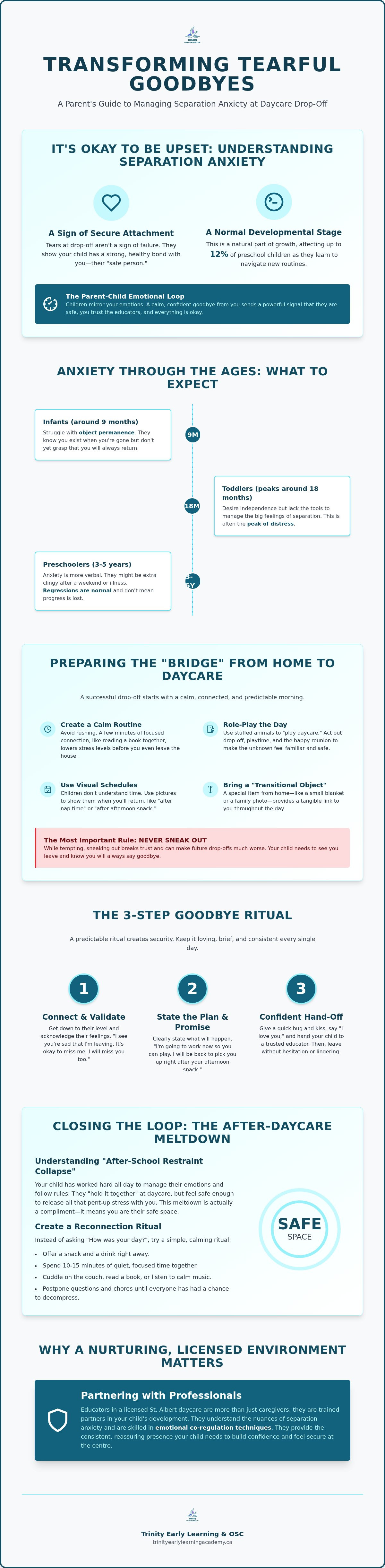
Separation anxiety is often misunderstood as a sign of distress or an indication that a child is unhappy with their environment. In reality, it is a healthy indicator of a secure attachment and a significant milestone in developmental progress. Your child’s brain is simply signaling that their "safe person" is leaving, which triggers a biological alarm system. Managing separation anxiety at daycare drop-off starts with realizing that this response is a natural part of Understanding Separation Anxiety and how children process transitions.
When a child enters a new environment, such as starting one of the many preschool programs in St. Albert, their amygdala may perceive the change as a threat. This can lead to a "honeymoon phase" where a child is initially excited by new toys and peers, followed by delayed anxiety after about two weeks. This happens because the child finally realizes that this new routine is a permanent change. It is a common experience that professional educators expect and are prepared to support.
The Developmental Timeline: What is Normal?
The way a child expresses anxiety changes as they grow. Infants around nine months often struggle because they are just beginning to understand object permanence; they know you exist when you are gone, but they don't yet understand that you will always return. Distress typically peaks around 18 months. At this age, toddlers have a strong desire for independence but lack the emotional tools to manage the big feelings that come with physical distance. For preschoolers, anxiety is usually more verbal or may manifest as clinginess after a long holiday, a weekend, or a period of illness. Regressions are a normal part of the learning process and do not mean that progress has been lost.
The Parent-Child Emotional Loop
Children are biologically wired to scan their parents' faces for cues about their safety. Through the power of mirror neurons, your child can pick up on your subtle hesitation, sadness, or stress. If you feel "parent guilt" or project anxiety, your child may interpret the daycare as a place of concern rather than a place of joy. Emotional regulation is a shared task where a parent’s calm, confident presence helps steady a child’s internal state. To manage your own feelings, remind yourself that quality childcare provides essential social and cognitive growth. Keeping your goodbye brief and steady sends a clear signal that you trust the educators and the environment, which helps your child feel secure enough to explore.
Preparing the "Bridge": Strategies Before You Reach the Centre
The work of managing separation anxiety at daycare drop-off begins long before you pull into the parking lot. A calm, predictable morning routine acts as the foundation for a successful transition. When a child feels rushed, their internal "alarm system" remains on high alert, making it harder for them to regulate their emotions later. Prioritizing even ten minutes of focused connection, such as reading a short book or eating breakfast together without the distraction of screens, can significantly lower a child's stress levels before they leave the house.
Role-playing is another powerful tool to build familiarity. You can "play daycare" at home using stuffed animals to act out the sequence of arrival, playtime, lunch, and the inevitable reunion. This demystifies the day and makes the unknown feel manageable. During these sessions, emphasize the importance of transparency. While it's tempting to sneak out while your child is distracted by a toy, this often backfires by damaging their sense of security. They need to know that while you are leaving, you will always come back. Honesty builds the trust necessary for a confident goodbye.
Visual Schedules and Predictability
Children lack a mature concept of time, so saying "I will be back at five o'clock" means very little to a toddler or preschooler. Instead, use a simple picture schedule that aligns with the rhythms of early childhood education in St. Albert. Visual markers like "Mommy comes back after nap" or "Daddy arrives after afternoon snack" provide concrete anchors that a child can track throughout their day. This predictability reduces the cognitive load on a child, allowing them to feel more secure in their environment as they wait for your return.
The Role of the "Transitional Object"
A "bridge object" serves as a physical reminder of your bond when you are apart. This might be a small family photo kept in their cubby or a "heart button" drawn on both your hands that they can "press" for a virtual hug during the day. When choosing a comfort item, ensure it meets the safety standards of your licensed childcare provider. You can also create a portable bridge through a special handshake or a "kiss in the pocket" ritual. Always validate their feelings by saying, "It's okay to feel sad that we're saying goodbye, and I will be here to pick you up after your afternoon play." This acknowledges their reality while reinforcing the certainty of your return.
The 3-Step Goodbye Ritual for a Confident Drop-Off
Once you arrive at the centre, having a structured, repeatable ritual is the most effective way of managing separation anxiety at daycare drop-off. This routine provides your child with a sense of control and predictability during a moment of high emotional intensity. A successful goodbye is defined as one that is consistent, even if it isn't always silent. By following these three steps, you create a transition that feels secure for both you and your little one.
- Step 1: The Arrival and Hand-Off. Walk into the classroom and immediately engage with the educator. When your child sees you interacting warmly with their teacher, it signals that this person is a trusted member of their "village." This social referencing helps lower their initial guard.
- Step 2: The Loving Validation. Acknowledge your child’s feelings without lingering. Use a simple phrase like, "I can see you feel sad that I'm leaving, and that's okay. I will be back to get you after your afternoon snack." This validates their internal experience while reinforcing the promise of your return.
- Step 3: The Clear Exit. Depart with confidence. Once the verbal goodbye is said, it is time to go. While it feels counterintuitive, "the linger" actually increases a child’s cortisol levels. Staying for "just one more hug" or watching through the window prolongs the distress and makes it harder for the child to begin the process of self-regulation with their educator.
Partnering with Your St. Albert Educators
Effective drop-offs are a team effort. Take 30 seconds to communicate your child’s morning mood to the staff. If they didn't sleep well or skipped breakfast, the educators can adjust their approach accordingly. Trusting the licensed daycare St. Albert standards ensures that your child is in the hands of professionals trained in co-regulation. If you feel anxious after leaving, don't hesitate to request a "settled in" photo or a quick text update. Seeing your child calmly playing ten minutes after you've left is often the best remedy for parent guilt.
What to Do if the Tears Continue
It's helpful to remember the "15-minute rule." Most children, even those who seem inconsolable at the door, settle into an activity within minutes of their parent’s departure. The tears are often about the transition itself, not the environment. However, if the distress persists for several weeks without improvement, it may be time to have a deeper meeting with the centre director. Together, you can adjust the transition plan, perhaps by arriving slightly earlier or having a specific "greeting peer" ready to meet your child at the door. Consistency remains your greatest ally in helping your child realize that daycare is a safe, joyful place to be.
Closing the Loop: Managing the After-Daycare Meltdown
Many parents find that the tears they worked so hard to avoid in the morning resurface as emotional "explosions" in the afternoon. This phenomenon is known as "After-School Restraint Collapse." Throughout the day, children work incredibly hard to follow rules, share toys, and manage their impulses. When they finally see you, their safe base, they feel secure enough to release all that pent-up energy. It is not a sign that they had a bad day or that the daycare is a poor fit. Instead, it is a sign of a deep, trusting bond where they know they can be their most vulnerable self with you.
Successfully managing separation anxiety at daycare drop-off requires looking at the entire day, including the transition back home. In a quality out of school care St. Albert program, professional educators help bridge this gap by balancing structured play with quiet rest. However, the final reconnection remains your most important task. Avoid the common "interrogation" where you ask abstract questions like, "How was your day?" or "What did you learn?" These queries require significant cognitive effort that a child may not have left. Focus on being present and available rather than demanding information.
The First 30 Minutes of Reconnection
The first 30 minutes of reconnection should prioritize physical touch and sensory grounding. A long hug or holding hands on the walk to the car provides the sensory input your child needs to feel secure. Always have a high-protein snack ready, such as cheese or yogurt, to stabilize blood sugar after a long day of learning and physical activity. Create a "decompress zone" in the car or at home where there are no digital distractions or immediate demands. This quiet period allows your child to transition from the high-stimulation environment of a learning centre back to the familiar calm of home at their own pace.
Strengthening the Home-Daycare Connection
Building a positive narrative around your child’s educators and peers helps reduce the friction of the next morning's drop-off. Talk about teachers and friends with warmth during dinner or bath time to reinforce that they are part of your child's extended family. Knowing you have reviewed a daycare safety checklist to verify the centre's high standards will give you the peace of mind needed for a calm evening. To minimize morning decision fatigue, prepare for the next day together by picking out clothes or packing bags the night before. If you are looking for a supportive environment that understands these complex family dynamics, contact our nurturing team today to learn more about our quality childcare programs.
Why a Nurturing, Licensed Environment Makes the Difference
Choosing a childcare provider is about more than finding a safe place for your child to spend the day. It’s about finding a partner who understands the emotional complexity of early childhood development. A licensed Alberta facility must adhere to strict quality and safety standards, which provides parents with the foundational peace of mind needed to remain calm during transitions. When you are confident in the centre's standards, that stability is felt by your child. Professional educators in these environments are specifically trained in co-regulation techniques. They don't just wait for a child to stop crying; they actively work to soothe the child’s nervous system through proximity, validation, and engagement.
A community-focused centre offers a level of intimacy that larger, impersonal facilities often lack. When every educator knows your child by name and understands their unique temperament, the environment begins to feel like a secondary home. This familiarity is a vital component of managing separation anxiety at daycare drop-off. Additionally, the current Alberta affordability grant has made these high-quality, lower-ratio environments more accessible than ever. Families can now prioritize centres that offer specialized emotional support without the financial barriers that once limited their choices.
The Trinity Early Learning Approach
At Trinity Early Learning & OSC, we embrace a "Trusted Nurturer" philosophy for every family we serve. We realize that every family’s journey is different, which is why we don't believe in a one-size-fits-all approach to transitions. Our St. Albert facility is intentionally designed to feel like a home away from home, featuring warm spaces that encourage both exploration and comfort. When a new family joins our community, we partner with them to create individualized transition plans. These plans might include shorter initial days or specific greeting rituals that align with the child’s specific attachment style and needs.
Taking the Next Step for Your Child
The best way to feel confident in a centre is to see it in action. We encourage you to book a tour of our facility to observe our educators and see how we handle morning routines first-hand. If you have questions about the financial side of quality care, we have developed a comprehensive daycare affordability grant Alberta resource to help you navigate the 2026 requirements. Remember that you are doing a great job. Transitioning to daycare is a significant milestone for both parent and child; with the right support, those tearful goodbyes will soon turn into confident, happy starts to the day.
Building a Bridge of Confidence for Your Family
Transforming your morning from a source of stress into a moment of connection is possible with the right tools. By establishing predictable routines and using a structured three-step goodbye, you provide your child with the security they need to thrive. Managing separation anxiety at daycare drop-off isn't about eliminating every tear; it's about building a reliable bridge of trust between your home and the learning centre. When you partner with professional educators who prioritize emotional co-regulation, you ensure that your child is supported through every developmental milestone.
At Trinity Early Learning & OSC, we are committed to providing licensed and accredited childcare that feels like family. Our experienced early childhood educators are dedicated to our St. Albert community, offering a nurturing environment where every child is known and valued. We invite you to book a tour at Trinity Early Learning & OSC to see our nurturing environment in action. You are doing a wonderful job navigating these early years, and we are here to support your family every step of the way.
Frequently Asked Questions
How long does separation anxiety usually last when starting a new daycare?
Separation anxiety typically lasts between two and four weeks as a child adjusts to their new environment. This period is often shorter for infants and can be slightly longer for toddlers who are navigating a peak developmental stage for distress. Consistency is the primary factor in reducing this duration. If you follow a predictable routine, your child will eventually realize that your departure is temporary and your return is certain.
Is it better to leave quickly or stay until my child stops crying?
It is almost always better to leave quickly once you have said your goodbye. Lingering or returning for one last hug often increases a child's cortisol levels and prolongs their distress. A quick, confident exit signals to your child that you trust the educators and the environment. Most children settle within minutes of their parent leaving, whereas staying longer can make the eventual separation feel more traumatic for everyone involved.
What should I do if my child was fine for weeks but suddenly starts crying at drop-off?
Sudden crying after weeks of successful drop-offs is often referred to as the end of the honeymoon phase. Initially, the novelty of new toys and peers may have distracted your child. Once the routine becomes permanent, they may experience a surge of anxiety as they realize the change is daily. This is a normal part of managing separation anxiety at daycare drop-off. Simply maintain your consistent ritual to help them move through this regression.
Can a transitional object really help with daycare separation anxiety?
Transitional objects are highly effective at providing a physical bridge between home and the learning centre. A small family photo, a special heart button drawn on the hand, or a daycare-approved comfort item can offer immense emotional security. These objects remind the child of your bond throughout the day. They serve as a sensory anchor, helping them feel connected to you even when you are physically apart in a new environment.
How do I know if my child’s separation anxiety is "normal" or something more serious?
Normal separation anxiety is typically confined to the moment of drop-off and resolves shortly after the parent leaves. It becomes more serious if the distress lasts the entire day, impacts eating and sleeping habits, or if the child is unable to be consoled by trusted educators. If these symptoms persist for more than four weeks without improvement, it is helpful to consult with your pediatrician or the centre director to discuss additional support.
What can I do if I am feeling overwhelmed by parent guilt during drop-off?
Parent guilt is a common response, but it’s helpful to remember that your child mirrors your emotional state. If you project confidence and peace, your child is more likely to feel secure. Focus on the long-term benefits of quality childcare, such as social development and cognitive growth. Remind yourself that you are not leaving them; you are providing them with a safe, nurturing space to grow while you fulfill your own professional responsibilities.
How do educators at Trinity Early Learning help soothe my child after I leave?
Our educators at Trinity Early Learning & OSC are trained in specific co-regulation techniques to help soothe your child. Once you depart, we use gentle redirection, sensory play, and one-on-one engagement to help them transition into the morning's activities. We prioritize building a secure attachment with every child. If you are feeling anxious, we can provide a quick update or photo to show you that your child has settled and is safely playing.
Does the type of daycare program (like preschool vs. daycare) affect separation anxiety?
The specific type of program, whether it is preschool or daycare, matters less than the quality of the transition support provided. Both settings involve a separation from the primary caregiver, which is the root cause of the anxiety. However, managing separation anxiety at daycare drop-off can sometimes be easier in programs with highly structured routines, as predictability helps children feel more in control. Our licensed St. Albert facility ensures that all programs prioritize emotional safety during every transition.


