

Imagine sitting at your kitchen table in St. Albert with a stack of receipts and a growing sense of dread as the tax deadline approaches. You want to ensure your family receives every dollar you're entitled to, but the intersection of provincial grants and federal rules often feels like a maze. Many local parents find that claiming childcare expenses CRA requirements can be the most stressful part of their annual return. It's completely natural to worry about whether you've organized your records correctly or if an Alberta affordability grant might change your federal claim.
We understand that your primary focus is providing a safe, nurturing environment for your children, not deciphering complex tax forms. That's why we've developed this guide to help you manage the financial side of childcare with total confidence. You'll learn exactly how to organize your documents and claim your expenses to maximize your family's savings this year. We will walk you through the 2026 deduction limits, explain how to handle receipts from licensed providers, and provide a clear strategy to keep your records audit-ready and organized.
Key Takeaways
- Identify the specific 2026 deduction limits for children under seven and those aged seven to sixteen to ensure you claim the full amount allowed by law.
- Learn why the spouse with the lower net income is typically responsible for claiming childcare expenses CRA deductions on their tax return.
- Understand the role of Form T778 and how to maintain organized records to simplify your filing process and prevent audit concerns.
- Discover how licensed care in St. Albert provides professional year-end receipts that clarify the interaction between affordability grants and tax claims.
- Follow a clear strategy to organize your financial documents and maximize your family's overall tax savings for the year.
Understanding Childcare Expense Deductions for Canadian Families
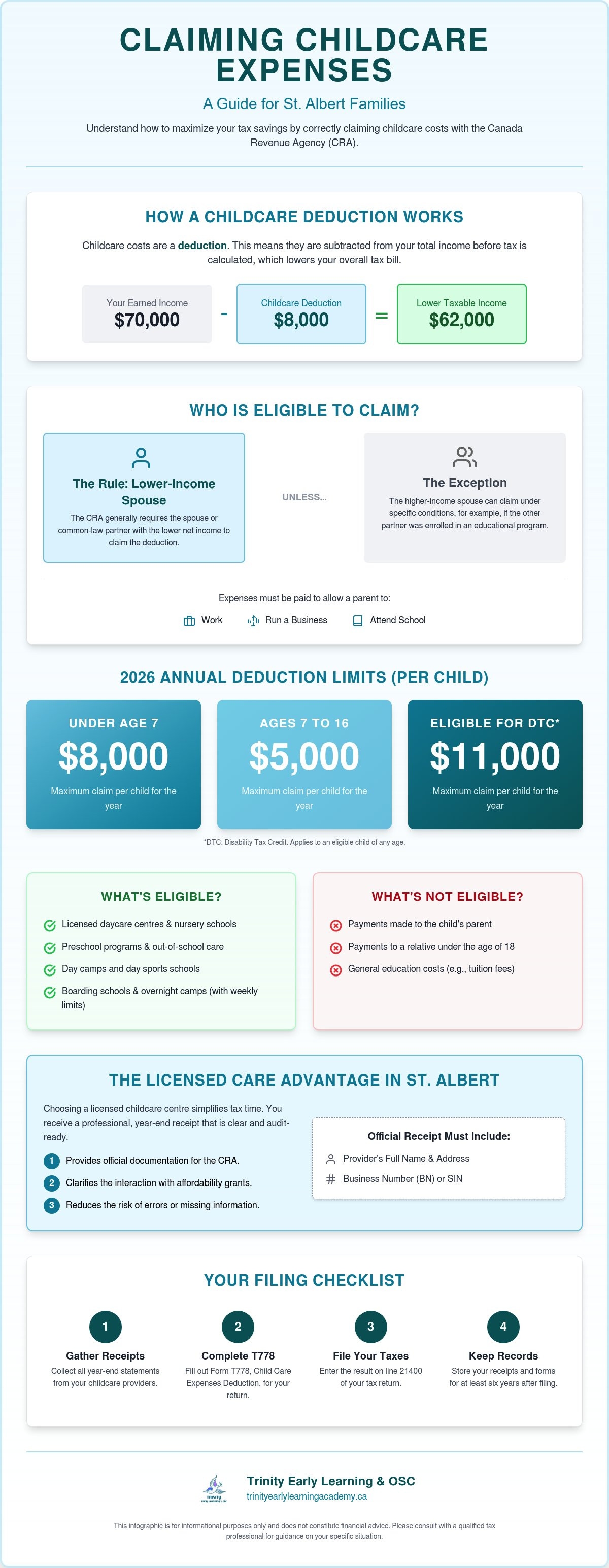
Childcare expenses are the costs you pay to have someone look after an eligible child so that you can focus on your professional or educational goals. In the Canadian income tax system, these payments serve as a deduction. This means they reduce your total taxable income rather than acting as a direct credit against the taxes you owe. By lowering your taxable income, you effectively pay tax on a smaller portion of your earnings, which can lead to a lower overall tax bill.
The Canada Revenue Agency (CRA) has specific rules regarding the purpose and timing of these claims. You must have paid the expenses to allow you or a supporting person to work, carry on a business, or attend school. Additionally, the CRA requires you to claim the expense in the specific tax year it was paid. Keeping your receipts organized throughout the year ensures that claiming childcare expenses CRA deductions remains a smooth process during the spring filing season.
What Qualifies as an Eligible Childcare Expense?
Most parents in St. Albert are familiar with standard daycare costs, but several other types of care also qualify. Eligible expenses typically include:
- Licensed daycare services and nursery schools.
- Preschool programs designed for early learning.
- Out-of-school care (OSC) for children before or after classes.
- Day camps and day sports schools where the primary goal is childcare.
- Boarding schools or overnight camps, though these have specific weekly limits.
It's vital to remember that payments made to certain individuals don't count. For instance, you cannot claim payments made to the child's parent or to a relative who is under the age of 18. This rule ensures the deduction supports professional caregiving arrangements rather than informal family help.
The Importance of Licensed Care for Your Claim
Choosing a professional environment provides more than just developmental benefits for your child; it also protects your financial interests. The CRA prefers receipts from a licensed daycare centre because these organizations are registered and follow strict administrative standards. If you are ever asked to provide proof of payment, a formal receipt from a licensed provider is the most reliable document you can offer.
A licensed provider will include their business name, address, and their business number on your year-end statement. This transparency makes claiming childcare expenses CRA straightforward and reduces the risk of errors or missing information. For families looking for high standards of care and administrative clarity, choosing a licensed daycare St. Albert families trust is a wise first step toward a stress-free tax season.
Determining Who Can Claim Childcare Expenses on Their Tax Return
One of the most common points of confusion for families involves which parent should file the claim. The CRA generally requires the spouse or common-law partner with the lower net income to claim the deduction. This policy is designed to ensure that the tax benefit is applied consistently across different family structures. Whether you're married or in a common-law relationship, the process of claiming childcare expenses CRA rules must be followed even if the higher-earning spouse paid for the childcare services directly.
To qualify for the deduction, you must be paying for the care of an "eligible child." In most cases, this means your child was under the age of 16 at some point during the tax year. However, there is no age limit if the child has a physical or mental infirmity and is dependent on you. Detailed instructions on how to report these details can be found on Form T778, Child Care Expenses Deduction, which helps you calculate the specific amount you're eligible to deduct.
Exceptions to the Lower-Income Spouse Rule
There are specific situations where the higher-income spouse is permitted to claim the expenses. If the lower-income partner was enrolled in an educational program, such as full-time or part-time studies at a designated college or university, the higher earner may be able to claim a portion of the costs. Other exceptions include periods where the lower-income spouse was confined to a bed or wheelchair, hospitalized for at least two weeks, or in prison.
If your family falls into one of these categories, it's vital to keep precise records. You'll need to document the dates of school enrollment or medical confinement to justify why the higher-income spouse is claiming childcare expenses CRA deductions. Clear documentation provides peace of mind if the CRA ever requests a review of your filing.
Special Considerations for Single Parents
For single parents, the process is often more straightforward because there is only one income to consider. You can typically claim the full amount of eligible expenses up to the annual limits. However, things can become more complex in shared custody arrangements. In these cases, each parent can only claim the portion of the expenses they personally paid.
If you're navigating a complex family structure, consulting a tax professional can help ensure you're following the rules correctly while maximizing your return. Choosing a partner like Trinity Early Learning & OSC ensures you receive clear, individual receipts that make this coordination much easier for both parents.
Calculating Your Maximum Childcare Deduction Limits for 2026
When you are claiming childcare expenses CRA, the total amount you can deduct isn't simply the total of all your receipts. The CRA applies a specific calculation to ensure the deduction is fair and reflects your actual financial contribution. Specifically, your deduction is the least of three amounts: the actual amount you paid, two-thirds of the lower-income spouse's earned income, or the total of the maximum dollar limits for all your children combined. This methodical approach ensures that the tax benefit aligns with both your earnings and the number of children in your care.
The two-thirds rule is particularly important for families where the lower-income spouse has a variable or modest income. If that spouse earns C$30,000, for example, the maximum total claim for all children would be C$20,000, regardless of how much was actually spent on care. It's also vital to remember that you can only claim the actual amount that came out of your own bank account. Any subsidies or grants that reduced your bill cannot be included in your tax deduction calculation because they were not costs you personally incurred.
How the Alberta Affordability Grant Affects Your Claim
St. Albert families often benefit from provincial support systems that lower their monthly costs. The Alberta Affordability Grant is paid directly to your childcare provider, which significantly reduces the fees you pay each month. Because this grant is a direct government payment to the centre, it isn't considered an out-of-pocket expense for you. You should only claim the "parent portion" of the fees, which is the net amount shown on your official tax receipt. For a detailed breakdown of how these savings work and how they lower your monthly commitment, visit our Daycare Affordability Grant Alberta guide.
Age-Based Limits and Disability Considerations
The specific dollar limits for claiming childcare expenses CRA depend on the age and health needs of your child. For the 2026 tax year, the maximum claimable amount for a child under seven is C$8,000. Once a child turns seven, this limit decreases to C$5,000 for the remainder of their eligibility until they turn sixteen. If your child is eligible for the disability tax credit, the limit increases to C$11,000 regardless of their age. This Guide to Claiming Child-Care Expenses offers more context on how these limits apply to different family scenarios. Understanding these transitions helps you plan your family budget more effectively as your children grow and their care needs change.
Step-by-Step Guide to Filing Form T778 for Childcare Expenses
Filing your taxes doesn't have to be overwhelming when you have the right tools. For Canadian parents, Form T778 is the official document used for claiming childcare expenses CRA deductions. You must file this form alongside your T1 General income tax return to ensure your claim is processed correctly. It acts as the bridge between your physical receipts and your final tax return. While you don't typically need to mail your receipts with your return, you must keep them for six years. This ensures you're prepared if the CRA ever requests a review of your records.
Organizing Your Receipts and Provider Information
A valid receipt is more than just a piece of paper. To meet CRA standards, each receipt must include the caregiver's name, address, and either their Social Insurance Number or their business number. If you use a professional centre in St. Albert, you can easily request a year-end tax summary. This document consolidates all your payments into one clear, professional statement.
To stay organized, consider creating a digital folder on your computer to save monthly invoices as they arrive. You can also use a dedicated mobile app to scan paper receipts immediately. This practice prevents the last-minute scramble for missing paperwork in April. If you're looking for a provider that prioritizes clear communication and administrative transparency, contact Trinity Early Learning & OSC today to learn about our licensed programs and how we support our families.
Completing the Form T778 Sections
Form T778 is divided into specific parts to help you calculate your deduction accurately. In Part A, you'll list the names and birth years of all eligible children. This section establishes the foundation for your claim based on the age-related limits. It's a simple but vital step to ensure the CRA knows exactly which children are being cared for.
Part B is where you perform the actual calculations. Here, you'll compare your total paid expenses against the two-thirds income limit and the basic annual limits. Once you determine the lowest of these three amounts, you'll transfer that final figure to line 21400 of your tax return. Taking the time to double-check that the numbers on your form exactly match your receipts will provide confidence and security during the filing process. It's this attention to detail that helps you maximize your savings and maintain a clear record for the future.
How Licensed Care in St. Albert Simplifies Your Tax Season
Choosing a licensed childcare provider in St. Albert offers more than just a safe environment for your child's development. It provides a level of administrative clarity that makes tax season significantly more manageable. When you are claiming childcare expenses CRA, the quality of your documentation is the most important factor in a successful deduction. Professional centres maintain rigorous records that align with provincial licensing standards, ensuring that every payment you make is tracked and recorded accurately throughout the year.
Professional year-end tax receipts from a licensed facility remove the guesswork from your filing. These receipts include all the mandatory information, such as the centre's business number and the total parent portion paid after grants are applied. This level of detail provides immense peace of mind. You can feel confident that your records are audit-ready and that you are meeting your obligations as a taxpayer while receiving the full benefit of the deduction.
The Trinity Early Learning & OSC Advantage
At Trinity Early Learning & OSC, we act as a knowledgeable advocate for our families. We understand that navigating the intersection of provincial grants and federal tax rules can be complicated. Our team is committed to helping you understand these financial support systems so you can maximize your family's budget. Whether your child is in our daycare or our out-of-school care programs, we provide the clear documentation required for claiming childcare expenses CRA deductions.
Our role in the St. Albert community is to be a stable and transparent partner for parents. We ensure that our administrative processes are as nurturing as our care programs. By providing accurate, timely financial statements, we help you focus on what truly matters: your child's growth and happiness. Our out-of-school care programs are specifically designed to be eligible for these claims, supporting families as their children move through different stages of their education.
Preparing for Next Year’s Tax Season Today
The best time to organize your tax records is right now. Setting up a simple record-keeping system today will save you hours of stress next spring. We recommend creating a dedicated physical or digital folder for all childcare-related communications and invoices. Choosing a licensed centre ensures that you have a professional team ready to support your record-keeping needs. You won't have to chase down individual caregivers for their SIN or address because all that information is already provided on our official receipts.
We encourage you to ask about tax-related documentation and financial support during the preschool enrollment process. Understanding these details early allows you to plan your family's finances with total confidence. If you have questions about our licensed programs or how we handle year-end receipts, we invite you to contact us. We are here to guide you through every step of the journey, from early learning to administrative support.
Securing Your Family's Financial Future with Confidence
Managing your family's finances doesn't have to be a source of stress when you have the right information and a supportive partner. By understanding the specific age-based limits and the role of Form T778, you can ensure that claiming childcare expenses CRA requirements are met accurately and efficiently. Choosing a professional, licensed centre in St. Albert provides the administrative clarity needed to coordinate provincial grants with federal deductions without the fear of a tax audit.
Our family-run centre provides a nurturing and professional environment where your child can thrive while we handle the administrative details with expertise. We understand the nuances of Alberta childcare grants and act as a stable partner for your family. Contact Trinity Early Learning & OSC to learn about our licensed programs and see how we can simplify your childcare journey. We look forward to supporting your family through a successful and stress-free year.
Frequently Asked Questions
Can I claim childcare expenses if I am a student?
Yes, you can claim these costs while enrolled in an educational program. If you are a student, the CRA allows the higher-income spouse to claim the deduction for the weeks you are in school. This ensures that families pursuing further education aren't financially penalized for their childcare needs. You will need to provide proof of your enrolment, such as a T2202 form, to justify this exception to the standard lower-income spouse rule.
What happens if my childcare provider does not give me a receipt?
You cannot legally claim the deduction without a valid receipt. The CRA requires documentation that includes the provider's name, address, and either a business number or Social Insurance Number. Choosing a licensed provider like Trinity Early Learning & OSC ensures you always receive professional year-end summaries. If a private caregiver refuses to provide a receipt, those payments are not eligible for claiming childcare expenses CRA deductions, which could cost your family significant tax savings.
Can I claim the costs of an after-school program in St. Albert?
Yes, costs for out-of-school care in St. Albert are fully eligible for the deduction. These programs allow parents to remain at work during the late afternoon hours, meeting the CRA's primary requirement for the claim. Whether your child attends a morning program or an afternoon session, ensure you keep the monthly invoices provided by your centre. These professional records make it simple to calculate your total annual investment when filling out your tax return.
Do I need to send my receipts to the CRA when I file my taxes?
No, you don't need to send your receipts when you file your income tax return. However, you are legally required to keep all childcare records and receipts for at least six years in case the CRA requests them for a review or audit. Organizing these documents in a dedicated digital folder or a physical file ensures you can respond quickly to any inquiries. Professional centres provide clear summaries that simplify this record-keeping process for busy families.
Can I claim childcare expenses paid to a family member?
You can only claim payments to relatives if they are 18 years of age or older and are not considered a supporting person for the child. For example, you cannot claim payments made to the child's other parent. If you pay a grandparent or an adult aunt, they must provide a receipt that includes their Social Insurance Number. This income must also be reported on their own tax return for your claim to be valid.
Is there a maximum income limit for claiming childcare expenses?
There is no maximum income limit that prevents you from claiming childcare expenses CRA deductions. However, the total amount you can deduct is limited to two-thirds of the earned income of the lower-earning spouse. While high-earning families are eligible, the actual tax benefit depends on your marginal tax rate. Because this is a deduction from your taxable income rather than a credit, it effectively reduces the amount of income you are taxed on.
How do I claim expenses if I have more than one child in daycare?
You will use Form T778 to list each child and their specific expenses separately. The CRA sets individual limits based on each child's age, such as C$8,000 for those under seven and C$5,000 for those aged seven to sixteen. Your total deduction will be the sum of these individual claims, provided the total does not exceed two-thirds of the lower-income spouse's earned income. Keeping separate records for each child ensures your calculations remain accurate.
What is the deadline for claiming childcare expenses for the 2026 tax year?
The deadline for claiming expenses for the 2026 tax year is April 30, 2027. If you or your spouse are self-employed, the filing deadline is June 15, 2027, though any taxes owing must still be paid by the end of April. It is wise to request your year-end receipts from your St. Albert childcare provider by February. This gives you ample time to organize your records and ensure you maximize your family's savings before the deadline.


