

You've just finished a hurried drop-off at your St. Albert childcare centre, and as you merge onto the Anthony Henday, that familiar wave of guilt begins to settle in. It's a heavy feeling, wondering if staying connected with your child during the workday is even possible while you focus on your career. Most parents in our community feel this tension between professional excellence and emotional presence. You want to be a provider, but you also want to be the anchor your child turns to first.
You can discover practical, guilt-free strategies to maintain a strong emotional bond while balancing your professional responsibilities. This guide provides a sense of peace about your childcare choice by introducing simple rituals that won't add to your workload. We'll explore how to use daily updates from your provider effectively and how to create a calm, intentional reconnection when the workday ends. By focusing on intentional daily bridges, you can ensure your child feels your love and presence even when you're at the office.
Key Takeaways
- Shift your mindset from physical proximity to emotional availability to effectively manage working parent guilt and build a deeper bond.
- Implement simple goodbye rituals and use transition objects, such as a matching bracelet, to provide your child with a sense of security throughout the day.
- Learn how to partner with your licensed childcare provider to ensure you are staying connected with your child during the workday through consistent daily updates.
- Tailor your bonding strategies to your child's specific developmental stage to ensure your interactions remain meaningful as they grow and learn.
- Identify the benefits of selecting a licensed St. Albert centre that prioritizes transparent communication and acts as a nurturing extension of your family unit.
Understanding Emotional Connection for Busy Working Parents
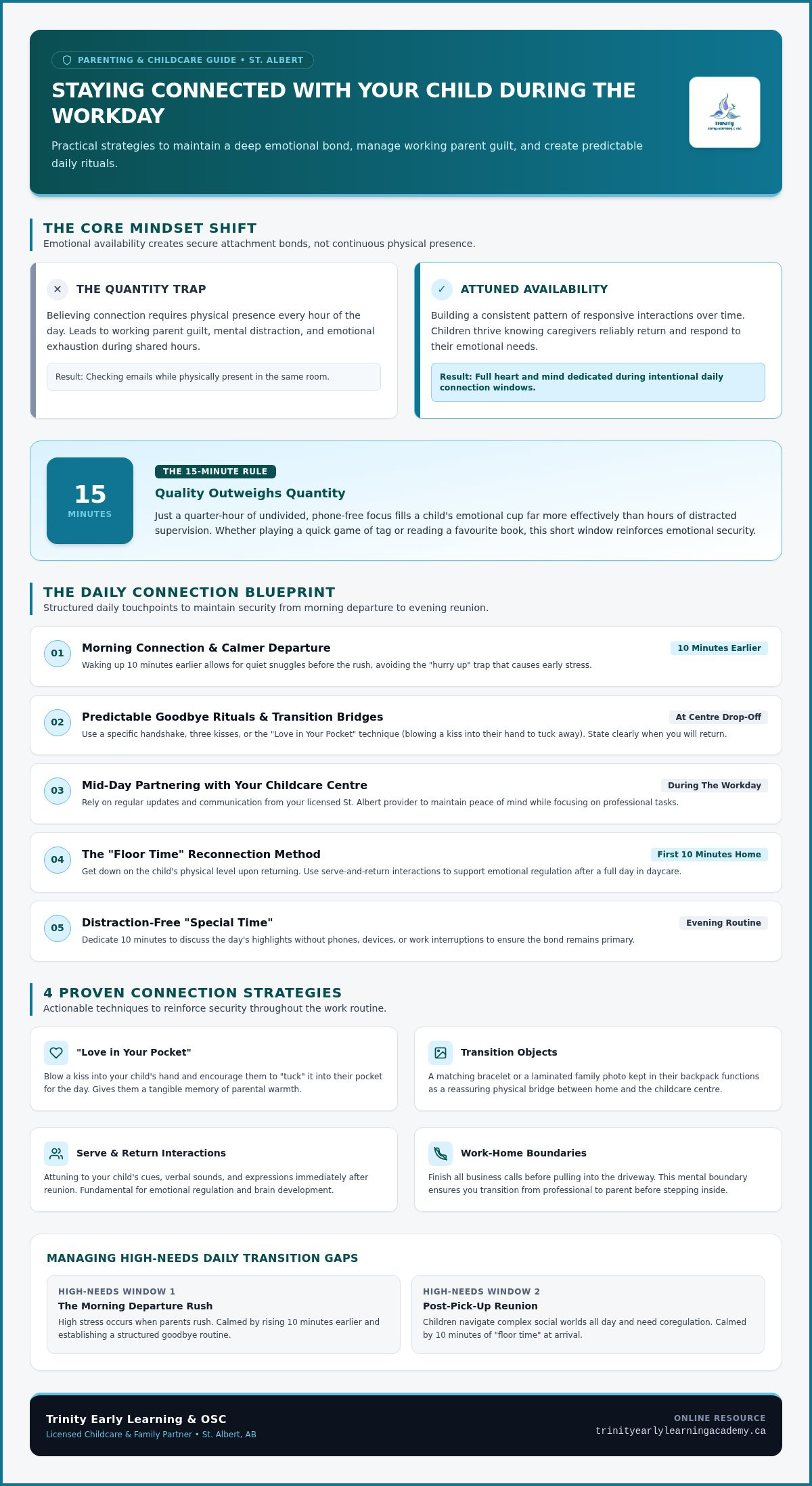
Many St. Albert parents believe that connection requires being physically present every hour of the day. In reality, emotional availability is the true foundation of a healthy relationship. Staying connected with your child during the workday doesn't mean you're failing if you're at your desk or on a job site; it means you're building a different kind of closeness. Working parent guilt often creates a barrier to genuine bonding because it leads to mental distraction or emotional exhaustion. When you feel guilty, you're often less present in the moments you actually have together. Connection is the consistent pattern of responsive interactions over time.
Children develop secure attachment bonds when they know their caregivers will reliably return and respond to their needs. This internal sense of safety doesn't disappear just because you're at work. A licensed childcare environment supports this by providing a stable, nurturing space where your child feels safe while you're away. This stability allows the bond to survive the workday and even flourish as the child learns to trust the rhythm of departure and reunion. It's the quality of the response, not the quantity of minutes, that builds this trust.
Quality Over Quantity: The 15-Minute Rule
Focused attention is far more impactful than hours of distracted supervision. The 15-minute rule suggests that just a quarter-hour of undivided focus can deeply satisfy a child's emotional needs. During these windows, it's vital to put away your phone and leave work thoughts behind. Whether it's a quick game of tag at a local park or reading a favourite book, this focused play reinforces your child's sense of security. They learn that when you are together, they have your full heart and mind. This short burst of presence fills their emotional cup more effectively than a whole evening of you checking emails while they play nearby.
Identifying Connection Gaps in Your Daily Routine
Recognizing when work stress is bleeding into your home life is the first step toward protecting your family time. High-needs times usually occur during the stressful morning rush or immediately after pick-up from daycare. These transitions are emotionally demanding for children who have spent the day navigating their own social worlds. Setting clear emotional boundaries, like finishing work calls before you pull into the driveway, helps you transition from professional to parent. By identifying these gaps, you can find better ways of staying connected with your child during the workday and into the evening. This proactive approach ensures that your home remains a sanctuary for both you and your little one.
Simple Daily Rituals to Bridge the Workday Gap
Staying connected with your child during the workday begins before you ever leave the house. Rituals provide a predictable framework that helps children feel secure even when you aren't physically present. Establishing a consistent goodbye ritual is a simple way to build this sense of safety. You might use a specific handshake, a special phrase, or a series of three kisses. These small, repetitive actions signal to your child that while you're leaving now, you are a reliable presence who always returns. Transition objects, like a matching bracelet or a small laminated photo in their backpack, act as a physical bridge between home and their childcare centre.
When you reunite at the end of the shift, the first ten minutes are critical for emotional regulation. These serve and return interactions are the building blocks of brain development and emotional security. By responding to your child's cues with focused attention, you reinforce the bond that was maintained throughout the day. Incorporating "special time" into your evening routine, where you spend ten minutes discussing the day's highlights without any distractions, ensures that the connection remains a priority despite a busy schedule.
Morning Connection: Setting a Positive Tone
Waking up just ten minutes earlier allows for quiet snuggles before the morning rush begins. This small window sets a positive tone and helps you avoid the "hurry up" trap that often causes stress for both parent and child. For children attending daycare, try the "Love in Your Pocket" technique: blow a kiss into their hand and have them "tuck" it into their pocket to keep all day. A predictable drop-off routine, where you say a clear goodbye and state exactly when you'll return, helps lower separation anxiety and builds long-term trust.
The After-Work Reconnection Strategy
The "floor time" method is highly effective for transitioning back to family life; get down on your child's level as soon as you arrive home. Instead of asking general questions, use specific prompts about activities they enjoyed at their licensed daycare St. Albert centre. Be prepared for "after-school restraint collapse," where children release the day's tension through tears or tantrums once they are back in their safe space. Handling this with empathy and a nutritious snack helps them feel supported as they decompress. If you're seeking a partner that understands these emotional needs, choosing a family-focused childcare centre can make these daily transitions much smoother for everyone involved.
Partnering With Your St. Albert Childcare Provider
A licensed daycare in St. Albert acts as a vital extension of your family unit. When you view your childcare provider as a teammate, the task of staying connected with your child during the workday feels much lighter. These educators are the eyes and ears that witness your child's growth while you're at the office. They see the "wow" moments, like a first successful tower of blocks or a kind gesture toward a peer, and sharing these details helps you feel like you were almost there. By partnering with your childcare provider, you create a seamless bridge between your professional life and your child's developmental journey.
Digital communication apps have transformed the way parents and educators interact. Platforms like Lillio or Brightwheel provide real-time updates, but it's vital to use them intentionally. Instead of checking every few minutes, set specific times to view photos and meal logs. This prevents work distraction while ensuring you're informed. When you see an update about a new interest, such as an obsession with trucks or a specific storybook, you gain a valuable conversation starter for the drive home. These digital tools are meant to support your bond, not replace your focus.
Maximizing the Daily Pickup Chat
The few minutes during pickup are a golden opportunity to strengthen your connection. Instead of just asking about logistics, ask educators about your child’s emotional wellbeing. Did they seem frustrated or particularly joyful during group play? Sharing updates from home, like a poor night's sleep or an upcoming visit from a favourite relative, helps teachers support your child more effectively. Building a relationship of trust with the staff ensures that the transition between care and home is smooth and supportive for everyone involved.
Staying Informed Through Technology and Reports
Photos and daily reports serve as excellent conversation starters during dinner. You can ask, "I saw a picture of you painting today; what colours did you use?" This shows your child that you are aware of their world, even when you are apart. High-quality early childhood education St. Albert programs prioritize parent communication because they understand that a child thrives when the adults in their life are on the same page. Setting notification boundaries allows you to stay connected without losing your work focus, creating a balance that benefits both your career and your family.
Connection Strategies for Different Developmental Stages
Connection isn't a one-size-fits-all concept. As your child grows, their cognitive abilities and emotional needs shift, requiring you to adapt your approach. Staying connected with your child during the workday looks very different for a toddler than it does for an elementary student. While younger children rely on sensory experiences to feel your presence, older children prioritize shared interests and respect for their growing independence. Older children need interest-led connection while younger children need sensory-led connection.
For families with older students, out of school care St. Albert programs offer a unique environment where children develop social skills and pursue personal hobbies. Staying informed about their specific activities in these programs allows you to bridge the gap between their school day and your work day. When you understand the specific projects or social dynamics they navigate, your evening conversations become more meaningful and validating.
Toddlers and Preschoolers: Sensory and Symbolic Bonding
Younger children live in a world of touch, sight, and sound. Since they can't yet read, traditional notes might not resonate. Instead, try drawing a small heart on a napkin or using stickers in their lunchbox as symbolic "love notes." Recording a short story or sending a voice note for their educator to play during a midday break can provide immense comfort. When you return home, engaging in sensory play, such as playdough or water activities, helps them regulate their emotions after a long day of learning. These tactile experiences allow them to decompress while feeling your supportive presence.
School-Age Children: Interest-Led Engagement
School-age children value feeling seen for their individual achievements and interests. Ask specific questions about their current projects or the games they played during their out of school care sessions. Creating a shared hobby, like building a model or working on a puzzle together in the evening, creates a natural space for conversation. It's also vital to respect their need for downtime after a structured day. Being emotionally available without forcing interaction allows them to come to you when they're ready to share. This balance of interest and independence is key to staying connected with your child during the workday and beyond.
If you're looking for a program that supports your child's growth at every stage, explore our licensed childcare and OSC options to find the right fit for your family.
Choosing a Childcare Partner That Prioritizes Family
Finding the right childcare provider is about more than just finding a safe place for your child while you work. It's about choosing a partner that aligns with your family values and supports your goal of staying connected with your child during the workday. In Alberta, the implementation of provincial affordability grants has simplified the financial aspect for many families. For children from birth to kindergarten age, full-time fees in licensed centres are capped at $326.25 per month. This financial predictability allows parents to focus less on costs and more on the quality of care and communication their child receives. A nurturing environment doesn't just benefit the child; it provides a foundation of support for the entire family unit.
Evaluating a centre's communication style before you enrol is a critical step in building a successful partnership. You want a provider that doesn't just manage daily tasks but also celebrates your child's growth. When a centre prioritizes family involvement, they provide the transparency you need to feel confident in your childcare choice. This professional relationship ensures that you remain an active participant in your child's early learning journey, even during your busiest office hours.
The Peace of Mind Factor: Safety and Licensing
Peace of mind is essential for professional focus. When you know your child is in a licensed, regulated environment, you can dedicate your full attention to your career tasks. You should consult a daycare safety checklist St. Albert parents trust to evaluate potential centres thoroughly. Licensing ensures that the facility meets strict provincial standards for health, safety, and staff certification. This professional structure creates a worry-free workday, allowing you to transition smoothly from your professional responsibilities to your family time at pick-up.
Nurturing Growth at Trinity Early Learning & OSC
At Trinity Early Learning & OSC, we understand that we are an extension of your home. Our St. Albert team is dedicated to keeping you involved in your child's daily wins and developmental milestones. We maintain a family-run, community-focused atmosphere that prioritizes open, transparent communication. By choosing a provider that values your role in your child's day, you find consistent ways of staying connected with your child during the workday. If you're ready to see how a supportive, licensed environment can benefit your family, book a tour at our St. Albert centre today to meet our team and explore our programs.
Building a Stronger Bond Every Day
Maintaining a deep bond with your little one while pursuing your career is entirely achievable through intentional daily habits. You've learned that staying connected with your child during the workday is built on responsive interactions rather than just physical presence. By establishing simple morning rituals and using digital updates as conversation starters, you turn ordinary moments into emotional bridges. These strategies help replace working parent guilt with a sense of calm and confidence.
Choosing a provider that values transparency makes this journey much smoother. At Trinity Early Learning & OSC, we offer licensed childcare and preschool programs designed for holistic early childhood development. Our team understands the local landscape, including Alberta’s affordability grant options that make quality care more accessible. We act as a stable extension of your home, ensuring your child feels safe and loved while you are away.
Visit Trinity Early Learning & OSC to see how we partner with families in St. Albert. You don't have to navigate these professional and personal transitions alone. We're here to support your family’s growth every step of the way.
Frequently Asked Questions
How do I deal with the guilt of being a working parent?
You deal with working parent guilt by reframing your professional life as a way to provide for your child's future and well-being. It is helpful to remember that quality childcare in St. Albert offers social and developmental benefits that complement your home life. Focusing on the quality of your time together rather than the quantity of hours helps reduce stress. Remind yourself that a happy, fulfilled parent is a great role model for a growing child.
What are some quick connection activities for busy mornings?
Quick morning connection activities include a "three-minute snuggle" before getting out of bed or a special "secret handshake" during breakfast. You might also try a "Love in Your Pocket" ritual where you blow a kiss into their palm for them to keep all day. These small, sensory-led moments set a positive tone for the day without requiring a significant time commitment. Consistent morning rituals help children feel secure before the transition to their St. Albert daycare centre.
How can I stay updated on my child's day without calling the daycare constantly?
You can stay updated on your child's day by using digital communication apps like Lillio or Brightwheel, which many St. Albert providers use. These platforms allow educators to share real-time photos, meal logs, and developmental milestones directly to your phone. This method is an effective way of staying connected with your child during the workday without interrupting the classroom flow. Setting specific times to check these updates helps you stay informed while maintaining your professional focus.
What should I do if my child cries every time I drop them off?
If your child cries during drop-off, maintain a calm, predictable, and short goodbye routine. Lingering often increases anxiety for both of you, so state clearly when you will return and leave with confidence. Most children at our St. Albert centre settle in quickly once their parents are out of sight. Trusting your childcare provider to handle the transition allows your child to build resilience and realize that you always come back as promised.
Are there specific rituals for children in out of school care?
Rituals for children in out of school care should be interest-led to match their developmental stage. You might establish an "evening debrief" where you discuss one specific project they worked on at their St. Albert OSC program. Another option is a shared hobby, like a weekend nature walk along the Red Willow Trail System. These rituals respect their growing independence while ensuring you remain emotionally available and aware of their social world and personal achievements.
Can my child still form a secure attachment if they are in daycare full-time?
Yes, your child can absolutely form a secure attachment while in full-time daycare. Attachment is based on the consistent pattern of responsive interactions they receive from you when you are together. High-quality, licensed childcare in St. Albert supports this bond by providing a stable, nurturing environment during the day. Staying connected with your child during the workday through intentional reunions ensures that your relationship remains the primary anchor in their life, regardless of your work schedule.
How do I transition from 'work mode' to 'parent mode' during my commute?
Transitioning from work mode to parent mode during your St. Albert commute requires a deliberate mental shift. Try turning off work-related podcasts or calls ten minutes before you arrive at pick-up. Use this time for silence or calming music to decompress from the stresses of the office. This "buffer" allows you to greet your child with undivided attention and a calm presence, making the evening reunion much more positive and connected for everyone involved.
What questions should I ask my childcare provider about our connection?
Ask your childcare provider specific questions about your child's emotional well-being and social interactions rather than just logistical details. You might ask, "Who did they play with today?" or "What activity seemed to bring them the most joy?" Inquiring about their specific interests helps you build a more detailed picture of their day. This partnership ensures that your St. Albert centre acts as a true extension of your family, supporting a holistic approach to your child's growth.


