What if the most effective way to prepare your child for school isn't through academic drills, but through an environment that values their emotional and social well-being just as much as their ABCs? Many St. Albert parents feel a quiet pressure to rush their toddlers into formal learning, yet they also worry that standard childcare might just be "babysitting." Choosing a path focused on holistic early childhood development resolves this tension by treating every interaction as a meaningful learning opportunity. It's about recognizing that a child's physical health, emotional security, and cognitive skills are all deeply connected.
We understand that you want a partner who sees your child as a whole person, not just a student in training. This guide explains the essential pillars of balanced growth and shows you how the Alberta Flight framework supports these goals in local licensed daycare settings. You'll also find simple, nurturing strategies to support your child's journey at home. By the end, you'll feel confident identifying quality care that provides the stable, professional environment your family deserves.
Key Takeaways
- Understand how integrating the five domains of growth, including physical, cognitive, social, emotional, and creative, creates a stronger foundation than academic drills alone.
- Explore the Alberta Flight framework to see how it shifts the focus toward honouring children as "mighty learners" within a supportive community.
- Discover practical, everyday strategies to support holistic early childhood development at home without the need for expensive toys or rigid schedules.
- Identify the features of a high-quality licensed daycare in St. Albert that prioritize your child's long-term success and emotional security.
What is Holistic Early Childhood Development?
Holistic early childhood development is a professional philosophy that views your child as a complete individual rather than a collection of separate skills to be mastered. While traditional educational methods often focus on "siloed" learning, such as teaching literacy or numeracy in isolation, a holistic approach recognizes that a child's emotional state directly impacts their ability to process new information. This perspective is rooted in the broader concept of holistic education, which seeks to engage all aspects of the learner, including their mind, body, and spirit. In a professional childcare setting, this means that a child's physical health and social confidence are treated with the same importance as their cognitive milestones.
All developmental domains are deeply interconnected during the early years. For instance, a child who feels socially secure is more likely to engage in the collaborative play that builds language skills. Physical activities like climbing or building with blocks are not just for exercise; they are essential for developing the spatial awareness and fine motor control required for later academic tasks. By focusing on the whole person, educators ensure that no part of a child's growth is left behind. This balanced approach creates a stable foundation for lifelong learning and well-being.
The role of the educator in this philosophy is that of a "Trusted Nurturer." Rather than acting as a distant instructor, the educator becomes a stable advocate who understands each child's unique temperament. This relationship allows the provider to tailor the environment to the child's specific needs, ensuring that every interaction feels like a natural extension of the child's curiosity. This high level of professional care instills a sense of security that allows children to thrive.
The Shift from "Babysitting" to "Early Learning"
In Alberta, the standard for licensed daycare has moved far beyond simple supervision. Modern programmes are designed to meet specific developmental milestones that prepare children for the social and academic environment of kindergarten. Holistic care provides a structured framework where play is purposeful. For example, a group activity is a deliberate exercise in social negotiation and language development. This intentionality ensures that children are not just "kept busy" but are actively building the resilience they need for future success. This transition from passive care to active learning is a hallmark of quality childcare in our community.
Why the Early Years (0-5) are Critical
The period from birth to age five represents a window of unparalleled brain plasticity. During these years, neural pathways form at an incredible rate, creating the foundation for all future learning and behaviour. Emotional security is the bedrock of this process. When a child feels safe and understood by a professional caregiver, their brain is free to explore and take the risks necessary for cognitive growth. In 2026, we define the "whole child" as an individual whose mental wellness, physical vitality, and social belonging are nurtured in unison to ensure they are prepared for the complexities of the modern world.
The Five Essential Pillars of Holistic Growth
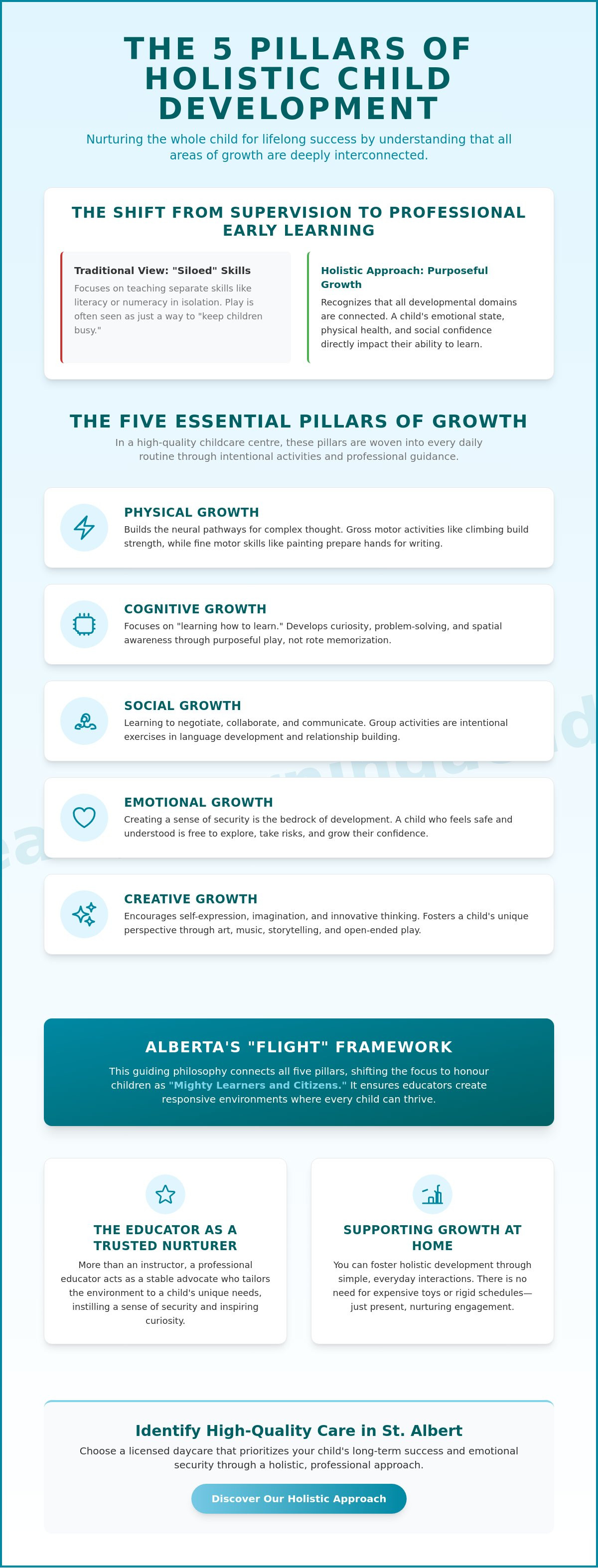
Effective holistic early childhood development relies on five core pillars: physical, cognitive, social, emotional, and creative growth. While traditional methods might prioritize one area over the others, a balanced approach ensures that no single domain is neglected. In a high-quality St. Albert childcare centre, these pillars are woven into the daily routine through intentional activities and professional guidance. This ensures that children are not just hitting isolated targets but are growing into well-rounded individuals who are ready for the complexities of the world.
These pillars are deeply symbiotic. For example, a child engaged in a group building project is simultaneously refining their fine motor skills (physical), solving structural problems (cognitive), and learning to negotiate with peers (social). This interconnectedness is a central theme within Alberta's Flight Framework, which guides educators in creating environments where these domains flourish together. By treating each pillar with equal importance, we provide children with the stable foundation they need for long-term success.
Physical and Cognitive Foundations
Physical development in the early years goes beyond simple exercise; it's the process of building the neural pathways required for complex thought. Gross motor activities like climbing or running build strength and coordination, while fine motor tasks such as painting or using child-safe scissors prepare the hands for writing. Cognitive growth, meanwhile, is focused on "learning how to learn." Instead of rote memorization, children explore early math and science concepts through sensory play. Measuring water in a sand table or sorting natural objects by colour helps children realize the logic of the world around them in a tangible, memorable way.
Social-Emotional and Creative Expression
Emotional safety serves as the fuel for intellectual curiosity. When a child feels secure, they are more willing to take the risks necessary for creative problem-solving. Social-emotional learning focuses on self-regulation and empathy, helping children understand their own feelings while respecting the boundaries of others. Creative expression is not limited to "art time" but is used as a vital tool for communication. Whether through music, storytelling, or dramatic play, children learn to express ideas that they might not yet have the vocabulary to say out loud. This builds the confidence needed to form healthy relationships and navigate social environments with ease.
In our community, we also recognize that holistic growth includes a child's sense of belonging within their culture and neighbourhood. A truly quality childcare environment fosters these connections, ensuring that every child feels like a valued member of a larger community. This sense of identity provides the final piece of the developmental puzzle, giving children the roots they need to grow with confidence.
Understanding the Alberta "Flight" Framework
In the province of Alberta, the gold standard for early education isn't found in a rigid textbook, but in a professional philosophy known as Flight: Alberta's Early Learning and Care Framework. This framework provides the essential roadmap for licensed daycare St. Albert providers to deliver high-quality, responsive care. It moves away from outdated models that view children as passive recipients of information. Instead, it embraces the concept of "Children as Mighty Learners." This means educators recognize that even the youngest children are capable, curious, and full of potential. By following this provincial guide, local centres ensure that holistic early childhood development is a daily reality rather than just a theoretical concept.
A key component of this framework is the co-construction of knowledge. In this model, educators don't simply "tell" children facts. They work alongside them, observing their interests and asking open-ended questions that spark deeper investigation. This collaborative approach creates a dynamic learning environment where children feel their voices are heard and their ideas are valued. It transforms the childcare experience into a shared journey of discovery, where the educator acts as a knowledgeable advocate for the child's natural curiosity.
The Role of Play-Based Learning
Play-based learning is often misunderstood as unstructured time, but within the Flight framework, it's a rigorous and intentional educational strategy. Professional educators use play to reach specific developmental goals through a process called "scaffolding." This involves providing the right amount of support to help a child move from what they can do now to what they can achieve with a little bit of guidance. Unlike passive screen time or rigid worksheets that limit a child's focus, active play engages the whole body and mind. It encourages children to experiment, fail, and try again, which is essential for building the cognitive resilience needed for future academic success.
A Focus on Local Community and Belonging
The Flight framework also emphasizes the importance of a child's connection to their local St. Albert environment. It encourages educators to use local landmarks, parks, and community stories to ground a child's learning in their own reality. This fosters a deep sense of belonging and identity. Rather than worrying about specific subject mastery, such as memorizing lists, the focus is on developing a "disposition to learn." This means nurturing the curiosity, persistence, and confidence that will serve them throughout their lives. Diversity and inclusion are also woven into these holistic Alberta programmes, ensuring that every child, regardless of their background, feels represented and respected in their early learning community.
How to Support Holistic Development at Home
Supporting your child's growth doesn't require a background in education or a room full of expensive gadgets. At its heart, holistic early childhood development is about how you engage with your child during the quiet, ordinary moments of the day. You can mirror the professional care found in a high-quality centre by adopting the role of a "Trusted Nurturer" at home. This means being a stable, responsive presence who views every interaction as a chance for connection and discovery. Whether you're sorting laundry or walking through your neighbourhood, you're helping your child make sense of their world.
Everyday errands are excellent opportunities for integrated learning. A simple trip to the grocery store can become a lesson in math as you count apples, or a language exercise as you describe the colours and textures of different vegetables. These moments don't feel like "lessons" to a child; they feel like meaningful participation in family life. By involving them in these routines, you're nurturing their sense of belonging and confidence, which are critical components of the Alberta Flight framework discussed earlier. This approach ensures that learning is a continuous, natural process rather than something that only happens in a classroom.
Creating a Nurturing Environment
Your home environment should be a safe harbour that encourages independent exploration. You don't need a vast play area; instead, focus on organizing a small space where your child can easily reach their materials. Using "open-ended" toys is a professional strategy that yields significant results. Items like wooden blocks, colourful silks, or natural materials like pinecones and stones don't have a single "correct" way to be used. This allows your child to lead the play, which builds creativity and problem-solving skills. Consistency is also vital. Predictable routines for meals and bedtime provide the emotional stability children need to feel secure enough to take cognitive risks during the day.
Five Simple Daily Activities for Whole-Child Growth
- Outdoor Exploration: Visit local St. Albert parks or the Red Willow Trail system to build physical strength and sensory awareness through nature.
- Shared Reading: Dedicate time each day to read together, which fosters language development, empathy, and the ability to focus on a single task.
- Cooking Together: Involve your child in simple kitchen tasks to practice early math through measuring and fine motor skills through stirring or pouring.
- Nature Scavenger Hunts: Look for specific colours or shapes in your backyard to sharpen observational skills and curiosity.
Providing children with ample unstructured time is vital for developing their natural creativity and self-reliance.
If you're looking for a partner to support these values throughout the week, we invite you to learn more about our quality childcare programmes. Our team is dedicated to extending the same nurturing environment you provide at home into our professional learning spaces.
The Trinity Approach: Holistic Excellence in St. Albert
At Trinity Early Learning & OSC, we believe that holistic early childhood development is the most effective way to honour a child's natural potential. Our programme is built on a commitment to nurturing the mind, body, and spirit within a professional and supportive environment. We intentionally design our space to stimulate the five pillars of growth, ensuring that every room and activity serves a developmental purpose. By integrating these principles into our daily routines, we provide a sense of stability and joy for the children in our care.
Our educators act as Knowledgeable Advocates for your child. They are trained to observe and respond to individual needs, ensuring that the Alberta Flight framework is not just a document on a shelf but a living part of our curriculum. This professional oversight allows us to co-construct learning experiences that are both challenging and emotionally secure. When educators and children work together, the result is an environment where curiosity is celebrated and milestones are met with confidence.
A Community-Focused Learning Centre
Our St. Albert facility is designed to feel like a warm, safe extension of your home. We understand the logistical needs of modern families, which is why we bridge the gap between early preschool learning and out-of-school care. This continuity of care provides children with a familiar environment as they grow, reducing the stress of transitions between different programmes. As a provider of Affordability Grant Daycare, we are proud to offer high-quality holistic care that remains accessible to families in our community. This provincial funding allows us to maintain high standards of safety and educational stimulation while supporting the practical needs of parents in St. Albert.
Partnering with Families for Success
We view parents as essential partners in the learning journey. Transparent communication is the foundation of this relationship, as it ensures that the support your child receives at home is mirrored in our professional childcare setting. We know that choosing a centre is a significant decision for any family. We invite you to see our philosophy in action and experience the calming, methodical rhythm of our daily activities. Seeing the environment firsthand is the best way to understand how we nurture every aspect of your child's well-being and long-term success.
Contact Trinity Early Learning today to join our community.
Building a Bright Future for Your Child in St. Albert
Choosing the right environment for your child's early years is a significant step toward their long-term success. By prioritizing holistic early childhood development, you ensure that their emotional, social, and physical needs receive the same professional attention as their cognitive growth. We've explored how the Alberta Flight framework provides a roadmap for this balanced care and how simple daily routines at home can reinforce these essential pillars of growth.
As a licensed childcare provider and participant in the Alberta Affordability Grant, Trinity Early Learning & OSC is committed to making high-quality care accessible to our local community. Our professional educators are specifically trained in the Flight framework to act as stable advocates for your child's unique journey. We invite you to book a tour of our St. Albert centre to see holistic learning in action. Together, we can create a nurturing foundation where your child feels secure, valued, and ready to explore the world with confidence.
Frequently Asked Questions
Is holistic early childhood development the same as Montessori or Waldorf?
Holistic early childhood development is a broad educational philosophy rather than a single trademarked method like Montessori or Waldorf. While all three prioritize the child's environment, holistic care in Alberta specifically aligns with provincial standards like the Flight framework to ensure a balanced growth of all developmental domains. It focuses on the child's connection to their community and their identity as a mighty learner.
How does holistic care prepare my child for kindergarten in Alberta?
Holistic care prepares your child for kindergarten by focusing on the soft skills that are essential for classroom success. By building self-regulation, empathy, and problem-solving abilities, children become more resilient and capable of handling the social and academic demands of a school environment. This foundation ensures they don't just memorize facts but actually understand how to learn and collaborate with others.
Does play-based learning mean my child won’t learn to read or write?
Play-based learning incorporates literacy and numeracy in meaningful ways that often exceed the results of traditional worksheets. When children write a grocery list during dramatic play or measure sand in a bucket, they are practicing the exact same skills required for reading and math. This intentional scaffolding ensures that academic concepts are mastered through active engagement rather than passive memorization.
How do educators track progress in a holistic daycare programme?
Educators track progress through a professional process called pedagogical documentation. Instead of simple checklists, providers in a holistic early childhood development programme use observations, photos, and written reflections to capture how a child is growing. This method provides a detailed, qualitative view of your child's milestones across all five pillars of growth, allowing for a more personalized approach to their care.
What should I look for in a daycare to ensure they use a holistic approach?
Look for a centre that prioritizes open-ended play materials and displays evidence of the Flight framework in their daily planning. You should see educators who act as partners in play rather than just supervisors. A high-quality holistic environment will also have a clear focus on the social-emotional well-being of the children, ensuring they feel safe and valued as individuals.
Is the Alberta Flight framework mandatory for all licensed daycares?
The Flight framework is the recognized provincial standard for early learning and care in Alberta. While it provides the curriculum roadmap for licensed programmes, it's designed to be flexible so that each centre can adapt it to their specific community. Choosing a daycare that actively uses this framework ensures that your child is receiving care that meets the highest professional standards in the province.
How can I tell if my child is benefiting from a holistic learning environment?
You can tell your child is benefiting when you see an increase in their confidence, curiosity, and ability to handle social challenges. Children in holistic environments often demonstrate better self-regulation and a genuine joy for learning. They will likely share stories about their discoveries and show a deeper sense of belonging within their group of peers and the local St. Albert community.
Can holistic development be supported if my child only attends out-of-school care?
Holistic development is absolutely supported within high-quality out-of-school care programmes. Even after the school day ends, children continue to grow socially and emotionally through collaborative projects and physical activities. A professional provider ensures that the transition from the classroom to care is seamless, maintaining a stable and nurturing environment that continues to respect the child's need for creative and social expression.


