
Many parents assume that social skills are simply "caught" by being around other children, but the truth is that meaningful social development requires intentional, educator-guided interaction. You might worry if your little one is too shy to speak up or perhaps a bit too assertive during a shared activity. It's natural to feel anxious about whether they're truly ready for the social demands of a kindergarten classroom. You want to know that your child isn't just being supervised, but is actively learning how to build relationships and manage their emotions.
This guide will show you how social skills development in daycare is a structured process that transforms "just playing" into vital social-emotional milestones. We'll explore the specific developmental goals within the Alberta Flight framework and explain how a licensed environment in St. Albert provides the stability your child needs. You'll gain a clear understanding of what these milestones look like and discover practical ways to support this growth at home. By the end, you'll feel confident that your child is building the foundation for lifelong success in a nurturing, community-focused setting.
Key Takeaways
- Learn how the first five years create a unique window of opportunity for your child to develop essential social-emotional foundations.
- Understand why social skills development in daycare is more effective when supported by intentional environmental design and mixed-age peer interactions.
- Identify key social milestones, such as delayed gratification and empathy, that help children navigate complex peer relationships.
- Discover the difference between simple supervision and the "Trusted Nurturer" approach, where educators actively coach children through social challenges.
- Realize how a licensed St. Albert centre provides the structured, community-based support necessary to ensure your child is socially prepared for kindergarten.
What is Social Skills Development in Early Childhood?
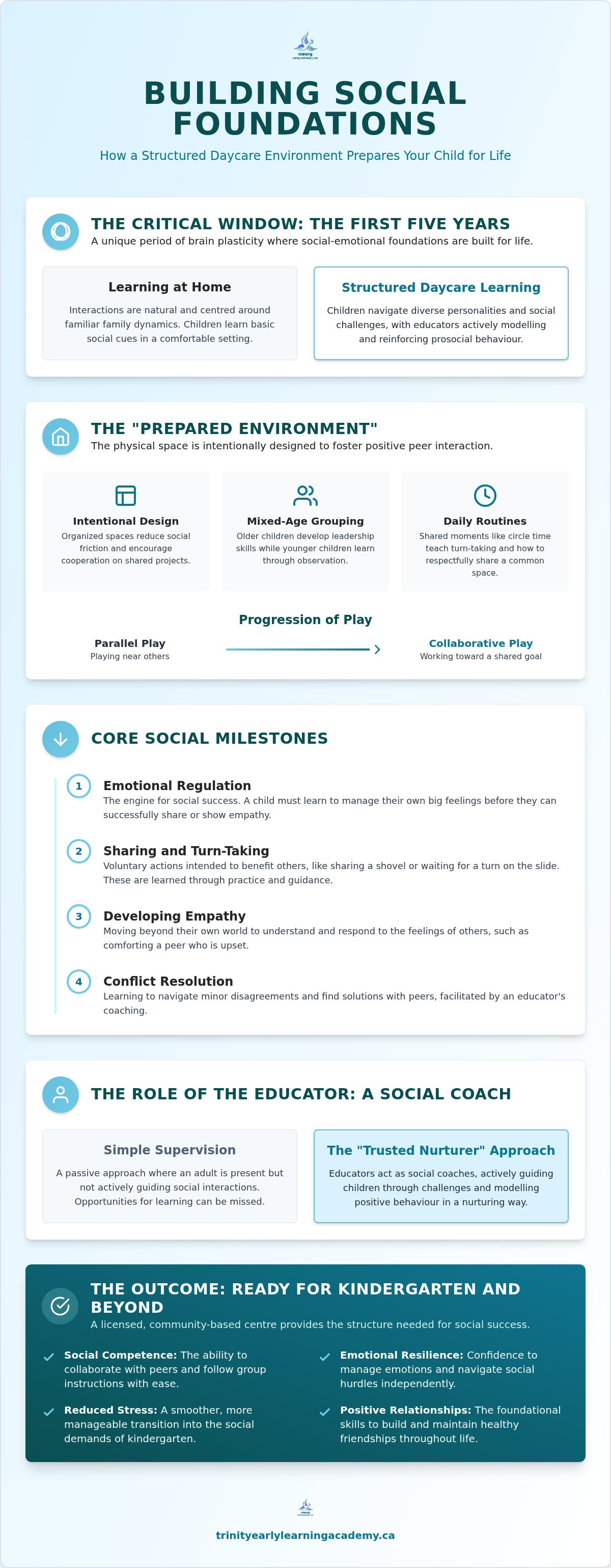
Social-emotional learning, often called SEL, is the foundation of a child's ability to understand their own feelings and interact effectively with others. It's about more than just being "polite." It involves the complex process of managing internal emotions and establishing positive, lasting relationships. During the first five years of life, the brain is exceptionally plastic. This creates a critical window of opportunity for social brain development. This period aligns closely with Erikson's stages of psychosocial development, where children first learn to navigate trust, autonomy, and initiative.
While children learn basic social cues at home, social skills development in daycare introduces a structured environment. At home, interactions are often "natural" and centered around familiar family dynamics. In a licensed daycare centre, children must navigate a wide variety of personalities and social hurdles. We focus heavily on encouraging prosocial behaviour. These are voluntary actions, such as sharing a shovel in the sandbox or comforting a peer who is upset, that are intended to benefit others. In a professional setting, these behaviours are modelled and reinforced by experienced educators who understand the nuances of early development.
Why St. Albert Parents Prioritize Social Learning
Families in our community are increasingly focused on early childhood education in St. Albert that looks beyond simple academics. Many local parents have noticed a "social gap" in children who had limited peer exposure in recent years. These children may find it harder to join a group or resolve minor disagreements. Developing social competence early is vital because it directly predicts success within the Alberta school system. Children who can collaborate with peers and follow group instructions often find the transition to kindergarten much more manageable and less stressful.
The Link Between Emotional Regulation and Social Success
You can't expect a child to share a favourite toy if they don't yet know how to manage the frustration of waiting. Emotional regulation is the ability to monitor and manage internal states, like anger, sadness, or even over-excitement. It's the engine that drives social success. A child must be able to regulate their own big feelings before they can successfully engage in prosocial acts. Daycare acts as a safe "lab" for these emotional experiments. Within this controlled environment, children can test out different responses and receive immediate, nurturing guidance from educators when they feel overwhelmed. This practice helps them build the resilience needed for lifelong social health.
How Daycare Environments Foster Peer Interaction
The physical space of a daycare is never accidental; it is what we call a "Prepared Environment." Every corner and shelf is intentionally organized to reduce social friction while encouraging cooperation among children. For example, a block corner that is too cramped can lead to accidental collisions and frustration. A well-designed centre provides enough space for children to work together comfortably on a shared project. This intentionality is a cornerstone of social skills development in daycare, as it allows children to practice setting personal boundaries and respecting the space of others in a supervised setting. When the environment is predictable and calm, children feel safe enough to take the social risks necessary for growth.
Mixed-age grouping in licensed settings creates a natural "mentorship" dynamic that you won't often find in traditional school classrooms. Older children develop leadership skills and patience by helping their younger peers, while younger children learn complex social cues through observation. Daily routines, such as circle time and shared mealtimes, further reinforce these social expectations. These moments teach children how to wait for their turn to speak and how to share a common space respectfully. This progression is vital as children move from parallel play, where they play near each other, to true collaborative play, where they work toward a shared goal. Understanding these Social Emotional Development Milestones helps parents see the purpose behind every activity in the daycare day.
The Power of Play-Based Social Learning
In Alberta, we adhere to rigorous standards for play-based learning preschool Alberta parents value. There's a vital difference between "free play" and "scaffolded play." In scaffolded play, an educator acts as a coach, helping children navigate social hurdles or expand their play themes. Dramatic play, like "playing house" or dressing up, is especially powerful. It encourages children to step into another person's shoes, building the empathy and perspective-taking needed for successful social skills development in daycare.
Developing Communication Skills in a Group Setting
A group setting provides a rich environment for learning non-verbal cues. Children learn to read body language and facial expressions through direct peer feedback and educator guidance. During story time, they practice active listening, which builds focus and respect for others. Educators play a key role by prompting children to "use their words" to express needs instead of acting physically. This transition to verbal expression is a significant milestone in social maturity. If you're exploring options for your child, visiting a licensed childcare centre can help you see these social lessons in practice.
Core Social Milestones: From Sharing to Conflict Resolution
Success in social skills development in daycare is marked by specific, observable milestones that build upon one another. These stages often begin with turn-taking. This is a child's first real encounter with delayed gratification. It's a significant cognitive leap for a toddler to understand that "not now" doesn't mean "never." Learning to wait for a specific toy helps children develop the self-control they'll need for more complex group dynamics later on.
As children grow, they begin to develop empathy. This milestone involves recognizing and responding to a peer's distress. You might see this when a child stops playing to bring a comfort object to a friend who has fallen. From there, children move into cooperative problem-solving. This usually happens during complex building or art projects where they must align their goals to succeed. The final, most advanced milestone is independent conflict resolution. This is the stage where children learn to negotiate and find middle-ground solutions without needing an adult to intervene. These skills aren't just for the playground; they are the building blocks of emotional intelligence.
The 'Art of Sharing' and Beyond
Sharing is a complex cognitive task. It requires what psychologists call "theory of mind." This is the realization that other people have different thoughts and desires than you do. Educators in licensed settings don't just force children to give up toys. Instead, they use "timed turns" to make the process feel fair and safe. This structured approach reduces anxiety and helps children feel secure in their environment. Over time, positive reinforcement helps children move from forced sharing to genuine, generous interaction. They start to realize that playing together is much more rewarding than playing alone.
Kindergarten Readiness: Social Milestones for St. Albert Schools
For families in our community, these social milestones are the true indicators of kindergarten readiness. Both the St. Albert Public and Catholic school divisions look for specific social competencies in new students. These include the ability to follow multi-step group instructions and the confidence to practice self-advocacy when they need help. High-quality preschool programs in St. Albert focus on these specific skills to bridge the gap between daycare and Grade 1. This ensures your child enters the classroom with the social tools they need to thrive in a more formal academic setting.
The Role of Professional Educators as Social Coaches
In a high-quality childcare setting, educators do much more than just supervise play; they actively facilitate social growth. While supervision ensures basic safety, facilitation involves recognizing "teachable moments" during daily peer interactions. This active coaching is central to social skills development in daycare. Our "Trusted Nurturer" philosophy provides children with a secure base. When a child feels safe and understood by their educator, they are more willing to take social risks, such as joining a new group or expressing a difficult emotion. This secure relationship is the foundation upon which all other social learning is built.
Educators also serve as constant models for respectful behaviour. Every interaction between staff members, or between an educator and a child, demonstrates how to listen and respond with kindness. When social mistakes happen, we prioritize positive redirection over punishment. For example, if a child grabs a toy, an educator might say, "It looks like you really want to play with that truck. Let's ask your friend when they'll be finished," instead of simply scolding the child. This approach guides the child toward a productive social script rather than just stopping a "bad" behaviour. It teaches them what to do next time, which is a vital part of social skills development in daycare.
Conflict Resolution Coaching Techniques
One effective technique used by professional educators is "Sportscasting." This involves describing the situation objectively without taking sides. An educator might say, "I see two hands on one shovel, and both of you want to dig in the sand." This helps children pause and process the conflict without feeling blamed. We then guide them to find their own solutions by asking, "What can we do so you both can dig?" This empowers children to resolve issues independently over time. When big emotions like anger or exclusion arise, educators stay close to provide a calming presence, helping children regulate their feelings before they attempt to solve the problem.
Supporting the Shy or Introverted Child
Social success looks different for every child, and it doesn't always mean being the loudest person in the room. For shy or introverted children, educators use "gentle entry" techniques. This might involve sitting near the child and narrating what others are doing, or inviting them to help with a small task near the group play. We value "observational learning" as a valid stage of development. A child who watches others is often absorbing social cues and preparing themselves to join in when they feel ready. If you want to see how our educators support every personality type, we invite you to learn more about our licensed daycare services in St. Albert.
Nurturing Connections at Trinity Early Learning & OSC
As a licensed daycare in St. Albert, we create a space where children feel safe to explore their social identities. Our family-run centre prioritizes a "family-feel" environment where every child is known and valued. Our commitment to the Alberta Flight framework ensures that we focus on holistic child development rather than just basic supervision. This curriculum encourages educators to see children as "mighty learners" who are capable of complex social interactions. In our small, community-focused setting, children form deep social bonds that provide a sense of security. This intimacy is vital for social skills development in daycare, as it allows for consistent peer groups and personalized support from our experienced educators.
We believe that a child's social world should feel stable and predictable. By maintaining smaller group sizes, we're able to act as "Trusted Nurturers" who guide children through the nuances of friendship and cooperation. This setting allows children to practice the social-emotional milestones we've discussed, such as empathy and conflict resolution, within a supportive community. We invite St. Albert families to tour our facility to see these social learning moments happen in real-time. Seeing our educators in action helps parents realize the difference that a professional, nurturing environment makes for a child's confidence.
Community-Based Learning in St. Albert
We believe that learning shouldn't be confined to four walls. Our educators lead local neighbourhood walks that use St. Albert's parks and public spaces to expand a child's social horizons. These experiences help build a sense of "belonging," which is a core pillar of the Alberta early learning curriculum. When children interact with their community, they realize they're part of something larger than themselves. We also prioritize collaborating with parents as partners in development. By sharing insights and strategies, we ensure that the social growth your child achieves at our centre continues at home. This partnership creates a bridge between the daycare environment and family life, providing the consistency children need to thrive.
Affordable, High-Quality Care for Your Child's Future
Providing your child with a strong social-emotional foundation is one of the best investments you can make for their future success. The long-term ROI of this investment is seen in increased confidence, better peer relationships, and improved academic outcomes in the Alberta school system. To help families access these benefits, we utilize the Daycare Affordability Grant Alberta program. This ensures that high-quality social skills development in daycare remains accessible to our local community. We encourage you to reach out to discuss our current enrollment options or to join our waitlist for the upcoming season.
Preparing Your Child for a Bright Social Future
The early years are more than just a precursor to school; they're the time when the blueprint for your child's social life is drawn. By choosing a setting that prioritizes social skills development in daycare, you're giving your little one the tools to navigate friendships, manage big feelings, and approach new challenges with confidence. We've seen how intentional room layouts, mixed-age play, and expert coaching from "Trusted Nurturers" turn everyday moments into significant developmental wins. These experiences ensure your child is not only ready for kindergarten but also equipped for lifelong success.
As a licensed and accredited Alberta facility, Trinity Early Learning & OSC is proud to be a St. Albert family-owned and operated centre. We're committed to making this high-quality care accessible by accepting provincial affordability grants. We invite you to see our nurturing environment first-hand and meet the educators dedicated to your child's holistic growth. Book a Tour at Trinity Early Learning & OSC to See Our Social Learning Environment. We look forward to welcoming your family into our community and supporting your child's journey toward a successful, socially connected future.
Frequently Asked Questions
Is it better for my child to learn social skills in daycare or at home?
Both environments play a vital role in your child's growth. While home provides the essential security of family bonds, daycare offers a unique, structured setting for interacting with peers of various ages. In a licensed centre, children must navigate diverse personalities and group dynamics that aren't always present in a family unit. This helps them develop the resilience and adaptability needed for broader social success outside the home.
What if my child is naturally shy? Will daycare be too overwhelming?
Daycare is often the best place for a shy child to build confidence at their own pace. Educators use "gentle entry" techniques to help introverted children join group play without feeling pressured. We value observational learning as a legitimate stage of development. By watching peers in a safe, supervised space, shy children slowly build the comfort level they need to participate, ensuring they never feel overwhelmed.
How do daycare educators handle biting or hitting during social conflicts?
Educators view these incidents as "teachable moments" rather than opportunities for punishment. We use positive redirection and "sportscasting" to help children understand the situation. For instance, an educator might say, "I see you're frustrated because you want that toy, but hitting hurts. Let's use our words to ask for a turn." This approach focuses on teaching the child appropriate social scripts and emotional regulation rather than using fear.
At what age do children start actually playing 'with' each other instead of just 'near' each other?
Most children begin the transition from parallel play to true collaborative play between the ages of three and four. Before this, toddlers typically play near each other without direct interaction. In a daycare setting, this shift is supported by group activities and shared projects. Social skills development in daycare is specifically designed to facilitate this move toward cooperative play, helping children learn how to negotiate roles and work together.
Can daycare help my child prepare for the social structure of a St. Albert kindergarten class?
Daycare directly prepares children for the social expectations of St. Albert Public and Catholic school divisions. By participating in routines like circle time and following multi-step group instructions, children learn the classroom "etiquette" required for Grade 1. They develop the self-advocacy and independence needed to navigate a larger school environment. This bridge ensures that the transition to a formal academic setting is a positive and successful experience.
How can I reinforce the social skills my child learns at daycare when we are at home?
You can reinforce these skills by using similar language and coaching techniques at home. Practice "sportscasting" during sibling play or playdates by describing what is happening without taking sides. Encourage your child to "use their words" to express feelings and model respectful interactions in your own daily life. Consistency between the daycare environment and home helps solidify social habits and makes these new skills feel more natural for your child.
Will my child pick up 'bad' social habits from other children in a group setting?
While children may occasionally mimic less desirable behaviours from peers, a licensed environment provides the perfect setting to address these moments. Educators are trained to redirect these habits immediately by explaining why certain actions aren't helpful for the group. This exposure actually helps children learn to distinguish between positive and negative social cues. It gives them the opportunity to practice making good choices in a safe environment.
How does the Alberta Flight curriculum specifically address social development?
The Alberta Flight framework views children as capable "mighty learners" and emphasizes a sense of belonging as a core pillar. It focuses on holistic development, where social skills development in daycare is integrated into every activity. The curriculum encourages educators to support children in building relationships, exploring their identities, and becoming active citizens within their small community. This structured approach ensures that social-emotional milestones are prioritized alongside physical and cognitive growth.


