

Imagine walking into a daycare centre and seeing a single educator trying to comfort three crying infants while two toddlers begin to climb a bookshelf. This is the exact scenario many parents fear when they consider group childcare. You want to be certain that your child isn't just a number in a crowded room. It's completely natural to feel anxious about whether your little one will receive the individual attention they need to thrive or if they'll simply be "babysat" throughout the day.
Understanding the importance of staff-to-child ratio in daycare is the first step toward finding peace of mind. These ratios aren't just administrative rules; they are the foundation of your child's safety and emotional development. In this 2026 guide, you'll discover how Alberta licensing standards protect your child's well-being and directly impact their learning outcomes. We will break down the current 1:3 and 1:4 ratios for infants, explain why smaller groups foster better social skills, and provide you with clear criteria to evaluate any facility during a tour.
Key Takeaways
- Learn how active supervision and rapid emergency response are directly maintained through mandated educator-to-child limits.
- Understand the importance of staff-to-child ratio in daycare and its direct impact on your child's language development and social-emotional growth.
- Gain a clear understanding of the 2026 Alberta licensing standards for different age groups, from infants to preschoolers.
- Discover how individualized attention from qualified educators transforms a standard childcare setting into a rich early learning environment.
- Identify the specific questions to ask during a tour to ensure a St. Albert daycare centre prioritizes your child’s safety and holistic well-being.
Understanding Staff-to-Child Ratios in Early Learning Environments
A staff-to-child ratio is the specific number of children assigned to one qualified educator within a classroom. While it might look like a simple administrative figure on a licensing certificate, it's actually the most critical indicator of how well your child's physical and emotional needs will be met. When you are Understanding Staff-to-Child Ratios, you realize they are the foundation of a safe, licensed daycare environment. These standards ensure that when a toddler scrapes a knee or an infant needs a bottle, an adult is immediately available to help without leaving other children unsupervised.
The importance of staff-to-child ratio in daycare cannot be overstated because it determines the quality of the learning that actually happens. In a room with too many children, educators spend their entire shift reacting to chaos. In a room with an optimal ratio, they proactively guide development. Lower ratios are always better for individualized learning because they allow teachers to notice the subtle cues that signal a child is ready for a new challenge. It's the difference between a child being part of a crowd and a child being truly seen by their caregiver.
Why Ratios Exist: Safety vs. Education
There is a vast difference between basic supervision and active engagement. Basic supervision simply ensures children are physically safe. Active engagement, however, means the educator is down on the floor, asking questions, and encouraging curiosity. When ratios are kept low, educators can anticipate and prevent accidents before they happen. This environment also prevents educator burnout. A teacher who isn't overwhelmed remains patient, nurturing, and emotionally available for your child. These high standards are a primary hallmark of quality licensed daycare services.
The Role of the Early Childhood Educator
A teacher's role transforms when they have fewer children to manage. Instead of acting as a manager of a large group, they become a "Trusted Nurturer." With a smaller group, they have the time to organize structured play-based learning that caters to each child's specific interests. If one child is fascinated by blocks while another wants to paint, a well-staffed room allows the educator to support both activities simultaneously. This level of attention ensures your child feels seen, heard, and valued every day. It builds the stable emotional foundation necessary for all future academic success.
The Critical Link Between Low Ratios and Enhanced Child Safety
Safety is the silent priority of every parent. When we discuss the importance of staff-to-child ratio in daycare, we are really talking about the margin of safety provided to your child during their most vulnerable years. Research from organizations like ZERO TO THREE emphasizes that low ratios and enhanced child safety go hand-in-hand, providing educators with the professional bandwidth to maintain active supervision. This means educators aren't just reacting to accidents; they are actively anticipating them. They can spot a potential trip hazard or a toy conflict before it escalates, creating a stable environment where children feel secure.
The importance of staff-to-child ratio in daycare also extends to emergency response. In a well-staffed room, if one child requires immediate first aid or a quiet moment of emotional support, another qualified adult is present to maintain order and calm for the rest of the group. This prevents the "chaos effect" that often occurs in overcrowded settings. Beyond physical safety, low ratios protect a child's emotional well-being by reducing the overwhelming noise and stress that large groups can generate. This is especially vital for sensitive children who need a calmer atmosphere to feel at ease.
Supervision During Transitions
Transitions are high-risk times in any childcare setting. Moving from the quiet of a classroom to the high energy of an outdoor playground requires meticulous coordination. Proper staffing levels ensure that no child is left behind or unmonitored during these shifts. This vigilance is equally critical during OSC program activities, where older children may be moving between different learning zones or preparing for outdoor play. When educators have fewer children to track, they can maintain a constant, reassuring presence.
Health Standards and Monitoring
Hygiene and health protocols are significantly easier to manage when ratios are respected. Educators have the time to ensure proper hand-washing and sanitization routines are followed consistently, which reduces the spread of seasonal illnesses. Teachers with fewer children to supervise are also more likely to notice a flushed cheek or a subtle change in a child's temperament that might signal the onset of a fever. They also have the necessary time to record milestones and safety incidents accurately. Strict adherence to ratios ensures every item on a daycare safety checklist is verified throughout the day. If you're looking for a centre that prioritizes these safety measures, consider visiting our St. Albert facility to see our educators in action.
How Individualized Attention Drives Cognitive and Social Development
While physical safety is a primary concern for many families, the importance of staff-to-child ratio in daycare is equally evident in a child's cognitive progress. When educators have fewer children to supervise, they can engage in more frequent one-on-one conversations. These interactions are the fuel for language acquisition. Instead of just hearing group instructions, children in well-staffed rooms hear rich, descriptive language that expands their vocabulary and comprehension. It's the difference between being part of a group and being a participant in a meaningful dialogue.
This individualized attention also supports vital social-emotional learning. Navigating conflict is a complex skill for a young child. Whether it's learning to share a favourite truck or waiting for a turn on the slide, children need adult guidance to process their big emotions. Educators in low-ratio environments can step in as "Knowledgeable Advocates" to model empathy and problem-solving in real time. This creates a tailored curriculum where the daily life of the classroom becomes a lesson in kindness. These consistent, positive interactions help build secure attachments, which are the essential foundation of confidence in early childhood education.
The Power of "Serve and Return" Interactions
"Serve and return" describes the essential back-and-forth interaction between a child and their caregiver. When a child babbles, gestures, or cries (the "serve") and the educator responds with eye contact, touch, or words (the "return"), vital neural connections are formed in the brain. High ratios often interrupt these critical brain-building moments because an educator's attention is fractured across too many needs. While Federal Child Care Standards highlight these interactions as markers of high quality, they are only possible when staffing levels allow for focus. For example, the intimate 1:4 ratio for infants in Alberta ensures constant "returns" for our youngest learners, whereas the 1:8 ratio for preschoolers reflects their growing ability to wait briefly for an adult's response.
Supporting Diverse Learning Needs
Every child arrives at the centre with a unique temperament and learning style. Some are bold explorers, while others are more observant and need a little more time to warm up to new activities. Educators with smaller groups have the bandwidth to adapt their approach to suit these different personalities. They can provide extra comfort to a child having a difficult morning or encourage independent play for a child who is ready to lead. This flexibility ensures that every child, regardless of their pace, feels supported and successful in their daily environment. The importance of staff-to-child ratio in daycare becomes most visible when you see an educator perfectly balancing the needs of a diverse group of learners.
Alberta Licensing Standards: Navigating the Legal Requirements
Alberta's Early Learning and Child Care Act provides a rigorous framework to ensure the safety and well-being of every child in a licensed facility. These regulations are not merely suggestions; they are legally mandated requirements that every centre must follow to maintain its license. Understanding the specific importance of staff-to-child ratio in daycare within the Alberta context helps parents recognize the high level of care their children receive in professional settings. These ratios are designed to change as children grow, reflecting their evolving needs for supervision and interaction.
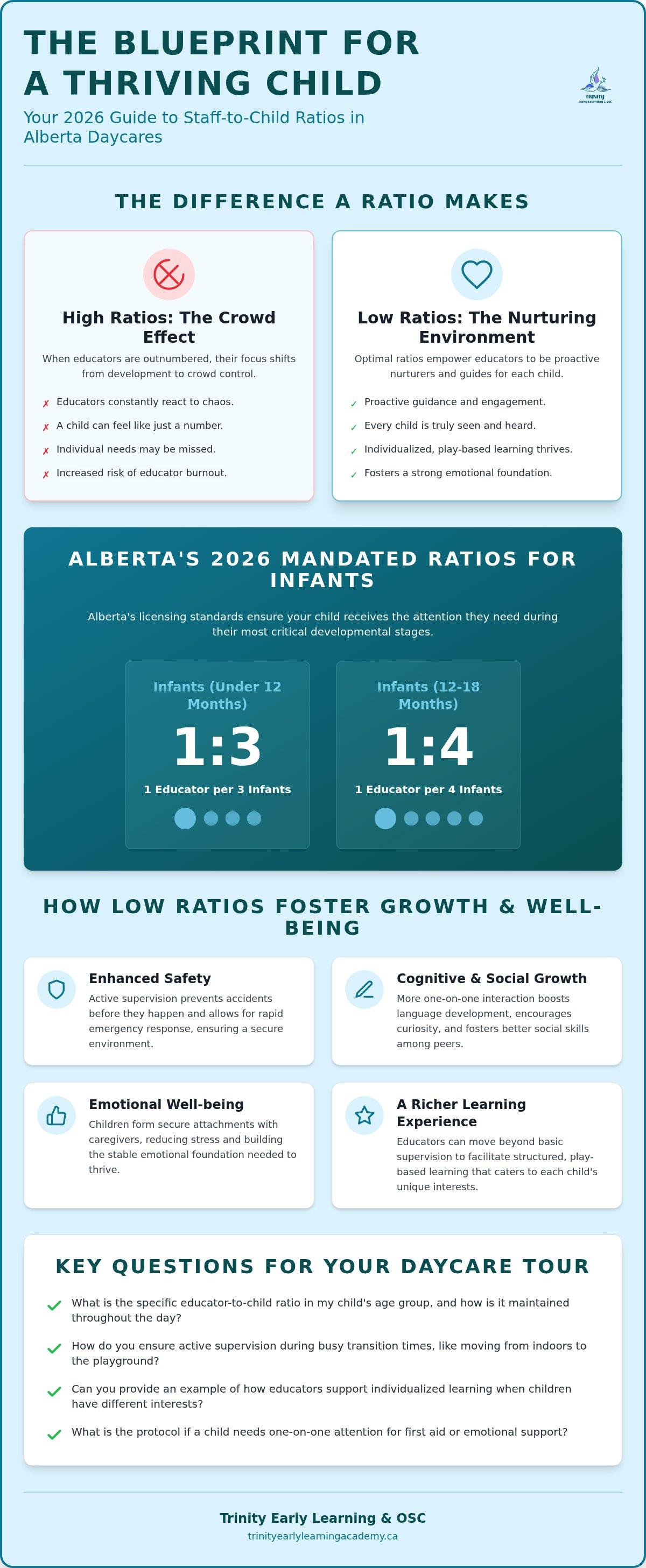
As of 2026, the mandated ratios for licensed daycare programs in Alberta are as follows:
- Infants (less than 12 months): 1 staff member for every 3 infants (1:3).
- Infants (12 months to less than 19 months): 1 staff member for every 4 infants (1:4).
- Toddlers (19 months to less than 3 years): 1 staff member for every 6 children (1:6).
- Preschoolers (3 years to less than 4 years): 1 staff member for every 8 children (1:8).
- Children 4 years and older: 1 staff member for every 10 children (1:10).
In many classrooms, you will find mixed-age groups. Alberta regulations allow for this, calculating the required ratio based on the age of the majority of children in the room. Licensed facilities are regularly inspected by government officials to ensure these standards are met without exception. Choosing a licensed centre provides you with the security of knowing that an external authority is constantly verifying the safety of your child's environment.
Licensing as a Minimum Standard
Government ratios represent the minimum legal requirement for operation, but they don't always represent the optimal environment for every child. Quality centres often strive to maintain better-than-required ratios to allow for more meaningful engagement and less stress for both children and staff. The availability of Alberta childcare grants is a vital resource in this regard. These grants help centres cover operational costs, allowing them to prioritize high-quality staffing and maintain the importance of staff-to-child ratio in daycare even during peak hours.
What to Ask During Your Daycare Tour
When you tour a potential facility, don't hesitate to ask detailed questions about their staffing practices. You should ask what their actual daily ratio is and if it ever fluctuates during early morning drop-offs or late afternoon pick-ups. Inquire about how they handle staff breaks to ensure that the required number of educators is always present in the room. Finally, confirm that the staff members are certified in Early Childhood Education (ECE), as this ensures they have the professional training to manage their assigned groups effectively. If you want to see how these standards look in practice, we invite you to book a tour at our St. Albert facility to meet our dedicated team.
Choosing Quality: Why Trinity Early Learning Prioritizes Optimal Staffing
Choosing a daycare is one of the most significant decisions you will make for your child's early years. At Trinity Early Learning & OSC, we recognize the profound importance of staff-to-child ratio in daycare and how it shapes the daily experience of every child in our care. Our licensed status isn't just a certificate on the wall; it's a guarantee that your child is learning in a safe, well-staffed room that meets or exceeds provincial standards. By prioritizing optimal staffing, we create an environment where our educators have the time to focus on holistic development. This means we don't just watch over children; we actively nurture their physical, social, and cognitive growth through intentional, play-based interactions.
Our Approach to Staffing and Support
Consistency is the heartbeat of a child's sense of security. We focus heavily on staff retention because we know that children thrive when they see the same smiling faces every day. This stability allows our educators to transition from being just caregivers to becoming "Trusted Nurturers" who truly understand your child's unique personality and learning pace. We also utilize the Alberta Affordability Grant to ensure that this high-quality care remains accessible for St. Albert families. This funding allows us to invest in our team and maintain a community-focused atmosphere where every child is known by name. It's this personalized approach that prevents our classrooms from feeling like "babysitting" and turns them into vibrant centres of early learning.
Next Steps for St. Albert Families
If you're ready to see the importance of staff-to-child ratio in daycare in action, we invite you to take the next step. Evaluating a centre is much easier when you can observe the interactions between educators and children firsthand. We encourage you to contact us today to schedule a personalized tour of our St. Albert facility. During your visit, you can observe our classrooms, ask questions about our specific ratios, and meet the dedicated team that makes our "Knowledgeable Advocate" philosophy a reality. You can also request our enrollment checklist to help you compare your options and find the perfect fit for your family's needs. We look forward to welcoming you into our community and providing the peace of mind you deserve.
Empowering Your Child’s Growth Through Quality Care
Selecting the right childcare environment is a vital step in supporting your child's early milestones. The importance of staff-to-child ratio in daycare cannot be overstated; it is the primary factor that transforms basic supervision into a rich, interactive learning experience. By ensuring educators have the capacity for active engagement, your child benefits from safer transitions and more frequent "serve and return" interactions. These moments build the foundation for language skills and emotional resilience that will serve them for a lifetime.
As a licensed provider in St. Albert, Trinity Early Learning & OSC is dedicated to maintaining high standards through our expert educators and holistic development programs. We understand that you need a partner you can trust. Book a tour today to see how Trinity Early Learning Academy prioritizes your child’s care. We are here to provide the stable, nurturing environment your family deserves and look forward to meeting you soon.
Frequently Asked Questions
What is the legal staff-to-child ratio for infants in Alberta?
The legal ratio for infants in Alberta depends on their exact age. For infants less than 12 months, the ratio is one staff member for every three children (1:3). For infants between 12 and 19 months, the requirement is one staff member for every four children (1:4). These strict standards ensure that our youngest learners receive the constant, individualized attention necessary for their safety and rapid developmental milestones.
Can a daycare exceed the legal staff-to-child ratio?
Yes, many high-quality centres choose to operate with more staff than the law requires. While provincial regulations set the minimum standard, exceeding these ratios allows for more meaningful "serve and return" interactions and reduced educator stress. At our St. Albert facility, we prioritize staffing levels that support a nurturing atmosphere. This commitment highlights the importance of staff-to-child ratio in daycare as a primary tool for enhancing a child's daily experience.
Do staff-to-child ratios include volunteers or kitchen staff?
No, only certified Early Childhood Educators who are directly supervising children count toward the legal ratio. Support staff, such as kitchen personnel, janitors, or administrative workers, are not included in these calculations. Volunteers may assist in the classroom, but they cannot be left alone with children or used to meet the mandated staffing requirements. This ensures that every child is always under the care of a trained, professional educator.
How do ratios impact the cost of daycare in St. Albert?
Maintaining lower ratios requires more qualified staff, which naturally increases operational costs. However, families in St. Albert can access the Alberta affordability grant to help offset these fees. This government support allows centres to maintain high-quality staffing levels without passing the full financial burden onto parents. It makes licensed, well-staffed childcare more accessible while ensuring that safety and developmental standards remain a top priority for local families.
What happens if a daycare is found to be out of ratio compliance?
If an inspection reveals that a centre is out of compliance, the Government of Alberta issues a non-compliance report. The facility must then take immediate corrective action to meet the required standards. Repeated or severe violations can lead to the suspension or cancellation of the daycare's license. Regular monitoring by licensing officers ensures that every facility remains accountable for the safety and well-being of the children in their care.
Are ratios different for out of school care programs in Alberta?
Yes, ratios change as children age and gain independence. For school-aged children in out of school care programs, the mandated ratio is one staff member for every 15 children (1:15). This reflects the reduced need for constant physical assistance compared to infants or toddlers. Even with these higher numbers, quality programs focus on active supervision to ensure that older children remain safe and engaged during their after-school activities.
Why are ratios lower for younger children?
Younger children require lower ratios because their physical and emotional needs are much more intensive. Infants and toddlers cannot communicate their needs verbally and require constant assistance with feeding, diapering, and mobility. Lower ratios ensure that educators can respond instantly to these needs while maintaining a safe environment. This high level of attention is also critical for the rapid brain development and secure attachment that occurs during the first three years of life.
How can I verify a daycare’s licensing and ratio history in Alberta?
You can verify any facility’s status using the Alberta Child Care Lookup tool available on the provincial government's website. This public resource allows you to view a centre's current licensing status, recent inspection results, and any history of non-compliance. Checking this information provides peace of mind and helps you understand the importance of staff-to-child ratio in daycare as it relates to the specific track record of a potential provider.


