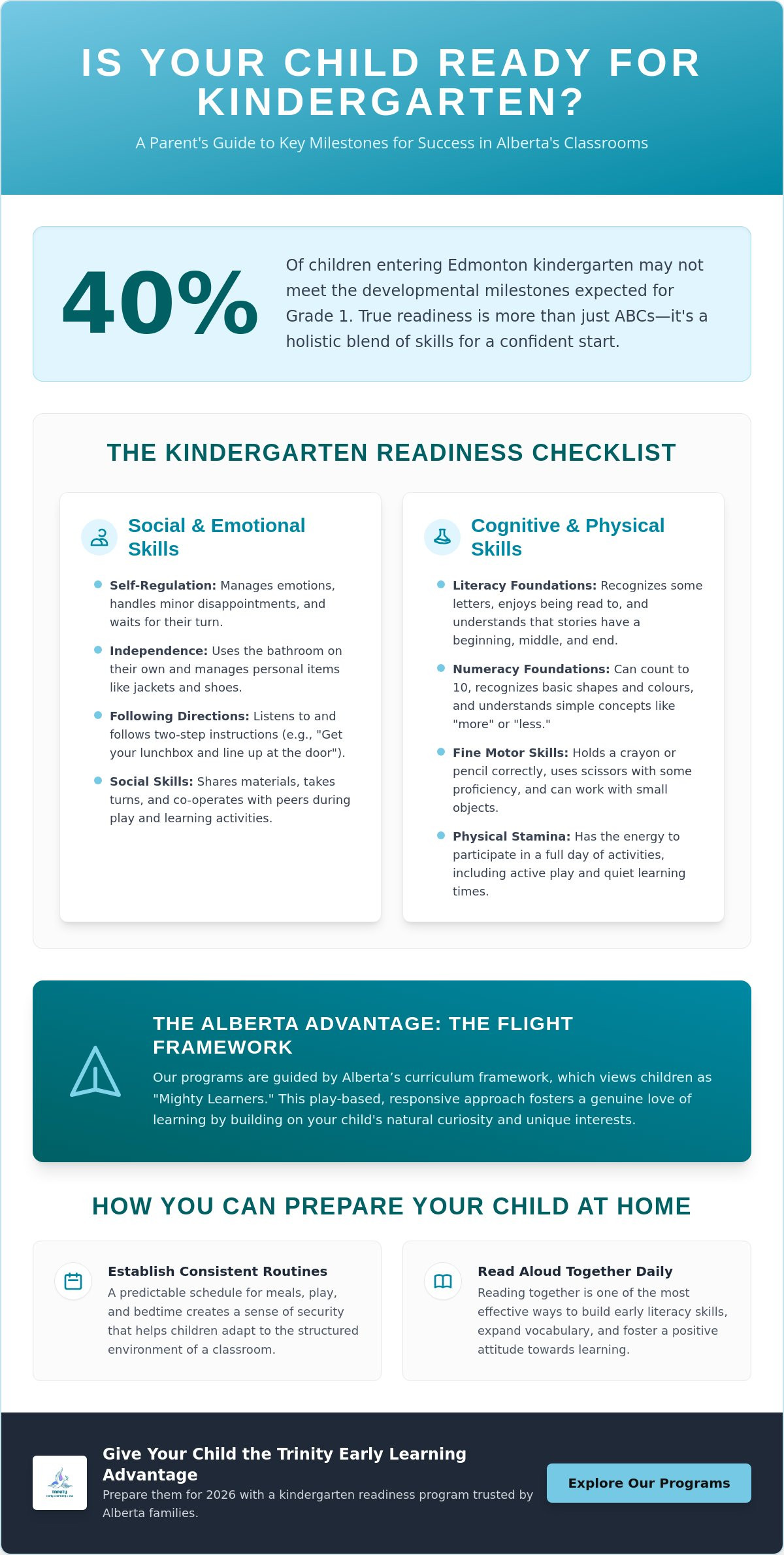
Did you know that recent reports from Edmonton Public Schools indicate only about 60% of children entering kindergarten meet the developmental milestones expected for Grade 1? This statistic can feel daunting for any parent trying to navigate the transition to formal schooling. It's completely natural to feel overwhelmed by conflicting advice or to worry that your child might be falling behind before they've even started. You want to ensure they feel confident, safe, and capable when they step into that first Alberta classroom.
We understand these concerns and are here to provide the clarity you need. This guide simplifies the transition by highlighting the exact social, emotional, and cognitive milestones your child needs for success. You'll discover a clear, actionable checklist of skills to foster at home. We also explain how a high-quality kindergarten readiness program Alberta families rely on can support this growth through structured, play-based learning. By the end of this article, you'll have a practical roadmap to help your child thrive socially and academically in 2026.
Key Takeaways
- Understand that readiness is a holistic combination of social, emotional, and physical skills that serve as a bridge to formal schooling.
- Identify essential self-regulation and independence milestones, such as managing personal belongings and bathroom routines, that foster classroom confidence.
- Learn the foundational literacy and numeracy expectations, including phonemic awareness and counting to 10, required for the Alberta curriculum.
- Discover how establishing consistent daily routines and reading aloud at home can create a stable environment for your child’s development.
- Explore how a high-quality kindergarten readiness program Alberta families trust can personalize learning through small group sizes and the Flight framework.
What is a Kindergarten Readiness Program in Alberta?
Preparing your child for school is a journey that begins long before the first bell rings. In our province, a kindergarten readiness program Alberta parents choose focuses on more than just the ability to recite the alphabet. True readiness is a holistic combination of social, emotional, and physical skills that allow a child to participate fully in a classroom community. It involves the stamina to follow a full-day schedule, the fine motor skills to use art tools, and the emotional resilience to try new things. Understanding What is Kindergarten Readiness? helps parents see that being "ready" means being equipped to learn, rather than already knowing everything the teacher will cover.
Alberta Education views the kindergarten year as a foundational bridge to Grade 1. The provincial curriculum is built around "learner expectations," which are goals designed to nurture a child’s physical, intellectual, social, and emotional development. These expectations encourage children to explore their identity, build relationships, and develop a sense of citizenship. A quality program helps children meet these milestones by creating an environment where curiosity is encouraged and safety is a top priority. This approach ensures that the transition to the K-6 curriculum feels like a natural next step rather than a jarring change.
There is a significant difference between academic readiness and developmental readiness. While academic skills like letter recognition are helpful, developmental readiness is often a better predictor of long-term success. Developmental readiness includes the ability to listen to instructions, share materials with peers, and manage personal needs independently. If a child can regulate their emotions and follow a routine, the academic pieces usually fall into place quite naturally. Our focus is on nurturing these core developmental pillars so that every child feels confident and capable as they begin their educational career.
The Role of the Alberta Flight Framework
The Flight framework is Alberta’s specialized curriculum for early childhood educators. It moves away from rigid, traditional teaching and instead focuses on the concept of the "mighty learner." This framework empowers children by treating them as active participants in their own growth. A program following this framework provides a superior foundation because it values play as a primary way of learning. It encourages educators to observe each child’s unique interests and use those interests to build essential skills. This responsive approach fosters a genuine love for learning that lasts well beyond the preschool years.
Why Early Preparation Matters for 2026
The transition to school in 2026 will be smoother for children who have experienced a structured, nurturing environment beforehand. Early preparation helps bridge the gap between the familiar comforts of home and the dynamic expectations of a school setting. Licensed childcare centres in St. Albert provide the perfect middle ground; they offer a professional, organized space that still feels like a community. By establishing familiar routines and group social dynamics now, we can help reduce "first-day jitters." This early exposure builds the confidence children need to walk into their first day of kindergarten with a smile.
The Social and Emotional Readiness Checklist
While many parents focus on academic drills, social and emotional maturity often serves as the true foundation for a successful start. In a comprehensive kindergarten readiness program Alberta educators look for specific behavioural milestones that signal a child is ready to thrive in a busy classroom environment. These skills allow children to navigate the complexities of Alberta's Early Childhood Services, where the focus is on building a strong community of learners. When a child feels secure in their ability to interact with others, they are much more likely to engage with the academic curriculum with confidence.
Specific milestones include:
- Self-Regulation: The ability to manage big emotions with minimal adult support. This includes recovering from minor disappointments or waiting patiently for a turn.
- Independence: Handling personal needs such as using the bathroom independently and managing clothing items like zippers and buttons on jackets.
- Following Directions: The capacity to listen to and follow two-step instructions in a group setting, such as "put your shoes in the cubby and come sit on the rug."
- Social Interaction: Practicing sharing, turn-taking, and showing empathy toward peers during play.
- Focus and Attention: Sustaining interest in a specific task or story for 5 to 10 minutes without becoming overly distracted.
Navigating Group Dynamics
As children grow, they move from parallel play, where they play near others, to cooperative play, where they work together toward a common goal. This shift is essential for classroom success. A structured preschool program in Alberta provides the daily opportunities needed to practice these interactions safely. You can support this at home by teaching simple phrases for conflict resolution, such as "I am using this right now, but you can have it when I am finished."
Developing a Growth Mindset
Resilience is built when children feel safe enough to try new things, even when they are difficult. We encourage a growth mindset by praising the effort a child puts into a puzzle rather than just the finished product. This approach helps them develop positive self-talk, which is a vital tool for emotional regulation. If you want to see how these values are put into practice, we invite you to learn more about our Quality childcare options in St. Albert. Building these habits early ensures your child views challenges as opportunities for growth.
Cognitive and Physical Foundations for School Success
Building a child's cognitive and physical stamina is just as vital as fostering their social confidence. While the Alberta curriculum emphasizes holistic growth, there are specific kindergarten readiness program Alberta benchmarks that help children navigate their new environment with ease. These foundations aren't about rigorous testing; they're about ensuring your child has the tools to explore, create, and communicate. By focusing on these core areas, you're giving your child the physical and mental agility to tackle the new Social Studies and Literacy requirements introduced in 2025 and 2026.
Literacy basics at this stage focus on phonemic awareness. This means your child should begin to recognize the sounds that letters make and identify their own name in print. In terms of numeracy, the goal is often counting to 10 and understanding one-to-one correspondence. This is the ability to touch each object as they count it, rather than just reciting numbers from memory. These small but significant steps are part of the essential Kindergarten Readiness Skills that allow children to participate in group learning activities without feeling overwhelmed.
Physical readiness involves both fine and gross motor development. Fine motor skills are necessary for daily tasks like using safety scissors or maintaining a proper grip on a crayon. These skills directly impact a child's ability to express their ideas on paper. Gross motor skills, on the other hand, prepare children for the physical activity of gym class and recess. Coordination for hopping, jumping, and catching a ball helps children feel physically capable and safe while playing with peers. It also builds the core strength required to sit comfortably on a rug for storytime.
Beyond physical stamina, clear vision is essential for a child's ability to focus on classroom materials. Many Alberta parents include a visit to The Eye Centre as part of their school-readiness checklist to ensure their child's eyes are healthy and prepared for the visual tasks ahead.
Communication and Language Skills
Clear communication is a primary tool for success in any classroom. Children should be able to speak in complete sentences and express their basic needs to educators. Listening comprehension is another key milestone; can your child retell a simple story after hearing it? You can expand their vocabulary naturally through daily conversations and by reading aloud every evening. This exposure to diverse words and sentence structures prepares them for the more formal literacy instruction they'll encounter in the coming year.
Physical Independence and Safety
Mastering physical independence is a practical requirement for most early learning environments. This includes achieving the "potty training" milestone and being able to wash their hands without constant supervision. Hand-eye coordination activities, such as building with blocks or threading beads, are excellent ways to prepare for the mechanics of writing. Finally, children should understand basic safety rules and classroom boundaries. Recognizing when to stay within a designated area and how to use tools safely ensures a secure environment for everyone.
How to Prepare at Home and Choose the Right Program
Preparing for the transition to school is a collaborative effort between your family and your chosen childcare provider. While a kindergarten readiness program Alberta parents select will offer professional guidance, the work you do at home creates a vital sense of stability. Establishing consistent daily routines, such as regular bedtimes and predictable morning schedules, should begin several months before September. These habits help children adjust to the structured flow of a classroom. Reading aloud remains the most effective activity you can do to support early literacy. It builds vocabulary and fosters a genuine interest in stories, which is a key component of the provincial curriculum.
When selecting a program, understanding the difference between licensed and unlicensed care is essential for your peace of mind. Provincial standards for licensed facilities ensure that every aspect of the environment, from nutrition to educator qualifications, meets rigorous safety benchmarks. These standards are designed to protect your child and ensure a high quality of care. Choosing a licensed centre also allows families to access the federal-provincial affordability grants, which the government is supporting with over $1.17 billion in transfers for the 2026-2027 year. This funding makes high-quality early education more accessible for families in St. Albert and across the province.
Visiting a potential centre is the best way to determine if it's the right fit. During a tour of a St. Albert facility, ask about the educator-to-child ratio and how they handle emotional outbursts. Observe the interactions between staff and children to see if the atmosphere feels nurturing and organized. A transparent provider will be happy to discuss their curriculum and how they prepare children for the specific expectations of Alberta's kindergarten classrooms.
Practical Home Activities for Readiness
You can build essential skills through simple, everyday play. Sorting games using coloured blocks or socks help build the mathematical logic required for numeracy. Encouraging periods of independent play allows your child to develop the focus they will need for individual tasks in school. One of the most practical things you can do is practice "lunch box" drills. Ensure your child can open their own containers and zip up their lunch bag independently. These small victories build the confidence they need to manage their own belongings in a busy lunchroom.
Choosing a Preschool in St. Albert
Finding the right environment involves looking for a balance between creative play and intentional structure. You should explore preschool programs St. Albert families recommend to find one that aligns with your child’s unique personality. It is also important to ensure the facility is a licensed daycare in St. Albert to guarantee that your child is learning in a safe, regulated space. If you are ready to see how our nurturing environment supports these developmental goals, we invite you to book a tour of our Licensed Daycare Services today.
The Trinity Early Learning Advantage: Preparing Your Child for 2026
At Trinity Early Learning & OSC, we believe that every child is a "mighty learner" capable of incredible growth. Our kindergarten readiness program Alberta families trust is built on the Flight framework, ensuring that our daily activities are both intentional and responsive to your child’s interests. We create a safe space where children feel empowered to explore new concepts while receiving the emotional support they need to build lasting confidence. This nurturing environment is essential for helping children realize their full potential as they prepare for the 2026 school year.
Our St. Albert facility prioritizes small group sizes to ensure every child receives personalized attention. This structure allows our educators to understand each child's unique developmental pace and social needs. By maintaining a calm, organized atmosphere, we reduce the sensory overwhelm that can sometimes happen in larger settings. This focus on individual growth ensures that no child feels lost in the crowd, providing a stable foundation for their future academic journey. We act as a knowledgeable advocate for your child’s development, ensuring they are seen and heard every day.
We understand that high-quality childcare is a significant investment for modern families. To support our community, we actively participate in the Alberta Affordability Grant system. This initiative significantly reduces the monthly cost for parents, making our professional services more accessible. Our administrative team is here to help you understand the financial support systems available, ensuring a transparent and stress-free experience. By leveraging these grants, we make it possible for more children to benefit from a professional early learning environment without placing an undue burden on the family budget.
Our Kindergarten Readiness Curriculum
Our daily schedule is a thoughtful blend of educational stimulation and pure joy. We balance structured learning blocks with plenty of time for creative play, ensuring that children remain engaged and excited about coming to our centre. Our curriculum focuses on holistic growth, placing equal value on emotional well-being and social confidence alongside literacy and numeracy. To keep you involved in the journey, we document your child’s developmental milestones and share regular updates. This transparent communication ensures you are always informed about the progress your child is making.
Join Our St. Albert Learning Community
Choosing Trinity means joining a family-run, community-focused centre that truly cares about your child’s success. We take pride in being a stable partner for parents, offering a helpful enrolment process that guides you through every step. While we do maintain a waitlist for certain age groups, we encourage families to reach out early to discuss their specific needs and timelines. If you are looking for a supportive environment that will help your child thrive socially and academically, Contact Trinity Early Learning & OSC today to tour our centre and secure your child’s spot for 2026.
Building a Bright Future for Your Preschooler
Preparing for the 2026 school year is an exciting milestone for your family. By focusing on holistic development, from emotional self-regulation to fine motor skills, you're giving your child the tools they need to navigate their first classroom with ease. Consistent routines at home combined with a nurturing environment in childcare are the most effective ways to foster a lifelong love of learning.
Selecting a professional kindergarten readiness program Alberta parents recommend ensures your child benefits from a structured, play-based approach. At Trinity Early Learning & OSC, our dedicated educators are specifically trained in the Flight framework to support your child's unique growth. As a facility licensed by the Province of Alberta, we also participate in the Alberta Affordability Grant program to ensure quality care remains financially accessible for our community.
Secure Your Child’s Future—Book a Tour at Trinity Early Learning Today
We look forward to partnering with you to make your child's transition to kindergarten a joyful and successful experience.
Frequently Asked Questions
Is kindergarten mandatory in Alberta?
No, kindergarten is not mandatory in Alberta. While it is an optional program, the provincial government and educators consider it a vital foundational year that prepares children for the transition to Grade 1. Most families choose to enrol their children to ensure they meet the developmental learner expectations and social milestones set by Alberta Education.
What age does a child start kindergarten in Alberta for the 2026 school year?
A child must be at least 4 years and 8 months old as of August 31 to be eligible for the 2026-2027 school year. This means children born on or before December 31, 2021, can register for the upcoming term. It's important to check with your specific school board for exact registration deadlines, which typically open in January or February of 2026.
How do I know if my child is socially ready for school?
Social readiness is often indicated by a child's ability to share materials, take turns, and show empathy toward their peers. You might notice they can follow simple two-step instructions and manage their emotions when faced with minor setbacks. Enrolling in a kindergarten readiness program Alberta families trust can help children practice these group dynamics in a safe, structured setting before they enter a larger classroom.
Does my child need to know how to read before starting kindergarten?
No, your child does not need to be a fluent reader before starting school. Teachers focus on phonemic awareness, which involves recognizing letter sounds and identifying their own name in print. The primary goal is to foster a curiosity for stories and a basic understanding of how books work. Reading aloud at home is the best way to support this natural progression without creating unnecessary pressure.
What is the Alberta Affordability Grant, and does it apply to preschool?
The Alberta Affordability Grant is a provincial funding initiative designed to reduce childcare fees for families using licensed providers. It applies to licensed daycare and preschool programs that serve children who have not yet started kindergarten. The government has committed over $1.17 billion for the 2026-2027 year to maintain these grants, helping to make high-quality early learning more financially accessible for St. Albert families.
What should I do if my child is not fully potty trained by September?
Most licensed programs require children to be fully potty trained before they begin, as educators focus on group learning activities. If your child is still practicing, start a consistent routine several months in advance to build their confidence. Focus on independence, such as helping them learn to manage their own clothing and hand-washing, to ensure they feel secure and capable in a school environment.
How can I help my child with separation anxiety before they start school?
Helping your child manage separation anxiety involves creating predictable routines and practicing short periods of time apart. You can read books about starting school and talk positively about the new friends they will make. A high-quality kindergarten readiness program Alberta families rely on can also help by providing a gentle introduction to a classroom routine, allowing your child to build trust with new educators in a nurturing space.
What are the benefits of a licensed preschool over a private playgroup?
Licensed preschools must adhere to strict provincial safety, health, and educator qualification standards that private playgroups may not follow. These facilities are regularly inspected to ensure they provide a high-quality learning environment and a safe physical space. Additionally, only licensed providers can access provincial affordability grants, which significantly reduces the cost of care while guaranteeing a professional curriculum like the Flight framework.


