
What if developmental milestones were a starting point for conversation, not a scorecard? Tracking developmental milestones with your daycare works best when families and educators share what they notice and look for patterns together. It’s natural to wonder which observations are useful, especially when your child behaves differently at home and in care.
A checklist can help organize questions, but it can’t capture everything your child is learning or diagnose a developmental concern. Children develop at different rates, and a skill that hasn’t appeared in one setting may show up in another. Sharing specific examples helps you and your child’s educators build a fuller, more balanced picture.
This guide explains how to exchange observations respectfully, connect what you see at home with what educators notice during the day, and agree on practical next steps. You’ll also find questions to ask a St. Albert daycare about family communication and guidance on when to discuss a concern with a qualified health professional.
Key Takeaways
- Make tracking developmental milestones with your daycare a shared conversation by exchanging brief, specific observations from home and care.
- Use the simple notice, describe, share, and revisit routine to discuss emerging skills without labelling or comparing your child.
- Understand how everyday observations differ from screening and clinical assessment, and what each can and cannot tell you.
- Ask educators how they gather family input, share observations, and agree on follow-up steps.
- Use a practical checklist when speaking with St. Albert daycares to assess whether their approach to developmental conversations feels respectful and open.
Why track developmental milestones with your daycare?
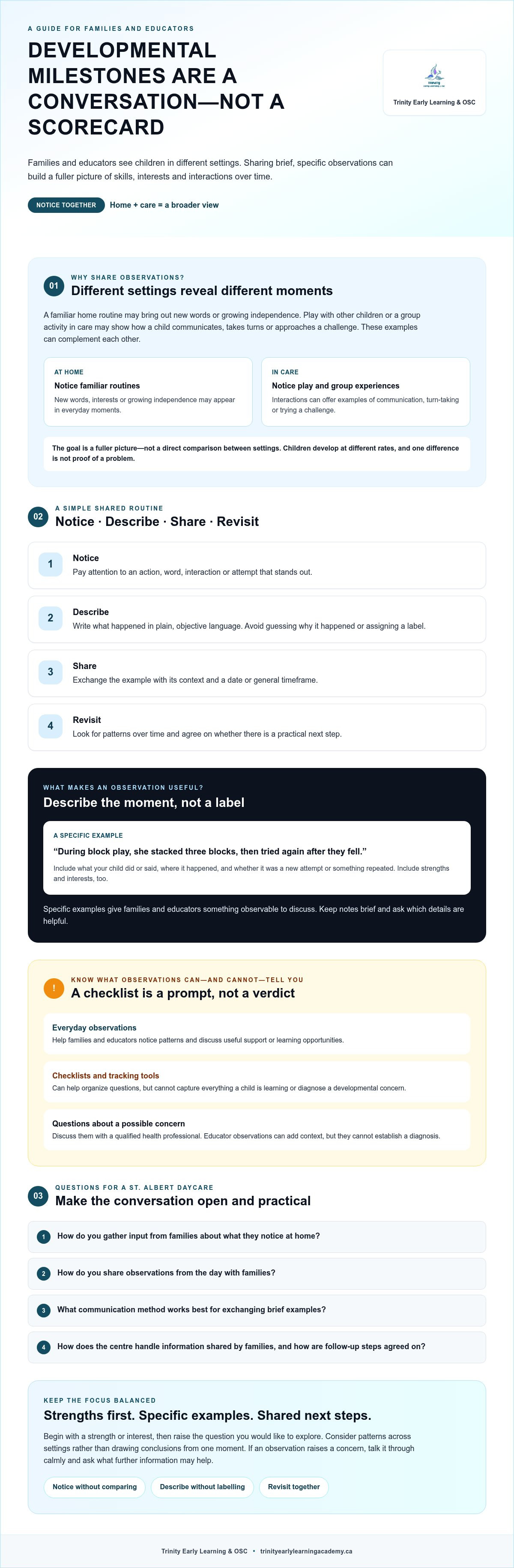
Tracking developmental milestones with your daycare means collecting observations over time to understand how your child’s skills, interests, and interactions are developing. It isn’t a scorecard, and families and educators don’t need to decide whether a child is “on track.” Everyday examples can help you notice patterns and consider what support or learning opportunities may be useful.
Home and daycare offer different views of a child’s experiences. Familiar routines at home may bring out new words or growing independence. In care, play with other children or a group activity may show how your child communicates, takes turns, or approaches a challenge. These examples can complement one another. For general background on the areas and changes involved as children grow, see this overview of child development stages.
Children don’t all develop skills on an identical timetable. A difference between your observations and an educator’s isn’t, by itself, proof of a problem. It may show that your child responds differently to the people, routines, or opportunities in each setting.
What counts as a useful developmental observation?
Useful observations describe what happened rather than assigning a label. Note what your child did, said, tried, or repeated, along with the context. For example, “During block play, she stacked three blocks, then tried again after they fell” gives more helpful detail than “She’s good at building.” Include strengths and interests as well as skills that are still emerging. Specific examples give families and educators something concrete to discuss.
Why compare observations from home and daycare?
Different settings invite different behaviours. A child may speak freely during a familiar bedtime routine but watch quietly during a group activity. Share changes, new interests, and questions you’ve noticed at home, and invite educators to describe what they see in care. Together, you can consider whether a skill appears in more than one context or is just beginning to emerge. The goal is a fuller picture, not a direct comparison between settings.
An observation describes what a child does; it does not diagnose a developmental condition. The Canadian Paediatric Society’s milestone guidance can help families learn about development. Questions about a possible concern are best discussed with a qualified health professional. Educator observations can add useful context to that conversation, but they can’t establish a diagnosis.
How can parents and daycare educators track milestones together?
A simple routine can keep tracking developmental milestones with your daycare practical and focused on your child’s experiences, rather than on labels or a checklist score. Families and educators can use four steps: notice, describe, share, and revisit.
- Notice: Pay attention to an action, word, interaction, or attempt that stands out.
- Describe: Record what happened in plain, objective language, without guessing why it happened.
- Share: Exchange the example with the educator or family, including the context and a date or general timeframe.
- Revisit: Look for patterns over time and agree on whether there’s a practical next step.
For example, note that your child asked another child for a turn during a play activity, rather than describing them as “social” or “advanced.” Specific examples make progress conversations clearer because they give families and educators something observable to discuss.
What should families and educators record?
Keep notes brief. Include what your child did or said, where it happened, and whether it was a new attempt or something they repeated. Avoid assigning a cause or judgement. Ask the educator which details are helpful, what communication method works best, and how the centre handles information shared by families. If you want a general reference while preparing questions, Pathways.org offers milestone tracking tools for parents and caregivers. Use any tool as a prompt for discussion, not a verdict about your child.
How do you make a progress conversation useful?
Begin with a strength or interest, then raise the question you’d like to explore. For instance, mention that your child enjoys helping with a familiar task, then ask whether educators have noticed them trying similar tasks in care. Consider patterns across settings instead of drawing conclusions from one moment. If an observation raises a concern, talk it through calmly and ask what further information may help.
Before ending the conversation, agree on one manageable follow-up, such as watching for a particular behaviour in a familiar routine, and decide when to revisit it. Choose a communication method and check-in rhythm that suit both your family and the educator. Families comparing care options in St. Albert can ask Trinity Early Learning & OSC about its daycare and preschool programs and how it communicates with families. Explore St. Albert daycare and preschool programs.
Milestone tracking, screening, and diagnosis: what is the difference?
These terms describe different ways of understanding a child’s development. Everyday observations help families and educators share what they notice. Screening uses structured questions to identify whether further discussion or assessment may be helpful. A clinical assessment is a more in-depth evaluation by a qualified health professional. The Canadian Paediatric Society’s milestone guidance and Alberta Health Services’ parent resources can help families learn about development, but a checklist or educator’s observations cannot diagnose a child.
| Approach | What it can do | What it cannot do |
|---|---|---|
| Everyday observation | Capture examples of skills, interests, interactions, and changes at home or daycare. | Confirm a developmental condition or provide a complete assessment. |
| Formal screening | Use structured questions to identify areas that may be worth discussing further. | Provide a diagnosis or a pass-or-fail verdict on a child’s development. |
| Clinical assessment | Allow a qualified health professional to consider concerns in greater depth and determine appropriate next steps. | Be replaced by a checklist or a single observation from daycare. |
Can a milestone checklist tell you whether a child is on track?
A checklist can help organize questions about particular skills, but it can’t show the whole child. It may not capture a child’s strengths, interests, opportunities to practise a skill, or differences between familiar and group settings. A missed item is not a diagnosis or a definite prediction of future development. Before using a tool, check who created it, the age range and purpose it was designed for, and whether it is intended for screening or general guidance. Treat results as a prompt for conversation, not a score.
When should a family raise a developmental concern?
If a question persists or you notice a change that concerns you, share it with your child’s educator and health provider. Bring concrete examples: what happened, in which situation, and whether you’ve noticed it more than once. You can also mention what your child enjoys or does well. Ask what the observation might mean and whether further guidance is appropriate. You don’t need to label the concern before raising it.
When tracking developmental milestones with your daycare, educator observations can add useful context to a family’s questions, especially when examples from care and home are considered together. They remain observations, not a diagnosis. A checklist can support the discussion, but decisions about assessment or next steps should be guided by a qualified health professional familiar with your child.
What questions should you ask your daycare about developmental progress?
Clear questions can help you understand what educators observe and how your family can contribute. There’s no need to expect a particular checklist or update schedule. Ask how the centre approaches communication, what options are available, and how you can follow up if something concerns you. These conversations can make tracking developmental milestones with your daycare a shared process, while keeping the focus on your child’s experiences rather than comparisons with other children.
Questions to ask about educator observations and family updates
During a conversation with your child’s educator, you might ask:
- What kinds of developmental observations do you usually share with families?
- How can I share examples or changes I notice at home?
- What’s the best way to raise a question or request a conversation?
- What communication options are available, and how do families know when an update is needed?
- How do you describe a child’s progress without comparing them with other children?
- How is information shared by families handled, and who can access it?
These questions help clarify the centre’s approach without assuming it uses a specific tool or reporting routine. Ask educators to describe an observation in concrete terms, such as what your child tried, said, or did during an activity. That makes it easier to understand the context and discuss what you’ve noticed at home.
Questions to ask when progress raises a concern
If an educator raises a concern, ask for the specific behaviour or situation that prompted the conversation. Then explore possible next steps together:
- Have you noticed this on more than one occasion or in a particular situation?
- What strengths or interests are you seeing alongside this question?
- Is there a practical way to support or observe this skill in the daycare setting?
- When should we reconnect to discuss what we’ve noticed?
- Would you recommend that I raise this question with my child’s health professional?
Share your own examples and ask for time to consider what you’ve heard. An educator can offer useful context from care, while a health professional can guide questions about assessment or development. For more help evaluating a St. Albert centre, read this licensed daycare guide for St. Albert families.
If you’re considering care in St. Albert, learn about Trinity Early Learning & OSC’s daycare programs and family communication.
How to choose a St. Albert daycare for supportive milestone conversations
A daycare’s approach to family communication can be as useful to compare as its programs and routines. During a visit or conversation, listen for clear, respectful answers about how educators share what they notice and how families can contribute. The aim isn’t to find a centre that promises a particular milestone process. It’s to understand whether you can work together to support your child.
What to look for in a supportive parent-educator partnership
Use this short checklist when comparing St. Albert daycare options:
- Specific examples: Do educators describe what a child did or tried, rather than relying on labels or comparisons?
- Family input: Are you invited to share observations, interests, or changes you’ve noticed at home?
- Respectful conversation: Can questions be discussed calmly, with attention to your child’s individual needs?
- Privacy: Can the centre explain how information shared by families is handled and who may access it?
- Follow-up: If a question remains unresolved, is it clear how you can continue the conversation?
Notice how educators respond to your questions. A thoughtful answer may include a concrete example, a question about what you see at home, or a clear explanation of how to follow up. Ask what communication options are available rather than assuming the centre uses a particular tool or schedule. For broader context on local early learning, see this early childhood education guide for St. Albert families. Families comparing preschool options may also find this preschool programs guide in St. Albert helpful.
How Trinity Early Learning & OSC can fit your family’s search
Trinity Early Learning & OSC provides licensed daycare, preschool, and out of school care in St. Albert. When comparing its programs, ask how educators share observations, invite family input, and handle follow-up questions. Their answers can help you decide whether the centre’s approach fits your family’s expectations.
As you compare options, focus on whether communication feels specific, respectful, and open to your perspective. To learn more about Trinity’s programs, visit Trinity Early Learning & OSC.
Keep the conversation open as your child grows
Developmental progress is easier to understand when families and educators share specific observations over time. A child may show different skills at home and in care, so compare patterns rather than judging progress from one moment or a checklist. Everyday observations can guide a conversation, but they aren’t a diagnosis.
Tracking developmental milestones with your daycare can be a practical partnership: share what you notice, ask educators what they see, and agree on a helpful next step if questions remain. If a concern persists, discuss it with your child’s health professional.
Trinity Early Learning & OSC provides licensed daycare, preschool, and out of school care in St. Albert. The centre also uses affordability grant programs to support accessible childcare. Ask Trinity about its current programs, communication practices, and grant details, including eligibility.
Contact Trinity Early Learning & OSC to learn about its St. Albert programs. With open communication and a focus on your child’s individual experiences, you can move forward with greater confidence.
Frequently Asked Questions
What does it mean to track developmental milestones with your daycare?
It means sharing observations over time so you and educators can build a fuller picture of your child’s emerging skills, interests, and interactions. You might mention a new word your child uses at home, while an educator shares how they communicate during play. The goal is to discuss patterns and possible next steps, not score your child. These observations are not a diagnosis, and children don’t all develop skills on the same timetable.
How often should daycare educators discuss developmental milestones with parents?
There isn’t one communication schedule that suits every family or daycare. Ask educators what communication options are available, how they typically share observations, and how you can request a conversation if a question comes up. You can agree on a check-in rhythm that works for both sides, while staying open to talking sooner if something needs attention. Ask how to share examples from home so they can be considered alongside what educators notice in care.
Can daycare educators diagnose a developmental delay?
No. Educators can describe what they observe in the daycare setting and share examples that may help a family understand a child’s experiences. Their observations can inform a discussion, but they can’t establish a diagnosis. If you or an educator has a concern, talk about the specific behaviours or situations involved and consider discussing your questions with your child’s health professional. A screening checklist may help guide a conversation, but it also isn’t a diagnosis.
What should I do if my child shows different skills at daycare and at home?
Share what you notice at home and ask the educator what they see in care. Different routines, relationships, and activities can bring out different behaviours, so a contrast between settings doesn’t by itself mean something is wrong. Compare specific examples and look for patterns over time. For instance, explain when your child uses a new skill at home and ask whether educators have noticed it during a similar activity or interaction at daycare.
Are developmental milestone checklists accurate for every child?
No checklist captures every child’s abilities, experiences, strengths, or circumstances. A checklist can summarize skills and help organize questions, but it isn’t a pass-or-fail test. A missed item doesn’t diagnose a condition or predict a child’s future development. Before using a tool, check its source, intended age range, and purpose. If an item raises questions, discuss it with an educator or health professional rather than drawing a conclusion from the checklist alone.
What questions should I ask a St. Albert daycare about my child’s development?
Ask what kinds of observations educators share, how you can contribute examples from home, and what communication options are available. You can also ask how they describe progress without comparing children, how information shared by families is handled, and how to follow up if a question remains. If an educator mentions a concern, ask which specific behaviours or situations prompted it and what next step they suggest. These questions can help you understand a St. Albert centre’s approach.
When should I speak with a health professional about a milestone concern?
Speak with your child’s health professional whenever you have a concern or a question about their development. You don’t need to wait for a checklist result or for an educator to raise the same concern. Bring concrete examples, including what you’ve noticed, when it happens, and whether anything has changed. You can also share observations from daycare, with the educator’s input. A health professional can help you understand whether further assessment or another next step may be appropriate.


