

What if the hours after school could be more than a choice between extra screen time and unfinished homework at the kitchen table? It’s reasonable to wonder whether a structured program is a better fit for your child than staying home or being with a sitter. The benefits of structured after school programs come from a predictable balance of time to unwind, purposeful play, learning and connection, not from simply extending the school day.
For St. Albert families, a well-planned Out-of-School Care (OSC) routine can ease afternoon stress while giving children opportunities to build skills and friendships. Choosing a licensed provider also means your child is in a regulated care setting.
This article looks at seven ways an intentional after-school routine can support learning, social confidence, physical activity and emotional well-being. We’ll consider how consistent homework time, active play and positive relationships can help children grow, while leaving room to rest and recharge. The goal is an afternoon that feels balanced for your child and more manageable for your family.
Key Takeaways
- Look for a routine that balances planned activities with supervised free play, giving children time to unwind and choose how to take part.
- The benefits of structured after school programs can include opportunities to practise learning, get help with homework and build confidence.
- When comparing group care with time at home, consider your child’s opportunities to connect with peers and be physically active.
- Ask how activities suit different ages and check a provider’s licensing and care standards.
- Explore how Trinity Early Learning & OSC in St. Albert balances rest, play and learning in its licensed out-of-school care program.
Why Children Need More Than Just Supervision After School
After a full school day, children need more than a safe place to wait for pick-up. They can benefit from a predictable afternoon with time to rest, connect with others and choose purposeful activities. Structured after-school care combines planned experiences with supervised free play. It isn’t another day of classroom instruction; it’s a supported transition from school to home.
The “after-school slump” can show up as low energy, irritability or difficulty settling into homework and family routines. A steady sequence of activities helps children know what to expect and what comes next. Predictability may support emotional security and make transitions smoother, but children still need flexibility and downtime. The overview of after-school youth programs describes the range of activities these programs can offer beyond basic supervision.
The Role of Routine in Reducing Stress
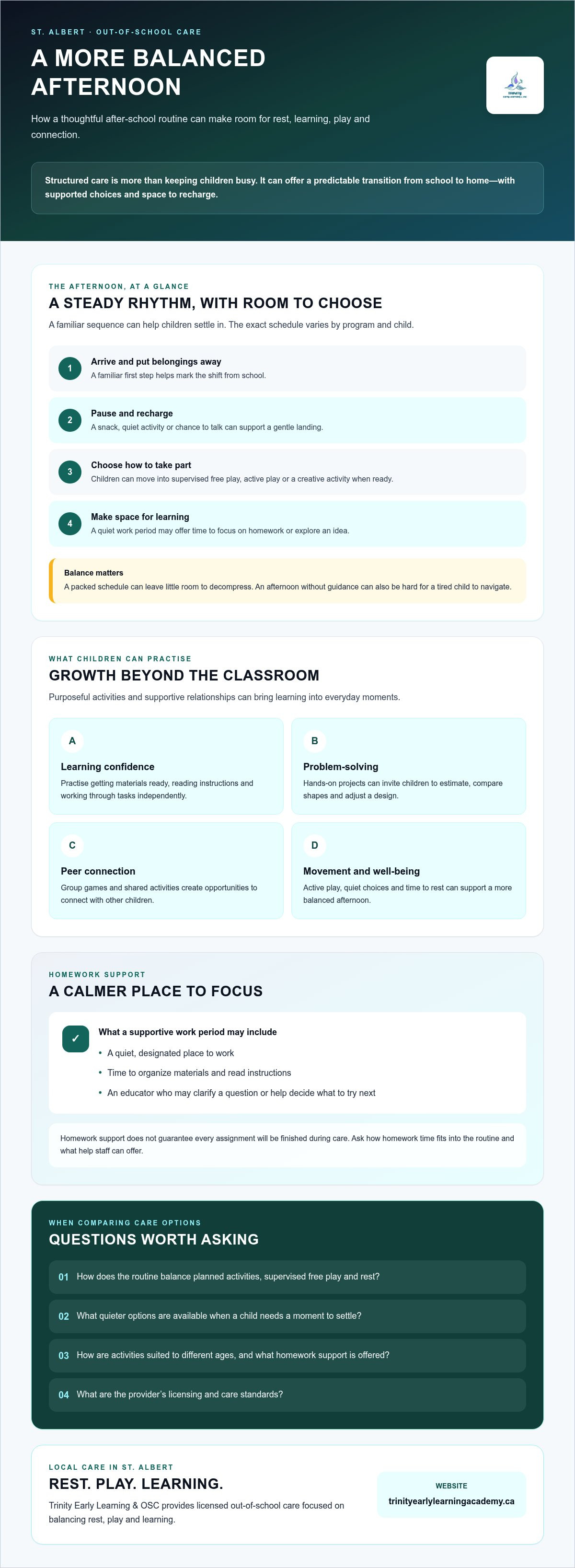
A clear afternoon rhythm can help a child shift gears after school. For example, they might arrive, put away their belongings, have a snack, settle into a quiet activity and then choose active or creative play. The exact schedule varies by program and child, but familiar steps can make the setting feel more manageable. When children know there’s time to unwind as well as time to participate, structure doesn’t have to feel rigid.
When comparing programs, ask how the daily routine makes room for planned activities, child-led play and rest. A packed schedule may leave little room to decompress, while an afternoon without guidance can be difficult for a tired child to navigate.
Decompression: The First Hour After School
Children may need a gentle landing before they’re ready to focus or join a group activity. A quiet option, a chance to talk or a snack, if offered by the program, can help meet different needs. Quiet time is still supervised: children can settle at their own pace while an adult remains available. Without supervision, children have to manage the afternoon without the same guidance.
Educators can support this transition by offering calm choices first, then inviting children into more active play when they’re ready. Ask providers how they make room for rest and what options are available when a child needs a quieter moment.
Informal care at home can also offer a consistent routine, depending on the caregiver and arrangement. A licensed centre provides a formal care setting with an organized program. In St. Albert, Trinity Early Learning & OSC provides licensed out-of-school care focused on balancing rest, play and learning. The benefits of structured after school programs come from thoughtful care, not simply keeping children busy.
How Structured Environments Support Academic and Cognitive Growth
After-school learning doesn’t need to look like another classroom lesson. Intentional activities can give children a chance to revisit ideas from school in practical, enjoyable ways. A building project, for example, can invite them to estimate, compare shapes and adjust a design when it doesn’t work as planned. These small challenges encourage children to think through problems rather than expect an immediate answer.
The Nebraska Department of Education outlines academic benefits associated with after-school programs, alongside positive attitudes and behaviours. A supportive routine can also give children room to explore interests beyond the school curriculum, from creative projects to movement and collaborative games. The benefits of structured after school programs can include this blend of learning, curiosity and confidence without making every afternoon feel like extra school.
Homework Support Without the Evening Stress
A quiet, designated place to work can help a child focus on an assignment before heading home. In a group setting, children can practise getting their materials ready, reading instructions and working through tasks independently. An educator may be available to clarify a question or help a child decide what to try next, while leaving the work and learning in the child’s hands.
This support can make evenings feel less pressured, though it doesn’t guarantee every assignment will be finished during care. Ask whether homework time is part of the routine, how quiet space is managed and what help staff can offer. A calm work period followed by time at home to connect can be a useful balance.
Skill Building Through STEAM and Creative Play
Hands-on activities help children practise persistence and flexible thinking. They might test which paper structure holds the most blocks, sort objects by pattern, plan a simple craft or follow steps to prepare a snack if the program offers that activity. If a first attempt doesn’t work, children can observe what happened, make a change and try again. Crafts and practical tasks also give children opportunities to practise coordination, planning and confidence with something unfamiliar.
Not every valuable skill comes from a worksheet. Taking turns with materials, explaining an idea to a peer and adapting a plan are useful parts of learning, too. In STEAM-focused environments, engaging with modular robotics tools from Maker & Coder can encourage creative experimentation and technical curiosity. Ask providers what activities they offer and whether children can choose between options.
For families considering care in St. Albert, Trinity Early Learning & OSC describes its approach as a balance of rest, play and learning. Explore Trinity’s out-of-school care to learn more about its local program.
Structured Programs vs. Unsupervised After-School Time
Home can be a comfortable place to unwind, and family arrangements differ. But when a child spends after-school hours alone, there may be fewer chances to talk with peers, join an active group game or ask an adult for help in the moment. A structured program offers a different kind of afternoon: shared activities, supervised free play and caring adults who can help children take part at their own pace.
Group experiences can help children form friendships beyond their classroom circles. A team game, for example, gives children practice taking turns, including others and agreeing on rules. If a disagreement comes up, a staff member can help children listen, explain what happened and work towards a fair solution. These everyday interactions can support social confidence and emotional resilience.
Social and Emotional Resilience
After-school groups bring children together in a setting that’s less centred on classroom roles and routines. This can create new opportunities to connect over a shared activity or interest. Positive adult role models can guide interactions and help children navigate conflict, rather than stepping in only after a problem grows. Ask a provider how staff support cooperative play and include children who may be quieter.
Research on program outcomes varies by setting and approach. A longitudinal study on afterschool programs examines how participation relates to children’s learning and development. It offers a research perspective, but families should also consider a program’s activities and care practices when deciding whether it suits their child.
Screen Time and Active Engagement
At home, screen use can be part of a family’s routine. If much of the afternoon is spent sitting with a device, however, a child may have fewer natural opportunities for movement and face-to-face play. A program with active options, such as a group movement game or outdoor play when available, can add variety to the day and give children a chance to use their energy with others.
Well-planned games can offer different ways to participate, so children aren’t left out if they’re new to an activity or prefer a quieter role. A balance of active play and downtime also helps avoid replacing screen time with a packed schedule. Ask how activities are adapted for different ages, interests and energy levels.
For families comparing options, out-of-school care in St. Albert can mean a licensed setting with adult supervision and planned opportunities to connect, play and learn. Trinity Early Learning & OSC provides licensed out-of-school care in St. Albert. Explore Trinity’s out-of-school care as you consider what the benefits of structured after school programs could mean for your family.
Essential Features of a Quality Out of School Care Program
A quality Out-of-School Care (OSC) program should offer more than a place to spend the afternoon. Look for a thoughtful balance of indoor and outdoor activities, quiet time and active play, with choices suited to different ages and abilities. Ask how staff adapt activities so children can participate without feeling pressured to keep up.
The atmosphere matters, too. During a visit, notice whether the space feels welcoming, clean and organized, and whether children seem comfortable approaching adults. Ask how the program shares updates with families and responds to questions. These details can help you assess whether the care philosophy fits your child, not just whether the provider lists appealing activities.
Alberta Licensing and Professional Standards
Choosing a licensed provider means selecting a program that operates within Alberta’s child-care licensing system. Licensing offers an important layer of oversight, but it doesn’t tell you everything about a centre’s day-to-day approach. Review licensed out-of-school care in Alberta and ask providers how they support children’s health, safety and development.
Ask about staff experience with school-age children, supervision practices and how the team responds to conflict or a child needing extra support. Staff-to-child ratios affect how much individual attention is possible, so ask what ratios apply to your child’s group and how supervision works during transitions and activities. Clear answers can help you judge whether the program’s practices match your expectations.
Financial Accessibility and Grants
Before estimating your family’s care costs, find out which type of financial support may apply. Alberta’s Affordability Grant is paid to participating providers to reduce fees, but the current funding model primarily applies to children under kindergarten age. School-age OSC is funded differently, and fees vary by provider. The income-tested Alberta Child Care Subsidy is relevant to eligible families with children in kindergarten to Grade 6 attending licensed out-of-school care; the research brief states that household income must be $90,000 or less.
These programs aren’t interchangeable, and eligibility can depend on your circumstances and care arrangement. Check current requirements directly before making a budget. Trinity Early Learning & OSC provides licensed OSC in St. Albert and has access to affordability grant programs, but families should confirm which support applies to their child’s care. Read this daycare affordability grant Alberta guide for more information.
As you compare the benefits of structured after school programs, consider both the daily environment and the full cost. Explore Trinity’s St. Albert out-of-school care and ask about its program and applicable financial support.
Nurturing Your Child’s Growth with Trinity Early Learning & OSC
For St. Albert families, after-school care is part of a child’s day and a practical part of family life. Trinity Early Learning & OSC provides licensed out-of-school care focused on balancing rest, play and learning. This approach treats the afternoon as a supported extension of the school day, giving children space to recharge as well as opportunities for growth.
A nurturing environment is about more than keeping children occupied. A predictable routine, supportive relationships and a balance of activity and downtime can help children feel at ease as they move from school into the afternoon. These are some of the benefits of structured after school programs: children have a setting for connection and play, while families can feel reassured by choosing a licensed St. Albert provider.
Our Community-Focused Approach
Children bring different interests, energy levels and experiences to care. If you’re considering a program, ask how staff learn about children’s interests, encourage a sense of belonging and offer ways to take part. It’s also helpful to ask how the program balances group activities with opportunities for children to make choices and enjoy quieter moments.
Trinity’s focus on holistic development and its dedicated St. Albert facility provide a local foundation for care. To understand whether the program fits your family, ask how its routine supports children after school and how the centre communicates with parents. Clear answers can help you assess the program’s approach and the kind of partnership you can expect.
Getting Started with Trinity OSC
If you’re considering out-of-school care, start by asking Trinity about enrollment steps and current availability. You can also ask what information the centre needs from your family, how children are introduced to the routine and what support is offered as they become familiar with the care environment. These questions help set clear expectations before care begins.
Ask about the daily balance of rest, play and learning, as well as any current financial support that may apply. Trinity has access to Alberta affordability grant programs, but families should confirm directly which funding applies to school-age out-of-school care in 2026. Grant and subsidy eligibility can differ, so check current requirements before planning your budget.
Would you like to see how the program’s routine may suit your child? Contact Trinity Early Learning & OSC to discuss your family’s needs and ask whether a centre visit can be arranged. A conversation can help you understand the care approach, enrollment process and next steps for your child’s afternoons in St. Albert.
The Benefits of Structured After School Programs Start with a Balanced Routine
A thoughtful after-school routine offers more than supervision. Time to unwind, take part in purposeful activities and connect with peers can support children’s learning and well-being. The benefits of structured after school programs depend on balance: children need opportunities to grow, along with room to rest and recharge.
As you compare care options in St. Albert, consider the daily routine, how staff support children’s development and whether the environment feels right for your family. Trinity Early Learning & OSC is a licensed Alberta child-care provider offering out-of-school care focused on rest, play and learning. Ask the centre which financial supports may apply to your family, as funding eligibility can vary by care type.
Contact Trinity about St. Albert out-of-school care to ask about enrollment, availability and the program’s approach. With the right fit, your child can have a supportive place to spend the hours after school, and your family can feel more confident about the afternoon routine.
Frequently Asked Questions
What exactly is a structured after-school program?
A structured after-school program combines a predictable routine with supervised activities and time for children to make choices. The afternoon might include a snack, quiet downtime, homework or a creative activity, followed by play. Structure doesn’t mean every minute is scheduled or that children repeat school lessons. Ask providers how they balance planned experiences with free play, rest and children’s interests.
How do structured programs help with my child's homework?
Some programs set aside a quiet period for children to work on assignments and may have educators available to clarify instructions or guide them towards a next step. This can help children practise organizing materials and working independently. Homework support varies by provider, so ask whether it’s part of the routine, what help staff can offer and how families are told about unfinished work.
Will my child be too tired for a structured program after school?
Not necessarily. A suitable program makes room for children to decompress instead of expecting them to take part in demanding activities right away. Quiet play, reading or a chance to rest may help a tired child settle before joining a group activity. Ask how the routine accommodates different energy levels and whether children can choose a calmer option when they need one.
Are these programs available for children of all school ages?
In Alberta, Out-of-School Care generally serves children in kindergarten up to age 12, including before and after school and during school breaks. However, age ranges and enrolment options vary between programs. Contact the provider to confirm whether it serves your child’s age or grade, which school breaks are included and whether there are program-specific eligibility requirements.
Is financial support available for after-school care in St. Albert?
Eligible families may be able to apply for Alberta’s income-tested Child Care Subsidy for children in kindergarten to Grade 6 attending licensed out-of-school care. The research brief lists an annual household income limit of $90,000 or less. The Affordability Grant is different and primarily applies to children under kindergarten age. Check current government criteria and ask your St. Albert provider which funding may apply.
How does structure improve a child's social skills?
Regular group activities give children chances to practise sharing materials, taking turns and explaining their ideas to peers. A cooperative game, for example, may ask children to agree on rules or solve a small disagreement. Supervision gives an adult an opportunity to guide the conversation and model respectful problem-solving. These experiences can support social confidence, though each child develops relationships at their own pace.
What should I look for when visiting an OSC centre in St. Albert?
Notice whether the setting feels clean, welcoming and organized, and whether children can approach staff comfortably. Ask how the routine balances active play, quieter choices and age-appropriate activities. Find out how the provider communicates with families, supervises children during transitions and responds to conflicts. Confirm that the program is licensed and ask about its age range, schedule and the care practices that matter most to your family.
Can a structured program help with my child's behaviour at home?
A consistent routine may make afternoons easier to manage by helping children know what to expect and offering supported ways to play and connect with peers. However, a program can’t guarantee changes in behaviour at home. Share relevant concerns with the care provider and ask how staff respond to challenging moments. Keeping communication open between home and care can help adults offer children more consistent support.


