
What if that chaotic swirl of brown finger paint and haphazard glue drips is actually complex brain work in action? When you open your child's backpack to find an unrecognizable paper creation, it's easy to wonder what they're truly learning, or how to react without asking the dreaded question, "What is it?" You might even feel a twinge of guilt sorting through daily stacks of construction paper at the kitchen counter. In early childhood development, understanding preschool art projects begins with realizing that the true value lies in the messy, hands-on process rather than a picture-perfect final product.
You will discover the real developmental milestones hidden inside your child's preschool creations, from fine motor control to emotional problem-solving, along with practical ways to support their creative growth at home. We will also examine how to speak confidently with your young artist about their work and explore how quality childcare programs integrate purposeful creative exploration into everyday routines.
Key Takeaways
- A deeper approach to understanding preschool art projects reveals that paint splatters and scribbles represent vital fine-motor coordination and cognitive problem-solving.
- Distinguish between adult-directed crafts and child-led process art to appreciate the independent thinking behind every mark.
- Learn how tactile materials like modelling dough, torn paper, and paint support emotional regulation and offer self-expression before speech fully matures.
- Master confidence-building conversation techniques that replace the question "What is it?" with observations that honour your child's effort.
- Discover how licensed early learning programmes design intentional spaces where children can explore creative materials safely and independently.
What Are Preschool Art Projects Really Teaching Your Child?
When young children sit down with paper and paint, they aren't working toward a museum display. They're conducting sensory experiments. A key element of understanding preschool art projects is shifting focus away from whether an art piece looks recognizable and looking instead at the intense physical and cognitive labour taking place. When thick tempera paint collides with cardstock, or when wet glue pools over torn tissue paper, children are testing physical boundaries, cause, and effect.
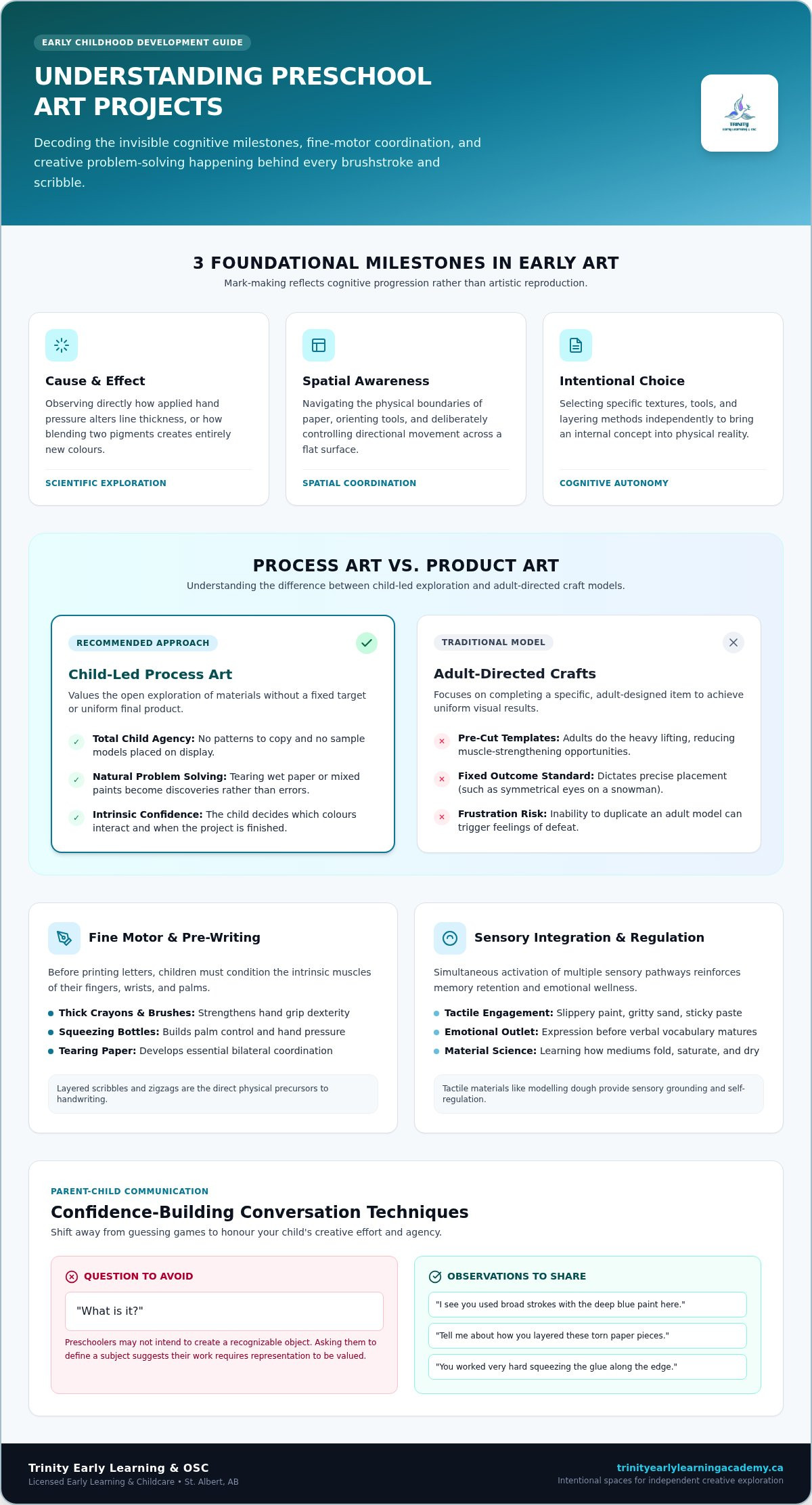
Researchers studying the developmental stages of child art demonstrate that early mark-making reflects cognitive milestones rather than artistic talent. When viewed through a developmental lens, every streak of colour demonstrates emerging mastery across three foundational areas:
- Cause and effect: Observing how pressure alters line thickness or how blending pigments creates new shades.
- Spatial awareness: Navigating the edges of the paper and controlling movement across a flat plane.
- Intentional choice: Selecting specific textures, tools, and layers to execute an independent idea.
Sensory Exploration and Brain Development
Hands-on sensory engagement builds vital neural connections during early childhood. Slippery finger paint, gritty sand, sticky paste, and crisp paper activate multiple sensory pathways simultaneously. This rich tactile feedback strengthens memory retention and encourages genuine scientific curiosity. As children discover how materials behave when folded, torn, mixed, or saturated, they establish intuitive mental models about material properties and physical consequences.
Fine Motor Skills and Pre-Writing Foundations
Long before children learn to print the alphabet, they must develop the physical strength and dexterity required to hold a pencil. Early artistic exploration provides this conditioning naturally. Grasping thick crayons and balancing paintbrushes develops the intrinsic muscles in little fingers, wrists, and palms. Squeezing glue bottles and tearing paper build bilateral coordination, requiring both hands to work together in harmony. In quality early learning spaces, understanding preschool art projects allows adults to recognize that messy zigzags and layered scribbles are the direct physical precursors to confident writing.
Process Art vs. Product Art: Decoding What Comes Home
Opening your child's backpack often reveals two distinctly different types of work. One day it might be an asymmetrical collage of ripped paper, buttons, and smeared purple paint; the next, an orderly paper-plate snowman where every button sits in a neat vertical line. Deciding which approach delivers greater value is fundamental to understanding preschool art projects. While uniform crafts look tidy on the fridge, process-focused activities offer far richer cognitive gains.
Early learning specialists at the National Association for the Education of Young Children outline how the debate over process art vs. product art defines creative learning environments. While product art focuses on completing a specific, adult-designed item, process art values the open exploration of materials without a fixed target. Discovering how a high-quality preschool structures these creative opportunities can help parents understand why open-ended art builds deeper confidence.
The Core Characteristics of Open-Ended Process Art
In process art, children retain full agency from start to finish. There are no patterns to copy, no sample models on display, and no right or wrong decisions. The child decides which tools to pick up, how colours interact, and when the creation is complete. When mistakes happen, such as wet paper tearing under heavy glue, they turn into natural problem-solving moments rather than ruined assignments.
Why Adult-Directed Crafts Fall Short in Early Learning
Adult-directed crafts often look impressive because educators do much of the heavy lifting. When adults pre-cut construction paper shapes and dictate where each googly eye belongs, children lose opportunities to strengthen hand muscles and test their own ideas. Attempting to replicate an adult standard can also spark feelings of defeat when small hands cannot achieve symmetry, turning a joyful creative moment into a compliance task.
Recognizing Developmental Stages in Children's Creations
As you observe art coming home across the preschool years, you can track predictable stages of progression:
- Uncontrolled scribbling: Broad, sweeping strokes driven by full-arm movement, reflecting pure physical energy and motor discovery.
- Controlled scribbling: Repeating loops, grids, and circles that show emerging wrist control and hand-eye coordination.
- Named scribbling: Assigning stories or identities to abstract marks, marking the shift into symbolic thinking.
Through this developmental framework, understanding preschool art projects transforms from judging visual tidiness into celebrating genuine cognitive milestones.
The Invisible Learning Behind Paint, Clay, and Torn Paper
Look past the surface of a smeared piece of construction paper or a battered lump of modelling clay, and you'll find quiet psychological and cognitive work underway. For children between ages two and five, verbal communication is still evolving. Art materials act as a secondary language. A deeper level of understanding preschool art projects involves seeing these physical media as tools for self-regulation, early mathematical reasoning, and emotional release.
Emotional Expression and Stress Management
Young children frequently feel overwhelming emotions that their vocabularies cannot yet articulate. Manipulating tactile substances provides an immediate, safe physical outlet for frustration, fatigue, or excitement. Pounding firm playdough, flattening soft clay, or tearing stiff cardstock offers deep proprioceptive input, soothing an overstimulated nervous system through constructive muscle engagement. Repetitive brushstrokes and deliberate stamping rhythms help slow down an active body. As educators at The Art of Education University emphasize when guiding adults on how to talk to kids about their art, acknowledging the intense physical energy poured into a project matters far more than evaluating the visual subject matter itself.
Spatial Awareness and Early Mathematical Concepts
Art tables function as early math and science laboratories. Every time a child glues scraps of paper across a sheet or decides where to place a painted circle, they make rapid calculations about spatial boundaries, symmetry, and balance. These simple creative choices lay the groundwork for geometric reasoning:
- Parts-to-whole relationships: Tearing strips of paper and reassembling them demonstrates how separate fragments combine to build a new structure.
- Proportions and scale: Determining how much paint a brush can carry before dripping teaches early lessons in volume and surface tension.
- Predictive science: Swirling primary colours together transforms an artistic whim into real-time hypothesis testing.
When parents embrace this perspective, understanding preschool art projects becomes an exercise in spotting foundational STEM concepts in daily play. A child is never merely playing with coloured liquid; they are measuring space, observing cause and effect, and testing physical limits.
How Parents Can Talk About Art to Build Confidence
When your preschooler hands you a sheet covered in overlapping black swirls, your immediate instinct might be to ask, "What is it?" While asked with affection, this question can signal that their creation fell short of representing something recognizable. In early childhood education, understanding preschool art projects means shifting from judging aesthetic accuracy to validating intentional effort. Descriptive commenting replaces evaluation with connection, validating the hard work your child poured onto the paper.
Meaningful Questions to Replace 'What Is It?'
Opening an authentic conversation encourages your child to share their thoughts and build expressive language without fear of getting the answer wrong. Instead of guessing, try these practical observation prompts:
- Invite storytelling: "Tell me about what you created here." This broad invitation gives them complete freedom to describe a story, an action, or simply their favourite part of the day.
- Notice specific visual details: "I see lots of swirling purple lines across the top and heavy dots at the bottom." Objective observations show you are genuinely paying attention.
- Focus on physical technique: "How did you get the green paper to stay attached under all that thick paint?" This celebrates creative problem-solving and persistence.
- Reflect on their experience: "Which part was your favourite to work on?" This reinforces that the joy of making matters far more than the final look.
Practical Ways to Manage and Celebrate Artwork at Home
Managing the daily volume of paper creations can quickly become overwhelming for families. You don't need to keep every single sheet to demonstrate love and pride. Setting up intentional routines helps you celebrate your child's milestones while keeping your living space calm:
- Establish a rotating gallery: Hang a simple wire with clips in the kitchen or hallway where children can display their favourite current piece for the week.
- Create a digital archive: Photograph 3D sculptures, paper-towel tubes, or fragile clay structures before recycling the raw materials respectfully out of sight.
- Curate an annual portfolio: Save two or three meaningful process pieces every month in an expandable folder or three-ring binder to document gross and fine motor growth across the year.
When families and educators partner closely, children develop deep resilience and expressive confidence. If you want to see how intentional, child-led creative spaces operate, explore the early childhood programmes at licensed daycare services in St. Albert that prioritize your child's holistic growth.
Creative Learning at Trinity Early Learning Centre in St. Albert
Every paint spill, ripped scrap of cardstock, and lumpy clay creation tells a story about your child's developing brain. In licensed early learning settings, these daily creative encounters are carefully planned developmental experiences rather than random filler activities. The core philosophy behind understanding preschool art projects centres on recognizing how skilled educators prepare the physical room, select responsive media, and stand back so genuine problem-solving can unfold.
At Trinity Early Learning & OSC, creative expression forms an essential pillar of quality childcare. Operating as an affordability grant daycare, the centre enables local families across St. Albert to access licensed, play-based care that nurtures emotional resilience, physical competence, and cognitive curiosity from an early age.
Our Approach to Process-Driven Childcare
Dedicated art studios and open-ended creative corners give young children uninterrupted time to test physical materials at their own rhythm. Instead of passing out identical templates, educators arrange natural loose parts, non-toxic tempera paints, textured papers, and malleable doughs. Teachers observe carefully, stepping in with open prompts that spark curiosity without taking over the work. This child-led methodology connects directly to the intentional structure of our preschool programs in St. Albert, where children practice independence and critical thinking through hands-on exploration.
Supporting Holistic Growth Through Everyday Learning
Shared artistic experiences do far more than refine fine motor control; they cultivate essential social skills. When children sit together around a sensory basin or a shared paper roll, they practice fundamental community habits:
- Negotiation and sharing: Waiting for a paintbrush or agreeing on how to divide modelling dough builds early empathy.
- Collaborative dialogue: Talking through shared building steps strengthens verbal communication and teamwork.
- Risk-taking and resilience: Watching a peer try a new technique encourages creative courage and mutual support.
Families wanting to understand how purposeful play anchors daily developmental milestones can read our guide to early childhood education in St. Albert. Gaining a deeper perspective on high provincial care standards is equally simple through our detailed overview of licensed daycare in St. Albert. When parents and educators join in understanding preschool art projects as active cognitive growth, everyday paint splatters become lasting developmental milestones.
Nurturing Your Child's Creative Confidence
Recognizing the deep cognitive, emotional, and physical growth within your child's creations completely changes how you look at a backpack full of paper. When parents shift their attention from visual perfection to the open exploration of materials, children gain the freedom to take risks, communicate complex feelings, and build foundational hand strength. Ultimately, understanding preschool art projects helps you celebrate those chaotic paint strokes as vital steps toward early literacy and confident problem-solving.
At Trinity Early Learning & OSC, our licensed daycare and preschool educators are dedicated to fostering child-led learning through intentional, play-based experiences. As a centrally located childcare centre serving St. Albert families and an approved provider for provincial daycare affordability grant programs, we partner with parents to support every stage of early development. Connect with Trinity Early Learning & OSC to explore our nurturing preschool programs and discover how a supportive, creative environment gives your young artist the confidence to thrive.
Frequently Asked Questions
Why do so many preschool art projects look like messy scribbles?
Scribbles reflect emerging gross and fine motor coordination rather than an attempt to depict realistic objects. Children under five are learning to control shoulder, elbow, and wrist muscles while testing how tools make marks on paper. Understanding preschool art projects means recognizing that scribbling is an essential physical precursor to forming letters and numbers, showing intentional brain work even when the visual result appears unstructured.
How do I respond when my child asks if I like their drawing?
Turn the focus back to their own feelings and creative choices by asking what they think of their work. You can respond with, "I love watching you create! How do you feel about all those bright yellow swirls?" This approach prevents them from relying solely on external approval. Reflecting their pride builds genuine intrinsic motivation, encouraging them to trust their artistic choices rather than drawing to please adults.
Is process art better than product art for preschool development?
Process art is significantly more beneficial for cognitive growth, creative resilience, and self-esteem in early childhood. Unlike craft projects that follow rigid adult templates, process art allows children to make autonomous decisions without fear of making a mistake. Uniform crafts may teach basic instruction-following, but open-ended art strengthens independent problem-solving, emotional regulation, and fine motor dexterity because the child directs every step.
What should I do if my preschooler refuses to touch messy art supplies?
Never force sensory participation; instead, offer tools that create comfortable physical distance between their skin and the materials. Provide paintbrushes, sponges attached to wooden clothespins, rollers, or kitchen utensils so they can manipulate textures without direct contact. You can also place wet paint or slime inside sealed plastic bags taped to a table. Meeting tactile hesitation with patience lets children explore cause and effect at their own pace.
How does preschool art help prepare children for kindergarten?
Creative activities build the hand strength, finger dexterity, and spatial awareness required for classroom printing. Gripping crayons, operating scissors, and manipulating clay exercise the small intrinsic muscles in the hands. Beyond physical stamina, open art develops task perseverance, sustained focus, and emotional self-regulation. These core social-emotional competencies help children transition smoothly into structured kindergarten learning environments across Alberta.
What are simple process art activities families can try at home?
Provide everyday household materials and let your child explore without directing the outcome. Tape a long strip of paper to the floor and offer varied markers or washable paint sticks. You can also set up a tray with watercolours, eye droppers, and paper towels, or mix homemade salt dough for sculpting with buttons and dry pasta. The key is stepping back and letting them experiment freely.
How do licensed daycare educators in Alberta evaluate art progress?
Educators in licensed Alberta programs evaluate artistic growth through developmental observation rather than finished aesthetic quality. Guided by provincial frameworks, teachers track pencil-grip progression, persistence through tactile challenges, and expressive communication. In quality childcare and preschool settings in St. Albert, like Trinity Early Learning & OSC, understanding preschool art projects involves documenting how children manipulate materials, solve spatial problems, and interact with peers during creative play.


