
What if the real secret to kindergarten readiness has nothing to do with flashcards or early reading drills? If you worry about how your little one will handle the emotional transition to elementary school, you aren't alone. Balancing everyday work commitments while second-guessing your early education choices creates immense pressure. Understanding how childcare helps with school readiness eases that stress by shifting the focus away from academic pressure and toward healthy developmental growth.
It's completely natural to wonder whether daily routines alongside peers can truly prepare a child for a structured school environment. In this 2026 guide, you'll discover how licensed early learning builds emotional regulation, social confidence, and independence for kindergarten success. Alberta's curriculum prioritizes personal responsibility, communication, and cooperative play over memorization. Ahead, we outline the practical milestones educators look for, giving St. Albert parents clear reassurance about preparing their children for the classroom.
Key Takeaways
- Kindergarten readiness centres on emotional regulation, peer cooperation, and self-help skills rather than early academic drills or flashcards.
- Understanding how childcare helps with school readiness reveals how daily group settings teach children to navigate peer conflict, express feelings, and build social confidence.
- Predictable daily daycare routines strengthen executive function, helping young learners follow multi-step directions and manage personal belongings independently.
- Purposeful, play-based activities introduce early literacy and numeracy concepts through hands-on exploration, storytelling, and problem-solving.
- Selecting a licensed early learning centre aligned with provincial frameworks ensures your child receives consistent educator support tailored to their unique pace.
What School Readiness Means for Early Childhood Development
Many families assume preparing for grade school means coaching a toddler through alphabet flashcards and counting sheets. In reality, kindergarten educators assess developmental maturity through a child's ability to regulate big emotions, cooperate with peers, and manage practical self-help tasks independently. When examining how childcare helps with school readiness, the greatest benefits appear in structured group dynamics where children practice attentive listening and mutual respect every day.
Stepping into a classroom involves navigating an unfamiliar social environment outside the family comfort zone. Quality childcare centres design intentional shared routines that cultivate personal resilience. Children learn how to follow daily timetables, communicate their physical needs to adult educators, and build genuine confidence in their own capabilities.
Moving Beyond Early Academic Drills
Modern kindergarten curricula prioritize natural curiosity, social empathy, and communicative problem-solving over memorization. Pushing formal drills too early often triggers unnecessary performance anxiety without improving long-term comprehension. In licensed early learning settings, educators foster pre-academic skills through rich storytelling, interactive conversations, and guided questions. These experiences build strong language foundations and creative thinking patterns naturally through play. Around the world, leading early childhood programs—such as the kindergarten curriculum at Oak Meadow International School Phuket—similarly emphasize exploratory, inquiry-led development to prepare young students for lifelong learning.
Key Developmental Pillars Educators Look For
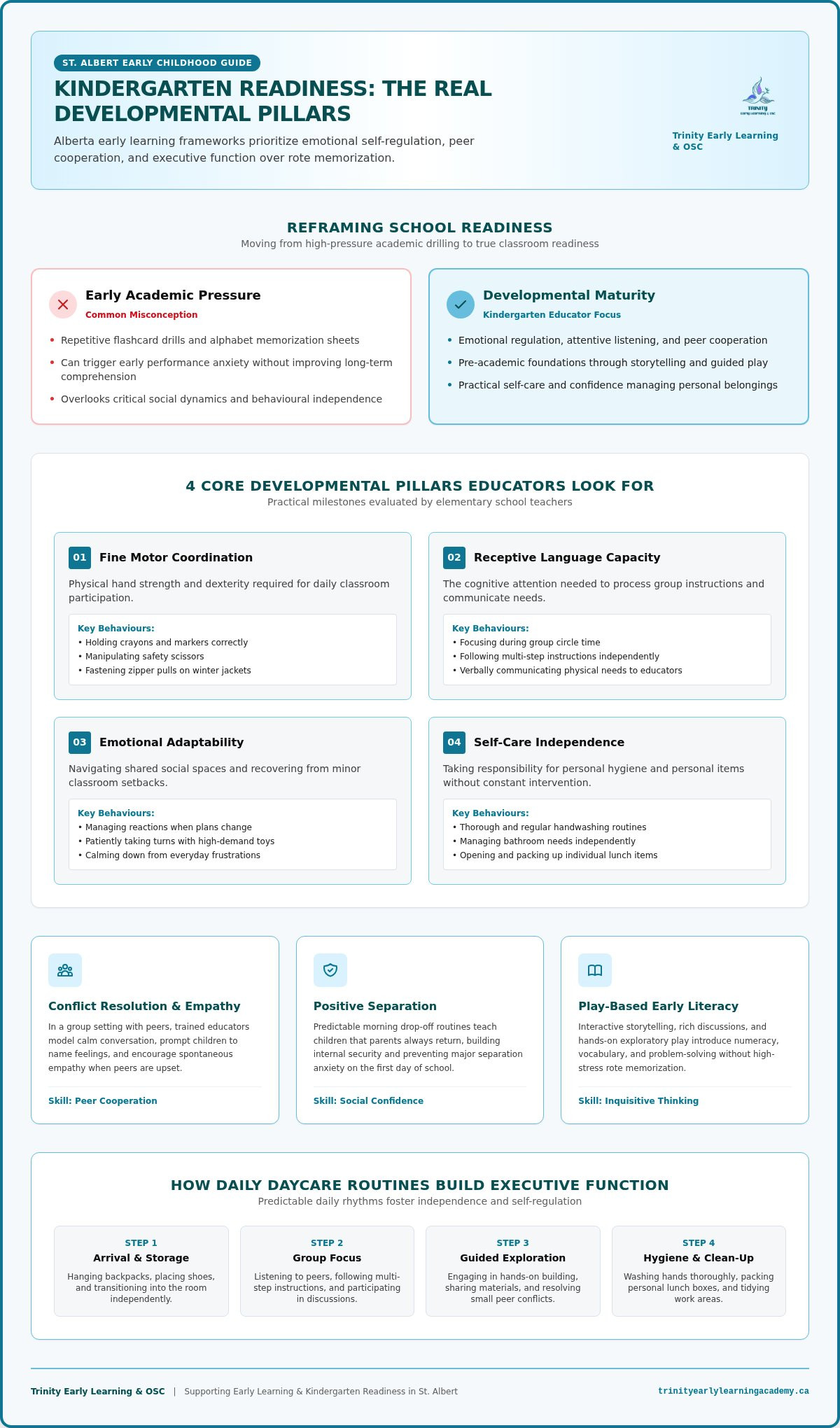
Elementary educators assess specific functional behaviours to ensure young students thrive in a shared classroom setting. Key developmental pillars include:
- Fine motor coordination: Hand strength and dexterity needed to hold crayons, manipulate scissors safely, and manage zipper pulls on winter jackets.
- Receptive language capacity: The focus required to understand and carry out multi-step instructions during group activities.
- Emotional adaptability: Managing personal reactions when plans change, taking turns with high-demand toys, and recovering from minor daily frustrations.
- Self-care independence: Managing personal hygiene routines, washing hands thoroughly, and packing up individual lunch items without continuous adult intervention.
Understanding these milestones highlights how childcare helps with school readiness across every developmental area. Rather than drilling academic worksheets, consistent group care provides the practical experiences children need to thrive socially and emotionally from their very first day of school.
Developing Emotional Self-Regulation and Social Confidence in Group Care
Children aren't born knowing how to manage intense emotional reactions; they build those skills through everyday social practice and guided adult mentorship. At home, a young child rarely faces a situation where fifteen peers want the same set of building blocks. Early educational research, including Head Start's approach to school readiness, emphasizes that emotional competence forms the bedrock of classroom learning. Experiencing this shared dynamic demonstrates how childcare helps with school readiness, giving children a safe space to name their emotions, practice calming techniques, and build social resilience long before grade school begins.
Learning Conflict Resolution and Empathy
When two children reach for the same tricycle on the playground, a valuable teaching moment happens. Rather than letting frustration escalate, trained early childhood educators step in to model calm conversation. They prompt children to express their feelings, listen to their peer's point of view, and agree on fair turn-taking strategies. Over time, children transition from self-centred reactions to noticing peer distress, often offering a comforting toy or kind words without prompting.
Building Confidence Through Positive Separation
Saying goodbye at drop-off can stir up heavy feelings for both parents and toddlers. Group care gently normalizes spending productive, joyful hours away from family. Consistent morning routines show children that parents always return, establishing a strong sense of internal security.
Overcoming separation hesitation early prevents severe anxiety when kindergarten arrives. St. Albert families find that enrolling in quality childcare nurtures a child's independent identity, ensuring they view new classroom environments as exciting spaces to explore rather than intimidating hurdles.
How Daily Childcare Routines Build Executive Function and Independence
While academic journals often measure executive function through laboratory tests, kindergarten teachers see it in ordinary classroom habits. A child who can remember their cubby spot, listen to a two-part instruction, and open their own snack container demonstrates advanced executive control. Daily group routines provide the real-world training ground where these mental muscles grow. Research into developing school readiness skills shows that regular daily rhythms directly cultivate working memory, cognitive flexibility, and inhibitory control.
This predictable rhythm is central to how childcare helps with school readiness across early childhood. When children know exactly what comes next in their day, their anxiety drops. They spend less mental energy wondering about the schedule and more energy engaging with tasks, listening attentively, and practising self-care without constant adult prompts.
Mastering Self-Care and Personal Responsibility
Managing personal belongings in a busy room is a major developmental milestone. During typical Alberta winters, getting ready to head outside requires serious focus, coordination, and patience. In licensed childcare settings, educators guide children through practical steps until they can handle them on their own:
- Pulling on snow pants, zip-up coats, boots, and mittens in proper order.
- Opening lunchbox containers, peeling fruit, and sealing water bottles securely.
- Washing hands with soap, drying them thoroughly, and using washroom facilities without direct assistance.
- Returning backpacks and indoor shoes to assigned cubbies after arriving.
Adapting to Structured Group Transitions
Moving between activities requires mental adaptability. A child might need to stop an engaging building project to join circle time, or shift from energetic outdoor play to quiet rest. Daycare schedules train this mental shift through predictable cues, visual schedules, and clean-up songs.
These daily repetitions build classroom stamina. By practising how childcare helps with school readiness through cooperative transitions, children learn to pack away materials, focus their attention during group stories, and respect speaking turns long before entering a formal elementary classroom.
Fostering Early Literacy, Numeracy, and Inquisitive Thinking Through Play
Early childhood frameworks across Canada, including Alberta's Flight curriculum, embrace purposeful play as the most effective path to foundational learning. Real pre-academic skill building does not require tracing workbooks or drilling flashcards. Instead, intentional play-based environments embed early math and language concepts into everyday experiences. Parents exploring early childhood education in St. Albert quickly discover that spontaneous curiosity builds a much deeper enthusiasm for school than forced seatwork ever could.
This dynamic learning method shows clearly how childcare helps with school readiness. Skilled early educators transform open-ended activities into opportunities for problem-solving, vocabulary growth, and scientific discovery without adding academic stress.
Play-Based Language and Pre-Reading Concepts
Early literacy takes root through rich spoken language long before children read printed words. During shared reading circles, educators model proper book handling, track words from left to right, and pause to discuss story characters. Singing silly rhymes builds phonological awareness, teaching young ears to recognize sound patterns and rhymes. In dramatic play areas, taking on roles like a grocery clerk or veterinarian encourages back-and-forth conversation, expanding expressive vocabulary naturally.
Developing Natural Curiosity and Number Sense
Authentic mathematics begins with hands-on physical materials. Counting wooden blocks to build a stable tower or sorting coloured buttons by size gives abstract mathematical concepts tangible meaning. Concrete early numeracy activities include:
- Comparing weights and liquid volumes through water and sand sensory bins.
- Creating repeating patterns using coloured wooden beads or sorting tiles.
- Exploring spatial geometry by fitting various magnetic shapes together.
- Strengthening fine-motor hand muscles through sculpting clay, painting, and tearing paper, which prepares fingers for comfortable pencil control.
Seeing children test ideas through self-directed investigation highlights how childcare helps with school readiness across cognitive domains. If you are preparing your child for a confident transition to elementary school, explore our licensed daycare services to see how purposeful play nurtures capable, curious learners.
Choosing the Right Early Learning Centre for Smooth Kindergarten Transitions
Selecting an early learning environment shapes how comfortably your child adapts to elementary school. Beyond colourful classrooms and appealing play areas, parents need to evaluate how effectively a centre fosters independence and social resilience. To assess baseline standards, families can consult our licensed daycare in St. Albert guide when evaluating prospective facilities. Ensuring a centre adheres to provincial health, safety, and educator certification standards provides peace of mind that daily programming meets high professional benchmarks.
Understanding provincial funding options is equally practical for family planning. St. Albert parents can learn about local support options in our daycare affordability grant Alberta guide, which explains how provincial fee reductions help make high-quality, licensed programs accessible.
Evaluating Program Philosophy and Educator Engagement
Touring prospective centres provides immediate insight into everyday classroom culture. Watch how educators interact with children across different activity zones:
- Physical posture: Look for staff who crouch down to speak at eye level, using patient tones to address questions or worries.
- Daily balance: Confirm that daily schedules evenly balance energetic outdoor movement with calming indoor routines.
- Emotional guidance: Ask how educators respond when a toddler expresses frustration, ensuring they focus on co-regulation rather than isolation.
- Holistic readiness: Discover specialized school readiness curricula in our preschool programs in St. Albert resource to see how child-led projects build confidence.
Community-Focused Care at Trinity Early Learning & OSC
Trinity Early Learning & OSC provides licensed daycare, preschool programs, and out of school care designed around healthy early development. Operating in St. Albert, our certified educators guide children through supportive peer routines that reinforce self-help skills, emotional regulation, and joyful inquiry. This responsive approach reflects the practical reality of how childcare helps with school readiness, ensuring children enter kindergarten feeling confident, capable, and excited to learn.
Families are warmly invited to book a centre tour to meet our team and experience firsthand how childcare helps with school readiness through community-rooted early care.
Preparing Your Child for a Confident Kindergarten Experience
Entering grade school marks a wonderful milestone in your family's life. True kindergarten readiness isn't measured by memorized flashcards or stressful academic drills; it grows through emotional resilience, self-care routines, and positive peer communication. Recognizing how childcare helps with school readiness helps you focus on what genuinely counts: raising independent, socially confident children who feel secure exploring new learning environments.
As a fully licensed childcare and preschool facility in St. Albert, Trinity Early Learning & OSC participates in the federal-provincial Child Care Affordability Grant to keep quality early education accessible for local families. Our experienced early childhood educators are committed to nurturing care that honours your child's unique developmental timeline. We provide the supportive structure, creative play, and social routines that turn the transition to grade school into an exciting adventure. Schedule a tour at Trinity Early Learning & OSC to support your child's journey and see our warm community in action.
Frequently Asked Questions
How does childcare help with school readiness compared to staying home?
Licensed group childcare provides daily, authentic practice navigating communal sharing, peer dynamics, and structured routines outside the family circle. While home environments offer deep emotional warmth, group settings naturally demonstrate how childcare helps with school readiness through cooperative play and consistent exposure to non-parental adult guidance. St. Albert children learn to advocate for themselves in larger peer groups, preparing them for busy elementary school classrooms.
At what age should a child start preschool to prepare for kindergarten?
Most children benefit from entering a preschool program between ages three and four. In Alberta, children must turn five on or before December 31 of the school year to register for kindergarten. Starting preschool one or two years prior allows children to adapt gradually to structured group settings, learn classroom expectations, and build peer relationships without the sudden pressure of full-day elementary school schedules. Parents exploring dedicated kindergarten readiness and early learning options across Alberta can check resources like jumpstartlearning.ca to learn more about structured preschool environments.
What social skills are most important for kindergarten readiness?
Attentive listening, empathy, cooperative turn-taking, and verbal conflict resolution are the most vital social skills for kindergarten. Teachers prioritize a child's ability to express personal needs with words, share communal materials, and respect personal space over early academic knowledge. Developing these relational habits ensures children feel safe and included, allowing them to engage positively in group activities across the school day.
Does a child need to know how to read before starting kindergarten?
No, children don't need to know how to read before entering kindergarten. Alberta's provincial curriculum expects educators to introduce formal reading instruction in the classroom through phonics and shared stories. Early childhood educators focus instead on pre-literacy foundational skills, such as recognizing letter sounds, holding books properly, enjoying storytelling, and expanding spoken vocabulary through rich daily conversation.
How do early educators help children who experience separation anxiety?
Educators ease separation anxiety by establishing predictable goodbye rituals, offering warm physical comfort, and redirecting attention toward engaging sensory activities. By greeting each child individually at drop-off and maintaining steady daily schedules, educators build secure attachments with their students. Over time, children realize that departures are temporary and safe, which builds lasting confidence when transitioning into St. Albert elementary schools.
Can play-based learning adequately prepare children for academic school expectations?
Yes, purposeful play is widely recognized as the most effective method for building academic readiness. When children build with blocks, sort beads, or stage dramatic play, they develop spatial awareness, early number sense, and narrative language skills. This joyful approach illustrates how childcare helps with school readiness by inspiring natural curiosity and critical thinking, laying an intellectual groundwork that rote memorization cannot duplicate.
How do daily childcare routines help improve a child's attention span?
Predictable daily routines train attention spans by alternating focused activities with active movement, teaching children when to concentrate and when to release energy. Participating in group circle times, completing multi-step art projects, and packing away personal toys trains working memory and mental discipline. These rhythmic transitions gradually stretch a child's capacity to focus calmly without causing frustration or cognitive fatigue.


