
What if a child’s fascination with a puddle, a tower of blocks or a curious question could guide the next learning experience? The phrase “what is emergent curriculum in early learning” might sound like another way to describe unplanned activities. In a thoughtful program, children’s interests help shape learning while educators observe, plan and extend it with purpose. Play can support communication, problem-solving and social development when educators build on what children are exploring.
This guide explains how children’s questions can lead to meaningful learning, what educators do to keep experiences intentional, and how Alberta’s Flight: Alberta’s Early Learning and Care Framework supports a flexible approach. You’ll also find practical questions to ask when considering licensed daycare or preschool in St. Albert. Trinity Early Learning & OSC offers these services locally. Ask the team how its educators plan experiences and connect children’s interests to learning.
Key Takeaways
- Learn what emergent curriculum in early learning means and how children’s interests can guide intentional experiences.
- Recognize the observe, interpret, plan and reflect cycle educators can use to build on children’s questions over time.
- Understand how emergent curriculum differs from play-based learning and fixed activity planning.
- Ask practical questions to find out how a program notices children’s interests and turns them into ongoing learning.
- When considering licensed daycare or preschool in St. Albert, ask each program about its curriculum and teaching approach.
What Is Emergent Curriculum in Early Learning?
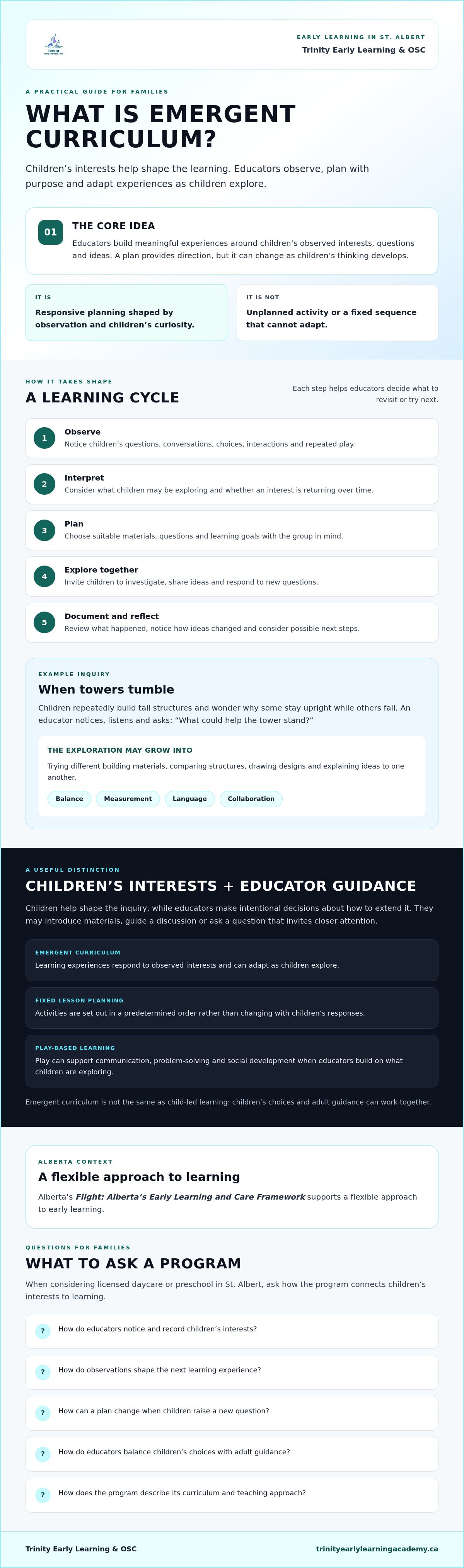
Emergent curriculum in early learning is an approach where educators build experiences around children’s observed interests, questions and ideas. Educators use what they notice to plan meaningful opportunities, then adapt those plans as children explore and respond.
The word “emergent” describes how the direction of learning develops over time. It doesn’t mean educators arrive without a plan or let every activity unfold without guidance. They make intentional decisions about suitable materials, questions and learning goals, and prepare experiences that can change as children’s thinking becomes clearer. The Emergent curriculum overview describes this approach as responsive planning shaped by children’s interests and educator observation.
This makes curriculum an evolving learning process rather than a fixed sequence of daily activities. Educators can support language, reasoning and collaboration while following an inquiry that matters to the children. A plan provides direction, but it can change when children make a new connection or raise a question worth exploring.
How is emergent curriculum different from a fixed lesson plan?
A fixed lesson plan sets out activities in a predetermined order. In an emergent approach, educators may prepare materials and have learning goals in mind while staying attentive to children’s responses. If the group becomes curious about shadows, an educator might invite them to notice how a shadow changes, compare shapes or share ideas about what makes it move.
The investigation can then shift based on the children’s questions. Their observations might lead to drawing, conversation or further exploration with light and objects. The educator isn’t simply abandoning the plan. They’re adapting it with purpose, connecting children’s curiosity to new ways of thinking and communicating.
Is emergent curriculum the same as child-led learning?
Not exactly. Children’s interests help shape the inquiry, but they don’t determine every teaching decision. Educators consider what children are exploring, what might extend their thinking and which experiences suit the group. They may guide a discussion, introduce materials or ask a question that encourages children to look more closely.
Children’s choices and adult guidance can work together. An educator might follow the group’s interest in shadows while helping children take turns, describe what they notice and consider different explanations. This balance keeps learning responsive without leaving children to direct every part of the experience on their own.
How Emergent Curriculum Turns Children’s Interests Into Learning
To understand what is emergent curriculum in early learning in practice, follow what educators do after a child shows curiosity. The process is not a one-time activity. Educators observe, interpret what children may be exploring, plan a possible next step, invite further exploration, document what happens and reflect before planning again. The National Association for the Education of Young Children (NAEYC) also describes the importance of attending to children’s ideas as educators shape learning experiences.
Observation helps educators decide what to revisit, what to introduce and how to respond to children’s questions. Repeated observations matter: an interest that returns in children’s conversations and play may be worth exploring further, while a single moment may not call for a longer inquiry. Educators can adjust their questions, materials or group plans as they see how children respond.
What does an emergent learning inquiry look like?
Imagine children repeatedly building tall structures and discussing why some towers stay upright while others fall. An educator might notice which materials the children choose, listen to their explanations and ask, “What could help the tower stand?” They could offer a range of suitable building materials and invite children to test their ideas.
As the inquiry continues, children might compare structures, draw their designs or explain their choices to one another. These experiences could connect with early ideas about balance, measurement, language and collaboration. The educator can follow the children’s responses rather than assuming every child will explore the question in the same way.
What do educators observe and document?
Educators may note children’s questions, conversations, choices, interactions and repeated play. Documentation could include written observations, children’s words or records of how an idea changes over time. Reviewing these details helps educators return to earlier thinking, notice new questions and consider possible next steps. Documentation supports planning. It doesn’t mean every moment becomes a formal lesson.
Family observations can add useful context. A child’s interest in building at home, for example, may help an educator understand a theme appearing in the program. Families exploring licensed daycare or preschool in St. Albert can ask how educators observe and extend children’s interests. To learn more about Trinity Early Learning & OSC’s local services, visit Trinity’s St. Albert early learning programs and ask about its curriculum and teaching practices.
Emergent Curriculum and Play-Based Learning: What Families Should Know
Play-based learning and emergent curriculum are related, but they describe different parts of an early learning experience. Play gives children a meaningful context for exploring ideas. Emergent curriculum describes how educators use observations of children’s interests and questions to inform what they plan next. Fixed activity planning, by contrast, follows activities chosen in advance, whether or not children’s responses change the direction.
Play and intentional teaching work together when educators follow children’s curiosity while thoughtfully guiding the experience. If you’re asking “what is emergent curriculum in early learning?”, this distinction can help: play may be how children explore, while an emergent approach shapes how educators notice, plan and respond.
| Approach | What guides the experience? | Educator’s role |
|---|---|---|
| Play-based learning | Children explore and learn through play. | Creates opportunities for play and supports learning through interaction. |
| Emergent curriculum | Children’s observed interests and questions help inform planning. | Observes, prepares and adapts experiences as children respond. |
| Fixed activity planning | A predetermined set or sequence of activities. | Leads the planned activity, with less room for children’s responses to change the sequence. |
Does emergent curriculum mean there is no structure?
No. Responsive learning still involves thoughtful preparation and guidance. Educators can arrange purposeful spaces, select appropriate materials and consider the group’s needs while leaving room for an inquiry to develop in an unexpected direction. Daily routines can continue alongside flexible learning experiences. Structure gives children a sense of what to expect, and flexibility lets educators respond to what children are exploring.
How can educators support learning without taking over?
Educators can listen closely and ask open-ended questions rather than immediately supplying an answer. If children are exploring how objects move, an educator might ask, “What do you notice?” or offer different materials to compare. They can introduce a new perspective or invite children to explain their ideas to one another, then adjust based on the group’s interest and participation. Guidance supports inquiry without deciding every step for children.
For families, the key is not simply whether children have time to play. Ask how educators connect play to learning and balance children’s choices with adult planning. A clear answer should describe both how children shape an inquiry and how educators decide what support to offer.
How Parents Can Recognize Emergent Curriculum in an Early Learning Program
Knowing what is emergent curriculum in early learning gives you a starting point, but examples from educators can show how the approach works day to day. Rather than relying on a program label, ask how educators notice children’s interests, decide what to do next and share what children are learning. A useful explanation connects children’s ideas with educators’ planning and guidance.
What questions can parents ask educators?
Ask for a recent example. For instance: “What question or interest from a child shaped an experience recently?” and “How did you respond with materials, conversations or later activities?” Specific examples can help you see whether educators revisit children’s ideas instead of treating each activity as separate.
You can also ask:
- How do you balance children’s interests with group routines and individual needs?
- How can families share observations or interests from home?
- How do you let families know what children have been exploring and what might happen next?
There’s no single required format for sharing learning. A program might explain its approach through conversations, written updates or examples of children’s work. Focus on whether the communication helps you understand your child’s experience, rather than expecting one particular method.
What can families look for during a program visit?
Notice whether children can reach and explore materials, and whether educators are available to support their play and thinking. If examples of children’s questions, drawings or projects are displayed or shared, ask whether the group has returned to those ideas over time. A display alone won’t tell the whole story, so invite educators to explain what children were exploring and how their responses influenced what followed.
These observations can help you connect curriculum with your child’s interests and daily needs, but they don’t confirm that a program follows an emergent approach. Trinity Early Learning & OSC provides licensed daycare and preschool in St. Albert. Ask the team about its teaching practices and how educators plan from children’s interests.
For more context as you compare local options, read this St. Albert early childhood education guide and the guide to preschool programs in St. Albert. To learn how Trinity approaches its daycare or preschool curriculum, ask Trinity about its teaching practices.
Choosing an Early Learning Program in St. Albert: Connect Curriculum With Your Child
Curriculum is one part of choosing an early learning program. Consider how your child tends to engage: do they like to spend time investigating a favourite subject, or feel more comfortable with familiar routines and gentle invitations to join in? An approach that responds to children’s interests can make room for exploration, while educator guidance helps keep experiences supportive and suitable for the group.
There’s no single curriculum style that fits every child or family. Compare how programs describe their teaching and ask for practical examples rather than relying on a label alone. If you’re still considering what is emergent curriculum in early learning, use the questions below to learn how an approach might feel in your child’s daily experience.
How can parents decide whether the approach fits their child?
Think about whether your child enjoys exploring an idea with calm adult support, and whether they benefit from predictable routines alongside open-ended activities. Ask how educators respond when children have different interests or prefer different materials. Their answer can help you understand how they make room for individual preferences while supporting the group.
During a conversation or visit, ask for an example of how educators adapt an experience when children respond in different ways. Clear examples can tell you more than a broad claim that a program is “child-led” or “play-based.” Consider whether the explanation feels consistent with your child’s temperament and daily needs.
What should families ask Trinity Early Learning & OSC?
Trinity Early Learning & OSC provides licensed daycare and preschool in St. Albert. Ask directly whether the program uses emergent curriculum or related responsive planning practices, and how educators observe, plan and share children’s learning.
It can also help to ask how educators make learning visible to families and how your observations from home can inform conversations about your child. The answers give you a clearer sense of the program’s approach without requiring you to know curriculum terminology in advance.
For a broader overview as you compare local options, read this guide to licensed daycare in St. Albert. You can also explore Trinity’s available programs and ask which licensed daycare or preschool option may suit your family.
Take Your Questions Into Your Program Search
Understanding what is emergent curriculum in early learning can help you look beyond the label. Children’s interests may shape an inquiry while educators observe, plan and guide experiences with purpose. Play can support that learning, and routines and adult support can provide structure.
As you compare early learning programs in St. Albert, ask for specific examples of how educators respond to children’s questions, revisit ideas and share learning with families. Consider how the approach fits your child’s interests, temperament and daily needs. Trinity Early Learning & OSC offers licensed daycare and preschool in St. Albert. Ask the team about its curriculum and teaching practices.
Explore Trinity’s early learning programs and ask us about our approach. A conversation can help you decide what feels right for your family and choose a next step.
Frequently Asked Questions
Is emergent curriculum the same as play-based learning?
No. Play-based learning describes play as a context for children’s exploration and learning. Emergent curriculum describes how educators use observations of children’s interests to shape planning. The approaches can work together: children might explore an idea through play while educators notice their questions and plan ways to extend the inquiry. A program may be play-based without describing its planning approach as emergent, so ask educators how they plan.
Does emergent curriculum mean there is no lesson plan?
No. Educators still prepare experiences, choose suitable materials and consider what children may learn. The difference is that a plan can be flexible rather than following a fixed sequence regardless of children’s responses. For example, an educator may prepare materials for exploring plants, then adjust the questions or activity if children become curious about leaves, roots or what plants need to grow.
What does an emergent curriculum activity look like?
An activity could begin when children notice a plant growing near their play space. An educator might invite them to look closely, offer paper for drawing or provide books about plants. Children’s questions could guide what the group explores next. The educator can support conversation, observation and creative expression while adapting the experience to children’s participation rather than expecting a particular outcome.
How do educators know what children are interested in?
Educators pay attention to what children ask, talk about, choose and revisit during play and everyday experiences. One moment may reflect passing curiosity; repeated questions or a return to an idea can suggest a longer inquiry. Educators may record observations and discuss possible next steps. Families can add useful context by sharing interests or questions their child brings up at home.
How can I tell whether a daycare uses emergent curriculum?
Ask educators to describe how they observe children, plan from their interests and share learning with families. Request a recent example of a child’s question influencing materials or a later experience, and ask how educators balance emerging interests with routines and group needs. Families considering Trinity Early Learning & OSC in St. Albert can ask directly about its licensed daycare curriculum.
Is emergent curriculum suitable for preschool children?
Emergent curriculum can be used with preschool children when educators shape experiences around their interests while offering appropriate guidance and structure. Whether a particular program suits your child depends on their temperament, interests and daily needs, as well as the educators’ approach. Ask the preschool how it responds when children prefer different activities and how educators help children explore ideas. Trinity offers preschool in St. Albert; contact the program to ask about its curriculum.


