
The best preschool choice may have less to do with its label than with what your child experiences each day. If you’re comparing the types of preschool programs Alberta families encounter, Reggio Emilia and Montessori may sound similar at first, but they can shape learning in different ways.
It’s natural to wonder which approach is better for your child. Neither is automatically the right fit for every family. Consider how a program supports your child’s interests, independence, relationships and comfort in the classroom.
This guide explains the central ideas behind Reggio Emilia and Montessori, what you might see in each classroom, and what to ask when visiting a preschool in St. Albert. It also offers ways to look beyond program labels and assess the daily experience. Trinity Early Learning & OSC describes its preschool curriculum as integrated with early learning. Ask how that curriculum appears in activities and educator-child interactions.
Key Takeaways
- Compare the types of preschool programs Alberta families may encounter by looking at daily activities, not just the approach named in a program description.
- Use the side-by-side comparison to consider how child choice, educator guidance and classroom activities may differ in Montessori and Reggio Emilia settings.
- During preschool visits, ask how educators plan learning, respond to children’s interests and communicate with families.
- Before choosing a St. Albert preschool, review your priorities and verify current program details, including licensing information, schedule and costs.
- Trinity Early Learning & OSC describes its preschool curriculum as integrated with early learning. Ask how this is reflected in daily activities and educator-child interactions.
Alberta Preschool Programs: Montessori & Reggio Emilia
A preschool program is an early-learning setting where young children take part in experiences that support development, relationships and discovery. Alberta families can encounter different educational influences, but a program label doesn’t tell you exactly what children do each day. Centres interpret approaches in their own ways, so ask how the philosophy shapes activities, the classroom and educator-child interactions.
Preschool describes an early-learning program, while daycare describes a childcare service arrangement. A centre may offer them separately or together. Ask about the schedule, daily routine and how learning fits into care rather than assuming every preschool has the same format. For local guidance, see preschool programs in St. Albert.
Montessori and Reggio Emilia are distinct approaches, not rankings of program quality or guarantees of particular outcomes. Their names offer a starting point for questions, not a substitute for seeing how educators put their ideas into practice.
What does a Montessori preschool generally emphasize?
Montessori settings are commonly associated with a prepared environment, purposeful learning materials and opportunities for children to work independently at their own pace. A child might choose a material from an accessible shelf and return to it while practising, as an educator observes, offers guidance and introduces activities when appropriate. Rather than leading every activity as a group lesson, educators support children’s engagement and learning. Details vary, so ask how the centre organizes materials, supports choice and responds when a child needs help.
What does a Reggio Emilia-inspired preschool generally emphasize?
Reggio Emilia-inspired practice commonly centres on relationships, collaboration and project-based exploration. A child’s question or shared interest may prompt an investigation that develops through conversation, observation and creative work. Children may express ideas in different ways, including drawing, building, movement and discussion. Educators listen, document learning and use what they notice to extend children’s questions. The Reggio Emilia approach is often associated with the idea that children have many ways to express and explore ideas. However, “inspired” can mean different things at different centres. Ask for examples of recent projects and how children’s interests influenced the learning.
Neither approach is automatically a better fit for every child or family. When comparing programs, focus on children’s experiences, the relationships they build and how educators support learning. Then look more closely at how classroom experiences may differ.
Reggio Emilia vs. Montessori: Preschool Differences
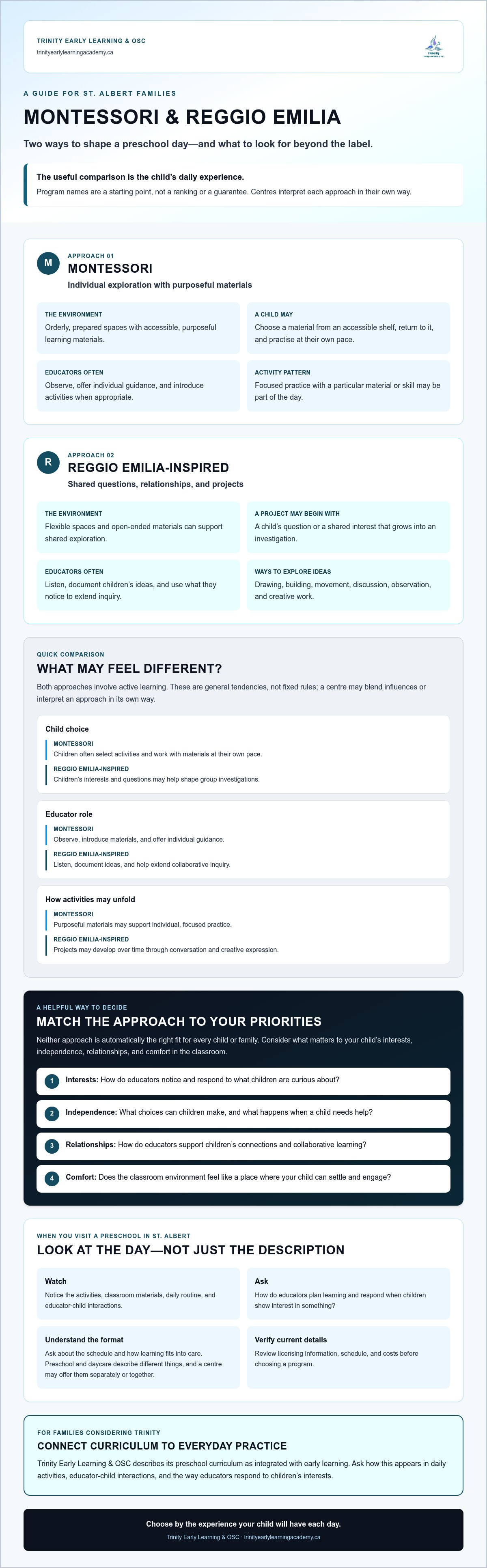
Both approaches involve active learning, but they may organize it differently. Montessori commonly offers purposeful materials and opportunities for individual, child-paced work. Reggio Emilia-inspired programs often build learning through shared questions, collaboration and projects. These are general tendencies, not fixed rules. A centre may blend influences or interpret an approach in its own way.
In brief: Montessori often organizes learning around individual exploration of prepared materials, while Reggio Emilia-inspired practice often develops through collaborative inquiry and projects.
| Classroom feature | Montessori tendency | Reggio Emilia-inspired tendency |
|---|---|---|
| Learning environment | Orderly, prepared spaces with accessible, purposeful materials. | Flexible spaces and open-ended materials that can support shared exploration. |
| Child choice | Children often select activities and work with materials at their own pace. | Children’s interests and questions may help shape group investigations. |
| Educator role | Educators observe, introduce materials and offer individual guidance. | Educators listen, document ideas and help extend collaborative inquiry. |
| Activity patterns | Activities may involve focused practice with a particular material or skill. | Activities may develop over time through projects, discussion and creative expression. |
How do classroom activities and materials compare?
In a Montessori-influenced classroom, a child might choose a specific material and repeat an activity while practising a skill. In a Reggio Emilia-inspired room, children might use loose parts, art materials or construction pieces to explore a shared question. Both approaches can involve hands-on discovery, but routines and activity goals may differ. Ask staff to describe a typical day and share examples of children’s current projects.
How do educators guide children in each approach?
Montessori educators may observe a child’s work and offer a suitable next step or quiet assistance. In Reggio Emilia-inspired practice, an educator may listen to children’s ideas, encourage them to explain their thinking and plan ways to extend a group project. Both roles can support communication, problem-solving and participation. During a visit, notice whether educators listen and respond to children. Ask how they include children who communicate or participate in different ways.
These comparisons can help families assess the types of preschool programs Alberta offers, but labels alone can’t confirm the quality of a specific classroom. The Government of Alberta’s guidance can help parents assess preschool programs in Alberta alongside what they observe during a visit. St. Albert families can also review Trinity’s preschool and childcare information and ask how its integrated early-learning curriculum appears in daily activities.
Which preschool approach fits your child? Compare the questions that matter
Choosing between approaches isn’t a test of your child’s personality. A child may enjoy quiet, individual activities one day and collaborative play the next. Consider your child’s needs, your family’s priorities and what you observe about the educators and classroom. Children can feel supported in different settings; no approach is automatically best for every child.
The best fit depends on the child and the program’s actual practice, not its label alone.
Use this decision matrix to guide your visit. These prompts are for discussion, not rules for predicting which approach will suit your child.
- Predictable individual activities: Ask how children choose and return to activities, and how educators offer guidance.
- Collaborative projects: Ask how children’s questions can lead to shared investigations and how educators support participation.
- Movement and active exploration: Ask how movement fits into the daily routine and where children can explore safely.
- Open-ended materials: Ask what children can create or investigate with them, and how educators extend their ideas.
What should parents observe during a preschool visit?
Look beyond the room’s layout and materials. Notice whether children can engage, communicate and explore, and whether educators respond with attentive support. If a child is unsure how to join an activity or wants to move on, watch how the educator helps them find a way forward. Ask for a specific example of how the centre’s stated approach shapes an ordinary day, including what educators do when a planned activity changes.
What questions reveal whether a program’s label matches its practice?
Ask how educators plan activities, respond to children’s questions and decide what to explore next. Find out how the centre shares information with families about learning, development and classroom experiences. Specific examples are more useful than broad descriptions of a philosophy.
- “Can you describe a recent activity and how it was planned?”
- “What happens when a child’s question changes the direction of an activity?”
- “How do you share what children are learning with families?”
After visiting preschools in St. Albert, compare the answers with your observations. Separate confirmed practices, such as how educators guide play or communicate with families, from terminology used to describe the program. This helps you compare the types of preschool programs Alberta families may consider without relying on assumptions about a child’s temperament.
How can Alberta parents assess preschool programs and ask about local options?
A clear comparison process makes visits more useful and helps you separate a centre’s educational approach from practical details such as schedule and enrollment. Use the same steps for each program you consider. For broader local context, read this guide to early childhood education in St. Albert.
- 1. Define your priorities. Note what matters most for your child’s daily experience, your family’s routine, location and communication with educators.
- 2. Review program information. Check how the centre describes its curriculum, care services and educational approach. Treat philosophy terms as a starting point for questions, not proof of how the program operates.
- 3. Arrange a visit. Observe the classroom, children’s activities and educator-child interactions. Ask whether what you see reflects a typical day.
- 4. Ask consistent questions. Discuss age groups, hours, services, enrollment steps, current openings and any family affordability supports. Confirm details directly with each centre.
- 5. Compare what you learned. Review your notes alongside your family’s priorities. Consider the learning environment and educator communication as well as travel and daily logistics.
What Alberta-specific details should families verify?
Check current Government of Alberta information about licensed childcare and the terms used for different program types. To confirm a centre’s licensing status or understand requirements for a particular service, use provincial sources rather than relying on a program label. Ask the centre which age groups it currently serves, what hours and services it offers, and whether details have changed. A Montessori or Reggio Emilia description doesn’t establish licensing status, eligibility for supports or current availability.
How can St. Albert families compare real programs?
Keep a short checklist and use it at each visit. Ask the same questions about the daily routine, enrollment process, schedule, current openings and family affordability supports. Confirm answers directly, since availability and program details can change. Include practical considerations such as travel time and how the schedule fits your family’s routine. Then compare those details with what you observed about children’s experiences and educator communication.
Trinity Early Learning & OSC provides preschool and licensed childcare in St. Albert and describes its preschool curriculum as integrated with early learning. Ask how that curriculum appears in daily activities, which current program details apply to your family, and whether affordability grant options are available and relevant to your circumstances. Ask Trinity about its St. Albert preschool.
Choosing a preschool in St. Albert: connect the approach to the program’s daily care
After comparing educational approaches, bring the decision back to the experience your child will have each day. A useful shortlist considers what you observed in the classroom, how educators connect with children, how the centre communicates with families, and whether the location and schedule work for your household. Confirm current details directly with each program before deciding.
Trinity Early Learning & OSC provides preschool and licensed childcare in St. Albert. Its preschool curriculum is described as integrated with early learning. Ask whether the program follows a particular philosophy and how its curriculum is reflected in everyday activities and educator-child interactions.
What should families ask Trinity about its preschool program?
Use your conversation to understand both the learning experience and the practical arrangements. Ask questions such as:
- How does the integrated early-learning curriculum appear in children’s daily activities?
- What routines, age groups and schedules are currently part of the preschool program?
- How do educators share information about children’s experiences and learning with families?
- What are the current enrollment steps, and is there availability for the schedule we need?
- Are affordability grant options available, and where can we confirm current details and eligibility?
Answers can help you understand what the program offers now. Ask for examples and compare what educators describe with what you see during a visit. Don’t assume a curriculum label tells you the centre’s current schedule, availability or eligibility for affordability supports.
What are the next steps after comparing approaches?
Arrange a conversation or visit with the programs that appear to match your family’s practical needs. Bring the same questions to each one. Afterward, compare your notes: Did educators explain the daily experience clearly? Did what you observed match their description? Could the location, schedule and family communication work for you?
If you’re reviewing local options, revisit this preschool program guide as another starting point. The types of preschool programs Alberta families consider can differ in approach, but your decision can rest on confirmed details and the care your child would experience. To learn more about a local option, explore Trinity’s preschool programs.
Choose a preschool with confidence
Montessori and Reggio Emilia offer different ways to organize early learning, but neither is the right choice for every child. As you compare the types of preschool programs Alberta families may consider, look beyond the label: observe how educators respond to children, ask what a typical day includes, and weigh the program’s schedule and location against your family’s needs.
Trinity Early Learning & OSC offers preschool and licensed childcare in St. Albert. Its preschool curriculum is described as integrated with early learning, and affordability grant options are available to ask about. Ask the team how learning appears in daily activities, and confirm current program details and any grant eligibility directly.
Ready to learn more about this local option? Explore Trinity’s preschool programs and bring your questions as you consider what will help your child feel supported and ready to learn.
Frequently Asked Questions
What is the difference between Reggio Emilia and Montessori preschool?
Montessori commonly emphasizes a prepared classroom, purposeful materials and child-paced individual activity. Reggio Emilia-inspired programs often build learning through children’s questions, collaborative exploration and projects. Educators in both approaches support children’s learning, but activity planning and guidance may differ. These are general principles, not guarantees of what happens in every classroom. Ask each centre to describe a typical day and give examples of how its approach guides educators’ choices.
Is Montessori or Reggio Emilia better for preschoolers?
Neither approach is automatically better for every preschooler. A child’s experience depends on the specific program, educator-child relationships and how the classroom responds to their interests and needs. Consider whether the daily activities, pace and ways of participating seem like a good fit for your child and family. A visit can help you see beyond a philosophy label. Observe how educators support children and ask how they adapt when a child needs help or another way to join in.
Can a preschool combine Montessori and Reggio Emilia approaches?
A preschool may draw on ideas associated with both approaches, but centres can use these terms differently. Ask whether the program follows a defined philosophy, is inspired by certain principles, or combines practices in its own way. Request specific examples: how children choose materials, how educators plan activities, and whether children’s questions lead to group projects. Clear answers help you understand the centre’s actual practice rather than relying on a label that may not explain the daily experience.
What should I look for when visiting a preschool in Alberta?
Notice how children engage, explore and communicate, and whether educators respond with attentive support. Ask what a typical day looks like, how children are helped to join activities, and how educators share learning and classroom experiences with families. Confirm current details such as the age groups served, schedule, services and enrollment process. For licensing information or provincial guidance, consult current Government of Alberta sources and confirm details directly with the centre.
How do I know whether a preschool really follows Montessori or Reggio Emilia?
Ask the centre to explain what the label means in its classroom and how the approach shapes ordinary activities. For Montessori, ask about the prepared environment, materials and educator guidance. For Reggio Emilia-inspired practice, ask how children’s questions inform projects and how educators document or extend learning. Request concrete examples from the current program, then compare those explanations with what you observe during a visit. Descriptions such as “inspired by” can reflect a range of practices.
Do Alberta preschool programs have to follow one specific educational approach?
No single Montessori or Reggio Emilia label should be assumed to apply to every preschool in Alberta. Centres may describe their curriculum in different ways, and a philosophy name alone doesn’t confirm licensing status, eligibility for supports or program availability. If you have questions about provincial expectations or a centre’s status, check current Alberta government information and ask the program to clarify which services it provides and how its curriculum is put into practice.
How can I compare preschool programs in St. Albert?
Use the same questions at each visit to compare classroom practice, educator communication and practical details fairly. Ask about the daily routine, age groups, schedule, enrollment and current availability, then consider location and how the program fits your family’s day. Families comparing the types of preschool programs Alberta offers can also ask about affordability grant options, but should confirm current details and eligibility directly. Albert and describes its curriculum as integrated with early learning.


