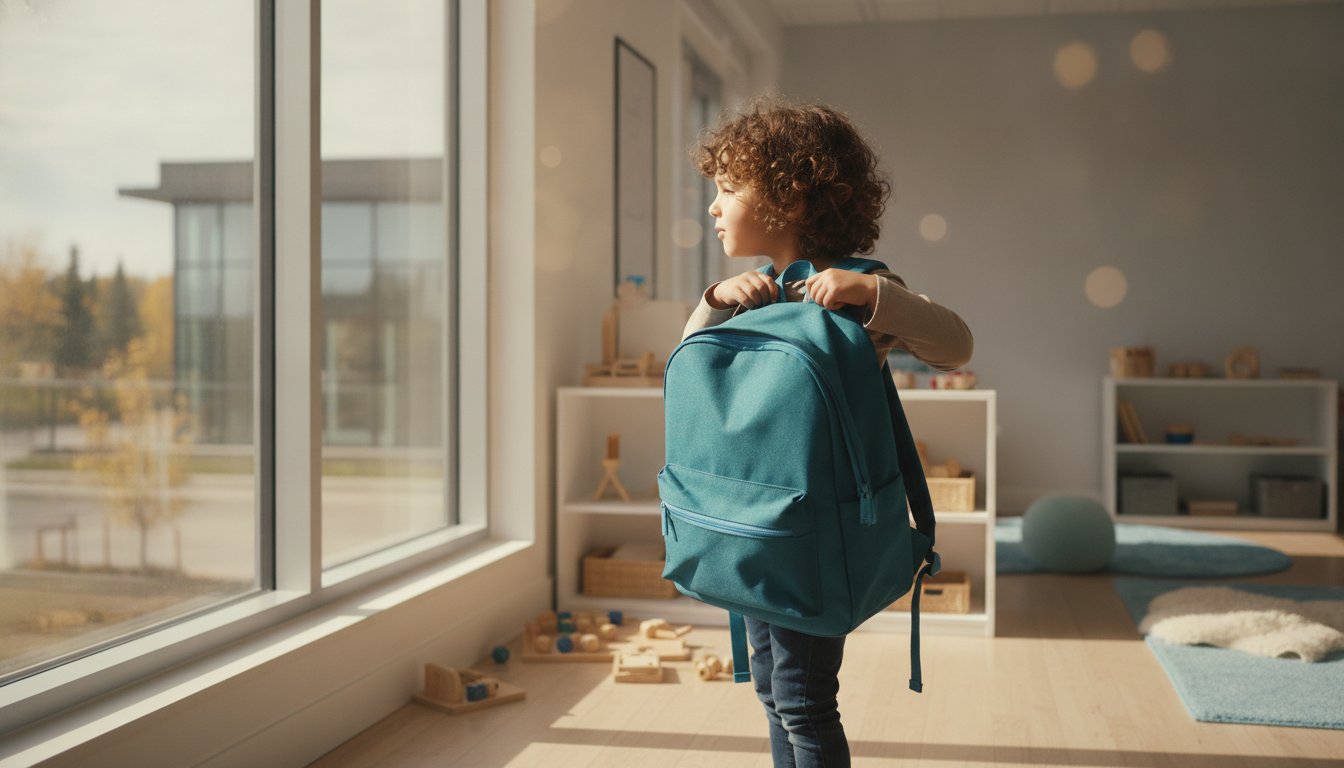
Imagine standing on the sidewalk in St. Albert next September, watching your child step onto a yellow school bus for the first time. It's a moment filled with pride, but for many parents, it's also shadowed by questions about whether their little one is truly ready for such a big step. Transitioning from daycare to kindergarten is about more than just new shoes and a lunchbox. It's a fundamental shift in your family's daily rhythm and your child's social world.
You likely feel a mix of excitement and worry about how they'll handle shorter school hours or if they'll keep up academically with their new peers. We understand that the logistics of bus schedules and the search for quality after-school care can feel overwhelming. This guide will help you navigate the emotional and practical aspects of this milestone while ensuring your child feels confident and supported. We'll provide a clear readiness checklist, a plan for managing your new routine, and the local insights you need to feel certain that your child will thrive in the St. Albert school system.
Key Takeaways
- Understand the environmental shift from a full daycare day to the shorter, structured schedule of a St. Albert kindergarten classroom.
- Prioritize social-emotional regulation and independent problem-solving skills to ensure your child is truly prepared for the classroom environment.
- Master the logistics of transitioning from daycare to kindergarten by practicing essential self-help skills like managing lunch containers and school-friendly clothing.
- Navigate the St. Albert school landscape with confidence by comparing local boards and exploring Out of School Care (OSC) options that fit your family’s schedule.
- Learn how to utilize available financial supports, including Alberta grants, to make high-quality care and early education accessible for your family.
The Big Leap: What to Expect When Transitioning from Daycare to Kindergarten
The move from a full-day licensed daycare to a kindergarten classroom is often the first major systemic change a child experiences. In St. Albert, 2026 is a particularly significant year for families. With the province having moved toward a flat fee for younger children and implementing a refreshed K-6 curriculum, the landscape of early education is evolving. Parents aren't just managing a new schedule; they're navigating a higher demand for spaces and a more structured academic environment. Transitioning from daycare to kindergarten involves moving from a 10-hour day of consistent care to a shorter, highly regulated school day that requires a different kind of stamina.
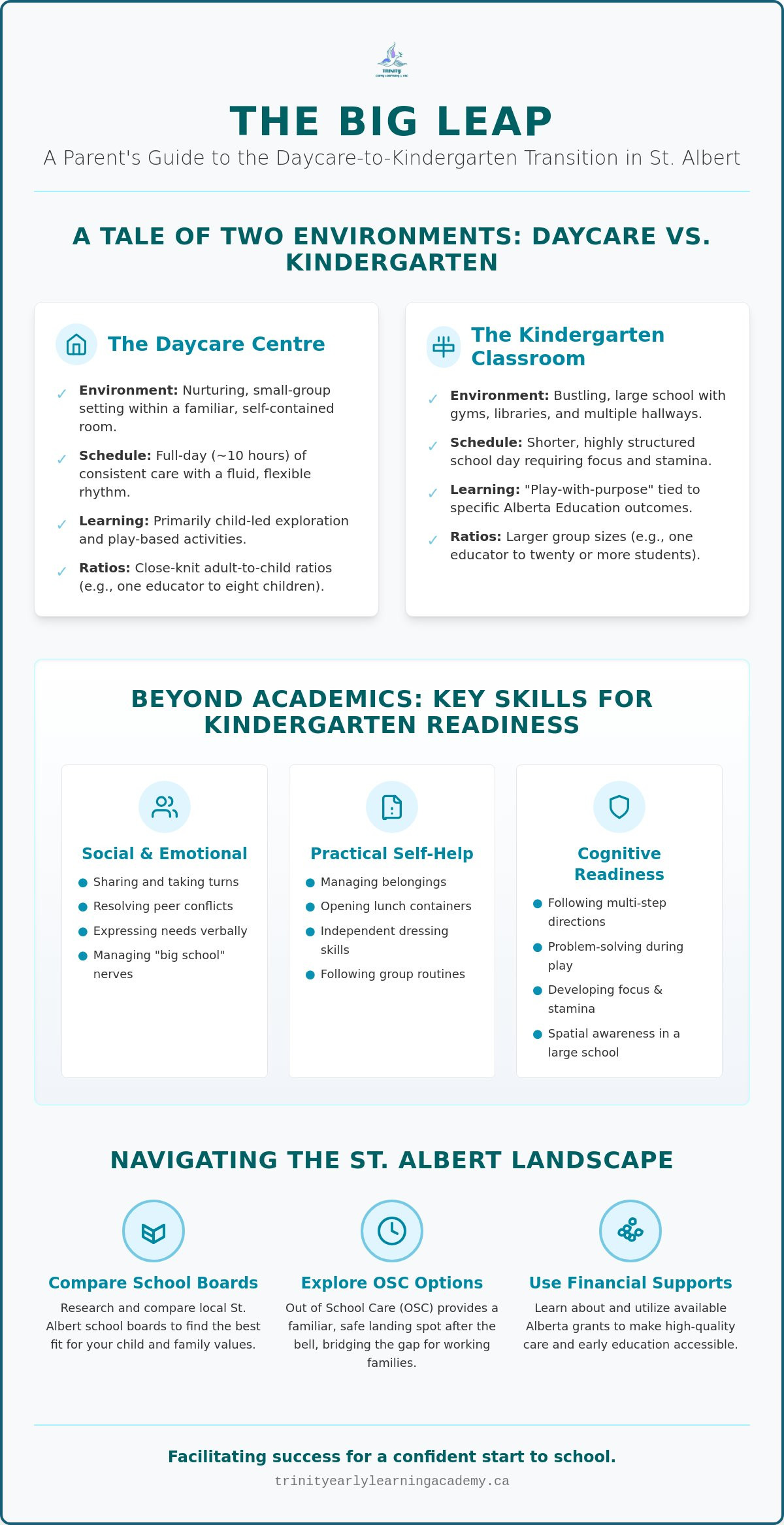
This shift represents a significant change in the level of adult support. While daycare centres prioritize close-knit ratios and individual attention, kindergarten classrooms often have larger groups with fewer educators. Developing these kindergarten readiness skills involves more than just academic knowledge. It requires a child to adapt to a world where they're one of twenty students rather than one of eight. It's a big change. Your child will go from a nurturing, small-group setting to a bustling school building where they must manage their own belongings and follow group-based instructions.
Identifying the Core Differences in Environment
In a daycare or preschool setting, the day is often fluid, allowing for extended periods of child-led exploration. Kindergarten introduces "play-with-purpose." This means that while children are still learning through activities, those activities are tied to specific Alberta Education outcomes. The physical environment also changes. Your child will move from a familiar, self-contained room to a large school building with a gymnasium, library, and multiple hallways. This requires a new level of spatial awareness and independence that we help foster in our preschool programs.
Managing Emotional Transitions for the Whole Family
Emotional labour is a real part of transitioning from daycare to kindergarten for both children and parents. It's natural to feel anxious about whether your child will make friends or listen to the teacher. We encourage parents to validate their child's "big school" nerves without projecting their own worries. Use positive reinforcement to build excitement about their new school centre. When the first day arrives, the most successful approach is a quick, loving goodbye. Lingering can often increase a child's distress. Trust that the educators are trained to help your child settle in, and remember that our OSC program provides a familiar, safe landing spot for them after the school bell rings.
Beyond Academics: Developing Essential Kindergarten Readiness Skills
When parents think about their child starting school, they often focus on whether the child can recite the alphabet or count to twenty. While these are helpful milestones, they aren't the primary indicators of success. Kindergarten Readiness is a holistic developmental state encompassing physical, social, and emotional maturity, rather than a simple checklist of academic test scores. In the process of transitioning from daycare to kindergarten, the ability to regulate emotions and interact with peers often outweighs rote memorization in importance.
A child's day in a St. Albert classroom requires significant mental and physical stamina. Moving from the flexible environment of a daycare centre to a structured school day demands a high level of focus. Play-based learning serves as the foundation for this transition, as it allows children to develop critical problem-solving skills in a low-pressure environment. For example, when a child works with others to build a complex structure, they're learning to negotiate, plan, and execute a shared vision. These are the exact skills they'll need when they enter a larger classroom setting. Additionally, mastering multi-step directions is a vital survival skill. A typical classroom request might be "Put your folder in your cubby, wash your hands, and find a spot on the carpet." Practising these sequences at home helps build the cognitive "muscle" required for school success.
Social and Emotional Milestones to Focus On
Success in a new school environment depends heavily on a child's ability to navigate social complexities. This includes sharing resources, taking turns, and resolving peer conflicts without constant adult intervention. It's also essential for children to feel comfortable expressing their needs and feelings clearly to a new teacher. Building the confidence to try a new task, even if it seems difficult at first, ensures they don't feel defeated by the new challenges of the curriculum. Focusing on these areas is a key part of easing the transition to kindergarten for the whole family.
Building Independence and Self-Care Habits
Practical independence is often what makes or breaks a child's confidence during those first few weeks. In Alberta, this specifically includes mastering winter gear. A child who can manage their own zippers, buttons, and boots feels empowered during the busy transition to outdoor recess. Independent bathroom routines and consistent hand-washing protocols are also expected. We encourage parents to help their children take responsibility for personal belongings, such as backpacks and hats, to prepare them for the organizational demands of a larger school. If you're looking for a supportive environment to practice these skills, our licensed daycare and preschool programs focus on fostering this exact type of independence every day.
The Logistics of 'Big School': Preparing Your Home Routine
The child's development is only one side of the coin. For parents, transitioning from daycare to kindergarten is a significant logistical shift that requires a new level of morning precision. In a licensed daycare setting, you might have enjoyed a flexible drop-off window. Kindergarten operates on a strict bell schedule. Missing the bus or being late for the morning line-up can create unnecessary stress for a child who is already processing a lot of change. Establishing a predictable home rhythm is the best way to ensure the whole family feels prepared for the first bell.
In cases where your primary transportation plan falls through, or if you require reliable transit in other Alberta hubs like Airdrie, taxicabairdrie.ca provides professional cab services to keep your schedule on track.
One of the most overlooked hurdles is the "Lunchbox Challenge." In many childcare environments, educators are available to help peel oranges or open stubborn plastic lids. In a busy St. Albert classroom, your child needs to be the master of their own meal. We recommend spending the summer practising with the exact containers they will use in September. If they can't open a container independently, it shouldn't go in the backpack. This small step builds immense confidence during those first few weeks of school. It empowers your child to focus on eating and socialising rather than waiting for an adult's help.
Mastering the Lunchbox and School Supplies
Many Alberta schools now prioritize "litter-less" lunches to reduce environmental waste. This means using reusable containers rather than disposable wraps or bags. Choose bento-style boxes with single latches that are easy for small hands to manipulate. Labelling is your best defence against the "lost and found" bin. Use a permanent marker or durable adhesive labels for everything from indoor shoes to water bottles. It's a simple way to ensure that items sent to school actually return home at the end of the day.
Adjusting Sleep Schedules and Morning Rhythms
The stamina required for a school day is different from a day spent at a daycare centre. To avoid the "October slump," start shifting bedtimes earlier about two weeks before the first day of school. A visual morning checklist can be a powerful tool for reducing anxiety. Include simple tasks like "brush teeth," "put on socks," and "grab backpack." When a child can see what comes next, they feel more in control of their environment. A nutritious breakfast, rich in protein and complex carbohydrates, provides the steady energy they need to stay focused until their first snack break.
Establishing a "Launch Pad" near your front door is an excellent organizational habit. This dedicated spot for backpacks, library books, and school notices prevents the frantic morning search for a missing shoe. Take time to practice the commute. Whether your child will be walking to a neighbourhood school or taking the yellow bus, physically doing the route several times helps normalize the experience. It turns a potentially scary "first time" into a familiar, safe routine. For parents who are also managing their own licensing requirements or those of older children, you can learn more about professional road test booking services.
Navigating the St. Albert School Landscape: Boards, OSC, and Grants
Understanding the local school system is a vital step for parents transitioning from daycare to kindergarten. In St. Albert, children are eligible to register for the 2026-2027 school year if they turn five on or before December 31, 2026. While the transition brings excitement, it also requires families to make important decisions about school boards and child care logistics. Registration for most local schools typically opens in early February 2026. It is not a first-come, first-served process during the official window, so you have time to research the best fit for your child's unique needs.
Understanding St. Albert School Board Options
Families in our community primarily choose between St. Albert Public Schools and Greater St. Albert Catholic Schools (GSACRD). Both boards offer high-quality education, but they differ in their programming and mission. St. Albert Public Schools provides a wide range of specialized programs, including French Immersion and Cogito. GSACRD offers a faith-based environment with a focus on holistic spiritual and academic growth. When researching, check the specific school boundaries for your neighbourhood, as priority is often given to students living within a school's designated attendance area. Exploring these options early allows you to align your child's education with your family's values.
Integrating Out of School Care (OSC) for Working Families
One of the biggest logistical hurdles for modern families is the gap between the school bell and the end of the workday. Kindergarten hours are significantly shorter than a typical daycare day. Out of School Care (OSC) serves as the essential bridge for this period. A licensed program provides a seamless environment where children can relax, play, and continue their social development after class. For many parents, finding reliable out of school care St. Albert is the key to maintaining professional commitments while ensuring their child is safe and supported.
The financial aspect of child care also changes during this milestone. For children in a licensed daycare or preschool, the Alberta Affordability Grant helps reduce fees to a flat monthly rate. However, once a child moves into a dedicated OSC program, these grants generally no longer apply. Instead, families with a gross household income of less than $90,000 can apply for the provincial Child Care Subsidy to help manage costs. We understand that these administrative details can be complex. If you have questions about how these changes affect your family, we invite you to contact our administrative team for personalized guidance on our licensed care options.
Bridging the Gap: How Trinity Early Learning & OSC Facilitates Success
Transitioning from daycare to kindergarten is a significant milestone, but it doesn't have to be a source of stress for your family. At Trinity Early Learning & OSC, we act as a stable partner during this time of change. Our approach ensures that the shift is not a sudden jump into the unknown but a natural progression supported by familiar faces and proven educational strategies. We focus on creating a nurturing environment where children feel secure enough to take the next big step in their educational journey with confidence.
The foundation for school success is built long before the first day of September. Our preschool programs St. Albert are intentionally designed to align with Alberta Kindergarten milestones. We move beyond simple academic rote learning to focus on the holistic development of every child. This includes fostering social-emotional regulation, which is a critical survival skill for larger classrooms. By prioritizing these developmental domains, we ensure our students are prepared for the social and academic expectations of the St. Albert school system.
Our Preschool Curriculum as a Kindergarten Foundation
In our classrooms, we encourage independence through daily routines. Children practice opening their own containers, managing their outdoor gear, and solving social problems with minimal intervention. These experiences act as a vital training ground. When they eventually step into a St. Albert public or catholic school, they already possess the self-help skills and confidence required to thrive. Our educators act as knowledgeable advocates, guiding children through purposeful play that builds the cognitive stamina needed for a full school day.
Seamless Transitions with Our St. Albert OSC Program
Consistency is the key to emotional stability for young children. When a child attends our out of school care (OSC) program, they find a familiar centre that remains constant even as their school environment changes. This continuity is vital during the year of transitioning from daycare to kindergarten. Our educators provide a bridge between the classroom and home, offering a safe space where children can relax after a day of focused school activity. We prioritize a welcoming, community-focused atmosphere that helps children feel at home the moment they arrive.
We understand that the kindergarten year is a period of adjustment. Our OSC program supports this by offering a balance of structured activities and much-needed relaxation. As experts in early childhood education St. Albert, we ensure a seamless hand-off between the school bus and our care. By maintaining a high standard of licensed care and a nurturing atmosphere, we help your child navigate their new world with joy. We're here to ensure your family feels supported through every logistical and emotional step of this transition.
Building a Foundation for Your Child's School Years
Transitioning from daycare to kindergarten is a significant milestone that requires both emotional and practical preparation. By prioritizing independence and social-emotional skills, you help your child step into their new St. Albert classroom with confidence. Success isn't just about academics; it's about the steady support and predictable routines you build at home and within your childcare community. Our licensed and accredited centre provides a seamless integration with local school schedules, ensuring your family stays organized and supported throughout the year.
Our experienced educators specialize in early childhood development and are dedicated to providing a nurturing, stable environment for every child. We understand the complexities of modern family life and act as a knowledgeable advocate for your child's growth. We invite you to book a tour at Trinity Early Learning & OSC to see how we prepare your child for kindergarten success. We look forward to partnering with you to make this transition a joyful and positive experience for your little learner.
Frequently Asked Questions
How do I know if my child is ready for kindergarten in Alberta?
To register for the 2026-2027 school year, your child must be five years old on or before December 31, 2026. Beyond the age requirement, readiness is defined by social-emotional maturity and the ability to manage self-care tasks independently. A child who can express their needs clearly and follow simple group instructions is generally well-prepared for the classroom environment. Holistic growth is often a better indicator of success than academic scores.
What is the difference between daycare and kindergarten schedules?
Kindergarten schedules are significantly shorter and more rigid than the flexible 10-hour days common in licensed daycare centres. Most St. Albert programs operate on half-day or alternating full-day schedules, which often leaves a gap for working parents. Transitioning from daycare to kindergarten requires a new plan for these shorter hours, making a reliable out of school care program an essential part of your family's daily rhythm.
How can I help my child with separation anxiety during the transition?
You can reduce anxiety by establishing a predictable morning routine and practicing quick, loving departures at the school door. Validating your child's feelings while remaining calm and positive helps them feel secure in their new environment. Because transitioning from daycare to kindergarten involves so much change, providing them with a familiar and consistent "landing spot" like a dedicated OSC program after school can help them feel more grounded.
What should I look for in a St. Albert out of school care (OSC) program?
Look for a licensed program that offers seamless transportation to and from your child’s specific school. A high-quality out of school care program should provide a balance of structured activity and much-needed relaxation, led by experienced educators who understand early development. It is also important to ensure the program’s philosophy aligns with your child's needs and offers a safe, nurturing community where they feel they belong.
Does the Alberta Affordability Grant apply to kindergarteners in OSC?
No, the Alberta Affordability Grant does not apply to out of school care programs for children in kindergarten to Grade 6. This specific grant is reserved for younger children in daycare or preschool settings. However, families with a gross household income of less than $90,000 per year may still be eligible for the provincial Child Care Subsidy. This subsidy provides financial assistance to help eligible families manage the costs of licensed out of school care.
What are the registration deadlines for St. Albert schools in 2026?
Kindergarten registration for the 2026-2027 school year typically opens in early February 2026 for both St. Albert Public and Greater St. Albert Catholic Schools. While registration is not first-come, first-served during this initial window, applying early is recommended. This ensures you have the best chance of securing a spot at your designated neighbourhood school before popular programs or specific school sites reach their maximum enrolment capacity.
How do I prepare my child for the school bus in St. Albert?
Start by walking to the designated bus stop several times before the first day to build a sense of familiarity. Explain the importance of staying seated and listening to the bus driver's instructions at all times. Many local school boards offer "First Rider" programs in late August. These sessions allow children to practice boarding the bus and learning safety rules in a calm, controlled environment before the school year begins.
What academic skills should my child have before starting kindergarten?
Teachers generally prioritize functional and social skills over specific academic milestones like reading. Your child should ideally be able to follow two-step directions, share resources with peers, and take responsibility for their own belongings. Fine motor skills, such as using a zipper or holding a pencil, are also highly beneficial. These foundational abilities allow your child to focus on new learning outcomes once they are settled into the classroom environment.


