

You've just finished another morning where your toddler clung to your leg, sobbing as if you were leaving them forever, and now you're sitting in your car at the office feeling a heavy weight of guilt. It's a heartbreaking struggle that leaves many parents wondering exactly what to do when your child hates daycare and whether their early learning centre is truly the right fit. This resistance often feels like a personal failure, but it's actually a developmental communication that we can decode together to restore peace to your mornings.
We understand that you simply want your child to feel safe, nurtured, and excited about their daily adventures. It's completely normal to feel exhausted by these power struggles, yet we promise there's a clear path toward tear-free drop-offs and genuine confidence in your childcare choice. This guide provides professional, compassionate strategies to help your child overcome their resistance and find joy in their environment. We'll explore how to identify specific triggers, refine your transition routines, and build a collaborative partnership with your licensed provider to ensure your little one thrives.
Key Takeaways
- Understand that daycare resistance is often a normal developmental milestone linked to separation anxiety rather than a failure of care or parenting.
- Discover practical steps for what to do when your child hates daycare, including how to establish a predictable morning routine that centres your child's emotional needs.
- Learn how to identify environmental triggers at your childcare centre, such as noise levels or transitions, that could be contributing to your child's distress.
- Professionalize your communication with educators by moving beyond the 30-second drop-off chat to gain deeper insights into your child's daily experiences.
- Gain clarity on the specific "stress test" timeline and objective red flags that help you decide if it is time to re-evaluate your current licensed provider.
Understanding the 'I Hate Daycare' Phase: Is This Normal?
It is 8:00 AM, and you are facing a tearful protest at the front door. This moment is incredibly stressful for any parent, but please realize that you aren't alone in this struggle. Most children experience some level of resistance when transitioning to an early learning environment. This phase is rarely a reflection of your parenting or the quality of the care provided; instead, it is a natural developmental response to change. When you're searching for what to do when your child hates daycare, the first step is to understand that these big emotions are actually a sign of a healthy attachment to you.
Daycare regression is another common hurdle that often catches families off guard. You might find that after a long holiday, a bout of illness, or even a busy long weekend, your child suddenly resists going back to their routine. This happens because consistent schedules provide a sense of safety for young children. When that routine is broken, they may feel a temporary loss of control, leading to a renewed protest at drop-off. View this as a request for extra reassurance rather than a permanent setback in their progress.
The Timeline of Adjustment
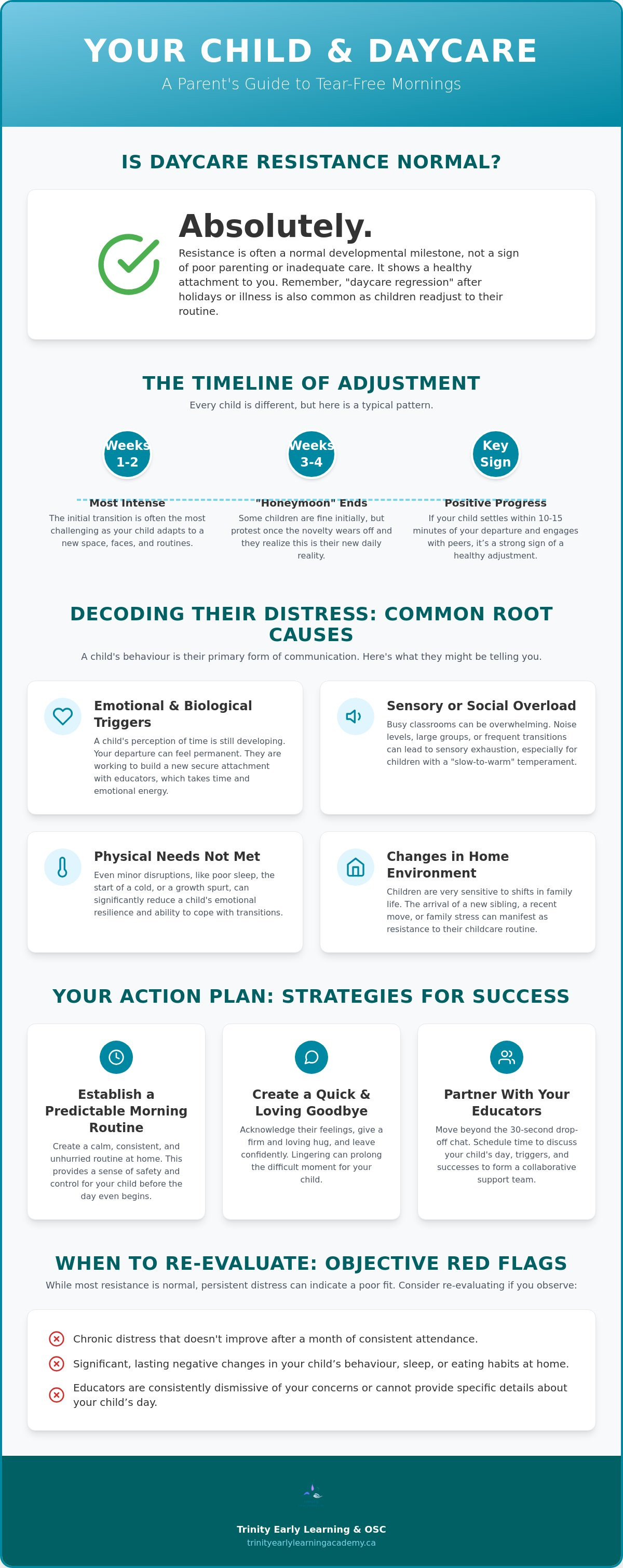
The first two weeks of a new program are typically the most intense as your child navigates a new physical space and unfamiliar faces. However, some families experience a "honeymoon phase" where the child is initially curious and calm, only to start protesting after three or four weeks. This occurs because the novelty has worn off and the child realizes this is their new daily reality. Distinguishing between temporary protest and chronic distress is key. If your child settles within ten minutes of your departure and engages with their peers, it is likely a normal transition phase that will pass with consistency.
Biological and Emotional Triggers
A child’s perception of time is vastly different from an adult’s. They don't yet have the cognitive ability to understand that "four o'clock" means you are coming back. To a toddler, your departure can feel permanent in the moment. This is where the concept of a "secure base" becomes vital for their emotional security. Even if you've chosen the best daycare St. Albert has to offer, your child still needs time to build a new secure attachment with their educators. This biological need for safety is the primary reason why some children struggle initially. They aren't "hating" the centre; they're simply working through the emotional labour of building trust in a new environment.
Identifying the Root Cause: Why Children Resist Childcare
When a child protests their morning routine, it is rarely a simple act of defiance. In early childhood, behaviour is the primary form of communication. Your child may not have the complex vocabulary required to explain that they feel overstimulated or insecure. Instead, they use tears and resistance to signal that something in their environment or internal state feels out of balance. To determine what to do when your child hates daycare, you must first act as a detective to uncover the specific triggers behind their distress.
Physical needs and social dynamics are often the quietest yet most influential factors. A slight disruption in sleep patterns or the early stages of a common cold can drastically reduce a child's emotional resilience. Similarly, even very young children navigate the complexities of peer interaction. A minor conflict over a shared toy or a change in the classroom's educator team can make the environment feel unpredictable. Identifying whether the resistance is tied to a specific day of the week or a particular event can help you address the root cause with compassion.
Sensory and Social Overload
The atmosphere of a busy classroom is naturally vibrant, but for some children, this energy leads to sensory exhaustion. In a high-quality early learning center St. Albert, professional educators are trained to manage these noise levels and provide quiet zones for rest. If your child has a "slow-to-warm" temperament, they may find large group sizes or frequent room transitions overwhelming. Watch for signs of overload, such as your child appearing unusually withdrawn or irritable immediately following pick-up, as these often indicate that the social environment is currently exceeding their comfort level.
Changes in the Home Environment
Children are incredibly sensitive to shifts in their family life. The arrival of a new sibling, a recent move, or even a parent’s new work schedule can create a sense of instability that manifests as daycare resistance. It is common for children to "save up" their most intense emotions for their parents, which is their ultimate safe space. This means a child might appear to be "hating daycare" when they are actually just expressing how much they miss the security of your presence. If you're looking for a partner to help manage these transitions, you might find that choosing a supportive licensed provider makes a significant difference in your child's emotional security. Understanding these home-to-centre connections is a vital part of knowing what to do when your child hates daycare and ensuring they feel supported in both environments.
This commitment to emotional security often extends to the entire household. For families who also want to ensure their pets are supported, professional environments like Tails On Trails Pet Resort provide a nurturing setting that reflects the same high standards of care parents seek for their children during transitions.
Practical Strategies to Smooth the Transition at Home
While identifying root causes is essential, you also need immediate tools to manage the daily struggle. When considering what to do when your child hates daycare, the environment you create before you even reach the centre is just as important as the care they receive there. Children rely on your emotional cues to determine if a situation is safe. If your body language projects anxiety or hesitation, your child will instinctively mirror that stress. Maintaining a calm, confident presence tells them that while this transition is hard, it is manageable and safe.
Predictability is the foundation of emotional security for young children. A morning routine that centres their needs reduces the number of "unknowns" they face before drop-off. You might also consider using "bridge objects" to maintain a tangible connection to home. A small family photograph kept in their cubby or a matching "heart" drawn on both your hands can serve as a powerful reminder that you remain connected even when you are physically apart. These small gestures provide a sense of continuity that helps bridge the gap between home and their early learning environment.
The Art of the Drop-Off
A successful goodbye is brief, loving, and final. You should aim for a ritual that lasts no more than three minutes. This might include a special handshake, a hug, and a clear statement of when you will return. It is vital that you never sneak away, even if your child is happily engaged in play. While sneaking out might avoid an immediate tantrum, it ultimately destroys the trust your child has in your departures. Instead, use validation techniques. Say, "I see you are feeling sad right now, and that's okay. I will be back to get you after your afternoon snack." This acknowledges their feelings while reinforcing the certainty of your return.
After-Daycare Reconnection
Many parents are surprised when their child, who was reportedly fine all day, has a total meltdown the moment they see them at pickup. This is known as "restraint collapse." Your child has worked hard to hold their emotions together in a social setting and finally feels safe enough to let go in your presence. To manage this, prioritize fifteen minutes of undivided attention immediately after you get home. Avoid asking broad questions like "How was your day?" which can feel overwhelming. Instead, ask specific, low-pressure questions such as "What was the funniest thing that happened at the water table?" or "Who did you sit next to during story time?" This focused reconnection helps your child process their day and reinforces the safety of your bond.
Collaborating with Your Licensed Daycare Provider
While home strategies are vital, the most effective solution involves building a strong partnership with your childcare team. When you are determining what to do when your child hates daycare, you shouldn't have to navigate the emotional challenges alone. A professional educator sees a side of your child that you rarely witness. By moving beyond the 30-second drop-off chat, you can access valuable insights into your child's "hidden" day. Scheduling a formal check-in allows you to discuss their eating habits, sleep quality, and peer interactions without the distraction of a busy classroom transition.
In a high-quality licensed daycare St. Albert families trust, the use of primary caregiving is a standard practice. This means your child is paired with a specific educator who focuses on building a deep, secure bond with them. This consistency helps the child feel seen and understood. Share your "home wins" and current challenges with this educator. If your child slept poorly or is excited about a new toy, let the provider know. This shared information ensures a consistent approach to emotional support throughout the day.
Building a Team Around Your Child
Educators at Trinity Early Learning & OSC are trained to support emotional regulation during difficult phases. If the morning protests continue, you can request a formal transition plan. This might include a temporary change in drop-off routine or extra one-on-one time with a favourite educator upon arrival. Many modern centres also use daily reports or communication apps. Use these digital updates to find "anchor points" for conversation at home. If you see they enjoyed a painting activity, you can mention it during dinner to reinforce the positive aspects of their day.
Leveraging Professional Expertise
Your child's educator serves as a knowledgeable advocate for your family's well-being. High early childhood education St. Albert standards ensure that staff understand developmental milestones and emotional safety. If you are concerned that the resistance is more than just a phase, ask for a professional observation or a developmental screening. This collaborative approach provides peace of mind and ensures your child receives the specific support they need to thrive. If you're feeling overwhelmed by morning struggles, contact our team of professional nurturers to discuss a personalized support plan for your child.
When to Re-evaluate: Signs Your Current Centre Might Not Be the Right Fit
While the initial adjustment period requires patience, there are times when a child's persistent distress indicates that the environment itself is not the right match. If you have consistently applied transition strategies and collaborated with educators for four to six weeks without seeing any improvement, it is time to perform an objective "stress test." When determining what to do when your child hates daycare, you must distinguish between a developmental phase and a fundamental lack of compatibility between your child's needs and the centre's operations.
Objective red flags often centre on stability and transparency. High staff turnover is a significant concern because it prevents the formation of the secure attachments children need to feel safe. If your child's primary educator changes frequently, the resulting instability can cause chronic anxiety. Similarly, a lack of transparency regarding daily incidents or a philosophy that feels overly rigid for your child's personality are valid reasons to reconsider your choice. Trusting your intuition is important, but balancing that feeling with professional evidence ensures you make a decision based on your child's long-term well-being.
Normal Anxiety vs. Poor Environment
Normal separation anxiety usually dissipates shortly after drop-off, but a poor environment may trigger deeper behavioural shifts. Watch for regressions that extend into your home life, such as frequent nightmares, sudden potty training setbacks, or a total loss of interest in previously enjoyed activities. These can be signs that the classroom lacks the necessary structure or emotional support. Reviewing a safe daycare environment Alberta checklist can help you verify if the centre meets high standards for teacher-child ratios and active engagement. If the educators appear overwhelmed or disengaged, your child's resistance is likely a response to a lack of emotional security.
Finding the Right Foundation
Sometimes, the issue isn't the quality of care but the type of program. For older toddlers who crave more cognitive stimulation, a structured preschool program St. Albert families recommend might be more appropriate than a general daycare setting. When touring new facilities, focus specifically on the emotional atmosphere and how educators interact with children during transitions. If you decide to move, frame the change positively to avoid causing more trauma. Explain that you've found a "new school" that is a better fit for their growing skills. This ensures the transition is viewed as a positive step forward rather than a reaction to a "bad" situation, helping your child build resilience for their new beginning.
Restoring Peace to Your Morning Routine
Navigating the emotional complexity of daycare resistance is a journey that requires patience, consistency, and professional support. By identifying the root causes of your child's distress and implementing predictable goodbye rituals, you can transform stressful drop-offs into moments of growth. It's helpful to remember that knowing what to do when your child hates daycare involves viewing their behaviour as a request for reassurance rather than a permanent rejection of their early learning environment.
At Trinity Early Learning & OSC, we are committed to being a supportive partner for your family. As a family-run, community-focused centre in St. Albert, our professional educators are dedicated to holistic development and emotional security. We are a licensed and Alberta Grant-approved childcare provider that prioritizes a safe, nurturing atmosphere where every child can thrive. Book a tour at Trinity Early Learning & OSC to see how we nurture every child's transition.
You don't have to manage these transitions alone. With the right foundation and a compassionate team by your side, your child can move past the tears and find genuine joy in their daily adventures.
Frequently Asked Questions
How long should it take for a child to stop crying at daycare drop-off?
Most children take between two and four weeks to adjust fully to a new childcare routine and stop crying during drop-off. This period allows them to form a secure bond with their educators and understand the daily rhythm of the centre. If the intense protests persist beyond a month without any signs of settling during the day, it is helpful to consult with your provider about a personalized transition plan.
Is daycare regression real, and what causes it after months of happy attendance?
Daycare regression is a real and common occurrence often triggered by disruptions such as holidays, illness, or a new sibling at home. Even after months of happy attendance, a child may suddenly protest drop-off because their sense of predictability has been temporarily shaken. Maintaining a consistent morning routine and offering extra reassurance usually helps them return to their previous comfort level within a few days.
Should I stay with my child at daycare until they feel comfortable?
Staying for an extended period often increases a child's anxiety rather than soothing it because it delays the inevitable transition. A prolonged departure sends a signal that the environment might not be safe, which makes the eventual separation harder for everyone. Instead, establish a brief, loving goodbye ritual that lasts no more than three minutes. This confidence tells your child that you trust their educators and that they are safe in their care.
What are the most common red flags to look for in a daycare centre?
Key red flags include high staff turnover, a lack of transparency regarding daily activities, and inconsistent adherence to safety protocols. If you notice that your child's primary educator changes frequently, it can prevent the formation of a secure attachment. You should also be concerned if the centre discourages unannounced visits or fails to provide detailed reports about your child's eating, sleeping, and social interactions.
Can a child truly 'hate' daycare, or is it just separation anxiety?
It is rare for a young child to truly "hate" a high-quality centre; most resistance is actually a manifestation of separation anxiety or sensory overstimulation. Children lack the emotional vocabulary to describe feeling overwhelmed by noise or missing their parents. When you are deciding what to do when your child hates daycare, it is essential to look for the "why" behind the tears, as it is often a request for more emotional support during a transition.
What should I do if my child only cries with one specific teacher?
If your child only cries with one specific teacher, it is important to observe their interaction and speak with the centre director. This protest might simply be a personality clash or a lack of a primary bond, especially if that teacher is new or has a very different energy level. A professional centre will work with you to ensure your child feels a secure connection with at least one consistent caregiver to facilitate a smoother morning transition.
How can I help my toddler realize that I will always come back for them?
You can help your toddler understand you will return by using concrete "anchor points" in their day rather than clock times. Tell them you will be back "after afternoon snack" or "after the playground time" so they have a tangible event to look forward to. Consistently arriving when you say you will builds their internal trust. Using a "bridge object," like a small family photo in their cubby, also provides a physical reminder of your connection while you are apart.
When is it better to switch daycares rather than trying to make it work?
Switching centres is often the best choice if you see no improvement after six weeks of consistent effort or if your child's personality fundamentally clashes with the program's philosophy. If the resistance is accompanied by significant regressions in sleep or potty training that don't resolve, it may indicate a lack of emotional fit. Trusting your professional intuition while weighing objective evidence ensures you find a foundation that truly supports your child's growth.


