
Imagine watching your child at a local St. Albert park as they struggle to share a shovel in the sandbox, leading to a tearful standoff that makes you question if you've done enough social skills activities for preschoolers at home. It's a common worry for many parents who want to ensure their little ones are prepared for the social dynamics of a structured learning environment. You aren't alone in feeling uncertain about what normal social development looks like or how to handle these everyday playdate conflicts.
The good news is that these foundational abilities are best nurtured through "play with purpose," a concept central to Alberta’s Flight curriculum framework. This guide provides practical, play-based strategies to help your child develop the empathy and cooperation needed for kindergarten and beyond. We'll explore fifteen engaging activities you can start today, covering everything from managing big emotions to mastering the art of turn-taking, ensuring you feel confident in your child's social progress.
Key Takeaways
- Understand why social-emotional learning provides the essential foundation for your child's future academic success within the Alberta educational framework.
- Discover engaging social skills activities for preschoolers that transform sharing and turn-taking into collaborative and rewarding experiences.
- Learn how to foster emotional literacy by helping your child identify and label their feelings to build a strong sense of empathy.
- Equip your child with a practical "Stop-Think-Act" framework to resolve conflicts and communicate effectively during playdates and peer interactions.
- Recognize how a licensed childcare centre in St. Albert provides the structured, nurturing environment necessary for children to realize their full social potential.
What are Social Skills for Preschoolers and Why Do They Matter?
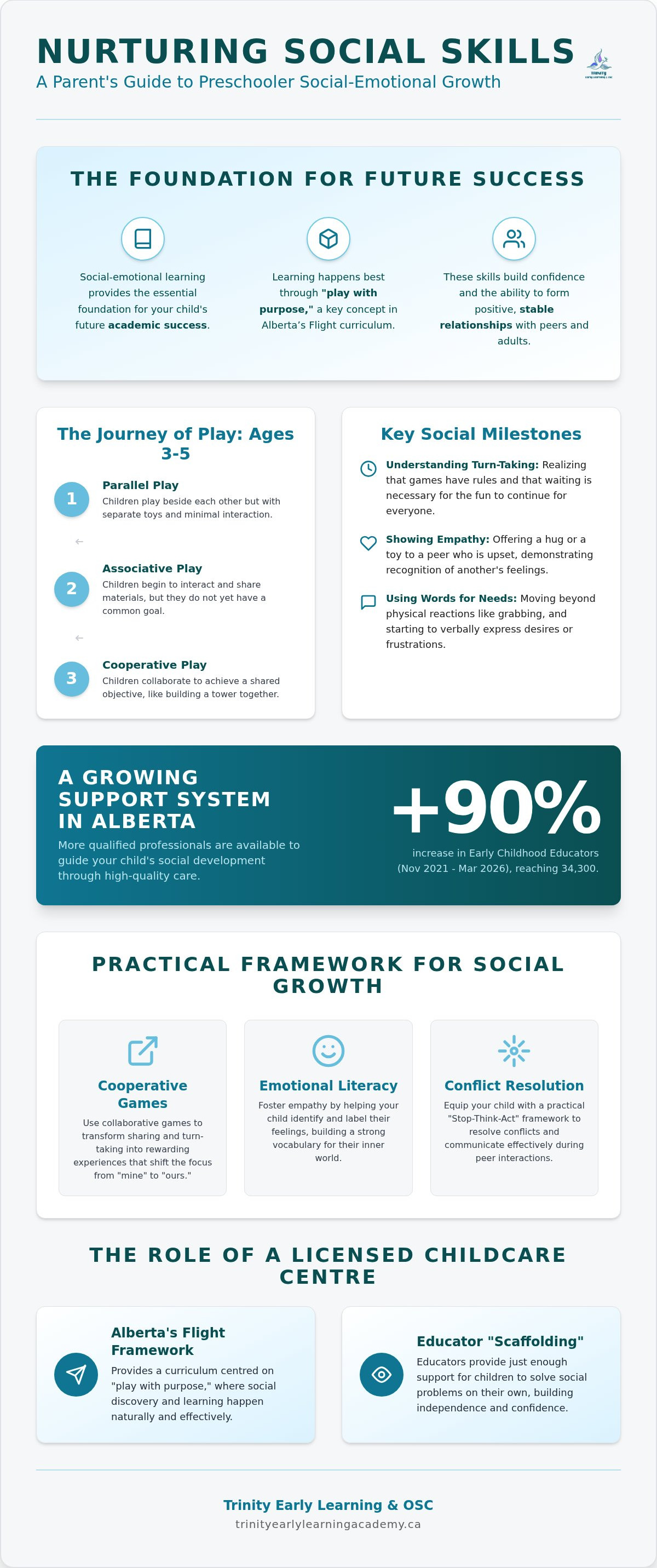
Social skills are the invisible tools that allow a child to interact effectively with the world around them. In the field of early childhood education, these abilities are often categorized under social-emotional development. This encompasses a child's capacity to manage their own emotions, understand the feelings of others, and establish positive, stable relationships with peers and adults. While many parents focus on ABCs and 123s, these social-emotional foundations are the true predictors of long-term academic success in the Alberta school system. Without the ability to focus and cooperate, a child will struggle to access the curriculum, regardless of their cognitive abilities.
Between the ages of three and five, children undergo a significant developmental shift in how they interact. They move from parallel play, where they play beside each other with separate toys, to associative and cooperative play. This transition is where they begin to share a common goal, such as building a block tower together or playing "house." This growth is supported by a growing workforce; between November 2021 and March 2026, the number of early childhood educators in Alberta increased by 90 percent to 34,300, ensuring more professionals are available to guide these interactions. High-quality licensed daycare in St. Albert prioritizes these milestones by providing a safe, structured environment where children can practice these complex interactions daily. Integrating social skills activities for preschoolers into their routine helps bridge the gap between playing alone and playing together.
Key Social Milestones for Ages 3-5
As children grow, their social capabilities become more refined. You can typically expect to see the following milestones during the preschool years:
- Understanding Turn-Taking: Children begin to realize that games have simple rules and that waiting for a turn is necessary for the fun to continue.
- Showing Empathy: A preschooler might offer a toy or a hug when they see a peer is upset or hurt, showing they recognize another person's emotional state.
- Using Words for Needs: Instead of physical reactions like grabbing or pushing, children start to use their words to express frustration or a desire for a specific toy.
The Role of Play-Based Learning
In a nurturing early learning centre, play is not just a break from learning; it is the primary "work" of a preschooler. This philosophy is deeply embedded in the Flight framework, Alberta's early learning and care curriculum. While structured lessons have their place, natural social discovery happens most effectively during open-ended play. This is where children encounter real-world challenges, like negotiating who gets the blue crayon or deciding the rules of a tag game. Educators use "scaffolding" during these moments. They provide just enough support to help a child solve a social problem on their own, rather than simply fixing the conflict for them. Engaging in purposeful social skills activities for preschoolers ensures that every interaction becomes a building block for future confidence.
Cooperative Games to Teach Sharing and Turn-Taking
Sharing is rarely a natural instinct for young children. In the early stages of development, a child's world is primarily focused on their own needs and immediate desires. Teaching a preschooler to give up a toy or wait for their turn requires patience and consistent practice. By reframing these moments as cooperative games rather than forced obligations, we help children see the value in working together. This approach is a core component of teaching emotional literacy, as it helps children recognize the needs of their peers while managing their own impulses.
In St. Albert, our weather often dictates whether we play indoors or outdoors. High-quality social skills activities for preschoolers should be adaptable to any environment. Whether you're at a local park in the summer or tucked away in a cozy playroom during a January snowfall, the goal remains the same: move from "mine" to "ours." These collaborative efforts are mirror images of the curriculum found in professional preschool programs in St. Albert, where educators facilitate group success through shared play.
Activity 1: The Collaborative Block Build
This activity transforms a standard building session into a lesson in patience. Instead of building separate structures, challenge your child to build one single "community tower" with you. The rule is simple: each person can only add one block at a time. This requires a shared vision and the ability to wait. It teaches children that their contribution is part of a larger whole. If your child finds the waiting period difficult, use a small sand timer to provide a visual cue for when it's their turn again. This scaffolding helps them realize that their turn will always come back, reducing the anxiety often associated with sharing.
Activity 2: Parachute Play (Home Edition)
You don't need a professional gym to enjoy parachute games. A large bedsheet works perfectly at home. Have everyone grab an edge of the sheet and place a soft ball or stuffed animal in the middle. The group must work in unison to keep the object "bouncing" without letting it fall off. This activity demands physical coordination and teamwork; if one person pulls too hard or lets go, the ball falls. To add a listening component, call out a family member's name. That person must run under the "parachute" and swap places with someone else while the sheet is high in the air. It's a joyful way to practice group awareness.
Building these habits at home creates a seamless transition into a group learning environment. If you're exploring how a structured setting can further support your child's growth, you might consider the benefits of our licensed childcare options that prioritize these social foundations every day.
Activities to Build Empathy and Emotional Literacy
Empathy is often described as the cornerstone of human connection. For a young child, developing this trait begins with a journey inward. Before a preschooler can understand that a peer is sad because a block tower fell, they must first understand the sensation of sadness within themselves. Using social skills activities for preschoolers that focus on naming these internal states helps build a robust emotional vocabulary. By teaching children to label a wide range of feelings, from joy and excitement to frustration and worry, we give them the tools to navigate their social world with greater clarity.
Emotional literacy is the ability to identify and communicate feelings effectively.
Perspective-taking is the next critical step in this developmental process. It involves moving beyond one's own immediate experience to consider how another person might be feeling in a specific situation. This shift from a self-centred view to a community-focused view is one of the most significant Social and Emotional Milestones for Preschoolers. When children learn to "walk in someone else's shoes," they are less likely to react with aggression and more likely to offer help or comfort. These skills are essential for the collaborative environment of a high-quality classroom.
Activity 3: The 'Feeling Mask' Craft
This hands-on project makes abstract emotions visible and tangible for young learners. Using simple paper plates, help your child create several masks representing different expressions: a wide smile for happy, downward-sloping eyes for sad, and an open mouth for surprised. While crafting, discuss the physical cues associated with each emotion, such as how our eyebrows move when we are angry or how our eyes crinkle when we are joyful. This activity helps children identify facial cues and expands their emotional vocabulary. Once the masks are finished, try playing a game where you ask your child to "wear" the mask that matches a story character's feelings. This physical action reinforces the connection between a situation and an emotional response.
Activity 4: Storytelling with a Twist
Books are powerful tools for social-emotional learning because they provide a safe distance to explore big feelings. To take this further, try reading a favourite book but pause at pivotal moments to ask, "How do you think they feel right now?" or "Why do you think they made that face?" This simple intervention encourages critical thinking and perspective-taking. It helps children realize that characters, like people, have internal lives that influence their actions. By incorporating these social skills activities for preschoolers into your daily reading routine, you help your child develop a more sophisticated understanding of how their peers might react in real-life playground scenarios. This builds a vital bridge between fiction and the social challenges they face every day.
Communication and Conflict Resolution Exercises
One of the most stressful experiences for parents is witnessing a physical conflict on the playground. When a child resorts to hitting or grabbing, it's often because they lack the verbal tools to express a big emotion or a specific need. These moments are not signs of poor behaviour; rather, they are opportunities for teaching. By introducing specific social skills activities for preschoolers, we can replace physical reactions with effective communication. This transition is vital for preparing children for the social expectations of a classroom setting.
To help children navigate these high-stress moments, we use a simple "Stop-Think-Act" framework. First, the child is encouraged to stop their physical impulse. Second, they think about what they want and how their peer might be feeling. Finally, they act by using their words. This three-step process simplifies complex social choices into manageable bites. It's a strategy frequently utilized within early childhood education in St. Albert, where educators model these scripts daily to ensure every child feels safe and heard.
Another powerful tool in our communication kit is the "I-statement." Instead of a child saying "You took my toy," which can sound like an attack, we teach them to say, "I feel sad when you take my toy." This shifts the focus to their own internal experience and invites a more empathetic response from their playmate. Practising these scripts at home through social skills activities for preschoolers builds the muscle memory needed for real-world interactions. If you're looking for a supportive environment where these communication skills are nurtured every day, learn more about our licensed childcare and preschool programs.
Activity 5: Puppet Problem-Solvers
Puppets provide a wonderful, low-pressure way to explore difficult social scenarios. Use two puppets to act out a common conflict, such as two friends wanting the same swing at the park. This creates a "safe" distance from the problem, allowing the child to analyze the situation without being overwhelmed by their own emotions. Your role as the parent is to facilitate; ask the child to suggest a solution for the puppets to try. This encourages them to become active problem-solvers who can see multiple sides of a disagreement.
Activity 6: The 'Telephone' Game Simplified
This classic game is excellent for teaching active listening and clear communication. Gather a small group and whisper a simple three-word phrase, like "The cat jumped," into the first person's ear. Each person repeats the phrase to the next until it reaches the end of the circle. The final person says the phrase out loud to see if it stayed the same. This activity demonstrates how easily messages can be misunderstood if we don't listen carefully. It's a lighthearted way to show that communication is a two-way street that requires focus from both the speaker and the listener.
How Licensed Childcare in St. Albert Fosters Social Growth
While home-based social skills activities for preschoolers provide a vital starting point, a licensed childcare environment offers the essential peer-rich setting required for real-world application. In a community-focused centre, children encounter a diverse range of personalities and social styles. This variety challenges them to adapt their communication and empathy in ways that are difficult to replicate in smaller family units. It is within these daily interactions that children truly realize the value of cooperation and the nuances of social harmony.
Our approach is guided by the Alberta Early Learning and Care Framework, also known as Flight. This framework views children as mighty learners and citizens, emphasizing that social growth happens through meaningful relationships and "play with purpose." Within this professional structure, everyday moments are transformed into intentional learning opportunities. Early Childhood Educators (ECEs) serve as social coaches who observe and gently guide interactions. When a conflict arises, an ECE does not just stop the disagreement; they use it as a teaching moment to practice the scripts and strategies discussed earlier, such as "I-statements."
The Benefit of Daily Peer Interaction
Circle time and shared meal times are critical periods for practicing group dynamics. In these settings, children learn to listen when others speak and respect the personal space of their peers. For those in an out of school care or mixed-age setting, younger children often look to older peers as role models for social behaviour. This community aspect fosters a deep sense of belonging within our St. Albert centre, helping children feel connected to a larger group beyond their immediate family.
Professional Scaffolding of Social Skills
Educators provide the scaffolding necessary for children to reach the next level of social maturity. This often includes the use of visual schedules, which help children feel secure by knowing what comes next in their day. When a child feels safe and the environment is predictable, they are more emotionally ready to engage in social skills activities for preschoolers with their friends. This professional oversight ensures that every child is supported at their individual developmental level. We invite you to book a tour at Trinity Early Learning to see our social-emotional curriculum in action and learn how we support your child's journey toward kindergarten readiness.
Building a Strong Foundation for Social Success
Nurturing your child's social-emotional growth is a journey that begins with simple, intentional moments at home. By integrating social skills activities for preschoolers into your daily routine, you help your child master the art of sharing, communication, and empathy. These foundations ensure they enter the classroom with the confidence to build lasting friendships and navigate new challenges with ease. While your support at home is invaluable, the structured environment of a professional centre provides the peer interactions necessary for children to truly thrive.
Trinity Early Learning & OSC offers a nurturing, family-run environment where your child's holistic development is our priority. As a licensed and accredited childcare provider, we are proud to be affordability grant eligible, making high-quality education accessible for St. Albert families. Our dedicated educators are here to act as social coaches, guiding every interaction with professional care. We invite you to explore our licensed preschool programs in St. Albert and see how our play-based curriculum supports your child's unique path. You are doing a wonderful job guiding your little one, and we are ready to partner with you in their success.
Frequently Asked Questions
What are the most important social skills for a 4-year-old to have?
At age four, the most critical skills include turn-taking, following simple multi-step directions, and expressing needs verbally rather than physically. These abilities form the backbone of social-emotional learning and are essential for a smooth transition into a structured classroom. Children should also begin to show basic empathy and a willingness to play cooperatively with peers for short periods.
How can I tell if my child's social development is on track for kindergarten in Alberta?
You can monitor your child's progress by observing their ability to engage in associative play and their response to social cues. In Alberta, the Flight framework emphasizes learning through relationships and purposeful play. If your child can wait for a turn or use "I-statements" to express frustration, they're likely on the right track for kindergarten readiness.
My child is very shy; will these social skills activities still work?
Yes, social skills activities for preschoolers are especially beneficial for children who are naturally reserved. Activities like puppet role-playing provide a safe, low-pressure environment to practice interactions without the direct spotlight. Over time, these small successes build the confidence needed to engage more comfortably in larger group settings at a local St. Albert centre.
What should I do if my preschooler refuses to share during playdates?
If sharing becomes a struggle, shift the focus from the object to a cooperative goal. Sharing is a learned skill that requires children to feel secure that their turn will return. Using a visual timer or engaging in collaborative builds helps them realize that working together leads to a bigger, more exciting outcome than playing alone.
How do daycare programs in St. Albert teach social skills differently than parents?
Licensed programs in St. Albert offer a peer-rich environment that parents cannot easily replicate at home. While parents provide the initial foundation, Early Childhood Educators act as social coaches within a community of diverse personalities. This professional scaffolding helps children navigate complex group dynamics and realize the impact of their actions on others in a "real-world" setting.
Can social skills activities help reduce my child's separation anxiety?
Engaging in social skills activities for preschoolers can significantly reduce separation anxiety by increasing a child's social competence. When a child feels confident in their ability to interact with peers and follow routines, the unknown aspects of daycare or preschool become less intimidating. This sense of social security makes the transition away from parents much easier to manage.
Are there specific games that help with active listening for preschoolers?
Games like "Simon Says" or "Red Light, Green Light" are excellent for developing active listening and impulse control. These activities require children to listen carefully to specific cues before acting, which is a vital skill for following instructions in a busy classroom. Simple rhythm games where a child repeats a drum pattern also strengthen their focus and auditory processing.
How often should we practice these social skills activities at home?
Consistency is more effective than intensity, so aim to integrate these activities into your daily routine. Even five to ten minutes of purposeful play each day can lead to significant improvements in social behaviour. The goal is to make social learning feel like a natural part of your child's life rather than a formal lesson.


