
TL;DR: Alberta childcare licensing requires a formal permit for any provider caring for seven or more children, mandating strict staff ratios and safety inspections.
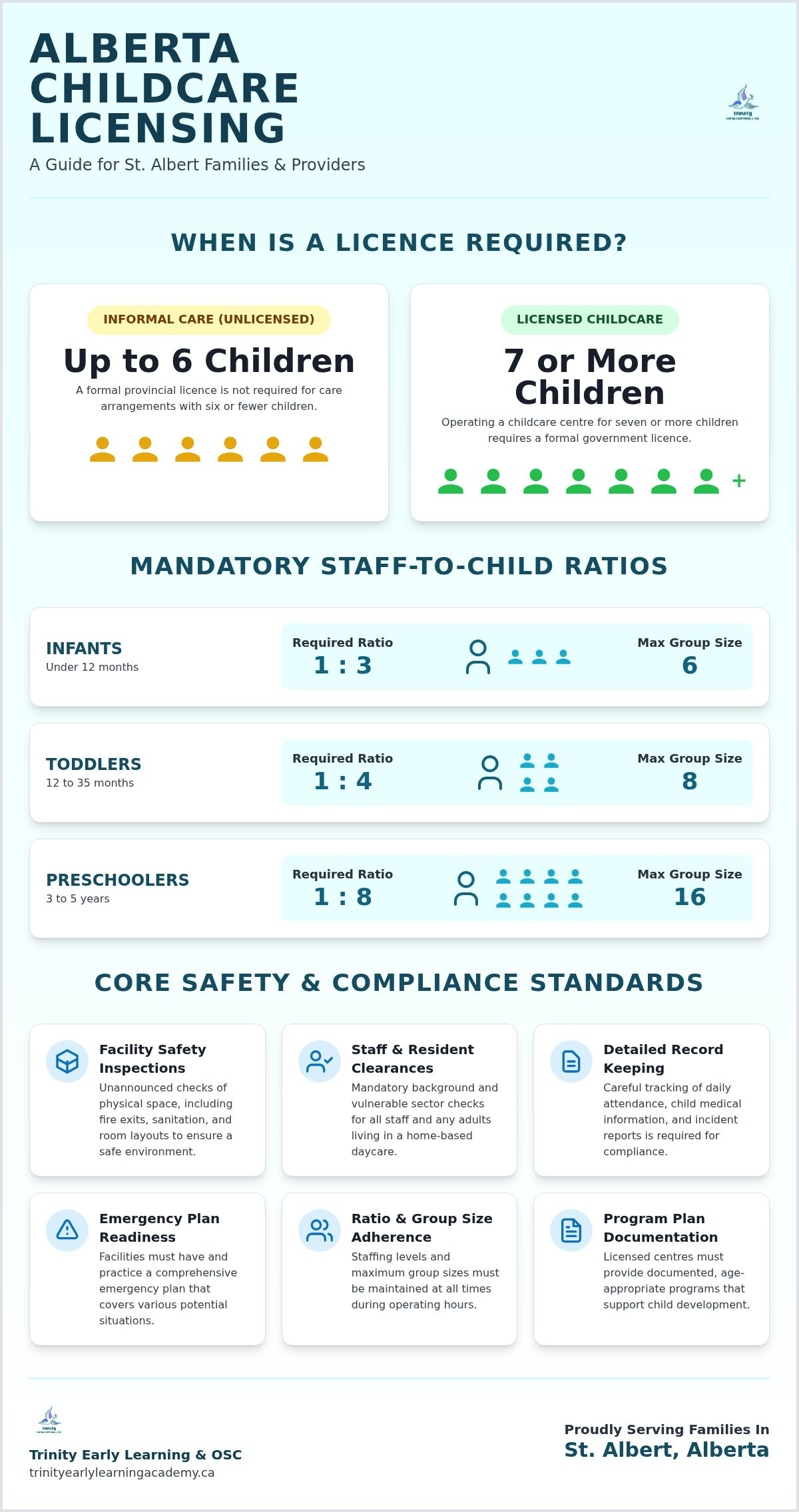
- Staffing ratios range from 1:3 for infants to 1:8 for preschoolers in Alberta's law.
- Except when caring for six or fewer children, unlicensed operation risks heavy government fines.
- Best for providers seeking higher enrollment, as centers allow larger groups than home settings.
- The five-step application process includes mandatory background checks and unannounced facility safety inspections. Operating a licensed childcare program in Alberta requires adhering to strict provincial regulations governing staff certification, adult-to-child supervision ratios, and comprehensive facility inspections. What are the Alberta childcare licensing requirements for local providers? Understanding these daycare rules (licensing standards) helps St. Albert parents evaluate safety, quality, and compliance in early education settings.
Match your family's routine to the Alberta childcare setup that fits
Selecting the right care option depends directly on your family's daily routine, budget, and learning goals. Parents often feel overwhelmed by choosing between a facility or a home daycare (family day home care). Exploring distinct environments helps clarify which structure best supports your child's growth.
Typical situations and concrete next steps drawn from the rules below:
- You need predictable group learning and documented routines: start with a licensed center that follows provincial daycare rules on safety and group sizes.
- You prefer a smaller setting and lower overhead: weigh a home daycare, noting the seven-child licence threshold.
- You want direct feedback on developmental milestones while keeping schedules flexible: prioritize programs that emphasize face-to-face progress updates.
For structured group learning, explore the programs at HOME. Facility programs follow daycare rules that govern safety and group sizes. A center supplies structured routines, while a home setup offers a smaller setting; your choice shapes daily social experiences and the feedback parents receive about milestones.
A user posting in the thelearningexperience.com discussion "Forum Dr Preschool & Daycare Grand Prairie, TX" shared: I can say that the Learning Experience provided my family with flexibility, face-to-face communication regarding my child’s progress through their development." (source)
This reader feedback shows how personalized communication and flexible care schedules assist parents during the decision-making process.
License thresholds show when Alberta law requires formal approval
You must have a valid license if you provide care for seven or more children in Alberta. Legally operating a facility requires meeting provincial standards.
When opening a facility, running a home daycare without licensing limits your capacity significantly. Based on Childcare in Canada Wikipedia 2024 entries, Canadian provinces regulate these programs to ensure proper safety and educational quality.
Following official daycare rules protects children and your business. The step-by-step process of how to get a license (application process) involves background checks, health inspections, and facility reviews. Careful planning shortens the timeline. You can review our HOME page to learn how Trinity Early Learning & OSC structures its compliant child programs.
Legal safeguards that hold day care facilities accountable
To safeguard young ones, licensed day care facilities must adhere to daycare rules. Local inspectors verify physical space safety, staff clearances, and emergency plans.
Background checks must cover every adult living on the property if care occurs in a residence. This requirement surprises many new operators; proper planning prevents sudden compliance issues.
Safety guidelines cover room layouts, fire exits, and sanitation practices. Staff must maintain specific supervision levels during indoor play and outdoor outings. You can explore structured options through the Early Childhood Education Programs at Trinity Early to see compliant routines.
Operators must track daily attendance and child medical records carefully. Missing files lead to penalties during any official check-up (inspection process). Regular record audits keep operations on track, so review regulations directly with your local authority.
Staff ratios and fees that protect children while controlling costs
Alberta requires adult-to-child ratios for all programs following standard daycare rules.
Managing staffing requirements demands daily scheduling discipline. Proper coverage maintains safety while fulfilling provincial regulations. To learn about our history, read ABOUT us today.
| Age Group | Required Staff-to-Child Ratio | Maximum Group Size |
|---|---|---|
| Infants (Under 12 months) | 1:3 | 6 |
| Toddlers (12 to 35 months) | 1:4 | 8 |
| Preschoolers (3 to 5 years) | 1:8 | 16 |
Ratio and group-size figures change with age. When hiring teenagers (minor staff supervision), direct supervision remains essential. Application fees vary by facility type, so request a personalized quote for exact figures. Navigating how to get a license takes careful planning; maintaining compliance protects your center during an official check-up and during keeping a license (licence renewal).
Understanding these structural rules helps parents evaluate their options with confidence.
Among Trinity Early Learning & OSC's Google reviews, Ri (5★) wrote:
"Really nice daycare, the staff is very nice and friendly. The owner cares about the well-being of the children. The price is really affordable. Thank you for your good work."
The feedback highlights how dedicated caregivers and affordable care create a supportive environment for children.
Five application steps that secure a child-care licence without delays
You complete the how to get a license in Alberta through five straightforward steps. Skipping one phase halts progress, so treat the sequence as a single build.
- Submit your application: You send your completed forms and required facility plans to the regional licensing office.
- Pass background checks: Every staff member must complete security screenings and vulnerable sector checks.
- Complete the official check-up: An inspector visits your facility to verify all safety and daycare rules are met.
- Obtain municipal approvals: You secure local zoning, fire, and health permits for your site.
- Receive your licence: The province issues your operating permit once all requirements pass verification.
Starting early saves time; moving step by step builds a compliant early learning facility.
Inspection checks that confirm a facility meets safety standards
Children stay safe when an official check-up verifies that your facility meets provincial daycare rules.
Inspectors make unannounced visits to verify safety, staff qualifications, and health standards. Non-compliance risks heavy fines or losing your facility licence. Failing an evaluation creates immediate risk; government enforcement keeps programs accountable to basic quality standards.
Keeping daily written logs prevents surprise violations during sudden audits. Missing paperwork triggers rapid enforcement actions.
According to Statistics Canada 2021 data, monitoring early learning coverage helps track service quality across regions. Running a center without compliance leaves you exposed; fixing small errors early avoids severe penalties. Trinity Early Learning & OSC helps providers maintain full operational readiness. Maintaining your status requires continuous, day-to-day adherence to regulations.
Five signs formal licensing will limit your operations
Formal daycare rules are a poor fit if you want absolute freedom over your daily operations.
Providers often struggle when they dislike strict administrative oversight. Operating independently requires far less paperwork than managing an official home daycare.
First, strict regulation limits your personal flexibility. Second, sudden changes to staff rules can disrupt your schedule. Third, mandatory physical space modifications might feel like a heavy burden on your private household.
Managing an official check-up takes substantial time away from direct child interaction. You should choose unregulated care if independence matters most to you.
Running a fully accredited program places commercial-style obligations inside a private family living room. Sometimes strict operational boundaries create scheduling conflicts that upset parents.
Writing in the babycenter.com.au topic "Those that use before and after school care..", one member stated: pros and cons?":
"The only one is not really my OSHC's fault but I wish they were open until 6:30pm rather than 6pm as that would align with my childcare provider hours and sometimes I'm in a big rush to collect my girl when I need to commute from work and there's peak hour traffic." (source)
This experience highlights how strict operational cutoff times can create practical friction for working families who face daily commute delays.
Center scale versus home daycare capacity for growth goals
Choosing between center-based care and a home daycare shapes your daily operations and long-term business capacity.
Operators choose facility scale based on personal leadership goals. Larger venues allow higher enrollment caps, while home settings offer lower overhead. Running a commercial facility means coordinating a small school community; home setups stay closer to an extended family gathering.
Your ideal choice depends on your growth targets and physical space. Commercial facilities suit those aiming for higher child enrollment. Residential care works best if you prefer smaller groups and lower upfront risks. If you need extra capacity, start small first.
You must follow distinct daycare rules for each physical location type. Ensure your chosen space matches local municipal zoning rules before committing to a lease or home renovation.
Management tools that keep licensing records audit-ready
Choosing structured software and management packages helps you maintain daycare rules with less manual effort. Automated tracking saves dozens of hours during mandatory record updates. Digital administrative platforms streamline daily attendance, staff schedules, and health check logs required by provincial authorities.
Selecting complete management suites keeps your administrative workflow organized from day one. Standard packages handle billing and family messaging; comprehensive bundles add compliance tracking and staff record storage.
Basic toolkits suit small centers, while modular enterprise packages work for multi-site operations. Software pricing varies depending on user capacity and feature selection, so ask for current pricing details matched to your headcount. Managing paperwork manually often leads to compliance mistakes during an official check-up. Digital logs keep your team audit-ready.
Frequently asked questions
What standards must licensed day care facilities meet?
Licensed day care facilities must follow Alberta daycare rules that cover physical safety, space limits, and proper staff qualifications.
Which types of childcare programs are covered by the regulation?
The regulations govern facility-based daycares, out-of-school care, and home daycare agencies operating within the province.
How do I apply for a child-care license?
Submit your official paperwork through the provincial portal to begin the how to get a license pathway.
What is required to renew a licence?
Keeping a license requires submitting an application before your current term expires while maintaining full compliance with all regulations.
What does the inspection process involve?
An official check-up involves unannounced site visits where inspectors verify safety protocols, staff records, and child care environments.
Decide with the same licensing questions you started with
Returning to the core questions (what Alberta childcare licensing requires, and how those daycare rules affect safety and daily fit) lets you build a secure early learning space in 2026.
Completing the full how to get a license takes clear planning, and maintaining the standards requires continuous attention from your team.
Contact the Trinity Early Learning & OSC team today to learn more about our early childhood programs or to request a program overview.


