

TL;DR: Licensed daycare in St. Albert provides verified safety through mandatory provincial inspections and significantly reduces monthly costs via automatic government fee reduction grants.
- Provincial grants and income-based subsidies apply exclusively to licensed facilities to lower market rates.
- Best for parents prioritizing certified educators and structured early learning frameworks over informal home care.
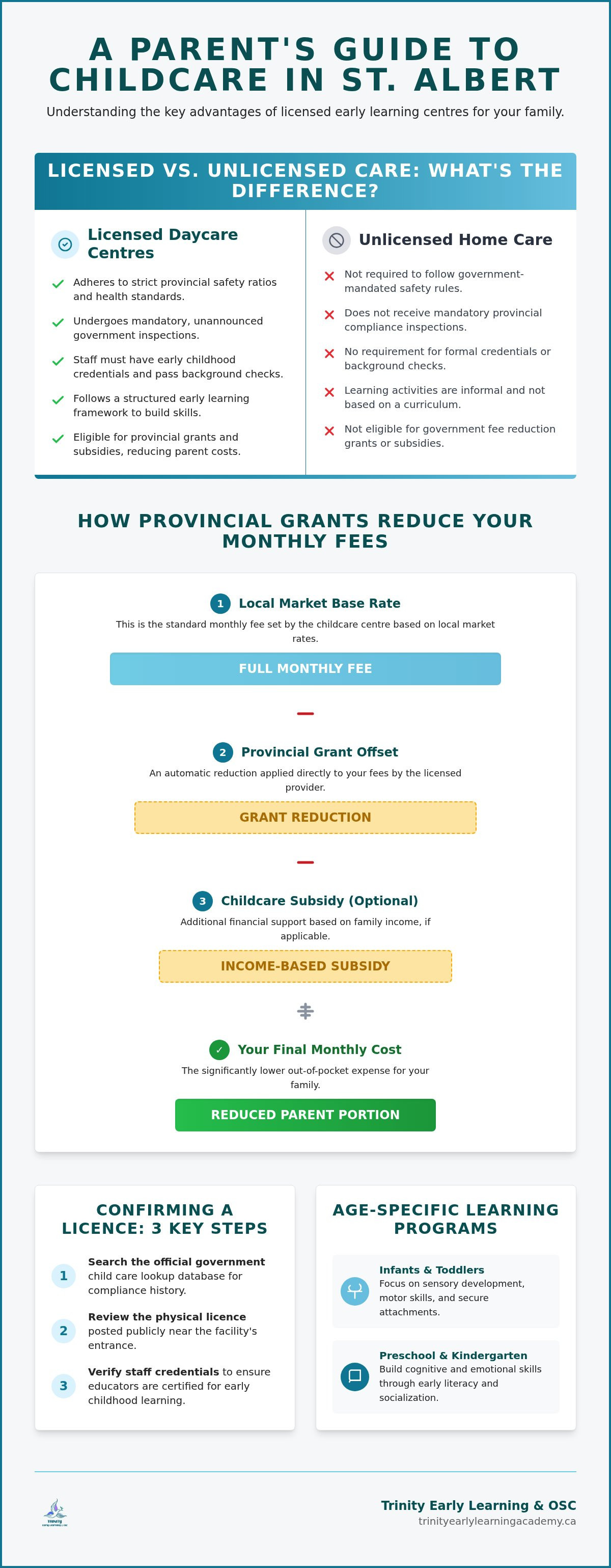
- The article's cost calculation table shows how base rates combine with provincial grant offsets. Choosing a licensed daycare in St. Albert guarantees adherence to strict provincial safety ratios while giving families access to fee reduction grants. Government subsidies significantly lower out-of-pocket costs for local parents. The decision usually turns on three questions: does the setting meet verified safety standards, can grants bring the monthly fee within reach, and will the daily schedule fit your work life?
Match your family's routine to a licensed St. Albert daycare that fits
Finding the right childcare requires balancing safety standards, daily schedules, and your child's developmental needs. Parents comparing center environments to home settings often feel pulled in several directions at once. Evaluating official licensing narrows the search quickly.
A short guide for common situations:
- Full-time office hours with a fixed commute: choose a licensed center whose drop-off and pickup windows cover your travel time, then apply provincial grants through the provider.
- Shift or irregular work: compare licensed operating hours first; if overnight coverage is required, weigh a private arrangement only after you accept the loss of mandatory inspections.
- Infant or toddler placement: join licensed waitlists early and confirm staff hold early childhood credentials before you tour.
Selecting a structured learning center like HOME provides reliable care through certified educators. Searching for care resembles choosing a school: you want a safe space that nurtures growth. Consider your family's daily routines first. Some programs suit structured full-time work, while others fit flexible shift patterns. Licensed centers follow strict provincial regulations, which gives parents a clear basis for trust and supports long-term childhood development.
Licensed care meets standards unlicensed settings are not required to follow
Licensed daycare provides stronger safety and developmental structure because regulated facilities must meet government standards.
Operating a regulated center requires mandatory staff background checks, CPR training, and adherence to early childhood education frameworks. As documented in Wikipedia's early childhood education coverage from 2026, formal early learning environments improve long-term cognitive outcomes compared to standard home setups. Choosing licensed care reduces reliance on unverified caregivers because formal oversight is built into the model.
Structured environments also deliver clear socio-emotional growth. Experiencing the Benefits of Early Learning Programs for Children gives young minds daily access to peer socialization and early literacy activities. Unlicensed home care may suit families seeking informal hours, but licensed facilities fit parents who prioritize verified safety logs and systematic learning. Parents often share how much their children thrive once settled into a high-quality program.
Tip: Check for mandatory unannounced provincial inspection logs posted publicly on-site before enrolling.
One poster on the thelearningexperience.com message board "Forum Dr Preschool & Daycare Grand Prairie, TX" wrote:
"The environment is warm, safe, and welcoming, and the curriculum is top-tier. My kids are learning so much and actually enjoy going every day." (source)
This feedback highlights how licensed facilities blend stringent safety protocols with a warm, engaging curriculum that keeps children excited to learn.
Local grants cut your monthly daycare costs
Calculating your net monthly childcare expense requires subtracting provincial grants and subsidies from local base rates. Your net cost drops when you combine these financial supports.
| Fee Type | Application Basis |
|---|---|
| Base Rate | Local market rate |
| Provincial Grant | Direct program offset |
| Childcare Subsidy | Income-based support |
Local grant applications process automatically through approved providers, which saves you administrative steps. You can check programs at the HOME page to see how funding applies. Alberta market data shows standard monthly rates span a broad range according to current market rates. Knowing how parent reviews reflect daily quality helps you evaluate whether the funded place still meets your standards.
Among Trinity Early Learning & OSC's Google reviews, Constanza (5★) wrote:
"I loved the facilities, the availability of different toys and attractions for children, and what can I say about the staff, very kind, empathetic and they make you feel safe and secure in the care of the children."
Seeing high standards firsthand reassures parents that funding support still delivers quality care. Ask a licensed provider how grants and subsidies apply to your child's age group and schedule.
Confirm real licensing before you enroll
To confirm a daycare's license, check the provincial lookup portal or inspect their posted physical permit. In practice, local public registers show compliance histories directly. Government inspectors regularly audit these facilities to ensure health and safety standards are met.
- Search the official government child care lookup database.
- Review the physical license displayed near the facility entrance.
- Verify staff credentials for Early Childhood Education Programs at Trinity Early.
- Ask the director for their latest inspection report.
Checking these records protects your child during critical developmental years.
In the thelearningexperience.com thread "Forum Dr Preschool & Daycare Grand Prairie, TX", a user posted:
"It took me quite some time to commit to an early education institution for my child. I can say that the Learning Experience provided my family with flexibility, face to face communication regarding my child’s progress through their development." (source)
Real parent feedback shows how open updates on a child's progress build lasting confidence in early learning institutions.
Align waitlists and operating hours with your work day
Evaluating waitlist durations and daily operational hours helps you choose a local program that fits your family's routine. Joining a waitlist early matters because high demand often creates long lead times for infant care spaces.
Parents balancing work commutes with facility drop-off windows need centers whose morning and evening coverage match real travel time. Prioritize centers that match your exact work hours rather than adjusting jobs around rigid drop-off rules. Daily operating schedules vary across St. Albert facilities. Many locations close precisely at six, which makes late rush-hour drives stressful.
Over at babycenter.com.au, a contributor to the discussion "Those that use before and after school care.. pros and cons?":
"The only one is not really my OSHC's fault but I wish they were open until 6:30pm rather than 6pm as that would align with my childcare provider hours and sometimes I'm in a big rush to collect my girl when I need to commute from work and there's peak hour traffic." (source)
Tight evening pickup times create friction for commuting parents who face unpredictable traffic. Selecting a licensed facility with hours aligned to your actual travel schedule removes that daily pressure. Contact centers early to confirm both waitlist length and closing time before you commit.
Early learning standards build cognitive and emotional skills
Structured early childhood pedagogy ensures your child develops essential cognitive and emotional skills. Picture choosing between two options: random play versus guided learning that builds actual problem-solving habits.
Structured play strengthens neural pathways during early childhood. According to the Child development Wikipedia page (2026), early experiences deeply influence physical, cognitive, and emotional growth. Standards keep activities intentional, so daily routines support measurable progress rather than leaving development to chance.
Age-specific programs match each developmental stage
Licensed daycare facilities provide tailored developmental programming for major age groups from early infancy through school age. A toddler needs a different pace and environment than a six-year-old.
Infant care focuses heavily on sensory exploration, individual schedules, and basic emotional bonding. Toddler programs emphasize physical movement, early language building, and initial social interactions. Preschool and kindergarten spaces transition children into structured learning, basic literacy, and foundational problem-solving tasks. Out of school care (OSC) offers a safe space for older kids to relax, complete homework, and engage with peers before or after class.
Selecting early childhood options depends directly on your child's developmental stage. Early placement works well for infants needing steady routine, while structured groups fit active older children. Review the age bands a center serves so the room your child enters matches their current needs.
Private unlicensed care only when flexibility outweighs oversight
Private unlicensed care fits families who need hyper-flexible hours or a lower child-to-adult ratio than formal facilities offer.
Parents often choose informal arrangements when shift work demands overnight coverage. Standard centers rarely accommodate irregular midnight schedules. Unlicensed home setups can feel personal and allow tailored daily routines.
Oversight still varies. Unregulated providers skip mandatory provincial inspections, so safety standards depend entirely on personal trust. Licensing guarantees strict background checks, staff qualifications, and ongoing monitoring. Private care suits odd schedules; regulated centers provide verified safety. Weigh the schedule gain against the inspection gap before you decide.
Daily updates and on-site meals simplify your routine
Licensed daycares in St. Albert simplify your daily routine by combining nutritious, freshly prepared meals with real-time digital updates.
Transparent updates reduce parenting stress during the workday. Dedicated staff members track your child's daily naps, meal consumption, and creative milestones using mobile applications. That ongoing connection keeps you informed without constant phone calls.
Balanced, on-site nutrition fuels active growing bodies. Culinary teams craft diverse, child-friendly menus that meet strict provincial dietary guidelines. You will not need to pack lunches. Choosing a program with integrated dining and daily reports keeps care consistent for working parents. Book a visit to see how meal service and reporting work in practice.
Frequently asked questions
Is licensed daycare better than unlicensed care for my child's development?
Licensed facilities follow strict provincial standards that directly support early child development. A regulated center supplies structured learning activities and certified educators who monitor key developmental milestones.
How do I know if a daycare is actually licensed by the province?
You can verify a facility's legal status by checking the official provincial childcare lookup tool or requesting to see their posted permit. Confirming license status is the direct way to assess safety and educational quality before enrollment.
Is licensed daycare better than unlicensed care?
Licensed care offers mandatory background checks, regular safety inspections, and qualified staff that unlicensed homes do not always guarantee. This regulation raises the baseline for child wellbeing.
How much does daycare cost?
Childcare fees depend on your child's age group, the program type, and whether you choose full-time or part-time care. Contact providers directly to request a personalized quote for exact figures.
Is a subsidy available?
Government childcare subsidies are available for eligible families enrolled in licensed programs to help lower monthly fees. Your specific household income level and chosen schedule determine the final funding amount.
Next steps for your family
The same three questions that open this guide still apply: verified safety ratios, grant-reduced monthly cost, and a schedule that matches your work day. Answering them with a licensed St. Albert provider locks in the standards and funding pathways described above.
To view individualized enrollment options and specific group openings, reach out to the Trinity Early Learning & OSC team. Schedule a personalized tour and direct consultation to see the program firsthand.


