

What if the support that lowers your daycare bill isn’t a tax credit at all? Families searching for tax credits for childcare in Alberta may be looking for tax-time deductions, family benefits or fee reductions. Each works differently, so it helps to know what belongs on a tax return and what can reduce fees before you pay.
Alberta’s Affordability Grant is paid to participating licensed childcare providers to help reduce parent fees. The federal Child Care Expense Deduction is claimed on a tax return and reduces taxable income. The Canada Child Benefit and Alberta Child and Family Benefit are tax-free payments, not childcare tax credits.
This 2026 guide explains how these federal and Alberta measures differ and what families filing a 2025 tax return should consider. For families in St. Albert, it also explains how fee reductions differ from tax-time support. Trinity Early Learning & OSC is a licensed daycare in St. Albert with approved Affordability Grant funding.
Key Takeaways
- “Tax credits for childcare in Alberta” can refer to different kinds of support. Identify whether a program affects your tax return, provides family payments or reduces childcare fees.
- Use current CRA and Alberta government guidance to confirm the rules for your family and tax year.
- Keep tax-return records separate from documents about childcare fee support.
- Follow a clear process: identify the program, gather the relevant records, file or apply according to its rules, then follow up.
- When planning childcare in St. Albert, consider tax-time support separately from fee reductions at a licensed daycare with approved Affordability Grant funding.
Tax credits for childcare in Alberta: what families should know first
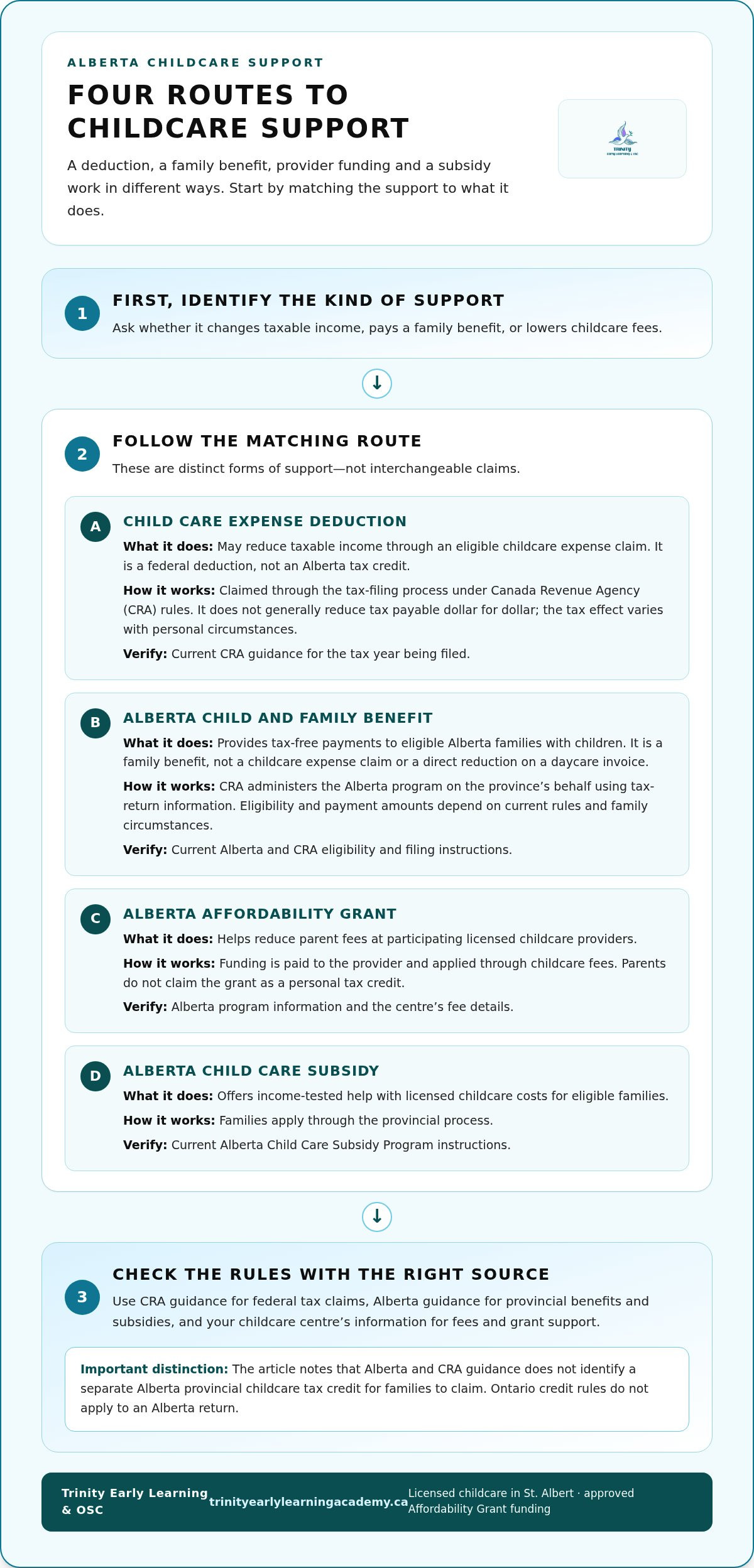
The phrase “tax credits for childcare in Alberta” can refer to several forms of support, even though they don’t all work as tax credits. Some affect the tax you owe or the income used to calculate tax. Others provide family payments or reduce childcare fees before tax time. First identify the type of support, then look for its eligibility rules and paperwork.
Provincial programs differ. For example, an Ontario childcare tax-credit page explains Ontario rules, not eligibility for an Alberta household. Use Alberta government and Canada Revenue Agency (CRA) guidance for Alberta programs and federal tax claims. The general overview of child benefits in Canada can provide context, but it doesn’t replace current official program rules.
Is there a separate Alberta childcare tax credit?
Alberta and CRA guidance describes several kinds of family and childcare support, including the Alberta Child and Family Benefit, the Child Care Expense Deduction and childcare fee supports. It does not identify a separate Alberta provincial childcare tax credit for families to claim. The phrase “tax credits for childcare in Alberta” is useful shorthand for a question, but it doesn’t mean a specific credit exists. Check current Alberta and CRA program information before filing.
Ontario’s provincial credit rules can’t be applied to an Alberta return. If you live in St. Albert, check the province, administrator and application or filing process for any program before relying on a claim.
Tax credit, deduction, benefit, or fee reduction?
These terms describe different ways support may reach a household. A tax credit reduces tax payable. A deduction reduces taxable income, so its value depends on how that income is taxed. A family benefit is a payment to an eligible household, not a discount on a childcare invoice.
The Alberta Child and Family Benefit is a tax-free provincial payment to eligible Alberta families with children. The CRA administers it using tax-return information. It is separate from a childcare expense claim and does not directly lower a daycare bill.
A fee reduction works differently. Alberta’s Affordability Grant is paid to participating licensed childcare providers to help reduce parent fees. The provider applies the funding to fees, so parents don’t claim the grant as a personal tax credit. Trinity Early Learning & OSC is a licensed daycare in St. Albert with approved Affordability Grant funding.
Keep the categories distinct as you review support:
- Tax credit: reduces tax payable.
- Deduction: lowers taxable income.
- Family benefit: provides a separate payment to eligible families.
- Fee reduction: lowers childcare costs through provider funding rather than a personal tax claim.
This distinction helps you direct each question to the right source: CRA guidance for tax-return claims, Alberta guidance for provincial benefits and subsidies, and information about the childcare fees and grant support at your chosen centre.
How the Child Care Expense Deduction differs from Alberta family benefits
These programs support family finances in different ways. A federal tax deduction is claimed on a tax return, a provincial family benefit is paid to eligible families, and grant funding can lower fees through a licensed childcare provider. Comparing each program’s purpose and administration can help you find the right rules without treating one form of support as a substitute for another.
| Program | Purpose | Administration | Where to verify |
|---|---|---|---|
| Child Care Expense Deduction | May reduce taxable income through an eligible childcare expense claim. | Federal measure claimed through the tax-filing process under CRA rules. | Current CRA guidance for the applicable tax year. |
| Alberta Child and Family Benefit (ACFB) | Provides tax-free payments to eligible Alberta families. | Alberta program administered by the CRA on the province’s behalf. | Current Alberta and CRA eligibility and filing instructions. |
| Affordability Grant | Helps reduce parent fees at participating licensed childcare providers. | Funding goes to the provider and is applied through childcare fees. | Alberta program information and the centre’s fee details. |
| Alberta Child Care Subsidy | Offers income-tested help with licensed childcare costs for eligible families. | Families apply through the provincial process. | The Alberta Child Care Subsidy Program. |
What the Child Care Expense Deduction does
The Child Care Expense Deduction is a federal deduction, not an Alberta tax credit. It reduces taxable income; unlike a tax credit, it doesn’t generally reduce tax payable dollar for dollar. The tax effect varies with a person’s circumstances. CRA rules determine which expenses and claimants qualify, so check the requirements for the tax year you’re filing before entering a claim or organizing supporting records.
What the Alberta Child and Family Benefit does
The ACFB is a tax-free Alberta family benefit administered by the CRA on the province’s behalf. It provides benefit payments rather than deducting childcare expenses from income. Eligibility and payment amounts depend on current program rules and family circumstances. Tax returns are central to benefit consideration, so follow the latest Alberta and CRA instructions, even if you don’t expect to claim a childcare deduction.
Where childcare fee affordability support fits
Grant-supported fee reductions affect what families pay for childcare, while a tax deduction is dealt with at filing time. They aren’t interchangeable, and the grant isn’t a personal tax claim. For more on how grant funding relates to fees, see the Daycare Affordability Grant Alberta: A 2026 Guide for St. Albert Families. Families considering local care can also explore the programs at Trinity Early Learning & OSC, a licensed daycare in St.
Use this comparison as a starting point, not an eligibility decision. Program rules can change, and family circumstances matter. Before filing or applying, confirm current requirements with the responsible government source and keep records for each program separate. That can help prevent a fee reduction from being mistaken for a tax claim, or a benefit payment from being treated as an expense deduction.
Which childcare support applies to your Alberta family?
Start with the question you need answered. Are you preparing a tax return, checking whether your household may qualify for family benefits, or trying to understand how childcare fees could be reduced? These routes can overlap, but each has its own eligibility rules, process and timing. Confirm the details that apply to your circumstances before claiming or budgeting for support.
If you’re preparing a tax return
If you paid for care so you or another eligible person could work, attend school or carry out another activity recognized under CRA rules, check whether the expense may qualify for the federal Child Care Expense Deduction. Don’t assume every daycare payment is eligible. CRA rules determine qualifying expenses, who may claim them and what records are needed. Filing circumstances can also affect who claims. Generally, the spouse with the lower net income makes the claim, subject to exceptions.
Review the Canada Revenue Agency Child Care Expense Deduction guidance for the tax year you’re filing. Check claimant conditions and expense rules, then keep receipts and supporting records. A claim should reflect expenses that meet current CRA requirements, not simply the total paid to a childcare provider.
If you’re checking family benefits
If you’re asking about household payments, review the Alberta Child and Family Benefit and the federal Canada Child Benefit separately. The ACFB is an Alberta benefit administered by the CRA, while the CCB is a federal benefit. Both are distinct from claiming childcare expenses on a tax return. Filed tax returns are central to benefit assessment, so keep returns up to date and follow current Alberta and Canada.ca instructions.
Published maximums apply to a specific benefit period and don’t guarantee what an individual household will receive. For example, the stated CCB maximums for July 2026 to June 2027 vary by a child’s age, and the ACFB amount depends on program rules and family circumstances. Treat these as period-specific reference points, not a personal estimate. Confirm current eligibility, payment details and dates using official program guidance.
If your priority is lowering childcare fees
If you’re comparing childcare costs, consider how fee support is applied. Albert with approved Affordability Grant funding to help lower childcare costs. The grant reduces fees through the provider; it isn’t a personal tax refund or a replacement for checking whether an expense qualifies for a deduction.
For more on grant funding and childcare fees, see Daycare Affordability Grant Alberta: A 2026 Guide for St. Albert Families. Families exploring licensed childcare can also review Trinity’s childcare programs as part of their local planning.
How to prepare for tax filing and verify childcare claims
Organizing records can help you separate tax-return questions from childcare fee support. Identify the program you’re checking, use current government guidance and group records by purpose. This is especially helpful when sorting out what people mean by tax credits for childcare in Alberta, since a tax claim, family benefit and fee reduction follow different processes.
- Identify the program. Decide whether you’re checking the federal Child Care Expense Deduction, a family benefit such as the Canada Child Benefit or Alberta Child and Family Benefit, or help with childcare fees. Note the tax year or benefit period you’re reviewing.
- Review current official rules. Check CRA guidance for tax claims, forms, filing dates and claimant requirements. For provincial fee support or family benefits, consult the relevant Alberta government program page. Rules and benefit-period details can change, so don’t rely on an old checklist or a figure from a different period.
- Gather records by purpose. For a possible tax deduction, organize childcare receipts and provider information, then confirm current CRA rules for eligible expenses and supporting documents. A receipt alone doesn’t establish that an expense qualifies. Keep tax records separate from fee-support documents, such as statements showing childcare fees and any provider-applied reduction.
- File using the applicable instructions. Complete the return for the correct tax year and follow current CRA directions for any claim. If you’re unsure about your situation, seek qualified tax advice rather than estimating a claim or refund.
- Follow up after filing or applying. Use your CRA account to review available tax and benefit information. For provincial childcare support, follow the Alberta program’s instructions for status updates or next steps.
Keep tax and fee-support records distinct
Use separate folders, whether digital or paper. One can hold tax-return records, including receipts and information needed to review a possible deduction. Another can hold childcare fee statements and correspondence about grant funding or a subsidy application. Keeping these documents apart helps prevent a provider fee reduction from being mistaken for a tax refund and makes it easier to find information if you need to review a claim or support arrangement.
Confirm benefit and filing details for the right period
A filed tax return can be central to family benefit assessment, even when current instructions don’t require a separate application. Check your CRA account for available information, and consult Alberta’s official guidance for provincial eligibility and payment details. Don’t assume a published maximum is what your household will receive; amounts depend on the rules for that period and your family circumstances.
For St. Albert families comparing fee support with tax-time planning, Explore Trinity’s childcare programs as you consider local care and plan your childcare budget.
Licensed Childcare in St. Albert: Cost Support Guide
Tax planning is only one part of a childcare decision. For St. Albert families, the day-to-day fit matters too: whether a licensed setting suits your child, whether its program meets your family’s needs, and what support may help with fees. Tax credits for childcare in Alberta shouldn’t be treated as a guaranteed discount on a daycare bill. Consider tax claims and childcare costs as related but separate parts of your family’s planning.
What families can consider beyond tax treatment
Start by looking at the care arrangement itself. Licensing, the program offered and how the setting supports your child’s early learning are practical considerations alongside household budgeting. A family looking for preschool, kindergarten care or out-of-school care may have different needs from a family seeking regular childcare for a younger child. Understanding the program helps you compare the care experience, not only its financial treatment.
For more on local licensing and quality considerations, consult Licensed Daycare in St. Albert: The Complete Parent’s Guide to Quality Childcare. Use that information alongside current government guidance about tax claims and family benefits. Each answers a different question: one can inform your local childcare decision, while official program sources explain eligibility and filing requirements.
How Trinity supports St. Albert families
Albert, locally owned and operated with a warm, family-centred approach. Its programs include childcare, preschool, kindergarten care and out-of-school care. Consider which program fits your child’s stage and daily routine, while keeping tax questions separate from the centre’s fee arrangements.
Trinity has approved Affordability Grant funding to help lower childcare costs. The support is applied through childcare fees; it isn’t a personal tax credit or a promise of a particular tax result. Grant funding also doesn’t determine whether a family qualifies for a separate benefit or tax claim. Those programs have their own current rules and depend on each family’s circumstances.
For families comparing licensed childcare in St. Albert, Trinity’s operating hours are Monday-Friday 06:30 a.m. - 05:30 p.m.; Saturday and Sunday Closed. A free registration offer runs till end of July 2026. Keep tax questions grounded in CRA guidance and consider provider fee support separately when planning the practical cost of care.
Take a clear next step by exploring Trinity’s childcare options or booking a tour. A visit can help you learn about the setting and consider which program may suit your family, while you verify tax and benefit details through the appropriate government sources.
Take the Next Step With Confidence
Childcare planning is easier when you consider both the numbers and your child’s everyday experience. Use current government guidance for tax and benefit questions, then consider the routines, learning environment and program that can help your child feel secure and supported. The phrase tax credits for childcare in Alberta can refer to several forms of support, so match each question to the right program before making a decision.
Your family’s needs may change as your child grows or work and school routines shift. A childcare option that fits today should also feel welcoming, with room for your child to learn, play and build confidence. A conversation or tour can help you picture how a local program could fit into family life without needing to settle every financial question first.
Explore childcare at Trinity Early Learning & OSC and consider whether its programs feel right for your family. Book a tour or pre-register online to take the next step.
Frequently Asked Questions
Does Alberta have a childcare tax credit?
Current Alberta and CRA guidance does not identify a separate Alberta provincial childcare tax credit. The phrase “tax credits for childcare in Alberta” may refer to different support, including the federal Child Care Expense Deduction, provincial benefits or fee reductions. If you’re preparing a return, use CRA rules for the tax year you’re filing rather than applying another province’s credit instructions to your Alberta taxes.
Can I claim daycare expenses on my Alberta tax return?
You may be able to claim eligible childcare expenses through the federal Child Care Expense Deduction, subject to CRA requirements. Not every daycare payment qualifies, and claimant rules can affect which spouse makes the claim. For a 2025 return filed in 2026, review the current CRA instructions for line 21400 and Form T778. Check the rules before filing, particularly if your family’s work, school or care arrangements changed during the year.
Is the Alberta Child and Family Benefit the same as a childcare tax credit?
No. The Alberta Child and Family Benefit is a provincial family benefit, not a credit for daycare expenses. It is assessed using tax-return information, and payments depend on current program rules and family circumstances. Receiving an ACFB payment doesn’t mean a particular daycare expense has been approved for a tax deduction. Review benefit information separately from childcare expense claim instructions.
Does the Canada Child Benefit cover daycare fees?
The Canada Child Benefit is a tax-free federal payment to eligible families, not a credit applied to a daycare invoice. Families may choose how to use household benefit payments, but the CCB doesn’t directly pay a childcare provider or determine whether an expense qualifies for a tax deduction. Check your CRA account and current CCB guidance for payment information. Keep benefit records separate from childcare receipts used to review a possible tax claim.
Can a family receive the Alberta Child and Family Benefit and childcare affordability support?
A family may be able to receive family benefits while also benefiting from an eligible childcare fee reduction, but each program has separate eligibility rules. The Affordability Grant is applied through participating licensed providers, while the ACFB is assessed using tax-return information. Eligibility depends on family circumstances and the rules in effect; receiving one form of support doesn’t guarantee another. Confirm current requirements before including support in your budget.
What records should I keep for childcare expenses in Alberta?
Keep childcare receipts and provider information organized by tax year, along with records that help explain the care arrangement and payments. If care was provided by an individual, CRA rules may require specific information on the receipt, so review current documentation requirements before filing. Keep separate records of fee reductions or subsidy decisions. A receipt documents payment, but it doesn’t by itself confirm that an expense is eligible.
Are Ontario childcare tax-credit rules available to Alberta families?
No. Ontario’s provincial childcare tax-credit rules apply to that province’s program and shouldn’t be used to determine Alberta eligibility. An Ontario page can explain Ontario’s system, but it can’t establish what an Alberta resident may claim. For a St. Albert household, use CRA guidance for federal tax claims and Alberta government information for provincial benefits or childcare fee support. Check the province and tax year on any guidance you consult.


