
What if using your CCB for daycare costs is less about paying one specific bill and more about planning your household budget? It’s reasonable to wonder whether the Canada Child Benefit must go toward childcare, how it differs from Alberta affordability funding, and whether the monthly deposit will arrive before a daycare payment is due.
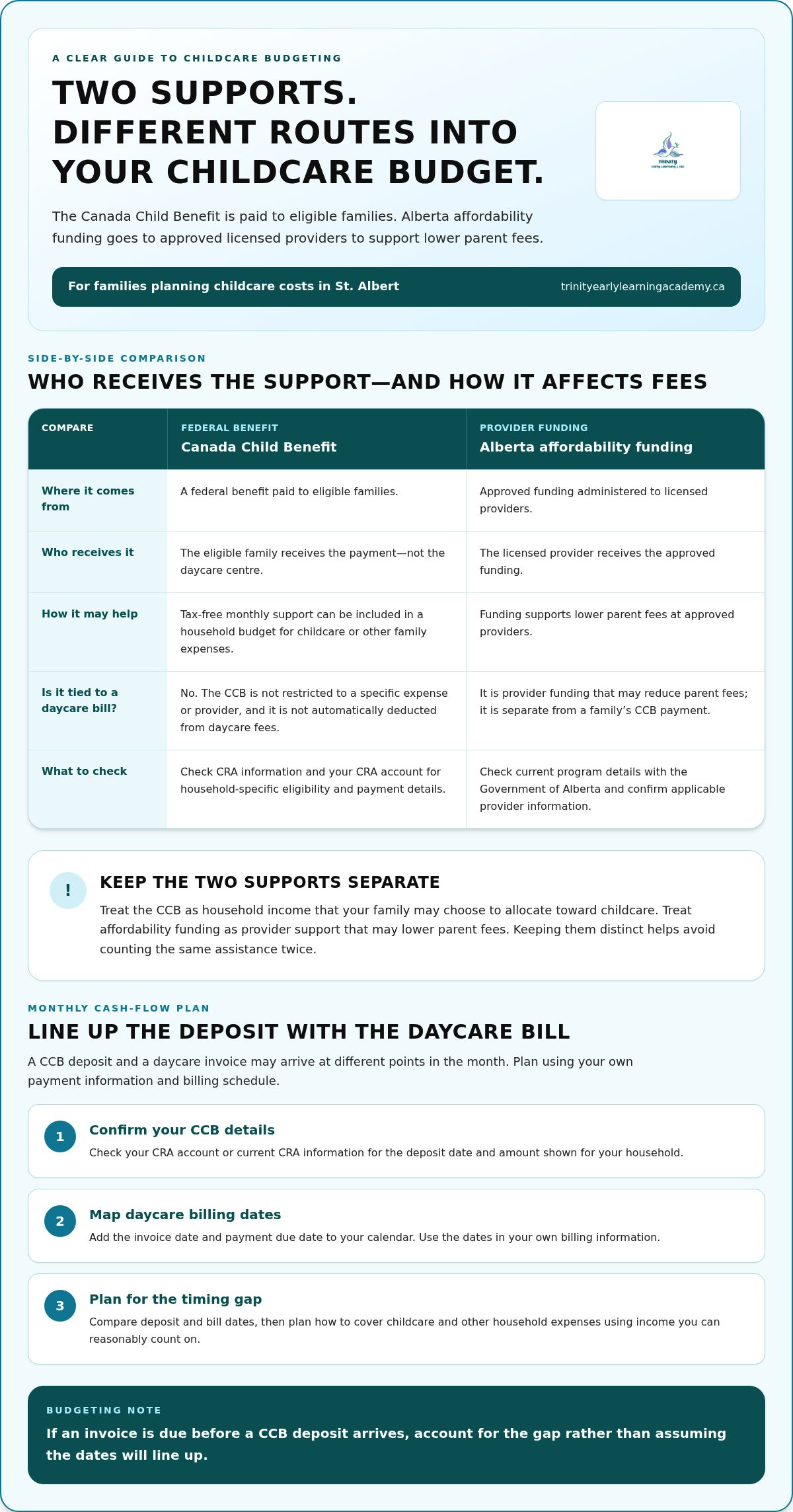
The CCB is a federal benefit paid to eligible families, and it isn’t restricted to particular expenses. Alberta childcare affordability funding works differently: approved funding goes to licensed providers to support lower parent fees. Keeping the two supports separate can help you plan without counting the same assistance twice.
This guide explains how the CCB can fit into everyday family spending, what to verify with the Canada Revenue Agency (CRA) and Government of Alberta, and how to plan around benefit deposits. For families considering care locally, Trinity Early Learning & OSC is a licensed daycare in St. Albert with approved affordability grant funding. Understanding the difference between federal support and provider funding can help you build a clearer childcare budget.
Key Takeaways
- When using your CCB for daycare costs, include it in your household cash-flow plan rather than treating it as a centre-specific fee reduction.
- Compare your CRA payment information with your daycare billing dates, then plan using the details shown in your CRA account or current CRA guidance.
- Keep federal CCB payments separate from Alberta affordability funding, and check each program’s current details with the relevant government source.
- Build a practical budget by listing confirmed income, daycare bills, and applicable affordability support. Review CRA details if your circumstances change.
- Explore childcare, preschool programming, kindergarten care, and out-of-school care at Trinity Early Learning & OSC, a licensed daycare in St. Albert with approved affordability grant funding.
Can you use the Canada Child Benefit for daycare costs?
Yes. Families can include daycare in their household spending plan and decide whether to use some of their Canada Child Benefit (CCB) for it. The CCB is a tax-free monthly payment from the federal government to eligible families with children under 18. It is paid to the family, not directly to a daycare centre, and it is not restricted to a specific expense or provider.
The CCB is flexible support paid to eligible families, while provider funding is administered separately and may reduce childcare fees. This distinction helps St. Albert parents avoid treating a CCB deposit as a daycare subsidy or a guaranteed credit on a centre’s invoice. For background on the benefit’s purpose and history, see this Canada Child Benefit (CCB) overview. For current eligibility and payment information, refer to CRA guidance.
What the CCB is designed to help families manage
The benefit is intended to help eligible families with the costs of raising children. Whether your family qualifies and how much it may receive depend on individual circumstances. Check CRA information for current eligibility requirements and payment calculations, and review your CRA account for details specific to your household.
The CCB can be part of your broader household budget alongside expenses such as food, housing, transportation, clothing, and childcare. It is not assigned to one spending category, so families can decide how to allocate their funds based on their needs.
What using CCB funds for daycare means in practice
For budgeting purposes, using your CCB for daycare costs means including the expected benefit in your household cash-flow plan and deciding whether some of it will go toward childcare. It does not mean you have applied for a dedicated daycare subsidy, or that a daycare centre will automatically deduct the CCB from fees. The benefit goes to the eligible family, which arranges payment for care.
For example, if an invoice is due before a CCB deposit arrives, you may need to account for the gap even if you plan to use part of the benefit for childcare. Plan around the actual payment and billing dates, rather than assuming they will line up. Confirm your deposit details through CRA and consider how your household will cover the invoice if the timing or amount differs from your expectation.
The benefit can support your overall budget, but it does not guarantee that a particular share of daycare fees will be covered. Keep the expected CCB separate from any provider fee reduction or other childcare funding. That gives you a clearer picture of what your family receives, what the daycare bills, and what you need to set aside from other household funds.
How CCB payment timing can fit into a daycare budget
A benefit deposit and a daycare invoice may fall at different points in the month. Planning for the timing gap can help you avoid assuming the money will be available on the day a bill is due. When using your CCB for daycare costs, focus on the payment information for your household and the dates on your childcare billing schedule.
Payment dates and bill dates belong in the same monthly plan. Knowing when money arrives is as useful as knowing when an expense is due. Follow these steps to map your cash flow:
- Confirm your CCB details. Check your CRA account or official CRA information for the next deposit date and the amount shown for your household.
- Map daycare billing dates. Add the invoice date and payment due date to your calendar. Use the dates in your own billing information rather than assuming every provider follows the same schedule.
- Plan monthly cash flow. Compare the dates, then decide how to cover childcare and other household expenses using income you can reasonably count on.
Check your own CCB details before planning
Use your CRA account or current CRA guidance to verify payment information before including it in a budget. CCB calculations depend on individual circumstances, so another family’s amount or schedule may not match yours. Shared-custody arrangements can also affect payments. If that applies to your family, consult CRA guidance for the current rules and information relevant to your situation.
Review your details if your circumstances change or CRA updates the information available to you. A plan based on an old deposit amount or date may leave less room for a bill due first. Use the information in your own CRA account rather than a general estimate.
Build a simple monthly daycare cash-flow plan
Use a calendar or household budgeting tool to put the expected CCB deposit and daycare billing dates side by side. Add other regular expenses, such as housing payments or utilities, to see which weeks may be tighter. Base the plan on confirmed household income and current CRA information, not an assumed benefit amount.
If your budget allows, a timing buffer can help manage a mismatch between a deposit and an invoice due date. Choose an approach that suits your household’s income and expenses. If there is no room to set funds aside, note the timing gap early and plan how to meet the bill from available income.
For St. Albert families comparing childcare arrangements, learning about licensed daycare and care programs can help you understand which billing details to include in your monthly plan.
CCB and Alberta childcare affordability funding: what is different?
Both programs can matter to a childcare budget, but they work in different ways. The CCB is a federal payment made to eligible families. Alberta affordability funding is a provincial program connected to licensed childcare providers. The CCB does not arrive as a centre-specific fee reduction. Check the two supports separately rather than treating them as one combined payment.
| Comparison | Canada Child Benefit | Alberta childcare affordability funding |
|---|---|---|
| Purpose | Provides eligible families with federal support for raising children. | Supports affordability in childcare through provincial funding arrangements. |
| How support reaches families | Paid to eligible families, who plan their household spending. | Funding is associated with participating licensed providers; check current provincial rules to understand how it affects fees. |
| Where to verify details | Canada Revenue Agency (CRA) guidance and your CRA account. | Current Government of Alberta childcare program information. |
How the federal CCB differs from provider affordability funding
The practical difference is who administers the support and where families see it. CRA provides CCB payment information to families, while provincial guidance explains Alberta’s affordability funding rules. In a household budget, the CCB belongs among family income. Provider affordability funding is a separate consideration when reviewing childcare fees and funding status.
Do not assume that receiving the CCB determines whether a provider participates in Alberta funding or how that funding applies to care. Keep the questions separate: use CRA for federal benefit details and current provincial information for childcare funding rules.
What St. Albert families should verify about Alberta funding
Program details can change, so consult Government of Alberta guidance for current eligibility, provider participation, and funding rules before relying on a fee estimate. Do not assume a general description applies to every type of care or family arrangement. For a closer look at the provincial program, the Alberta daycare affordability grant guide offers further context for St. Albert families.
Trinity Early Learning & OSC is a licensed daycare in St. Albert with approved affordability grant funding. This is useful context when comparing federal benefits with provider funding, but it does not establish a particular family’s fee or savings. Review current provincial rules alongside the care arrangement and billing details relevant to your household.
Separating the two supports makes your plan clearer: use CRA information for CCB payment questions and provincial guidance for affordability funding. Then base your daycare budget on the details that apply to your family and chosen care.
A practical checklist for planning daycare costs with CCB
A useful childcare budget keeps three things distinct: confirmed household income, billing details, and any affordability support that may apply. This makes using your CCB for daycare costs easier to plan without assuming a payment amount, fee reduction, or deposit date that may not match your family’s situation.
Use this checklist for childcare, preschool programming, kindergarten care, or out-of-school care. Keep the records together but separate their sources, so you can see which details come from CRA, which relate to your care billing, and which depend on current Alberta program rules.
Gather the information your household budget needs
- Record confirmed income: Note the CCB payment details shown in your CRA account. Use information specific to your household rather than an estimate or another family’s experience.
- Write down billing details: Keep the current payment schedule, invoice dates, due dates, and any confirmed information that applies to your family’s care arrangement.
- Separate the records: Store CRA benefit information apart from invoices and payment receipts. This helps prevent a federal benefit from being mistaken for a provider credit or fee adjustment.
- List possible affordability support separately: Record what you know about Alberta funding, then check current provincial guidance for the program rules and provider participation relevant to your care.
Once these details are in place, compare the timing of income and bills. If a payment is expected after an invoice is due, note the gap and decide how your household will manage it using confirmed available funds. Avoid filling in missing information with a guessed CCB amount or an assumed fee reduction.
Review the plan when family or program details change
Revisit your budget if your family circumstances change or CRA updates your benefit information. Check the payment details again before relying on an earlier figure or date. If the care arrangement changes, update the billing information too, since a new schedule may affect your household cash flow.
Alberta funding rules and program information can also change. Consult current provincial guidance before counting possible affordability support in your plan. Keep that review separate from checking your CCB with CRA; each source answers different questions. For related information about licensed care, the licensed daycare guide for St. Albert can help you think through care options.
A clear checklist can support calmer decisions, whether your child attends childcare, preschool programming, kindergarten care, or out-of-school care. To explore local options, learn about care programs at Trinity Early Learning & OSC, a licensed daycare in St. Albert.
Explore licensed daycare in St. Albert with Trinity Early Learning & OSC
Choosing care is a family decision as well as a budgeting one. Trinity Early Learning & OSC is a locally owned, licensed daycare in St. Albert. Families can explore childcare, preschool programming, kindergarten care, and out-of-school care in a warm, family-centred environment.
What families can learn about Trinity's care
Each family’s needs are different. A parent looking for childcare may focus on a consistent care setting, while a family considering preschool or out-of-school care may have different questions about the program and daily routine. Learning about each option can help you decide what may suit your child and household arrangements.
Trinity’s features include CCTV monitoring, an inclusive program, and low child-to-educator ratios. These features support a care environment where families can feel informed and children can receive attentive support. Trinity’s family-centred approach puts children’s well-being at the heart of care, while the inclusive program supports a welcoming environment for families.
Trinity’s approved affordability grant funding is separate from using your CCB for daycare costs. The CCB is part of a family’s household finances, while provider funding relates to childcare affordability. Grant approval is useful to know as you review care options, but it does not determine an individual family’s fee or promise a particular saving. Keep CCB information and daycare billing details distinct as you plan.
Take a local next step
As you explore care, consider what matters most for your child and family. You may want to learn about the program suited to your child’s stage, how the care setting supports inclusion, and what billing details belong in your household budget. Considering these questions together can help you make a thoughtful choice without relying on an assumed benefit amount or fee reduction.
A visit can help you become more familiar with the centre and its environment. Explore the programs and book a tour to learn more about Trinity’s approach to care. For your CCB payment details, use current CRA information. For childcare budgeting, use the billing information that applies to your family’s care arrangement.
Take a practical next step and Explore Trinity Early Learning & OSC.
Take the next step toward care that fits your family
A clear budget can make childcare decisions feel more manageable, but the right plan also needs to fit your child’s needs and your family’s routine. As you continue using your CCB for daycare costs, ground your financial planning in current CRA details and the billing information for your chosen care. Then consider what will help your child feel supported in a learning environment.
A visit is a practical way to get a sense of a centre’s atmosphere and discuss care programs that may suit your family. You can learn more about the setting while keeping questions about your benefit information directed to CRA and questions about your individual billing focused on your care arrangement.
When you’re ready, explore Trinity Early Learning & OSC and book a tour. Trinity is a licensed daycare in St. Albert, locally owned and operated, with operating hours Monday-Friday 06:30 a.m. - 05:30 p.m.; Saturday and Sunday Closed.
Frequently Asked Questions
Can I use my Canada Child Benefit to pay daycare costs?
Yes. Families can include daycare in their household spending plan and decide how to allocate their CCB. For example, you might set aside part of the deposit for a childcare invoice while keeping funds available for other household needs. Using your CCB for daycare costs does not mean you are receiving a dedicated daycare subsidy. Check your own CRA payment details and compare them with your billing dates.
Does CRA send the Canada Child Benefit directly to my daycare provider?
No. The CCB is paid to eligible families, not directly to a daycare provider. You manage the funds and pay childcare expenses according to your billing arrangements. For a monthly budget, keep the benefit deposit in your household income records and the daycare invoice in your care-expense records. Your CRA account or current CRA guidance is the source for your payment information.
Is the Canada Child Benefit the same as Alberta childcare affordability funding?
No. They are separate programs: one is federal and the other is provincial. Verify CCB details with CRA and check Government of Alberta guidance for current childcare funding rules. Trinity Early Learning & OSC has approved affordability grant funding, but that fact alone does not establish the fee or savings for a particular family. Use the billing information that applies to your care when estimating childcare expenses.
Can I receive the CCB if my child attends daycare?
Daycare attendance by itself does not determine whether your family qualifies. Review CRA’s current eligibility and payment rules alongside your family’s circumstances. If your child starts or stops care, do not assume this automatically changes your CCB. Check your CRA account and make sure the information CRA uses about your family is current before planning around an expected payment.
Does shared custody affect Canada Child Benefit payments?
It can. Shared-custody arrangements may affect CCB payments, and the outcome depends on the circumstances CRA considers. Do not estimate your household’s payment based on a general example or another family’s arrangement. Review CRA’s current shared-custody guidance and the information in your own account. This can help you avoid building recurring childcare expenses around a payment amount that may not reflect your situation.
Can I use the CCB for out-of-school care costs?
Yes. Your household budget can account for out-of-school care alongside other expenses for your child. Compare billing dates with your income schedule, then plan for the invoice. The CCB is not limited to one type of childcare or provider. Review your billing information and consult current Alberta guidance separately for any affordability funding that may apply.


