

A lasting interest in books grows through ordinary, enjoyable moments. How daycares foster a love of reading comes down to giving children choices, sharing stories aloud, inviting guest readers, and making books part of familiar routines. These experiences help children connect reading with curiosity, comfort, and time spent together.
It’s natural to hope a child will enjoy books, but keeping story time relaxed and engaging takes thought. This article explains how children’s interests can guide book choices, how questions and conversation bring read-alouds to life, and how guest readers offer a fresh voice. You’ll also learn how simple, steady routines can make books a welcome part of the day for babies, toddlers, and preschoolers. Small moments, from revisiting a favourite story to letting a child choose where to read, can build a positive relationship with books over time.
Key Takeaways
- Offer children books that reflect their interests, while making room for new topics and different perspectives.
- Guest readers can bring fresh voices and stories into a childcare setting, helping make books a shared experience.
- Show your own enjoyment of reading and invite children to predict, notice details, and connect stories to their lives.
- Keep read-alouds warm and responsive: follow a young child’s cues, pause for conversation, and revisit favourite books.
- Build a simple reading routine around a familiar moment in the day so stories become a welcome part of children’s lives.
1. Letting children choose books based on their interests
A child who loves buses may be more eager to open a story about a city route than an unfamiliar fairy tale. Offer choices based on observed interests, such as animals, construction, superheroes, or cooking. Include picture books, comics, simple maps, and magazines. Let young children choose where to read, too: a cushion, a quiet corner, or a spot beside a familiar educator can make book time more inviting. Regular chances to choose help children see themselves as readers.
Choice works best alongside thoughtful book selection. Educators can look for age-appropriate text and pictures that support the same message. Diverse books can reflect children’s families, cultures, and communities while introducing people and places they may not know. A group might explore one story about a familiar family routine and another about a community in a different environment. This gives children something to recognize and discuss without limiting their reading to familiar experiences.
Reading level matters, too. A book that is too challenging can make independent reading frustrating, while a familiar text gives a child a chance to practise confidence and expression. An adult can invite a child to read part of a book and notice whether it feels manageable. Notice whether the child can follow the words and understand the passage, then adjust the book or offer support. For younger children, picture discussion, pointing, and storytelling can reveal interest and enjoyment better than independent word reading.
Books can also support children learning English or multiple languages. Choose picture books with clear illustrations, and talk about objects, actions, and characters in the child’s familiar language and in English. Bilingual books and stories that reflect a child’s home language can connect familiar words with new ones.
Digital books offer another way to explore a story, especially when an educator or caregiver reads alongside the child. Pause to discuss an illustration, name a character, or ask what might happen next. Shared attention and conversation make a screen-based story interactive rather than solitary.
Educators can gauge interest by noticing which books children choose, how long they stay with a story, and whether they point, comment, ask questions, or return to it later. A family reading event can extend that choice beyond the classroom: invite caregivers to share a favourite story, then help children make a simple book from their drawings and dictated words. A child who draws a pet and tells its story has a personal reason to revisit the pages.
2. Guest readers and book donations in early education centres
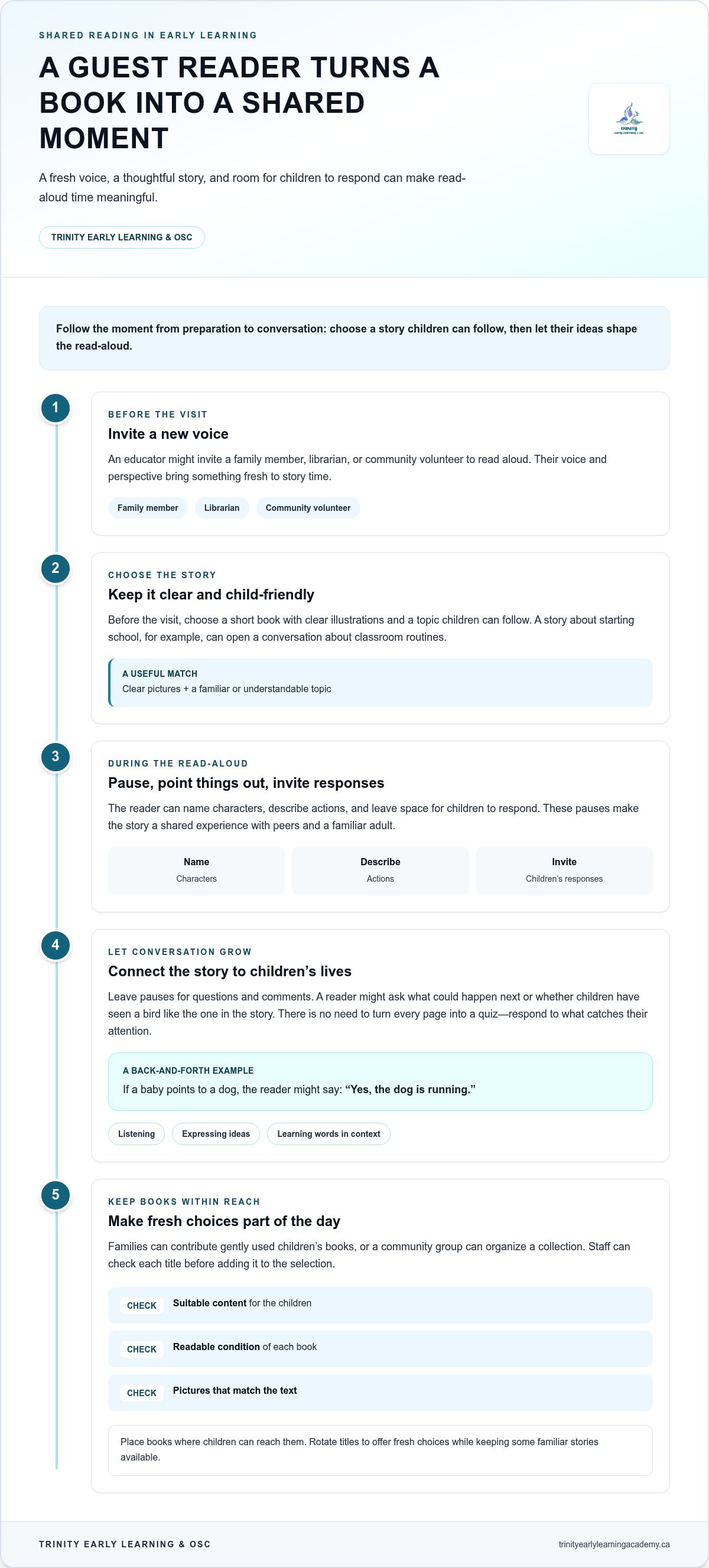
A guest reader brings a new voice and perspective to story time. An educator might invite a family member, librarian, or community volunteer to read aloud. Before the visit, choose a short book with clear illustrations and a topic children can follow. The reader can pause to name characters, describe actions, and invite responses. A story about starting school, for example, can prompt conversation about classroom routines. Children hear different voices and ways of telling stories while sharing the experience with peers and a familiar adult.
Book donations can broaden a centre’s selection. Families may contribute gently used children’s books, or a community group may organize a collection. Staff can review each title for suitable content, readable condition, and pictures that match the text. Place new books where children can reach them instead of storing them out of sight. A donation of animal stories, for instance, can support children’s questions about pets and wildlife. Rotating titles provides fresh choices while keeping some stories familiar.
Conversation helps children connect spoken language with meaning. During a read-aloud, an adult can name an object, wait for a child’s response, then add a word or idea. If a baby points to a dog, the reader might say, “Yes, the dog is running.” A toddler can answer with a sound or gesture, and the adult can continue the exchange. Preschoolers may predict what a character will do next. These back-and-forth moments let children practise listening, expressing ideas, and learning words in context.
Canadian early learning guidance is set by provincial and territorial frameworks, so recommendations differ across the country. A practical literacy approach centres on warm interactions, conversation, stories, and opportunities to explore language through play. These experiences support communication without turning every book into a formal lesson.
A literacy-rich daycare environment makes print part of everyday activity. Children might find books in an accessible reading area, picture labels near familiar objects, and story-related materials in play spaces. After reading about a market, educators could offer pretend grocery items and invite children to name or sort them. Children then use story vocabulary in conversation, connecting oral language with early literacy.
Shared reading also gives children time to ask questions, relate a story to their experiences, and build vocabulary. A reader can ask, “What might happen next?” or “Have you seen a bird like that?” There’s no need to turn each page into a quiz. Leave pauses for children to comment, and respond to what captures their attention. Families exploring early learning and childcare can look for settings where books and conversation have a visible place in the day.
3. Modelling reading and active reading strategies
Children notice how adults handle books, magazines, and written messages. An educator can pick up a magazine, read a short article, and explain what caught their interest. During a story, name the page, author, and beginning as you turn through the book. These simple actions show that reading has a purpose beyond completing a task. A child who sees an adult pause to enjoy an illustration or laugh at a funny line also sees reading as something people choose to do.
Make your thinking audible during a read-aloud. Before turning the page, say, “I think the character will look under the table because the toy is missing.” Then read on and reflect on whether the prediction fit the story. Ask children what they notice, and give them time to answer in their own words. If a picture shows dark clouds, for example, invite them to connect the image with what they know about rainy weather. This models prediction, observation, and making meaning from clues.
Adults can model how readers respond to unfamiliar words, too. Pause at a word such as “enormous,” point to the large object in the illustration, and explain that it means very big. Then use it in a new sentence, such as “That is an enormous block tower.” Naming the author or pointing out the title helps children understand how books are organized. These demonstrations make print features and vocabulary clear without interrupting the story for long.
Enjoyment matters in writing, too. After reading a story about a lost mitten, an educator can write a short note with the children: “We found the red mitten by the door.” Say each word as you write, then read the sentence back. Children can add a drawing or dictate a different ending. The adult shows that writing can tell a story, share information, and preserve an idea, not just put letters on a page.
Parents and educators can share what they read and why. An adult might say, “I’m reading this recipe to find out what comes next,” or describe a favourite part of a book. Invite children to listen, then share what they liked or disliked about a story. A preschooler might say the bear was brave; an adult can point to the moment that supports that idea. These brief exchanges show how readers think, form opinions, and talk about text.
Keep the example genuine. When an adult enjoys a picture book, poem, newspaper, or audiobook, sharing that interest gives children a real model to observe. A child may imitate the adult by turning pages, retelling a scene, or pretending to read aloud. Parents can reinforce the same message at home by letting children see them read for pleasure or for a practical reason. In these everyday moments, adults show that reading and writing belong in ordinary life.
4. Reading aloud to babies, toddlers and preschoolers
Read-alouds can begin in infancy, before a baby understands every word. Newborns’ brains are sensitive to the sounds and complexities of language, so a caregiver’s voice matters from the start. Hold a board book where the baby can see its pictures, name what appears, and pause when the baby looks, reaches, or vocalizes. If the child touches a picture of a cat, respond by naming it and describing what it’s doing.
Follow each child’s cues. A toddler may turn pages quickly, point to one picture, or wander away before the story ends. Keep the book available, describe an illustration, or return to the page that caught their attention. Sitting still isn’t required for storytelling. A caregiver can share language through a song about the picture, a short description during play, or a walk to find something from the story.
Interactive read-alouds support early literacy by connecting spoken language with written words, illustrations, and meaning. An adult can pause for a child’s comment, ask what a character might feel, or connect an event to the child’s experience. These exchanges build vocabulary and comprehension while giving children practice expressing ideas. After a character drops a toy, for example, ask what happened and what might help. Shared story time shows how daycares foster a love of reading through conversation, attention, and connection.
Preschoolers can take a more active role in shared story time. Use an expressive voice for a character, slow down at an exciting moment, and leave space for children to predict what comes next. During The Very Hungry Caterpillar, children might talk about the foods shown or recall what happens after the caterpillar eats. Keep questions suited to their attention and language skills, and let conversation grow naturally from the story.
Plan daily opportunities to hear stories aloud, rather than relying on a book only when time remains. A reading period of at least 15 minutes a day is one practical recommendation, but the experience should stay enjoyable. Repeat a favourite book when children request it. Familiar wording lets them anticipate what comes next, notice details, and absorb new vocabulary during each sharing. These predictable moments show how daycares foster a love of reading without making story time feel like a lesson.
Read with warmth, not performance pressure. A caregiver can change their voice, use a gentle gesture, or act out a character’s surprise, then watch how children respond. Invite preschoolers to retell the story in their own words or act out a scene with simple props. Babies can join with a gaze or gesture; toddlers with a sound or movement. Each response gives the adult a cue for keeping the story engaging.
5. Reading routines for babies and preschoolers
A predictable reading cue helps books become part of a child’s day, not an occasional activity. An educator might put a familiar basket near the play area and invite children to browse after morning arrival. At home, a parent could connect a short story with a regular moment, such as after breakfast. The routine matters more than finding a perfect time. A familiar cue helps children anticipate books and return to them on their own.
For babies, keep books within reach during calm, supervised moments. A caregiver can share a sturdy board book after a diaper change or before a nap, following the baby’s attention rather than requiring a full story. If the baby turns away, pause and try again later. Repeating the routine gives the child chances to notice familiar pictures and hear words in a comfortable setting.
Toddlers often move between stories and play. An educator can leave a few books near blocks, toy animals, or pretend food, then connect a child’s actions to a story. A toddler stacking blocks might choose a book about buildings, look at one page, and return to play. That brief visit still makes reading part of the day. Songs, rhymes, and movement can also keep language in the routine.
Preschoolers can help shape a longer story routine. Set aside ten to fifteen minutes a day for shared stories, then let children choose a book or where to sit. Before reading, invite them to look at the cover and say what they notice. Afterwards, children can retell a favourite part, act out a character’s actions, or draw a new ending. These steps link listening, speaking, play, and early writing.
How can daycares make books accessible throughout the day? Place a small, reachable selection in more than one familiar area, such as a cosy corner and the dramatic-play space. Keep books facing outward when possible, and rotate the selection to reflect current interests, seasons, or classroom themes. A book about snow, for example, can sit near winter clothing during Alberta’s colder months. Children can then choose a story during play, quiet time, or a transition.
Consistency doesn’t mean every day must follow the same script. If a group is restless, an educator can share one page, sing a related rhyme, or return to the story later. If children are engaged, allow more time for discussion. Families can use the same approach at home by keeping books easy to reach and following the child’s interest. For St. Albert families looking for a setting where early learning fits into daily care, explore childcare options.
Trinity Early Learning & OSC: Licensed Daycare Services
Trinity Early Learning & OSC is a licensed daycare in St. Albert, offering Childcare and Preschool programming for families seeking early learning and care. Its warm, family-centred setting can give children opportunities to enjoy books alongside other early learning experiences. The centre also offers Kindergarten care and Out-of-school care, along with approved affordability grant funding to help lower childcare costs.
Choosing care is a family decision shaped by your child’s age, daily routine, and learning needs. Explore Trinity Early Learning & OSC’s childcare and early learning programs in St. Albert, then book a tour or pre-register online to take the next step.
Make room for stories in your child’s day
Understanding how daycares foster a love of reading can help you notice the small moments that invite a child to engage with books. Choose one simple reading moment to build on this week. Your child might bring home a favourite topic, retell a story in their own way, or ask to hear a book again. Follow that cue with an unhurried conversation, a drawing, or a story shared together. There’s no need to turn it into a lesson. Your child’s response can guide what you explore next.
Reading habits grow through connection between a child’s experiences at care and at home. If you’re considering childcare in St. Albert, think about the kind of early learning environment that would suit your family and support your child’s interests. Contact Trinity Early Learning & OSC to learn more about its programs and discuss your family’s needs. Each shared story is an opportunity to make books feel welcoming, familiar, and worth returning to.
Frequently Asked Questions
How do Canadian daycares encourage a love of reading?
Daycares encourage reading by making books a welcoming part of children’s everyday experiences. In St. Albert, families can ask how a centre connects stories with children’s play, conversations, and interests. The ways daycares foster a love of reading often show up in small details: children can revisit a story, talk about its characters, or use its ideas in pretend play. These experiences help books feel meaningful beyond story time.
How often should daycare educators read aloud to children?
Educators should plan regular read-aloud time each day, while responding to children’s attention and energy. A shared reading period of at least 15 minutes a day is one practical recommendation, though a child may benefit from shorter story moments throughout the day. For example, an educator can share a brief book before outdoor play and return to a longer story during a calmer period.
What types of books are best for infants, toddlers, and preschoolers?
The best choice depends on a child’s age, interests, and current way of engaging. Infants can explore sturdy books with clear pictures and familiar objects. Toddlers may enjoy repeated phrases, simple actions, and books they can point to or help turn. Preschoolers can explore longer stories, informational books, and picture books with more complex ideas. A child’s response helps educators decide what to offer next.
How can daycares choose inclusive books that reflect diverse families and cultures?
Choose books that portray varied families and communities with care, accurate details, and respectful language. Look beyond a single book about a culture: include stories where people from different backgrounds take part in everyday family, school, and community life. Check that illustrations and text support each other, and consider whose voices appear as main characters. In St. Albert, family input can help educators choose books children recognize and value.


