

A 15-month-old crying at daycare isn’t automatically a sign that the care arrangement is wrong. Crying at drop-off often eases after a few weeks, but if you’re wondering what to do if your child is unhappy at daycare, look at how they’re settling throughout the day, not only how they feel at goodbye. If the distress continues after two or three months, it’s time to discuss what’s happening with caregivers and consider whether the arrangement is meeting your child’s needs.
It’s understandable to feel worried when your child cries, clings to you or resists going in. This article explains how to talk with your child and their caregivers, support a smoother transition and recognize behaviour changes that may need more attention.
You’ll also learn when it may help to rethink the care arrangement, so you can make a calm, informed decision based on your child’s experience.
Key Takeaways
- Notice whether your child settles after drop-off or remains distressed during the day, and share those observations with caregivers.
- Ask educators about your child’s activities, peer interactions and emotional well-being so you can work together on practical changes.
- Watch for lasting behaviour changes at home, including regression or clinginess, rather than judging the situation by tears at goodbye alone.
- Use calm conversations and consistent routines to help your child express what feels difficult and feel more prepared for daycare.
- If your child remains unhappy despite supportive steps, consider whether another childcare arrangement may better meet their needs.
1. Considering a different daycare or in-home babysitter
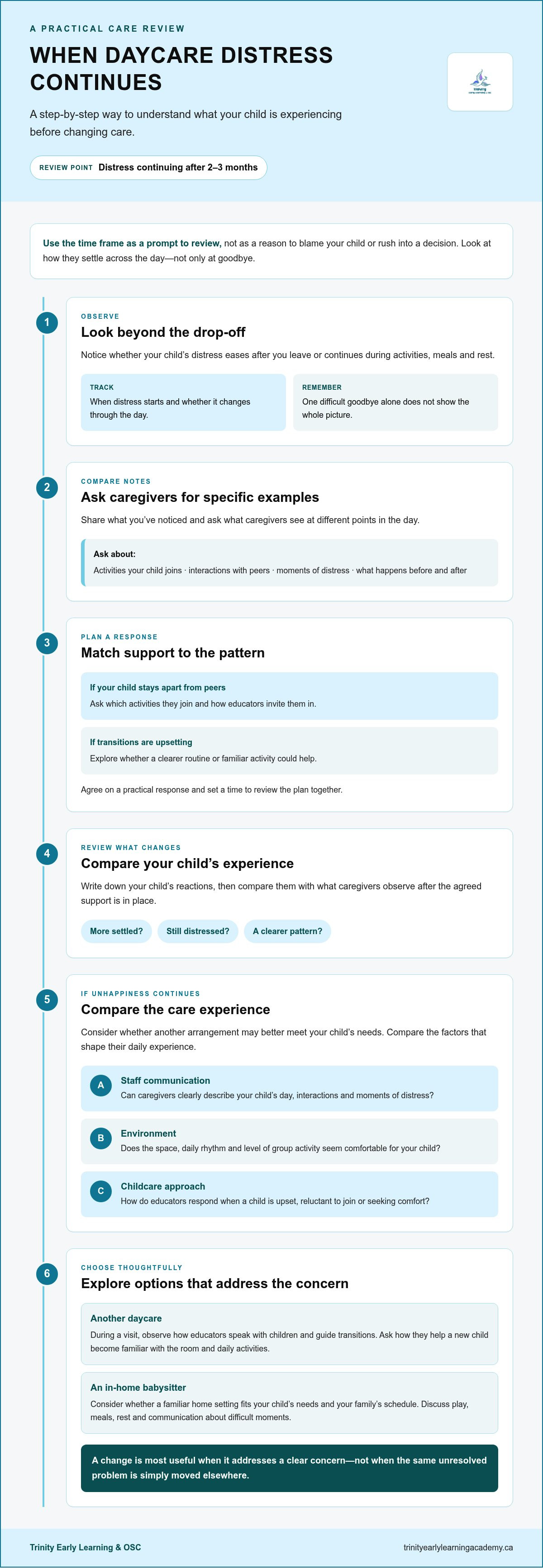
If your child is still crying at daycare after two or three months, reassess the arrangement. That time frame is a reason to review what’s happening, not to blame your child or make a rushed decision. Look for patterns: does distress ease after you leave, or continue during activities, meals and rest? Ask caregivers for specific examples from different parts of the day.
Before changing care, discuss what you’ve noticed and agree on a practical response. For example, if your child stays apart from peers, ask which activities they join and how educators invite them in. If they become upset during transitions, explore whether a clearer routine or familiar activity could help. Set a time to review the plan together, then compare your child’s experience with what caregivers observe.
If your child remains unhappy despite these efforts, consider other arrangements. Compare the factors that shape your child’s daily experience:
- Staff communication: Can caregivers describe your child’s day, interactions and moments of distress clearly?
- Environment: Notice whether the space, daily rhythm and group activity level seem comfortable for your child.
- Childcare approach: Ask how educators respond when a child is upset, reluctant to join or seeking comfort.
Another daycare may offer a different environment, routine or approach. During a visit, observe how educators speak with children and guide transitions. Ask how they help a new child become familiar with the room and daily activities. You can also share what has helped at home, such as a predictable goodbye routine, so caregivers understand your child’s cues.
An in-home babysitter is another possible arrangement. Consider whether care in a familiar home setting fits your child’s needs and your family’s schedule. Discuss how the caregiver would structure play, meals and rest, and communicate about difficult moments. A change is most useful when it addresses a clear concern, rather than simply moving the same unresolved problem elsewhere.
Write down your child’s reactions before deciding. For example, note whether they seem more settled after a change in routine or remain distressed across settings. If you’re weighing what to do if your child is unhappy at daycare, use these observations and conversations with caregivers to decide whether to adjust the current plan or explore another childcare arrangement.
2. When Should Parents Be Concerned About Behaviour at Daycare?
A child’s response can vary from one daycare day to the next. A tantrum or subdued mood after starting care may ease as the child adjusts. Look at what changes over time, rather than treating one difficult drop-off as proof that something is wrong. If distress continues or grows, ask caregivers what they see during play, meals and transitions.
For parents asking about rights and complaint procedures in Canada, begin with the provider’s written policy, document your concerns and raise them with the director. Procedures vary by province and care arrangement, so keep the discussion focused on specific observations and the response you need.
Watch for behaviour changes at home as well as at daycare. Regression after a few months in care can be a sign of stress, especially if a child who was managing a routine begins struggling with it. Note when the change started, what happened beforehand and whether it appears on daycare days or across the week. These details can help caregivers respond to a pattern rather than a single moment.
Age matters when interpreting a child’s behaviour. Children aged 2–3 years are still developing language and emotional-regulation skills, so difficulty sharing a toy or expressing frustration can occur. Ask what happened before a conflict, how staff responded, and whether the child returned to play. A positive account includes the educator’s response and the support that helped, not only a label such as “difficult.”
Social challenges deserve attention when a child repeatedly avoids peers, seems fearful around a particular child or reports unkind behaviour. Ask caregivers for concrete examples: where the interaction happened, what each child did and how staff intervened. A child may not explain an incident clearly, so compare their words with the educator’s observations. Repeated distress linked to the same interaction calls for a timely conversation.
Use a simple record to compare observations: date, behaviour, setting and what helped. For example, note whether a child withdraws after a noisy group activity or becomes upset when play ends. Share the pattern with caregivers and ask what they notice at daycare. Agree on one supportive response, then check whether your child’s participation or mood changes.
If concerns persist despite discussion, review the provider’s complaint process and follow its stated steps. St. Albert parents can also compare care settings by considering communication, the environment and the approach to children’s emotional needs. Explore care options in St. Albert as you consider what setting may better suit your child.
3. Emotional regulation and communication
A daycare conversation works best when adults listen before offering solutions. Children aged 2–3 years are still developing language and emotional-regulation skills, so they may show distress through behaviour before explaining it. A child might push away a backpack, become quiet after pickup or cry when asked about the day. Treat these reactions as information, then invite the child to communicate in a calm moment.
To talk about why your child dislikes daycare, ask open-ended questions such as, “What did you play today?” or “Who did you spend time with?” Listen without correcting or rushing to reassure them. If they mention a difficult situation, reflect what you heard: “You felt sad when the game ended.” This helps your child express feelings and gives you clearer details to share with caregivers.
Keep questions simple and give your child time to answer. A toddler may communicate through gestures, play or a few repeated words. If they say, “No daycare,” you might ask, “What feels hard?” Avoid asking several questions at once or suggesting an answer, such as, “Did someone take your toy?” That can make it harder to understand what your child experienced.
Before talking with a caregiver, prepare one example and a clear request. You could say, “After daycare, Maya has been quiet and says she played alone. What did you notice during free play?” Then ask what may have triggered the moment, how staff responded and which strategies are helping. Questions about activities, peer interactions and emotional well-being can reveal whether home and daycare observations match.
If a brief conversation doesn’t resolve the concern, schedule a meeting with the educator or director. Describe what you’ve seen without assigning blame, and invite the caregiver’s perspective. Together, brainstorm practical supports instead of imposing a plan. For example, you could agree that an educator will invite your child into a familiar activity, then share how your child responded.
Keep communication active after the discussion. Check in regularly with your child and caregivers, and compare specific examples rather than relying on a general impression. If the first strategy doesn’t help, discuss a change and observe the response. This gives everyone a shared way to assess progress while helping your child build skills for naming feelings, asking for help and joining daily activities.
4. Crying and distress at daycare drop-off
Crying at drop-off can happen as a child adjusts to separation, a new routine or an unfamiliar room. Distress at the doorway doesn’t show by itself how the child feels all day. Ask caregivers whether your child settles, joins activities or continues crying after you leave. One parent reported that their two-year-old usually calmed within 10 minutes or less, illustrating why the full transition matters.
Adjustment times vary. Children’s drop-off protests may ease after a few weeks, while one parent reported that their child took 5-6 weeks to stop protesting preschool. A childcare provider suggested adjustment can take 6 weeks, and another parent said their child became comfortable after 2 months. One parent reported distress lasting 7 months, so use the child’s experience, not a single timeline, to guide your next steps.
Ask educators to describe what happens after goodbye. Find out whether crying continues, what helps your child settle, and whether they take part in play or routines. Ask whether staff have noticed withdrawal or reluctance to participate. Separation anxiety, difficulty with a new environment or unkind behaviour from other children can each contribute to distress. Specific observations can help you identify the reason and discuss a useful response.
A gradual introduction may help when the schedule allows it. Start with shorter visits and slowly extend the time your child spends at daycare. For instance, a parent suggested trying 3 half days a week. Ask caregivers whether a familiar comfort item, such as a favourite toy or blanket, can accompany your child. A predictable sequence, such as hanging up a coat before choosing an activity, can also make arrival easier to understand.
Keep goodbye calm and consistent. One parent said staying with their child during the first several days, then leaving on the last two days, helped the transition. Another parent described a routine where the child pushed them out the door, which took about 3 days to become painless. These are individual examples, not a required schedule. Agree with caregivers on a brief routine that fits your child and repeat it consistently.
Track what changes. Note whether your child settles more quickly, accepts comfort or begins an activity after drop-off, then compare these observations over time. If distress persists, discuss adjustments with caregivers, such as a gradual introduction or a familiar arrival activity. Your child’s tears deserve attention, but understanding what happens after goodbye gives you a clearer basis for deciding what support to try next.
5. Signs a child may need additional support
Look for patterns that continue beyond the first adjustment period, not just one difficult morning. Persistent clinginess at home that begins after starting daycare and has not eased after about a month may signal stress. For example, a child who previously entered play independently might suddenly need constant reassurance at home. Note when the change began and whether it appears on daycare days, weekends or both.
Regression after a few months in care can also point to stress. A child who had stopped resisting bedtime might begin struggling again, or a child who usually joins family activities might withdraw. Record the behaviour, when it happens and what came before it. Then compare your notes with caregiver observations to see whether the same change appears at daycare.
Young children may not have the words to explain what feels wrong. Their distress might show as silence, refusal to participate, unusual clinginess or repeated upset around a particular routine. Ask caregivers whether your child plays, accepts comfort and connects with familiar adults. Concrete examples, such as avoiding a group activity or becoming tearful before rest time, make the conversation more useful.
Meals can offer another clue. Children are generally more willing to eat and begin meals when they feel comfortable and are surrounded by people they trust. If your child’s appetite or participation changes at daycare, ask what staff observe during meals and whether your child seems settled with the group. Consider this alongside mood, play and behaviour at home.
Use a simple record to guide next steps. For each observation, note the date, setting, behaviour and what helped. For example, write down whether clinginess began after a change in the daycare routine, or whether withdrawal followed a difficult peer interaction. Share the pattern with caregivers and agree on a supportive response, then review whether your child’s comfort and participation improve.
Reach out to a family health professional when persistent changes concern you, especially if they affect daily routines at home and daycare. Bring your notes and caregiver observations so the discussion has clear examples. If your child’s distress continues despite a shared plan, reconsider whether the current care setting is meeting their emotional needs. The key is to act on lasting changes rather than dismissing them as a passing phase.
If you’re concerned about a pattern, discuss your child’s care needs and the kind of support that may help.
Trinity Early Learning & OSC: Licensed Daycare Services
Trinity Early Learning & OSC is a licensed daycare in St. Albert, offering childcare for families considering a different care setting. If your child remains unhappy after you’ve discussed concerns and tried practical adjustments, exploring another daycare may be a reasonable next step. Trinity offers Preschool programming, Kindergarten care and out-of-school care, along with affordability grant funding to help lower childcare costs. Reviewing these options can help you decide whether a different setting suits your family’s needs. Contact Trinity Early Learning & OSC to discuss its childcare programs.
Choose a thoughtful next step for your family
If you’re wondering what to do if your child is unhappy at daycare, give yourself room to make a considered decision. Before your next conversation, write down what you hope will change for your child, such as feeling comfortable joining activities or asking an educator for help. These priorities can keep discussions focused on your child’s needs and make it easier to decide what support feels appropriate.
You can also talk with Trinity Early Learning & OSC about the care setting you’re considering. A conversation can help you explore whether its childcare options align with your family’s needs and what matters most to your child. You don’t need to have every answer before reaching out; start with the concern you want to discuss.
Contact Trinity Early Learning & OSC to begin a conversation. Taking one clear step can help you move forward with care and confidence.
Frequently Asked Questions
15-Month-old cries a lot: is it unavoidable?
No, frequent crying isn’t inevitable for every 15-month-old, though separation and unfamiliar routines can be difficult. Ask the educator what happens after you leave: does your child accept comfort, explore toys or join play? Also mention changes at home, such as disrupted sleep or stronger clinginess. These details can help identify whether distress centres on drop-off, a particular routine or something else during the day.
2-Year-old unhappy: bad fit or hard adjustment?
It may be a hard adjustment, a mismatch with the care setting, or a specific difficulty your child can’t yet explain. A 2-year-old may have limited language for describing peer conflicts or transitions. Compare how they respond to different parts of the day, such as free play and rest time. Ask the educator what they observe, then consider whether a practical change helps your child engage more comfortably.
When should parents be concerned about behaviour at daycare?
Pay attention when a change persists, intensifies or affects several parts of your child’s day. For example, note whether a child who once joined play now regularly withdraws, or whether distress follows the same interaction. Record what you observe and when it occurs. Share those details with the educator and agree on what to watch next. Seek professional guidance if ongoing changes are affecting daily life at home.
What signs suggest a child is unhappy or distressed at daycare?
Possible signs include repeated crying, withdrawal from play, reluctance to participate or new clinginess at home. One sign alone doesn’t explain the cause. Look for a pattern, such as becoming quiet after daycare or resisting a particular activity. Ask caregivers whether they see similar behaviour during the day, and compare their observations with what you notice at home. Specific examples can clarify what support may help.
How should parents discuss daycare concerns with educators and directors?
Describe what you’ve observed, give a concrete example and ask for the educator’s perspective. You might say, “After pickup, Sam says they played alone. What did you notice during group play?” If the concern continues, request a discussion with the director and explain what response you’re seeking. Keep a written record of the concern and any agreed steps so follow-up stays focused and clear.
What questions should I ask daycare staff about my child’s daily routine and care?
Ask which activities your child chose, how they interacted with peers and which parts of the routine seemed difficult. You can also ask how they responded to comfort, whether they ate and rested as usual, and what helped them rejoin play. Request a specific example from the day rather than a general “fine.” This gives you a clearer picture to compare with your child’s behaviour at home.
How long does it usually take children to adjust to daycare?
There’s no single adjustment timeline for every child. Children’s drop-off crying often eases after a few weeks, while reported experiences range from settling after 6 weeks to becoming comfortable after 2 months. Track whether your child is gradually accepting comfort, exploring or joining routines. If distress stays intense or new concerns appear, discuss the pattern with caregivers instead of relying on a calendar alone.
When should I consider changing daycares or keeping my child home?
Consider a different arrangement if your child remains unhappy despite discussions and practical changes, or if observations point to an ongoing concern in the setting. Ask caregivers to describe what they’ve tried and how your child responded. Keeping your child home can be a short-term family decision while you assess next steps, but consider how it affects the care routine. Focus on your child’s experience and your family’s needs.


