

What if the best sign of a daycare fit isn’t a shared philosophy statement, but the way your child is cared for each day? Finding a daycare that aligns with my parenting values can feel like a deeply personal decision. You want your child’s routines, relationships, and learning experiences to support the priorities you hold at home, but it can be difficult to know what those values look like in practice.
That uncertainty is understandable. A centre may describe an approach that sounds right, yet you still need to picture how it shapes everyday care. Start by naming what matters most to your family, whether that’s emotional security, independence, play, consistency, or another priority. Then connect each priority to something your child might experience during the day.
This article will help you turn family values into practical questions and observations as you consider childcare in St. Albert. We’ll look at how priorities can show up in routines, communication, and early learning, and how to decide what matters most for your child. Trinity Early Learning & OSC provides licensed daycare, preschool, and out-of-school care in St. Albert, giving local families several care options to consider.
Key Takeaways
- Start by naming the parenting values that matter most to your family, such as connection, independence, play, routine, inclusion, or learning.
- When finding a daycare that aligns with my parenting values, look at how priorities show up in everyday care, not just in a centre’s stated philosophy.
- Separate non-negotiable needs from preferences. Alignment doesn’t require identical beliefs on every parenting topic.
- Use a simple fit exercise: rank your priorities, connect each to a daily care experience, and consider your child’s age, temperament, schedule, and St. Albert routines.
- Compare licensed daycare, preschool, and out-of-school care in St. Albert with your child’s stage and your family’s practical needs.
Finding a Daycare That Aligns with Your Parenting Values Starts at Home
Choosing childcare can feel personal when the way your child is supported matters as much as the practical arrangements. You may value connection, independence, play, routine, inclusion, early learning, or a balance of several priorities. Begin by identifying what matters most to your family, rather than expecting one childcare setting to reflect every hope you have.
Values alignment means shared priorities are reflected in the everyday care a child experiences. It doesn’t require a centre and family to approach every decision in exactly the same way. Instead, use your priorities to identify which parts of your child’s day are most important to you.
How can you identify your family’s core childcare values?
Picture a good day for your child. What helps them feel secure, engaged, and understood? Think about how they respond to new people, transitions, group activities, and quieter moments. Your child’s temperament and developmental stage can shape what support feels right. Family routines may also make consistency or flexibility especially important.
Separate essentials from preferences. An essential might be a caring response when your child is upset; a preference could be a particular activity or routine. Reflecting on different parenting styles and their impact on child development can help you name the approaches that feel closest to your family’s beliefs, without treating any one style as a checklist for childcare.
Turn broad values into clear priorities
Broad values become more useful when you connect them to observable actions. If kindness matters, you might look for patient guidance, respectful interactions, and support as children work through disagreements. If independence is a priority, consider whether children have age-appropriate chances to try tasks themselves, with help when needed. The same value can look different as a child grows.
Write a short family priorities statement to keep your thinking focused. It doesn’t need to be formal. For example: “We want our child to feel connected, practise doing things independently, and have time for play.” Use your own words and keep the statement centred on your child’s needs, not an idealized version of a perfect day.
- Connection: What helps your child feel welcomed and comforted?
- Routine: Which familiar patterns help your child manage transitions?
- Play and learning: What kinds of exploration keep your child engaged?
- Inclusion: How do you want your child’s identity, needs, and relationships to be respected?
Choose a few priorities to guide your reflection. Treating every preference as essential can make comparisons harder and leave less room for different approaches. A concise set of values gives you a practical lens for considering childcare in St. Albert, while leaving room to adjust your expectations as your child’s needs change.
Connect Parenting Values with a Daycare’s Everyday Care
A childcare philosophy can sound reassuring, but its meaning becomes clearer in ordinary moments: a transition between activities, a child’s attempt to solve a problem, or a conversation with a caregiver. To assess whether care fits your family, translate each priority into something you can recognize in your child’s experience. This moves the focus from broad statements to practical signs of how a value is put into practice.
What might your values look like during an ordinary day?
If predictability matters to your child, familiar rhythms and support during transitions may help the day feel easier to follow. If curiosity is a priority, look for opportunities to explore materials, ask questions, and learn through age-appropriate experiences. Emotional security may be reflected in warm, respectful relationships, including how a caregiver responds when a child needs comfort or help.
These are prompts for your thinking, not a fixed checklist. A toddler may need more support through transitions than an older child. One child may enjoy group play, while another prefers to observe before joining. The same family value can call for different kinds of support as a child’s stage, temperament, and confidence change.
Play, routines, relationships, and communication can all offer clues. A family that values independence might want a child to have chances to try manageable tasks while still receiving help when needed. A family that prioritizes connection may pay particular attention to how children are welcomed and how their feelings are acknowledged. Focus on the experience behind the value, not just the word used to describe it.
How can values shape family communication?
Clear, respectful communication helps parents and caregivers understand what supports a child across home and care. Think about what information helps you feel connected: how your child is settling into routines, what has captured their interest, or when they needed reassurance. Your priorities can guide the updates and conversations that feel useful, while leaving room for different family preferences.
For a broader local context, Trinity’s licensed daycare guide for St. Albert families discusses licensed childcare in the community. Use it alongside your own reflection to consider which everyday experiences matter most to your family.
When finding a daycare that aligns with my parenting values, keep your priorities connected to observable experiences rather than assuming every family defines them in the same way. Trinity Early Learning & OSC provides licensed daycare, preschool, and out-of-school care in St. Albert. Explore Trinity’s childcare services as you consider which option suits your family.
Does a Daycare Need to Share Every Parenting Value?
No. A childcare setting doesn’t need to mirror every family belief or parenting habit for a child to feel supported. Families and caregivers may have different ways of approaching play, routines, or learning. What matters is whether your child’s well-being is respected and whether the priorities that matter most to your family are reflected in everyday care.
A good fit depends on shared priorities, not identical parenting styles. This can ease the pressure to find a perfect match. Focus on the expectations central to your child’s emotional security, development, and sense of belonging. Then consider which differences are practical preferences that can adapt to group care.
Which differences matter most to your family?
Start with the needs behind your expectations. If your child is adjusting to a change or needs support with communication, patient, respectful responses may be especially important. If a family routine is meaningful, think about whether it can be maintained or adapted in a childcare setting. Distinguish the principle you want upheld from the exact way you practise it at home.
Sort expectations into three groups: essential, flexible, and still uncertain. An essential might be that your child is treated with respect. A flexible preference could be the order of familiar activities. Marking where you’re comfortable with adaptation, and where you’re not, makes your priorities clearer without turning every difference into a deal-breaker.
How can you think through a possible mismatch?
When an approach gives you pause, connect the concern to your child and why it matters. Ask yourself: Is this about a core need or a familiar habit? What effect could the difference have on my child’s comfort, participation, or development? Some concerns deserve closer thought, while other differences may simply reflect a reasonable variation in how care is organized.
Look for observable practices rather than relying on labels such as “structured,” “play-based,” or “nurturing.” Those words can mean different things to different people. Consider what the approach would involve for your child: how transitions are handled, how adults respond to children’s needs, or how play and exploration fit into the day. Specific practices tell you more than a label alone.
One difference doesn’t automatically mean a setting is unsuitable. Look at the overall pattern: does the approach support your child’s well-being, and can your essential expectations be discussed respectfully? Clear expectations help families and caregivers understand what matters, while recognizing that children’s needs and group-care routines may require flexibility.
For parents finding a daycare that aligns with my parenting values, this distinction can make the decision feel more manageable. You’re not looking for a perfect copy of home. You’re looking for care that respects your family’s core priorities and supports your child, even when some everyday practices differ.
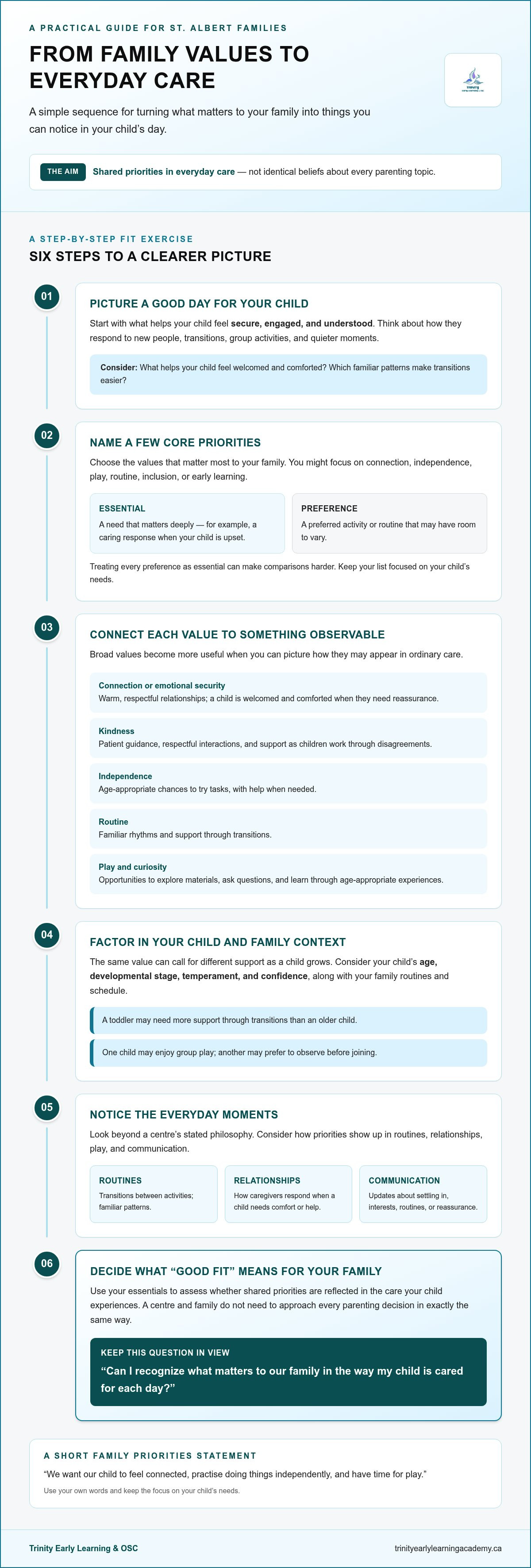
A Practical Values-to-Care Fit Exercise for St. Albert Families
Once you’ve clarified what matters to your family, put those priorities into a simple map. This turns broad hopes into a reflection tool you can revisit as your child grows or your family’s routine changes. It isn’t a scorecard for judging care. It helps you identify what your child needs and which everyday experiences could support those needs.
Build a simple family priorities map
Create three columns: priority, why it matters, and what it could look like in care. Add a practical example to each row. For instance, connection might matter because your child takes time to warm up. In care, that priority could translate into a calm, welcoming transition into the day.
- Predictability: Helps my child feel prepared; care could include familiar rhythms and support during transitions.
- Curiosity: Encourages exploration; care could include opportunities to investigate age-appropriate materials or ideas.
- Independence: Builds confidence; care could include chances to try suitable tasks with guidance.
Rank your priorities once you’ve listed them. Which feel essential now, and which would be welcome but flexible? Review the map with another parent or caregiver in your household. They may notice a need you haven’t considered or explain why a routine matters to them. Comparing perspectives can turn unspoken assumptions into clear, shared expectations.
Use your child’s age, temperament, and current stage to keep the map realistic. A child who finds busy transitions difficult may need different support from a child who enjoys moving quickly between activities. Consider your St. Albert family routine, too, including the journey between home, work, school, and care. A priority is most useful when it connects to your child’s actual day.
Include affordability and the type of care you need
Practical fit matters alongside values. Consider whether licensed daycare, preschool, or out-of-school care is relevant to your child’s stage and your family schedule. These options meet different childcare needs, so first identify the type of care you’re considering, then assess how it fits your priorities.
Affordability is another part of a workable care plan. Include your budget alongside your child’s needs and the values you hope care will support. For information about support that may affect childcare costs, consult the Alberta daycare affordability grant guide and review its current program details.
For more local context on early learning, Trinity’s early childhood education guide for St. Albert can help you consider learning alongside your family’s other priorities. Explore Trinity’s childcare services as you compare options for your family in St. Albert.
How Trinity Early Learning & OSC Supports Families in St. Albert
Trinity Early Learning & OSC is a family-run, licensed childcare provider serving families in St. Albert. Its services include licensed daycare, preschool, and out-of-school care. Use your family priorities map to consider which type of care fits your child’s current stage and your household’s needs. Each option serves a different childcare purpose.
For families finding a daycare that aligns with my parenting values, connect those priorities with the type of care your child needs. Think about your child’s current stage, your family’s regular routine, and the values you hope their care experience will support. A short priorities map can keep that reflection focused.
Which care options does Trinity provide?
Trinity provides licensed daycare for families seeking daytime childcare, preschool as an early learning service, and out-of-school care for school-age care needs. Consider your child’s stage and your family’s schedule when deciding which service is relevant.
For example, if your child is at a preschool stage, think about how early learning fits with your family’s priorities. If your child is school-aged, out-of-school care may fit your care planning. Your child’s needs and daily routine can help guide the choice.
How can affordability fit into the decision?
A care arrangement also needs to be practical for your family. Affordability grant programs support access to Trinity’s childcare services, making cost a useful part of your reflection alongside your child’s needs and family priorities. Program names, eligibility, and terms can change, so use current information when considering how financial support applies to your situation.
Think of values and access as connected parts of the decision. A service type may suit your child’s stage, while affordability and your family’s routine help determine whether it fits your circumstances. You don’t need to settle every consideration at once. Aim for a thoughtful match between your child’s needs, your family’s priorities, and a care option that makes sense for your household in St. Albert.
Trinity’s licensed daycare, preschool, and out-of-school care give local families options at different stages. Explore Trinity Early Learning & OSC and its childcare services for your family in St. Albert.
Let Your Priorities Guide the Next Step
Your family’s needs may shift as your child grows, so treat the priorities you’ve identified as a guide, not a fixed checklist. Revisit them after a change in routine or developmental stage. You may find that one concern becomes less central while another deserves more attention. This flexibility helps you make thoughtful decisions without expecting every part of childcare to match home exactly.
Finding a daycare that aligns with my parenting values is about choosing care that respects what matters most to your family and supports your child’s well-being. Take time to reflect on what you’ve learned and let your priorities guide the decision. A clear understanding of what your child needs can make the next step feel more grounded.
Trinity Early Learning & OSC provides licensed daycare, preschool, and out-of-school care for families in St. Albert. Explore childcare options with Trinity Early Learning & OSC and consider which service fits your child and household.
Frequently Asked Questions
How do I know which parenting values matter most when choosing daycare?
Notice what consistently helps your child feel comfortable, engaged, and ready to participate. Think about recent moments: does your child settle more easily after a familiar goodbye, or thrive when given time to explore something new? These patterns can point to priorities that matter in care. Focus on what supports your child now, rather than choosing values that sound ideal in theory.
Can a daycare support my child if its approach is not exactly like ours at home?
Yes. A child can benefit from care that differs from home in some routines, as long as their needs and your family’s essential expectations are respected. Group activities may be organized differently from play at home, while caregivers can still support a child who needs time to warm up. When finding a daycare that aligns with my parenting values, consider how differences affect your child, not whether every practice matches.
What should I consider when my family’s routines differ from daycare routines?
Identify which parts of your home routine help your child manage change, such as a familiar phrase at drop-off or a predictable sequence before rest. Then think about how your child might adjust when the order of activities differs. A routine doesn’t need to be identical across settings. Knowing which elements provide comfort can help you prepare your child for transitions and maintain consistency where it matters most.
Is play-based care compatible with structured family routines?
Yes. Play and structure can work together. A day can have predictable periods for activities while still allowing children to explore, imagine, and follow their interests within those periods. At home, you might keep regular mealtimes while leaving room for open-ended play. Consider whether structure helps your child feel secure and whether play supports exploration suited to their stage and temperament.
How can I explain my child’s needs and family priorities to a daycare?
Share a concise, practical picture of your child. Describe what helps during transitions, how they signal tiredness or overwhelm, and what usually comforts them. For example, you might explain that your child prefers to observe before joining a group activity. Say why particular routines matter to your family, and separate essential needs from preferences that can adapt to the care setting.
Can childcare affordability grants affect which daycare is right for my family in Alberta?
Yes. Affordability support can be one factor in deciding what care is practical for your household, alongside your child’s needs and the type of service you’re considering. Alberta programs and terms may change, so review current information from the Government of Alberta before making a budget decision. Don’t assume a grant applies automatically to every family or care arrangement; review the current eligibility details.
What type of childcare should I consider in St. Albert: daycare, preschool, or out-of-school care?
Start with your child’s age and the care period your family needs. Daycare is generally for daytime childcare, preschool is an early learning experience, and out-of-school care is for school-age care needs. These options serve different purposes. In St. Albert, compare the support that fits your child’s current stage with your household schedule, then consider which option best supports your priorities.


