

You’ve chosen a new care arrangement, but now comes a harder question: how do you tell your child’s daycare without adding stress to an already significant change? Knowing how to give notice at a daycare starts with checking your agreement and finding out how the centre wants withdrawal details provided.
It’s understandable to feel unsure about the final date or worry that your decision could create tension with educators. A respectful, clear message can keep communication positive, while a little planning can help your child adjust.
This guide explains what to review before giving notice, what to include in your message, and how to prepare your child for their last days in care. You’ll also find practical steps for planning the next routine, including for families looking at daycare, preschool, or out of school care in St. Albert.
Key Takeaways
- Separate a firm decision to leave from questions that still need a conversation with the daycare.
- Review your agreement and written withdrawal policy for the notice method, final care date, and any required form.
- Learn how to give notice at a daycare with a clear message and a record of what you sent.
- Use a straightforward process and letter framework to communicate your decision respectfully.
- Prepare your child for the change with age-appropriate language, familiar routines, and a plan for care in St. Albert.
When is it time to give notice at a daycare?
Deciding to leave daycare can feel emotional, even when the change makes sense for your family. Your child may be attached to educators, friends, and familiar routines, and you may appreciate the care they’ve received. You can value those relationships and still decide that another arrangement better fits your family’s needs.
First, separate what’s settled from what still needs discussion. If your family has confirmed a move, a work schedule change, or a school transition, you may already know when care must end. For instance, families preparing for an overseas move might connect with early learning centres like Children of Tomorrow Pre-school Singapore to establish their new care schedule in advance. If you’re weighing a concern that may be temporary, such as a routine that isn’t working or a question about your child’s day, speak with the daycare before presenting it as a final withdrawal decision.
Daycare is part of a child’s early learning experience, including their development, relationships, and care. The broad Early Childhood Education Overview offers context for why a change in setting can feel meaningful. That doesn’t mean leaving is harmful. It’s a reminder to consider both the practical arrangements and your child’s experience.
What to consider before deciding to withdraw
Clarify why you’re considering a change and whether the reason affects your intended last day. A move may set a firm date, while a shift in family schedules or care needs may still be taking shape. Consider how your child might respond to leaving familiar educators and peers, and which parts of the daily routine you can keep steady. If the decision isn’t final, discuss your options before giving notice.
- Move: Is the relocation date confirmed, and will it change when your child can attend?
- Schedule change: Is the new routine settled, or are you still working through the details?
- School transition or changing care needs: When does your family expect the new arrangement to begin?
These questions can help you distinguish a confirmed plan from a concern that needs more conversation. You don’t need to criticize the current provider to explain that your family’s circumstances have changed.
How to prepare for a calm conversation
Before speaking with the daycare, decide which caregiver or guardian will communicate the decision. Write down the key details: your child’s name, your planned final care day, and the reason for leaving if you want to share it. Keep the message respectful and focused on next steps. If you’re unsure of the date, say so rather than giving one you may need to change.
A simple opening can keep the conversation clear: “We’ve decided to end care because our family’s plans are changing. We’re working toward [planned final day] and would like to discuss the next steps.” This gives the daycare useful context without requiring a lengthy explanation. If the decision is still under consideration, make that clear and frame the conversation as a discussion, not formal notice.
Once your family is ready, learning how to give notice at a daycare starts with communicating the decision clearly. Next, check the written agreement and withdrawal policy for the required process and date details.
What should you check before giving daycare notice?
Before settling on a final care date, find the documents that set out your arrangement with the daycare. The signed agreement, family handbook, and written withdrawal policy can explain how notice is counted and what steps the centre expects. Start with your own documents rather than relying on a friend’s experience or a general online example. Terms can differ between providers and agreements.
Look for sections or terms such as withdrawal, termination, notice, final attendance, and account closing. Note the exact wording, including how notice must be delivered, which date counts as the last day, and whether a withdrawal form is required. These details help you choose a date based on the written process, not an assumption.
Find the notice period and final-day process in your documents
Read the relevant sections together. A policy may explain when notice begins, whether a particular form or delivery method is required, and how the final attendance date is recorded. If the wording has more than one possible interpretation, ask the daycare director how it applies to your family. Refer to the clause or sentence you’re unsure about, and keep the response with your records.
- Notice delivery: Check whether the policy names a method, recipient, or form.
- Final care day: Confirm how the centre determines the last date your child attends.
- Account terms: Review any written provisions about tuition, deposits, outstanding balances, or account closure.
Don’t assume a deposit will be returned, applied to a balance, or forfeited. The agreement’s wording matters, and financial terms can differ between daycares. If a clause is unclear, request an explanation before relying on your interpretation.
Separate the daycare’s policy from Alberta-wide requirements
Your signed documents and the current written policy describe the process for your family. A notice period you hear about from another parent, or see described as common practice, doesn’t automatically apply to your agreement or establish a province-wide requirement. Keep those sources distinct, especially before deciding on dates or account terms.
If you need to understand whether an Alberta-wide rule applies, verify the specific claim using current Government of Alberta information. Licensing requirements are not a substitute for the withdrawal terms in your documents. If the policy and agreement seem to conflict, ask the daycare director to clarify the process in writing.
Once you’ve identified the relevant instructions, you’ll have a clearer basis for how to give notice at a daycare and choosing a date that fits the written process. If you’re arranging a new care setting in St. Albert, Trinity Early Learning & OSC offers daycare and preschool programs as part of your planning. Explore Trinity Early Learning & OSC's daycare and preschool programs.
How to Give Daycare Notice: In Person or in Writing?
Use the method set out in the daycare’s agreement or written policy. If it names a form, email address, or person who must receive notice, follow those instructions. A conversation can make the exchange feel more personal, while a written message creates a dated record. Using both can provide clarity and help preserve a respectful relationship.
Use this comparison to consider what each method does well. It doesn’t replace the daycare’s stated process, and a phone call or in-person conversation alone may not meet a written notice requirement.
| Method | May be practical when | What to keep in mind |
|---|---|---|
| Private conversation | You want to share the decision respectfully or discuss immediate arrangements. | Follow up in writing if the policy calls for written notice, and record the date of the conversation. |
| Phone call | You need to speak directly with the director or administrator and cannot meet in person. | Note who you spoke with and summarize the key details in a follow-up message. |
| The daycare accepts email notice and you want a written record of the date and details. | Send it to the named recipient or address, and retain the sent message and response. | |
| Required form | The provider’s process specifies a form for withdrawal. | Complete each requested field and keep a copy of the submitted form. |
When a conversation can help
A private conversation gives you room for a brief explanation and practical questions, such as what steps follow or how the final care date will be handled. Speak with the director or administrator rather than discussing family details in a shared space. Keep the reason honest and concise. You can explain that your circumstances are changing without sharing sensitive personal information or defending your decision.
If an in-person discussion isn’t convenient, a phone call may serve a similar purpose. Keep the exchange calm and focused on arrangements. A warm, direct tone helps both sides understand what has been decided and what still needs to be settled.
Why written confirmation can prevent confusion
Written notice gives you a dated record of your message and the final care day you’re requesting. Send it to the person or address specified in the daycare’s process, and include your child’s name so the centre can identify the account. If you first speak by phone or in person, send a brief follow-up that records the date and summarizes the agreed next steps.
Save the message, any required form, and the daycare’s written response with your childcare records. If the centre replies with a different date or asks for more information, refer to the exchange and resolve the detail before plans move forward. Keeping a clear record makes how to give notice at a daycare easier for everyone involved.
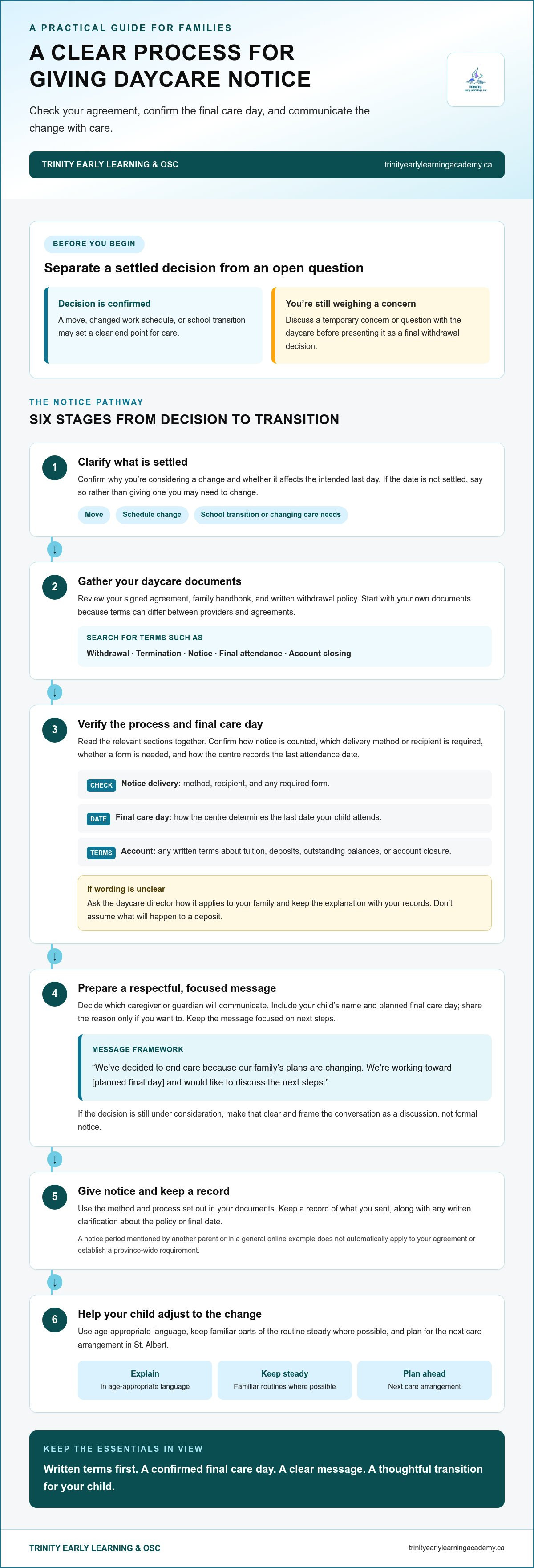
How to give notice at a daycare: steps and a letter framework
After reviewing the daycare’s withdrawal instructions, gather the notice details before sending anything. A short, factual message helps the director or administrator understand your request and gives your family a record of the next steps. Use the sequence below, adapting it to the written process for your child’s care.
Use these steps to send clear notice
Follow the daycare’s stated instructions rather than relying on a general template. If the policy requires a particular channel or form, use it. Keep a copy of what you send, then look for written acknowledgement so you can resolve any questions about the date or account arrangements.
- Review the instructions. Find the withdrawal process and note any delivery requirements.
- Identify the requested final day. Work out the date using the policy’s wording, and avoid substituting an assumed notice period.
- Address the right person. Send the notice to the director, administrator, or recipient named in the daycare’s process.
- State the decision clearly. Identify your child and say that your family is withdrawing from care.
- Request acknowledgement. Ask the daycare to confirm receipt, the recorded final care day, and any remaining account or departure steps.
- Save the record. Keep the sent notice, any completed form, and the response with your childcare documents.
What to include in a daycare withdrawal letter
A letter or email can be warm without being lengthy. Include the notice date, your child’s name, your name and contact details, and the final care day you’re requesting. State the withdrawal directly, thank the educators for their care, and ask about any final-day arrangements or account steps. You don’t need to include private family details unless you choose to.
Subject: Withdrawal notice for [child’s name]
Date: [date of notice]
Dear [director or administrator’s name],
Please accept this message as notice that [parent or guardian’s name] is withdrawing [child’s name] from care. We’re requesting [date] as [child’s name]’s final care day.
Please acknowledge receipt and let us know whether this date is recorded, along with any remaining account or departure steps. Thank you to the educators for supporting [child’s name] during their time at the daycare.
Sincerely,
[parent or guardian’s name]
[contact details]
Replace each bracketed item and adjust the wording to match the daycare’s required process. If the provider supplies a form, complete it as directed and include the same key details where requested. This framework helps you communicate how to give notice at a daycare without assuming every centre uses identical terms.
If your family is arranging care in St. Albert after giving notice, explore Trinity’s childcare programs as part of planning your child’s next routine.
After notice: help your child transition and plan care in St. Albert
Once the end date is clear, focus on helping your child understand what will happen next. A change in care can bring mixed feelings, even when it’s the right choice for your family. Simple explanations, familiar routines, and a predictable handover can help your child feel supported.
Make the final days feel predictable
Explain the change in words your child can understand. A young child may need a short, concrete explanation, such as, “You’ll be going to a different place for care soon.” Older children may want more detail or time to ask questions. Share the news at a pace that suits your child, and be ready to repeat the explanation as the transition approaches.
Keep familiar parts of the day steady where possible, such as the morning routine, a favourite comfort item, or the usual bedtime. Let your child express sadness, excitement, or uncertainty without dismissing those feelings. Reassure them that trusted adults will help, and explain what to expect on their last day and during the next care routine.
Before the final day, coordinate practical details with the daycare. Confirm when to collect your child’s belongings and whether there are handover arrangements to complete. If you want to share information about your child’s routine or needs with the next care setting, prepare it in advance. An organized departure can help close one chapter thoughtfully.
Coordinate the next childcare arrangement
When circumstances allow, plan the next schedule before the current arrangement ends. Consider the days and hours your family needs, your child’s age and stage, and whether daycare, preschool, or out of school care best fits the upcoming routine. Families comparing local options can use this licensed daycare guide for St. Albert as a starting point.
For families reviewing affordability, Trinity’s Alberta daycare affordability grant guide explains relevant information for St. Albert families. Trinity offers licensed daycare, preschool, and out of school care in St. Albert, with affordability grant options to support family access to care. Include the new arrangement in your transition plan, while leaving room for your child to adjust. Consistent routines at home and in care can make the change easier to understand.
- Before the final day: Confirm the next arrangement’s start date and plan how your child will hear about it.
- At handover: Collect belongings and share any relevant routine information you want the next caregivers to know.
- After the change: Keep familiar home routines where possible and make time to listen to your child’s questions.
Each family’s transition will look different. If you’re planning a new care routine in St. Albert, explore Trinity’s childcare programs in St. Albert as one step in arranging what comes next.
Plan the next step with confidence
A change in childcare can be a fresh start for your family. As the new arrangement takes shape, give yourself room to adjust plans if your child needs reassurance or time to settle. A thoughtful transition doesn’t need to be perfect. Small, steady steps can help your family feel prepared.
If you’re still considering what may suit your family’s next routine, review your options and think about the kind of environment where your child can feel secure and supported. For local families, Trinity offers licensed daycare, preschool, and out of school care in St. Albert. Explore Trinity’s childcare programs as you plan what comes next.
With a clear plan for how to give notice at a daycare and a steady approach to the change ahead, you can move forward with greater confidence.
Every transition takes its own shape. Trust your knowledge of your child, stay open to their questions, and take the next step when your family is ready.
Frequently Asked Questions
How much notice should I give at a daycare?
Use the notice period in your signed daycare agreement or current written withdrawal policy. Don’t assume a standard number of days applies to your family. Check how the document counts notice and whether it runs from the day the message is received or another date. If you’re unsure, ask the director to clarify the calculation before choosing your child’s final day.
Is written notice required when withdrawing a child from daycare?
Written notice is required if the agreement or withdrawal policy says it is. Even if you first speak with the director, a written message can document the date and details of your request. Include your child’s name and the final care day you’re requesting, then keep the daycare’s response. If a specific form is required, follow that process rather than relying on a separate note alone.
Can I give daycare notice by email?
You can give notice by email if the daycare’s written process accepts email for withdrawals. Send it to the designated recipient or address, and make the subject line clear, such as “Withdrawal notice for [child’s name].” Keep a copy of the sent email and any reply. If the policy requires another channel or a form, use that method and treat email as a follow-up record.
What happens if I cannot give the notice period in my daycare agreement?
Contact the director as soon as you know the timing may not match the agreement. Explain the situation briefly and ask what options are available, then request written confirmation of any agreed change. Review the agreement for terms about fees, tuition, deposits, or account closure, since the financial outcome depends on the wording that applies to your family. Don’t assume a shorter notice period automatically changes those terms.
Can I withdraw my child before their daycare start date?
You can tell the daycare you no longer plan to start care, but the agreement may set out different cancellation steps for a child who hasn’t attended yet. Review the enrollment documents for withdrawal instructions, deposit terms, and any account conditions. Send your message through the stated channel and ask the centre to confirm the cancellation and any remaining steps in writing. Keep the response with your enrollment records.
What should I tell my child when they are leaving daycare?
Tell your child clearly that their care arrangement is changing, using language they can understand. For example, you might say, “You’ll finish at this daycare, then start going to a new place.” Avoid making promises about details that aren’t settled. If your child asks why, give a simple, honest answer that doesn’t criticize educators. Let them know they can talk with you as questions or feelings come up.
How do I plan a daycare change without disrupting my child’s routine?
Keep familiar anchors in place as the new arrangement begins, such as the order of getting dressed, breakfast, or bedtime. If the schedule will change, explain what will be different and what will stay the same. Prepare practical items in advance, such as a bag or comfort item, and leave room for your child to adjust. For families arranging a new care setting in St. Albert, planning the start date alongside the current end date can help reduce uncertainty.


