

What if daycare could give an only child more chances to practise social skills without treating their family size as a problem? It’s understandable to wonder whether a child who doesn’t have siblings has enough opportunities to share, cooperate and play with peers. But “only-child syndrome” isn’t a recognized clinical diagnosis; it’s an informal label based on stereotypes. Understanding how daycare helps with the only-child syndrome starts with seeing group care as a place for social practice, not a remedy for a supposed condition.
In a supportive daycare setting, children can take turns, join group play and navigate everyday interactions with other children. These experiences can be valuable, but children develop at their own pace, and daycare isn’t necessary simply because a child has no siblings.
This article explains what the only-child label does and doesn’t mean, how peer interaction can support social growth, and what to consider when weighing childcare. For families in St. Albert, licensed daycare at Trinity Early Learning & OSC is one option for regular opportunities to learn and play alongside peers.
Key Takeaways
- “Only-child syndrome” is a stereotype, not a clinical diagnosis. A child’s sibling status doesn’t determine their personality or social skills.
- Daycare can give children everyday opportunities to interact and play with peers, but it isn’t a required solution.
- Consider your child’s comfort, needs and your family’s circumstances when deciding whether group care is a good fit.
- Encourage social confidence with low-pressure opportunities, such as playdates, community activities and group programs.
- Licensed daycare in St. Albert can provide a setting for children to learn and play alongside peers.
What Does 'Only-Child Syndrome' Mean, and Is It a Real Diagnosis?
If you’ve heard that an only child is more likely to be lonely, demanding or uncomfortable around peers, you may wonder whether the label points to a real concern. “Only-child syndrome” is an informal phrase, not a formal developmental or mental health diagnosis. A child’s place in the family doesn’t establish a clinical finding.
The label reflects assumptions about children who grow up without siblings. For background on how the idea developed and has been discussed, see Only Child Syndrome: Debunking Myths. A stereotype may sound familiar, but that doesn’t make it true of an individual child.
Being an only child alone does not establish a developmental problem. A child’s behaviour is better understood in context, including their age, temperament, relationships and experiences, rather than explained by sibling count.
Why the phrase can create unnecessary worry
A broad label can make ordinary behaviours seem like evidence of a problem. A child who watches before joining a game may simply need time to feel comfortable. A child who finds sharing difficult may be practising a skill, not showing a trait caused by having no siblings.
Children differ in how they approach new people, manage frustration and express what they want. Those differences occur in families with one child or several. Calling only children inherently selfish, lonely or socially behind turns a complex picture into a judgement. It can also shift parents’ attention from what their child needs to worry about family size.
Focus on specific situations instead. Does your child warm up after watching? Are some activities easier than others? These observations give you a practical starting point for offering support without treating a label as an explanation.
What matters more than sibling count
Social development grows through relationships and everyday experiences. Siblings can be one source of interaction, but they aren’t the only one. Time with parents and extended family, friendships, play with other children and group activities all shape a child’s experiences. The quality and fit of those interactions matter more than assuming that every child with siblings gets the same practice.
Consider your child as an individual: what interests them, where they feel at ease, how they communicate, and which interactions they enjoy or find challenging. One child may readily join a group game; another may prefer a quieter activity or one-on-one play. Neither response, by itself, defines their social ability.
This perspective can help families weigh childcare without pressure. Understanding how daycare helps with the only-child syndrome means viewing group care as one possible setting for peer interaction, not a way to correct a child’s sibling status. If you have a specific concern about communication, relationships or development, speak with a qualified health professional who can consider your child’s circumstances and offer individualized guidance.
How Daycare Can Give Only Children Everyday Social Practice
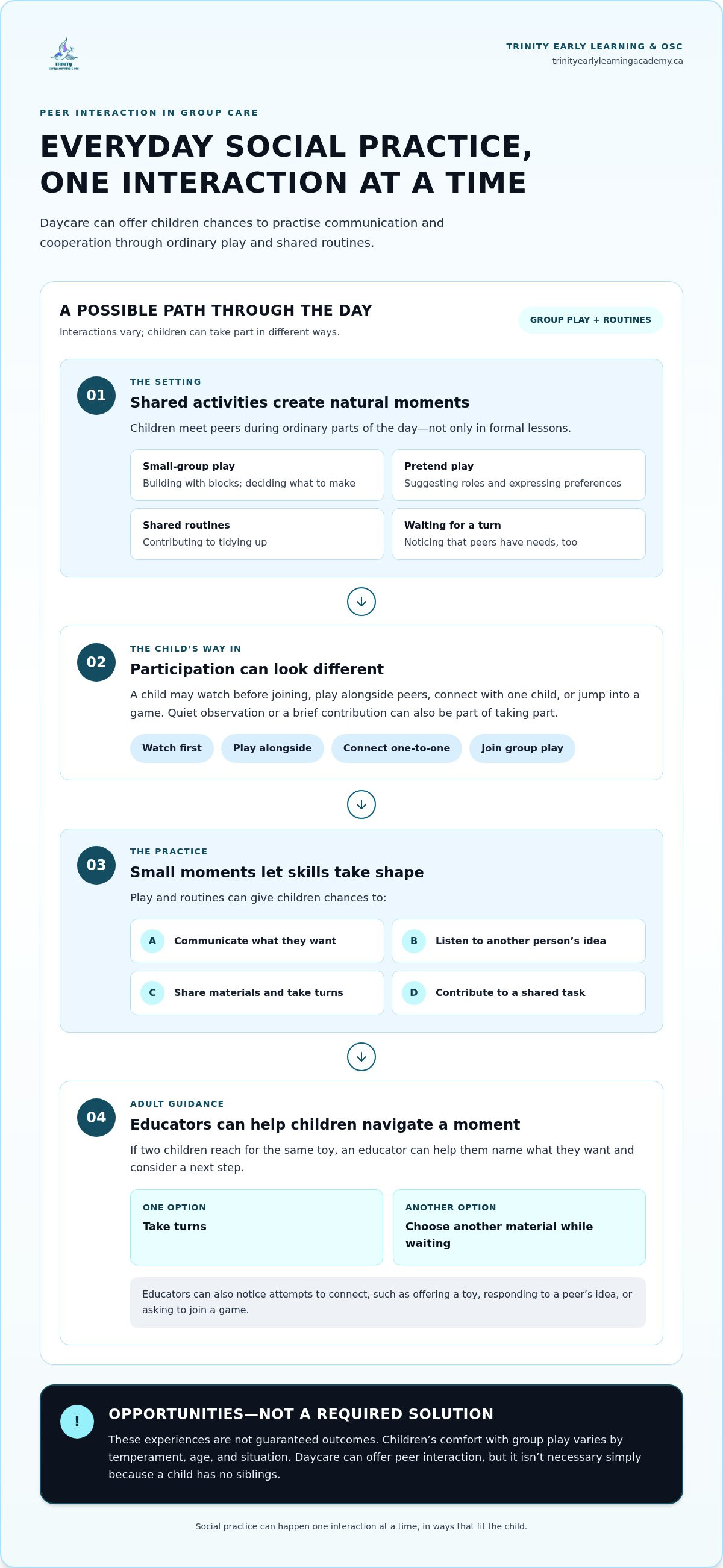
Group care brings children into contact with peers through ordinary parts of the day. These interactions don’t need to be formal lessons. A child might watch others build with blocks before joining in, wait for a turn with a favourite toy, or tell a playmate which colour they want to use. Each moment gives children a chance to communicate and respond in a shared setting.
These are opportunities, not guaranteed outcomes. Children take part in different ways, and comfort with group play varies by temperament, age and situation. Some children jump into a game; others observe, play alongside peers or connect with one child at a time.
Learning through play and shared routines
During small-group play, children may decide what to build, listen to another person’s idea or find a way to share materials. Pretend play can invite them to suggest roles and express preferences. Tidying gives children a chance to contribute to a shared task, while waiting for a turn helps them notice that other children have needs, too.
Predictable group routines create familiar opportunities to practise cooperation, one interaction at a time. Participation doesn’t have to look the same for every child. Watching quietly or contributing briefly can also be part of taking part.
How educators can support peer interactions
Educators can make peer interactions easier to navigate by modelling calm, respectful language. If two children reach for the same toy, an educator might help them name what they want and consider a next step, such as taking turns or choosing another material while they wait. The goal is to guide the moment, rather than label either child as unkind.
Adults can also notice attempts to connect, such as offering a toy, responding to a peer’s idea or asking to join a game. Acknowledging these efforts can give children words and examples to draw on in similar situations. Still, children respond differently to group care, and one setting won’t suit every temperament.
When considering how daycare helps with the only-child syndrome, think about the peer experiences that matter to your child. Do they benefit from time to observe before joining? Do shared activities interest them, or are they more at ease in quieter interactions? These observations can help you decide whether group care fits your family, without treating daycare as a required solution.
For families in St. Albert, Trinity Early Learning & OSC provides licensed daycare, where children can learn and play alongside peers in a group-care environment. Explore licensed daycare in St. Albert as one possible setting for everyday social practice.
Does Daycare Prevent Only-Child Challenges, or Is the Stereotype Misleading?
Daycare isn’t needed to correct a child’s sibling status. Group care may provide more time around peers, but it shouldn’t be treated as a remedy for being an only child or as a way to prevent a presumed social difficulty. There’s no single path to social confidence, and family structure alone doesn’t determine how a child will relate to others.
Weigh the potential for peer interaction alongside practical considerations: your child’s comfort in group settings, their need for familiar routines, your family’s schedule and preferences, and the other opportunities for connection in their life. The right choice is one that fits the child and family, not one made to meet a stereotype.
What daycare may offer, and what it cannot promise
Group care can give children a setting to encounter peers as part of their day. This is an opportunity to experience different personalities and ways of playing, not a treatment or a guaranteed route to a particular social outcome. Children also build relationships through family, friends and community experiences, so daycare is one possible part of a wider social life.
In other words, how daycare helps with the only-child syndrome is best understood as potential practice with peers, not prevention of a condition. General guidance can help parents consider options, but it can’t predict how an individual child will respond.
When a child needs a different pace or support
A new group setting may take time to adjust to. Observe how your child responds over time: whether they become more comfortable, how they communicate their needs, and which situations seem easier or harder. Share those observations with educators and keep the focus on your child’s experience, not a label.
Some children prefer a gradual introduction to unfamiliar settings or smaller, familiar social experiences. Others may enjoy group routines but need quiet time afterward. These differences don’t, by themselves, point to a developmental concern. They can help your family decide what feels manageable and whether a particular arrangement is a good fit.
If concerns about development or communication persist, seek individualized guidance from an appropriate child-development professional or your child’s health-care provider. Bring clear examples of what you’ve observed, when it happens and how it affects everyday life. This context can help a professional consider your child’s circumstances and discuss suitable next steps.
How Parents Can Support Social Confidence With or Without Daycare
Social confidence can grow through ordinary, low-pressure experiences. Daycare is one option, but families can also create opportunities for connection through playdates, community activities or group programs. The aim isn’t to make a child perform socially. Offer chances to interact while respecting their pace and interests.
Build social opportunities gradually
A flexible approach can help a child feel more at ease. Start with a familiar person or a shared activity your child already enjoys, then follow their cues. A short visit with one playmate, for example, may feel more manageable than a busy group activity. If your child watches before joining, allow time. Quiet observation can be one way to get comfortable.
Everyday moments at home can model skills children use with peers. Take turns choosing a game, listen while your child explains an idea, and show how to disagree respectfully: “I’d like a turn when you’re finished.” These exchanges let children hear and practise useful language without turning play into a lesson.
When planning an activity, consider what could make participation easier: a familiar location, a clear activity to share, or the option to take a break. If your child seems hesitant, offer reassurance and a choice rather than insisting they join in. You can try again another time or choose a setting that feels more comfortable.
Notice progress without comparing children
Look for changes in your child’s own comfort and communication, rather than comparing them with a sibling, classmate or imagined age-based standard. Progress might mean staying near a group for longer, answering another child, suggesting an activity or asking for help. These moments can matter even if your child still prefers quieter play.
Brief notes after social experiences can help you identify what works. What seemed enjoyable? What felt difficult? Did your child need more time, a familiar adult nearby or a quieter space? Patterns can guide future activities and help you explain your observations to educators or a relevant child-development professional if you have questions. Avoid treating one difficult interaction as a conclusion about your child’s social ability.
Understanding how daycare helps with the only-child syndrome means seeing it as one possible source of regular peer contact, while recognizing that social confidence can grow in different ways. Families considering care in St. Albert can use this licensed daycare guide for St. Albert families to learn more about local childcare. If group care feels like a suitable next step, explore licensed daycare in St. Albert as one option for learning and play alongside peers.
How Trinity Early Learning & OSC Supports Peer Learning in St. Albert
For St. Albert families considering childcare, licensed daycare can be a setting where children learn and play alongside peers. Trinity Early Learning & OSC provides daycare and early learning in a group-care environment. Shared activities and routines can give children opportunities to notice others, communicate and take part, while each child’s experience remains their own.
That’s the useful distinction behind how daycare helps with the only-child syndrome: it can provide regular peer interaction, but it isn’t a treatment for a condition or a requirement for children without siblings. Base the decision on your family’s care needs and whether the setting feels suitable for your child.
What local families can consider when exploring daycare
Think about your child’s day as a whole. Consider which routines feel familiar, how they respond to new environments and what kind of care arrangement works for your family. You might also notice whether your child settles after observing, seeks out shared activities or needs time to adjust. These details can guide a practical conversation about fit without setting expectations for a particular social outcome.
For broader context on licensed childcare in the area, Trinity’s licensed daycare guide for St. Albert offers families a starting point as they learn about local care.
When preschool may also be part of the conversation
Daycare isn’t the only early-learning option. Trinity also offers preschool in St. Albert for families exploring different ways to support their child’s early learning. As you compare options, keep your child’s needs and your family’s circumstances at the centre of the decision. A child’s social confidence doesn’t depend on attending a particular program.
Families considering preschool can find more context in the guide to preschool programs in St. Albert. It can help you think about how preschool fits alongside your child’s routines and care needs.
There’s no need to choose daycare solely because your child has no siblings. Group care is one possible setting for peer learning; other children may find connection through family, friends or community activities. Choose the option that suits your child and works for your family.
If licensed group care feels like a good fit, explore licensed daycare in St. Albert at Trinity Early Learning & OSC.
Choose a Next Step That Fits Your Family
As you consider how daycare helps with the only-child syndrome, base your decision on your child’s needs and your family’s daily life, not pressure to meet a social expectation. A useful next step is to notice which settings your child enjoys, what helps them feel at ease and what kind of care fits your routines. You don’t need to decide everything at once.
For families in St. Albert, Trinity Early Learning & OSC offers licensed daycare, preschool and out of school care. Learning about these options can help you picture how a group setting might fit into your child’s day, while leaving room for the choice that suits your circumstances.
Explore licensed daycare in St. Albert and take a thoughtful next step toward care that supports your family. Every child’s path is individual, and a calm, informed choice is a meaningful place to begin.
Frequently Asked Questions
Is only-child syndrome a real diagnosis?
No. “Only-child syndrome” is an informal phrase, not a recognized clinical diagnosis. It can encourage assumptions about personality based on family size, but a label cannot explain an individual child’s behaviour or identify a developmental concern. If you’re unsure about something specific, note what you observe, when it happens and how it affects daily life, then discuss those details with a qualified health professional.
Does an only child need daycare to learn social skills?
No. Daycare isn’t a requirement for an only child to learn social skills. Children can practise communication and cooperation in different relationships and settings. A child might plan a game with a cousin, take turns during a family board game or join a community activity. Choose experiences that fit your child’s comfort and your family’s needs, rather than enrolling because you feel sibling status needs correcting.
Can daycare help an only child make friends?
Daycare can give a child chances to spend time with peers, which may help them become familiar with other children and shared activities. Friendships aren’t guaranteed, and children connect in different ways. A child may first recognize a familiar peer, play alongside them or gradually join an activity. If you’re considering how daycare helps with the only-child syndrome, think of peer contact as an opportunity, not a promised result.
Do only children have trouble sharing?
Not automatically. Sharing is a skill children practise in different situations, and difficulty giving up a preferred object can happen whether or not a child has siblings. At home, try a clear turn-taking arrangement: use a timer for a favourite toy or agree that one person finishes a puzzle before the next person uses it. Notice whether your child can ask for a turn or wait with support, rather than judging by one moment.
How can parents support an only child’s social confidence outside daycare?
Offer a manageable opportunity connected to your child’s interests. If they enjoy drawing, invite a familiar peer to work on a picture together; if they like movement, try a community activity where they can participate at their own pace. You can stay nearby at first and let your child decide when to join. Afterwards, ask what they enjoyed or found tricky, without turning the outing into a test.
What if my only child prefers playing alone?
Enjoying solo play isn’t, by itself, proof that something is wrong. Notice whether your child seems content, can communicate their needs and sometimes welcomes interaction in settings they enjoy. You might offer a shared activity without insisting they participate, such as building beside another child with separate blocks. If concerns persist or affect everyday communication and relationships, share specific examples with your child’s health-care provider or another qualified professional.
Is preschool different from daycare for an only child?
Preschool and daycare are different early-learning and care options, and the right fit depends on a family’s needs and the program itself. Neither is necessary because a child has no siblings. St. Albert families can consider what kind of arrangement suits their routines and their child’s readiness for a group setting. Trinity Early Learning & OSC offers licensed daycare and preschool, along with out of school care.


