
What if the most important "classroom" your child ever enters is actually a supervised circle of toddlers learning to share a single red truck? It's completely normal to feel a sense of hesitation or even guilt when considering childcare; many parents worry their child might feel overwhelmed or that they're missing vital bonding time. However, understanding how daycare helps with social skills development can transform that worry into confidence.
In this 2026 guide, you'll discover the specific ways a licensed daycare environment in St. Albert fosters essential social milestones, empathy, and communication skills. We'll show you why these early interactions are a critical developmental investment rather than just a convenience. You'll learn about the benefits of the current Alberta flat-fee model and affordability grants, which make high-quality care more accessible for local families. We'll also provide practical tips for choosing a centre that prioritizes emotional growth through both structured and play-based learning, ensuring your child feels secure and supported while they grow.
Key Takeaways
- Understand why a licensed daycare acts as a "social laboratory," providing intentional learning opportunities that differ from casual play in a home setting.
- Discover how daycare helps with social skills development through guided peer interactions and the unique benefits of multi-age mentorship.
- Learn how professional educators model empathy and help children navigate "big feelings" to build a strong foundation for emotional intelligence.
- Explore the structured 4-step approach to conflict resolution that transforms toddler disagreements into essential communication milestones.
- Gain practical tips for identifying a social-first centre in St. Albert that prioritizes community connection and active educator engagement.
The Foundation of Early Socialization in Daycare
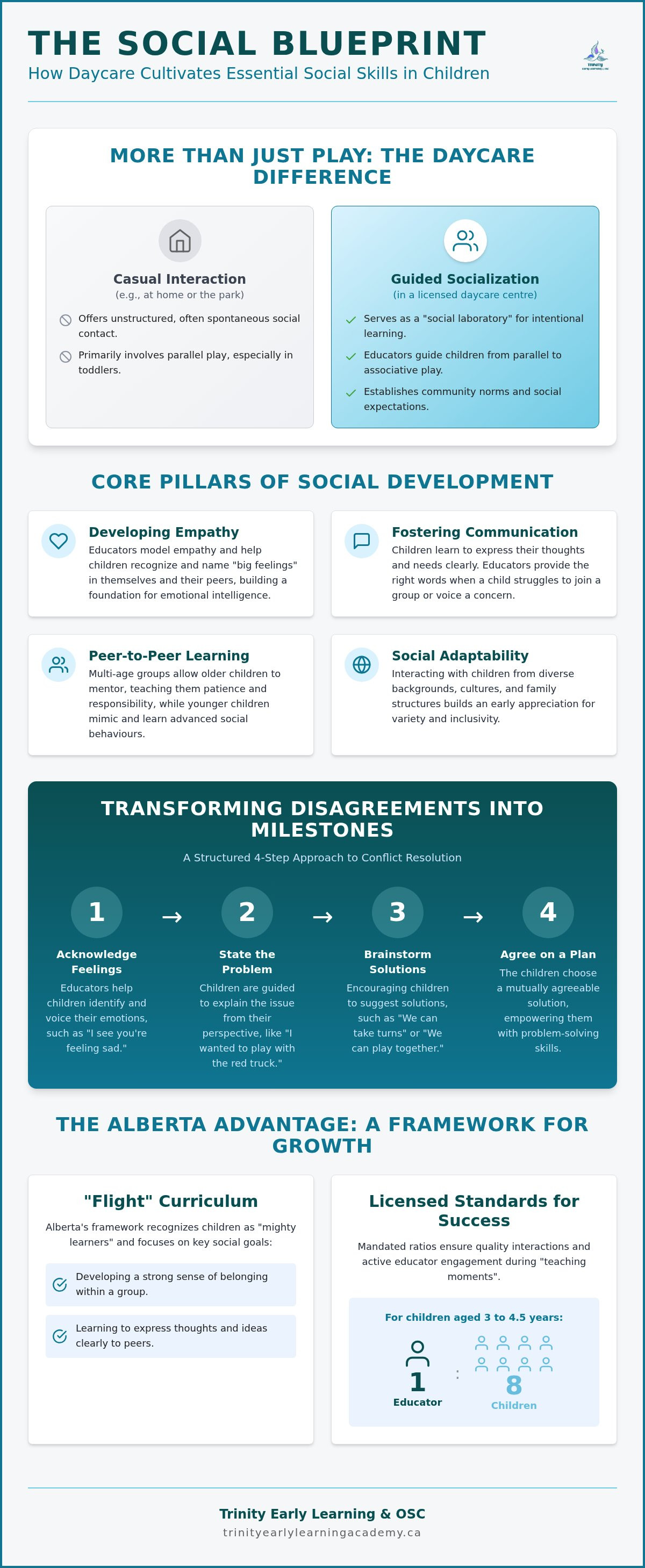
Socialization in a professional childcare setting is much more than just putting children in the same room. It's an intentional, guided process where children learn to understand community norms and navigate social expectations. While a trip to a local park offers casual interaction, a daycare serves as a "social laboratory." In this controlled environment, educators facilitate consistent peer engagement that helps children move beyond their immediate family circle. This transition is essential for building the confidence needed to interact with the wider world. The Foundation of Early Socialization is a core pillar of early childhood education, as it establishes the groundwork for all future interpersonal relationships.
In Alberta, this process is guided by the "Flight" framework. This curriculum recognizes children as "mighty learners" and focuses on specific social milestones, such as developing a sense of belonging and expressing thoughts clearly. Educators use these guidelines to ensure that daily activities aren't just "busy work," but are instead purposeful opportunities for growth. Research consistently shows that children who master these early social skills experience greater academic success later in life. They're better equipped to follow instructions, collaborate on group projects, and manage the classroom environment with ease.
Socialization vs. Simple Interaction
It's helpful to distinguish between different types of play to understand how daycare helps with social skills development. Younger children often engage in parallel play, where they play near others but don't necessarily interact. As they grow, professional educators guide them toward associative play, where they begin to share toys and communicate during activities. Educators monitor these shifts closely; they step in to provide the right words when a child is struggling to join a group. Social-emotional learning (SEL) in the context of St. Albert childcare is the purposeful practice of managing emotions and building positive relationships within a supportive community.
The Crucial Role of Licensed Standards
The quality of social coaching depends heavily on the environment's structure. Choosing a licensed daycare St. Albert families can trust ensures that child-to-staff ratios remain at safe, effective levels. For example, the 1:8 ratio for children aged three to four and a half years allows educators to be present and active during social "teaching moments." A stable, consistent environment is vital for a child's sense of security. When children feel safe and know what to expect from their caregivers, they're much more likely to take the social risks necessary to make new friends and explore new ways of communicating.
Structured Peer Interactions and Peer-to-Peer Learning
In the early years, children naturally view the world through an egocentric lens. This is not a flaw; it's a developmental stage where they're the centre of their own universe. A structured daycare environment gently shifts this perspective toward group awareness. By participating in a shared space, children begin to realize that their peers have different thoughts, feelings, and needs. They learn that sharing a toy or waiting for a snack is a shared experience that benefits the entire group. This realization is a cornerstone of how daycare helps with social skills development, as it teaches children to navigate a world that doesn't always revolve around them.
The "older-younger" dynamic is a powerful tool in this transition. In multi-age settings, older children often step into mentorship roles. They learn patience and responsibility by helping younger peers with simple tasks like putting on a coat or tidying up a play area. Conversely, younger children observe and mimic the more advanced social behaviours of the older group. This natural cycle of peer-to-peer learning fosters a sense of community that is difficult to replicate in a home environment alone. Developing Emotional Intelligence and Empathy begins with these small, daily acts of kindness and cooperation.
Learning Through Diverse Peer Groups
Interacting with children from various backgrounds is essential for building social adaptability. St. Albert is a growing community, and our early learning centres reflect that diversity. Exposure to different family structures, cultures, and abilities helps children develop an early appreciation for the world's variety. It teaches them that while we're all unique, we can all contribute to a positive group dynamic. This inclusive atmosphere prepares children for the diverse social landscapes they'll encounter in grade school and beyond.
The Power of the Daily Routine
Routines provide the social predictability children need to feel safe. Circle time, for instance, serves as a daily anchor where children practice active listening and wait for their turn to speak. These moments teach the self-regulation required for successful group participation. When children know that circle time always follows morning play, they can focus on the social interaction rather than the stress of the unknown. Group meals also play a vital role. They're a platform for practicing manners and developing conversational skills in a relaxed, social setting. For shy children, these structured transitions reduce social anxiety by providing clear expectations for every part of the day. If you're looking for a supportive environment that values these daily connections, consider exploring a community-focused childcare program in your neighbourhood.
Developing Emotional Intelligence and Empathy
Emotional intelligence begins with the ability to identify and name complex feelings. In a daycare setting, children encounter a wide range of emotions, from the joy of a shared game to the frustration of a lost block tower. Educators play a vital role in this process by providing the "social vocabulary" children need to express their needs. Instead of reacting with tears or physical outbursts, children learn to say, "I feel sad because I wanted that toy." This simple shift from impulse to communication is a fundamental way how daycare helps with social skills development. It turns a potential conflict into an opportunity for understanding.
When a child feels emotionally secure, they're much more likely to engage in social risk-taking. This means they feel safe enough to approach a new peer or join a group activity without the paralyzing fear of rejection. This security stems from a consistent, nurturing environment where their feelings are validated and respected. By building this emotional foundation early, children develop the resilience needed to navigate more complex social hierarchies as they grow older. They learn that even if a social interaction doesn't go as planned, they have the tools to recover and try again.
Self-Regulation: The Key to Social Success
Self-regulation is the ability to manage one's own emotions and behaviour in response to a situation. Quality daycare programs use specific techniques, such as quiet reflection areas or guided breathing exercises, to help children regain their composure after a "big feeling" moment. These impulse-control skills are directly linked to future academic performance. Children who learn to regulate their emotions in preschool programs St. Albert families trust are often better prepared for the structure of kindergarten. They can focus on lessons and follow instructions because they aren't overwhelmed by their own internal emotional states.
The Educator as a Nurturing Guide
Professional educators act as "Trusted Nurturers," providing a bridge between a child's home life and the wider world. They don't just supervise play; they actively model empathetic responses. During a "teachable moment," an educator might sit with two children and explain, "Look at Sarah's face; she looks sad because the tower fell. How can we help her feel better?" This guided empathy helps children recognize the impact of their actions on others. Educators strike a careful balance by providing comfort when it's needed while encouraging the social independence that allows children to solve minor peer issues on their own. This supportive guidance ensures that children feel heard while they learn the essential art of caring for the people around them.
Conflict Resolution and Communication Skills
Conflict is often viewed negatively, but it's actually a vital developmental tool. When two toddlers want the same blue truck, they're facing their first real-world negotiation. This is a primary way how daycare helps with social skills development. Unlike a playground where a parent might simply separate the children to keep the peace, a licensed daycare uses these moments as structured lessons. These interactions teach children that disagreements are a natural part of life that can be solved with patience and the right words.
Quality centres in St. Albert follow a consistent 4-step approach to coach these moments. First, the educator approaches calmly to ensure everyone is safe and the situation is stable. Second, they acknowledge the feelings involved, helping both children feel heard and understood. Third, they gather information by asking open-ended questions about what happened. Finally, they facilitate a brainstorm where the children suggest their own solutions. This process moves the child from a physical reaction to a cognitive one, teaching them to "use their words" to solve problems effectively.
The Art of Negotiation and Compromise
Children learn that "no" is a healthy social boundary that must be respected. Educators support this by introducing tools like sand timers for turn-taking agreements. This structure teaches children that they don't have to give up a toy immediately, but they must respect the agreement to share eventually. It builds the confidence to stand up for oneself politely while respecting the rights of others. These skills ensure that children enter the school system with a strong sense of fairness and social responsibility.
Communication Beyond Words
Much of our daily social interaction is non-verbal. Children learn to interpret facial expressions and body language through cooperative games and group activities. They begin to recognize when a friend is feeling overwhelmed even before a word is spoken. These skills are essential as they transition into the more complex social environments of grade school. For older children, these foundations are reinforced in out of school care St. Albert programs, where social complexities naturally increase with age. Learning to read these cues early prevents many misunderstandings and fosters a more harmonious group dynamic.
If you want to see how our educators coach these vital interactions in person, book a tour of our St. Albert centre today.
Choosing a Social-First Daycare in St. Albert
Selecting the right childcare provider is a significant decision that shapes your child's early experiences with the world. While many centres offer safe supervision, a social-first environment focuses on the intentional coaching discussed throughout this guide. When you tour a facility, observe the educators closely. Are they sitting on the floor engaging with the children, or are they simply watching from a distance? Active engagement is a primary indicator of how daycare helps with social skills development, as it shows that staff are ready to facilitate those "teachable moments" during play. A centre that feels like a community rather than just a service provider will naturally foster a stronger sense of belonging for your child.
The financial aspect of high-quality care is also a vital consideration for modern families. In Alberta, the transition to a flat-fee model and the availability of the universal Affordability Grant have made licensed care more accessible. Families with a household income under $180,000 may also qualify for additional subsidies for children up to kindergarten age. These financial supports ensure that a high standard of social-emotional education isn't a luxury, but a developmental investment available to the St. Albert community. Choosing a licensed centre also means you benefit from increased transparency, such as the 2026 regulation requiring the public posting of high-risk incident notices within one business day.
Evaluating the Social Atmosphere
During your visit, take a moment to look at the physical layout. An effective social environment features open play areas that encourage collaborative games alongside quiet corners for self-regulation. Observe the children's interactions; do they seem to be collaborating on projects, or are they playing in isolation? You should also ask the director about their specific approach to "big emotions." A centre that prioritizes social growth will have a clear, nurturing strategy for helping children navigate frustration and conflict without resorting to punitive measures.
The Trinity Early Learning Advantage
Trinity Early Learning & OSC is dedicated to nurturing holistic growth within a safe and supportive St. Albert environment. We understand that your child's emotional well-being is just as important as their physical safety. As a licensed provider, we integrate the Alberta "Flight" framework into our daily routines to ensure every child reaches their social milestones with confidence. Our use of provincial affordability grants reflects our commitment to making quality childcare accessible to local families. We invite you to join our community and provide your child with a balanced foundation for life. Before you make your final choice, use this checklist to evaluate your options:
- Does the centre have a specific curriculum for social-emotional learning?
- How do educators model empathy and respectful communication?
- Are there daily routines, like circle time, that encourage group participation?
- What are the staff-to-child ratios during peak social play times?
- How does the centre keep parents informed about their child's social progress?
Building a Bright Social Future for Your Child
Investing in high-quality childcare is about more than just finding a safe space for the day; it's about providing a foundation for lifelong interpersonal success. You now understand how daycare helps with social skills development by transforming everyday play into meaningful lessons in empathy and negotiation. Through the guided "social laboratory" of a licensed environment, your child learns to navigate complex emotions and build lasting peer connections that will serve them well into their school years and beyond.
As a licensed St. Albert daycare and preschool, Trinity Early Learning & OSC is deeply committed to this holistic growth. Our professional, nurturing educators use the Alberta "Flight" framework to turn every interaction into a purposeful developmental milestone. Because we are an active affordability grant participant, this high standard of social-emotional care remains accessible for families throughout our community. We invite you to Book a Tour at Trinity Early Learning & OSC to see our social-first approach in action! We look forward to welcoming your family and helping your child grow with confidence, empathy, and joy.
Frequently Asked Questions
Does daycare help shy children with social skills development?
Yes, daycare is often the ideal environment for shy children because it offers gradual, supervised social exposure. Educators act as "Trusted Nurturers," helping children navigate small group settings before moving to larger ones. This gentle approach builds the confidence needed for more complex interactions. By providing a consistent routine and familiar peers, daycare reduces the anxiety associated with new social situations, allowing shy children to flourish at their own pace.
At what age do children start learning social skills in daycare?
Social learning begins from the moment a child enters a licensed centre, regardless of their age. Infants learn by observing facial expressions and responding to the tone of their caregivers. As they transition into the toddler years, the focus shifts to parallel play and eventually associative play. This progression is a key part of how daycare helps with social skills development, as it aligns with the child's natural developmental milestones and readiness for peer interaction.
Can daycare help my child prepare for the social demands of kindergarten?
Absolutely. Daycare provides a vital "rehearsal" for the social expectations of the Alberta school system. Children practice following group directions, waiting for their turn during circle time, and collaborating on projects. These experiences build the social-emotional readiness required for kindergarten. By the time they enter a formal classroom, they've already mastered the art of listening to a teacher and navigating the dynamics of a diverse peer group with confidence.
How do daycare educators handle bullying or aggressive social behaviour?
Professional educators use a proactive coaching model rather than a punitive one to address aggressive behaviour. They follow a structured 4-step conflict resolution process that involves identifying feelings and brainstorming solutions together. This approach teaches children the impact of their actions on others and encourages them to use their words to express frustration. By modelling empathy, educators transform difficult moments into essential lessons in self-regulation and respectful communication within the daycare community.
Will my child pick up 'bad habits' from other children in daycare?
While children may occasionally mimic undesirable behaviours from peers, these instances serve as valuable teachable moments. Educators use these opportunities to discuss social boundaries and reinforce the community norms of the centre. They help children understand why certain actions aren't helpful for the group. This guidance ensures that children learn to distinguish between positive and negative social cues, ultimately strengthening their personal values and their ability to make good social choices.
How can I support the social skills my child learns in daycare at home?
You can reinforce these skills by using the same "social vocabulary" at home that your child hears in daycare. When your child experiences a "big feeling," help them name it and discuss a positive way to respond. Practice simple turn-taking during family meals or games to mirror the sharing they do with peers. Consistent communication between parents and educators ensures that the social milestones achieved during the day are supported and celebrated at home.
Is a play-based daycare better for social skills than a structured one?
The most effective environments often combine both approaches to support holistic growth. Play-based learning allows children to experiment with social roles and creativity in an organic way. Meanwhile, structured routines like circle time provide the predictability and security children need to take social risks. This balanced foundation ensures that children develop both the spontaneous negotiation skills found in play and the self-discipline required for more formal group settings in St. Albert.
How does the Alberta Affordability Grant impact the quality of social learning?
The Alberta Affordability Grant ensures that high-quality social learning is accessible to more families by reducing the financial burden of licensed care. This funding allows centres to maintain appropriate staff-to-child ratios, such as one staff member for every eight children aged three to four. These ratios are critical for how daycare helps with social skills development, as they ensure educators have the time to provide individualised social coaching and emotional support to every child.


