
What if the clearest sign your child is ready for preschool isn't their ability to recite the alphabet, but rather how curiosity-driven they are about the world around them? It's completely natural to feel a mix of excitement and worry as you watch your toddler grow. You may feel concerned about separation anxiety, or perhaps you're unsure if their potty training progress is where it needs to be for a structured learning environment. To help you find clarity, we have created an expert-backed is my child ready for preschool quiz and a comprehensive readiness checklist.
Many parents also feel confused about how a preschool program differs from their current daycare routine. We understand that you want to make the best choice for your child's holistic development. This guide will help you realize where your child stands today and provide a sense of security about their next steps. You will gain a clear understanding of your child's social and emotional preparedness, learn actionable ways to build their confidence at home, and explore the licensed preschool centres available in our St. Albert community.
Key Takeaways
- Learn why social and emotional maturity are the most significant indicators of readiness, often outweighing chronological age in Alberta programs.
- Identify common misconceptions about academic prerequisites and realize that preschool is designed to nurture, not require, early literacy and numeracy.
- Use our interactive is my child ready for preschool quiz to gain an objective perspective on your toddler's current independence and communication levels.
- Discover simple, actionable ways to organize your home routine to help your child feel secure and prepared for a structured classroom setting.
- Understand how to utilize local St. Albert resources, such as the Alberta Affordability Grant, to access high-quality licensed childcare.
What is Preschool Readiness? Understanding the Milestone
Preschool readiness isn't a race or a test of intelligence. It's a developmental phase where a child becomes capable of thriving in a structured, peer-focused environment. Before you start our is my child ready for preschool quiz, understand that this milestone is about social and emotional maturity rather than a specific birthday. In Alberta, programs prioritize a child's ability to engage with others and regulate their feelings over their chronological age. Using our is my child ready for preschool quiz can help you identify these specific social markers in your own toddler's behaviour.
Many parents worry their child isn't "smart" enough for preschool because they haven't mastered their ABCs. True readiness is functional. Can they follow a two-step direction? Can they express a basic need to a teacher? These skills allow a child to feel successful in a group setting. Academic skills like counting or letter recognition are outcomes of the preschool experience, not prerequisites for entry. High standards for early childhood education St. Albert educators maintain ensure that children are supported exactly where they are developmentally.
Preschool vs. Daycare: Key Differences for St. Albert Families
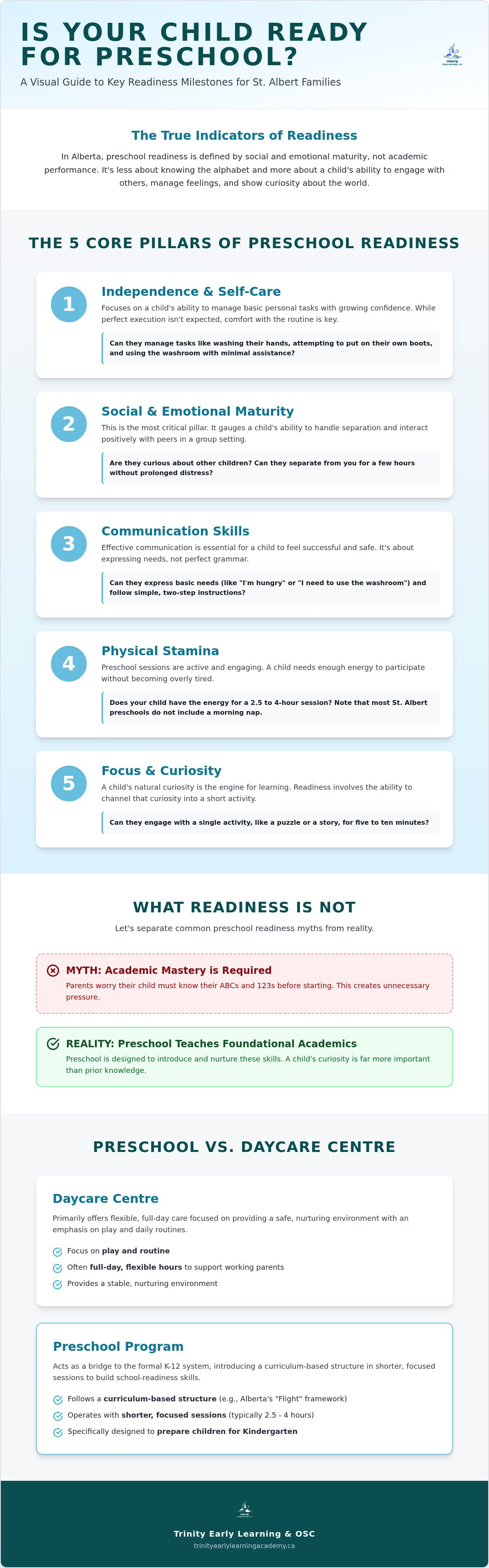
Daycare often provides flexible, full-day care focused on play and routine. Preschool serves as a bridge between home life and the formal K-12 school system. It introduces a curriculum-based structure during shorter, focused sessions. This helps children adjust to a classroom rhythm without the pressure of a full school day. Some families choose a hybrid approach. They combine the nurturing environment of licensed daycare St. Albert services with specific preschool hours. This balance supports working parents while ensuring the child gains essential school-readiness skills in a stable environment.
The Role of the Alberta Early Learning Framework
Alberta utilizes a framework called "Flight." This model views children as mighty learners and focuses on a holistic view of what readiness means by emphasizing child-led play and social responsibility. Educators look for signs of curiosity and the ability to build relationships with peers. Readiness is a partnership. It requires open communication between the centre, the child, and the parents. Trinity Early Learning acts as a compassionate partner in this journey. We use play-based learning to ease children into structure. This approach ensures they feel safe and confident as they explore new social boundaries and develop their independence.
The 5 Core Pillars of Preschool Readiness
Assessing your child's development involves more than just checking a calendar. While chronological age provides a guideline, true readiness is built upon a foundation of specific developmental markers. These markers align with Head Start's definition of school readiness, which emphasizes that success is a shared responsibility between the child, the family, and the educational environment. If you are currently wondering where your toddler falls on this spectrum, our is my child ready for preschool quiz can provide a helpful starting point for your observations.
To help you understand this transition, we categorize readiness into five core pillars:
- Independence and Self-Care: Can they manage basic tasks like putting on their boots or washing their hands with minimal assistance?
- Social and Emotional Maturity: Are they showing curiosity about their peers? Can they separate from you for a few hours without prolonged distress?
- Communication Skills: Can they express their basic needs to an adult and follow simple, two-step instructions?
- Physical Stamina: Does your child have the energy to participate in a 2.5 to 4 hour structured session? Most preschools in St. Albert do not include a morning nap.
- Focus and Curiosity: Can they engage with a single activity, such as a puzzle or a story, for five to ten minutes?
Independence: The Potty Training Question
This is often the most significant concern for parents. You might worry that your child must be perfectly independent before they can start. In reality, most licensed centres look for a child who is comfortable with the routine of using the washroom, even if they still need occasional help with buttons or zips. It is about a consistent transition away from diapers rather than absolute perfection. A safe daycare environment Alberta families trust will always prioritize your child's dignity and hygiene during this learning phase.
Social Readiness: Beyond Parallel Play
In early toddlerhood, children often engage in parallel play, where they play near each other but not necessarily with each other. A sign of preschool readiness is the shift toward cooperative play. You might notice your child offering a toy to a friend or following a peer's lead during a game. These small acts of empathy suggest they will thrive in a group setting. Taking an is my child ready for preschool quiz can help you distinguish between a temporary phase and long-term readiness. If your child is shy, don't worry. Shyness is a personality trait, not a lack of readiness. As a compassionate partner in early learning, we focus on helping every child find their voice at their own pace.
Common Misconceptions: What Readiness is NOT
Parents often feel immense pressure to ensure their child is "advanced" before they even step into a classroom. This anxiety usually stems from common misconceptions about what a preschool environment actually requires. While you might be searching for an is my child ready for preschool quiz to confirm their academic standing, it's vital to realize that readiness isn't a test of knowledge. It is a state of being. Preschool is exactly where these foundational skills are nurtured. It is not a place where they must already exist in a perfect form.
Educators look at the key domains of school readiness, which focus on physical well-being and social development rather than just cognitive facts. A child who cannot count to twenty is just as welcome as one who can. The goal of early education is to meet every toddler where they are and provide the tools they need to grow at their own pace. We believe in creating an environment where a child feels safe enough to make mistakes and learn through discovery.
The Academic Trap: Focusing on Skills vs. Disposition
Many parents fall into the trap of focusing on rote memorization, such as reciting the alphabet. However, a "disposition for learning" matters much more for long-term success. This includes traits like curiosity and the persistence to try a puzzle again when it doesn't fit. High-quality preschool programs St. Albert families trust emphasize this holistic growth over repetitive worksheets. Academic readiness is a secondary goal that naturally follows once a child achieves social-emotional stability.
Separation Anxiety: A Professional Perspective
Another frequent myth is that a child who cries at drop-off is "not ready" for the experience. This couldn't be further from the truth. Separation anxiety is a normal developmental phase that demonstrates a healthy attachment to a caregiver. Our educators are specifically trained to handle these emotional transitions with professional care and compassion. We often use a "15-minute rule" to gauge how a child is settling in. Most children stop crying and begin to engage with toys or peers within that short window once the parent has left.
To build confidence during the goodbye routine, keep your departures brief and predictable. Tell your child exactly when you'll return, such as "after snack time." This consistency creates a sense of security. If you're still feeling hesitant, taking an is my child ready for preschool quiz can help you determine if their anxiety is a temporary transition hurdle or a sign that a few more months of home-based prep might be beneficial.
Is My Child Ready for Preschool? The Parent Quiz
This is my child ready for preschool quiz is designed to provide you with a clear, objective view of your child's current developmental stage. It's not a high-stakes exam, but rather a tool to help you realize where your toddler might need a little extra support before entering a classroom. Spend a few days observing your child's natural behaviour to answer these questions accurately.
Step 1: Observation. Spend a morning at a local St. Albert park or playgroup. Does your child watch other children with interest? Do they eventually try to move closer to the group, even if they don't speak yet? Curiosity is a primary indicator of readiness.
Step 2: The Communication Test. Can your child express a basic desire to someone they don't know well? For example, if a librarian asks what book they want, can they point or use simple words to answer? They don't need perfect grammar, but they do need to communicate needs to a teacher.
Step 3: The Routine Check. Notice how your child reacts when you say, "It's time to clean up." Do they understand that one activity is ending and another is beginning? Preschool relies on these small transitions to keep the day organized and calm.
Step 4: The Independence Audit. Check their physical autonomy. Can they open their own lunchbox? Can they attempt to put on their shoes? Educators are there to help, but a child who tries these tasks independently will feel much more confident in a group setting.
The Practical Skills Checklist
Beyond the steps above, look for these specific functional markers during your daily routine at home:
- Can follow two-step directions, such as "Pick up your socks and put them in the basket."
- Can express basic physical needs like hunger, thirst, or the need to use the washroom.
- Shows a genuine interest in other children and occasionally attempts to join their play.
- Can sit and engage with a short story or a circle time activity for approximately 10 minutes.
Interpreting Your Results
If your child manages most of these tasks, they are likely "Ready to Go." You can begin exploring a preschool St. Albert Alberta families recommend to find the right fit. If they struggle with several areas, they might be "Almost There." You can bridge this gap by practicing "preschool skills" at home, like eating lunch from a container or following a set schedule.
A "Not Yet" result is never a failure of parenting. It is simply a gift of time. Some children benefit immensely from an extra few months of growth before starting a structured program. If you're ready to see how a supportive environment can help your child grow, book a tour of our St. Albert centre today to meet our nurturing team.
Preparing for Preschool: Next Steps for St. Albert
Once you have completed the is my child ready for preschool quiz, you may find that your child is nearly there but could use a little extra support in certain areas. This is a common realization for many St. Albert families. Readiness is not a fixed destination; it is a process that you can actively support through small, purposeful shifts in your daily routine. By introducing these changes now, you create a sense of stability that will help your child feel secure when their first day of school arrives.
We believe that high-quality early childhood education should be accessible to all families in our community. In Alberta, the provincial government provides significant support to help manage costs. You can learn more about how to navigate the daycare affordability grant Alberta offers to see how it applies to your family's situation. This funding is designed to reduce financial barriers so that your child can benefit from a professional learning environment without undue stress on your household budget.
Building Preschool Skills at Home
You can begin "Preschool Prep" by practicing school-like activities in a low-pressure way. Use timers for play sessions to help your child realize that activities have a beginning and an end. This helps them manage the transitions they will encounter in a classroom. Reading books about starting school can normalize the environment and manage expectations about what a teacher does. Additionally, try to encourage independent play for fifteen-minute intervals. This builds the focus needed for the structured segments of a preschool day while fostering a sense of autonomy.
Why Choose Trinity Early Learning & OSC?
Choosing the right centre is about finding a compassionate partner that respects your child's individual pace. At Trinity Early Learning & OSC, we serve as a community hub for St. Albert families. We offer a nurturing environment where play-based learning is the foundation of every day. Our educators are dedicated to holistic development, ensuring that every child feels safe and valued. For families with multiple children, our availability of out of school care for older siblings simplifies your daily logistics and provides a consistent environment for the whole family.
Ultimately, the decision to enroll depends on a combination of your parental intuition and the insights gained from the is my child ready for preschool quiz. If you feel your child is curious and ready for a new adventure, we are here to support that transition. Schedule a tour at our St. Albert centre to see our preschool program in action! Visiting our facility allows you to observe our educators and see firsthand how we foster growth in a safe, organized, and joyful space.
Starting Your Child's Educational Journey in St. Albert
Deciding when to start preschool is a significant milestone for any family. We have explored how social and emotional maturity, rather than academic knowledge, serve as the true indicators of readiness. By using our is my child ready for preschool quiz, you've taken a proactive step in understanding your child's unique developmental needs and strengths. Every child grows at their own pace, and your intuition as a parent is your most valuable guide during this transition.
Trinity Early Learning & OSC is a licensed and accredited provider committed to being your stable and compassionate partner. Our dedicated St. Albert educators focus on holistic, play-based learning to ensure every child feels secure and valued. We are also proud participants in the Alberta Affordability Grant program, which helps make high-quality early childhood education accessible for our community. Our goal is to provide a nurturing environment where your child can build confidence and curiosity.
If you're ready to see how our supportive programs can help your child thrive, we invite you to take the next step. Book a tour at Trinity Early Learning & OSC today to meet our team and explore our centre. We look forward to helping your little one discover the joy of learning in a safe and joyful space.
Frequently Asked Questions
What age do most children start preschool in St. Albert?
Most children in St. Albert begin preschool between the ages of 2.5 and 4 years old. This range allows toddlers to develop the foundational social skills needed for a structured environment. While some children start earlier, many parents wait until their child is closer to 3 to ensure they can communicate basic needs. It is important to check the specific age requirements of your chosen centre as they can vary slightly between different local programs.
Is potty training mandatory for preschool enrollment in Alberta?
Potty training requirements vary by provider, but many licensed preschools in Alberta require children to be independent in the washroom. While educators understand that occasional accidents happen, a child should generally be out of diapers to participate in the daily routine. If your child is still in the middle of this transition, it might be helpful to discuss your progress with the centre director during a tour to see how they support developing independence.
How can I help my child with separation anxiety before preschool starts?
You can ease separation anxiety by practicing short periods of time apart before the first day. Start by leaving your child with a trusted relative or friend for an hour to build their confidence. Talk positively about the new friends they will make and the toys they will play with. Creating a consistent and brief goodbye routine helps your child realize that you will always return after their session is finished each day.
What is the difference between preschool and Junior Kindergarten?
Preschool is a broad term for early learning programs serving children from 2.5 to 4 years old. Junior Kindergarten is specifically designed for children who will be turning four by a specific cutoff date in the school year. While both focus on play-based learning and social development, Junior Kindergarten often introduces slightly more structured activities to prepare children for the transition into the formal K-12 school system. Both options prioritize holistic growth and emotional stability.
Can I use the Alberta Affordability Grant for preschool programs?
Yes, licensed preschool programs in St. Albert are eligible for provincial funding. The Alberta Affordability Grant is paid directly to providers to reduce the monthly fees for parents. For preschool-specific programs operating less than four hours a day, the grant typically provides a reduction of up to $100 per month. This makes high-quality early childhood education more accessible for families regardless of their total household income levels. It is a significant benefit for local parents.
What should I do if the quiz shows my child isn’t ready yet?
If an is my child ready for preschool quiz suggests your child isn't ready yet, consider it a gift of time rather than a setback. You can focus on building independence at home by encouraging your toddler to tidy up their toys or practice putting on their own shoes. Re-evaluating in a few months is often the best approach. Every child develops at a different pace, and forcing a transition too early can cause unnecessary stress.
How long are typical preschool sessions at Trinity Early Learning?
Typical preschool sessions at our centre are designed to fit the developmental stamina of young children. These sessions generally last between 2.5 and 4 hours. This duration provides enough time for structured play, social interaction, and creative activities without causing over-stimulation or exhaustion. By keeping sessions focused and engaging, we ensure that children remain curious and excited about their learning environment throughout the entire morning or afternoon. This structure helps them prepare for full school days.
Does my child need to take a screening test for preschool in St. Albert?
Formal screening tests are not typically required for general preschool enrollment in St. Albert. Instead, most centres use an informal observation or a parent-completed is my child ready for preschool quiz to understand a child's needs. These tools help educators prepare the right environment for your toddler. If a child has specific developmental concerns, some programs may suggest a more detailed assessment to ensure they receive the appropriate support services and professional care they deserve.


