

You drop your child off at a new centre, but as you walk back to your car, a lingering sense of unease settles in your chest. Is it just first-day jitters, or did you actually witness a sign of a poor-quality facility? Understanding how to spot a bad daycare environment is a vital skill for any parent seeking a safe, nurturing space for their little one. It's completely natural to feel anxious about child safety or confused by complex licensing standards. You want the best for your child's holistic growth, and the thought of choosing the wrong provider can feel incredibly heavy.
We're here to help you replace that worry with professional clarity. This article provides a comprehensive checklist of critical red flags and subtle warning signs that indicate a centre may not meet high-quality standards. You'll learn exactly what to look for during a tour and how to interpret your child’s daily experiences. By the end of this guide, you'll have the actionable tools needed to evaluate any facility with confidence. We'll explore everything from staff-to-child ratios to administrative transparency, ensuring you find a community-focused environment where your child can truly thrive.
Key Takeaways
- Identify the difference between the "busy hum" of an engaged learning environment and the chaotic noise levels that signal a lack of classroom management.
- Recognize critical red flags in caregiver interactions, such as staff disengagement or a failure to provide emotional support to children in distress.
- Learn how to spot a bad daycare environment by evaluating essential operational factors like licensing status and staff-to-child ratio violations.
- Understand why a lack of age-appropriate toys or the absence of a structured daily routine can lead to increased anxiety and behavioral issues for your child.
- Gain a clear, actionable checklist to help you choose a professional centre that prioritizes safety, holistic growth, and administrative transparency.
Initial Red Flags: What Your Senses Tell You During a Daycare Tour
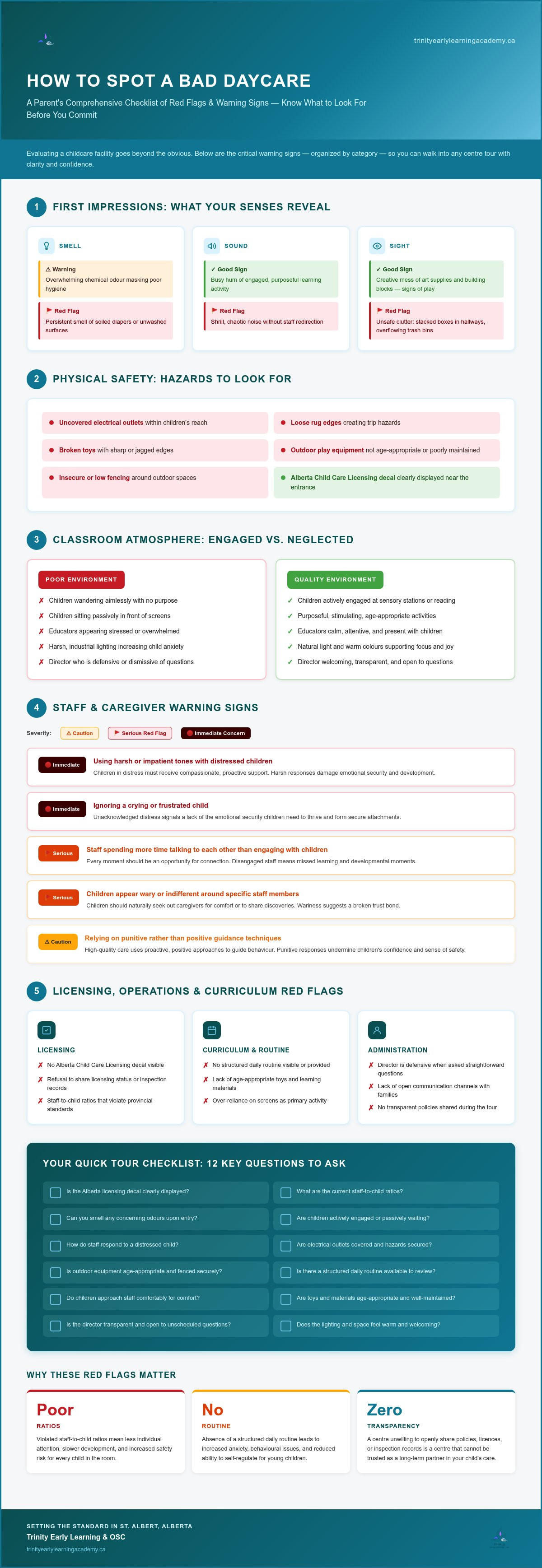
When you first walk into a childcare facility, your instincts often provide the most reliable data. Learning how to spot a bad daycare environment starts with a simple sensory assessment. A high-quality centre should feel organized and welcoming, not overwhelming or neglected. Pay close attention to the "Smell Test." While a slight scent of mild disinfectant is normal, an overwhelming chemical odour might be masking poor hygiene. Conversely, persistent smells of soiled diapers or unwashed surfaces are immediate red flags that indicate a lack of consistent cleaning protocols.
Listen to the volume of the room. There is a distinct difference between the "busy hum" of engaged learning and the shrill, chaotic noise of an unmanaged classroom. If children are screaming without redirection or if the volume feels oppressive, it often points to inadequate staffing or a lack of structured routine. Look at the physical space too. A "creative mess" of art supplies and building blocks is a sign of play, but unsafe clutter like stacked boxes in hallways or overflowing trash bins suggests a disregard for safety and organization.
The Environment and Physical Safety
Safety is the foundation of any reputable licensed daycare. During your tour, keep a watchful eye for visible hazards. Look for uncovered electrical outlets, loose rug edges that could cause trips, or broken toys with sharp edges. The outdoor play space requires equal scrutiny. It should feature secure, high-quality fencing and equipment specifically designed for the age groups served. Most importantly, look for the Alberta Child Care Licensing decal. In Alberta, this should be clearly displayed near the entrance, serving as your first proof of professional accountability and adherence to provincial standards.
The "Atmosphere" of the Classroom
The emotional tone of a classroom determines how well a child will develop. Observe the children: are they actively engaged in sensory stations or reading, or are they wandering aimlessly? If you see children sitting passively in front of screens, it's a significant indicator of a non-stimulating environment. Educators should appear calm and attentive rather than stressed or overwhelmed. The physical atmosphere matters as well. Harsh, industrial lighting can increase child anxiety, whereas natural light and warm colours create an inviting space that supports focus and joy.
Finally, consider your interaction with the director. A professional leader will greet you warmly and handle unscheduled questions with transparency. If they seem defensive or rushed, it may reflect a culture that doesn't value open communication with families. These first impressions are vital for building the trust necessary for a long-term partnership in your child's care.
The Human Element: Warning Signs in Caregiver and Staff Interactions
While the physical facility provides the initial framework for safety, the quality of interactions between educators and children is the true heart of any program. Understanding how to spot a bad daycare environment requires looking beyond the classroom equipment to the people who will be guiding your child's development. Disengaged educators are a significant red flag. If you observe staff members spending more time talking to each other than interacting with the children, it indicates a lack of focus on the children's needs and educational stimulation. Every moment in a centre should be an opportunity for connection, not just supervision.
A lack of emotional support is another critical warning sign. Watch how caregivers respond to a child who is crying or frustrated. If they ignore the distress or use harsh, impatient tones, the environment is not providing the emotional security children need to thrive. Proactive, nurturing responses are essential. A professional licensed daycare service ensures that educators are trained to handle these moments with compassion and expertise.
Observing Direct Caregiver-Child Bonds
During your visit, watch how the children interact with the staff. Do they approach the educators for comfort or to share a discovery? If children seem wary, indifferent, or unusually quiet around certain staff members, it may suggest a lack of a strong, trusting bond. High-quality care relies on positive guidance techniques rather than punitive measures. Positive guidance is a proactive approach that uses clear, consistent communication to help children develop self-regulation and social skills without the use of punishment. If you hear shaming language or see educators using "time-outs" as a primary tool, it's a sign that the centre lacks professional developmental strategies.
Staff Stability and Professionalism
Staff turnover is a quiet but damaging red flag. Frequent changes in your child’s primary caregiver disrupt their sense of security and continuity of care. Ask the director how long the current lead educators have been with the centre. If the majority of the team has been there for less than six months, it often points to a poor workplace culture or systemic management issues. Professionalism also manifests in daily operations. Educators should be dressed appropriately for active, floor-level play, and their ECE (Early Childhood Education) levels should be clearly confirmed. A lack of visible "joy" or enthusiasm in the staff is often the most telling indicator of an environment where neither the children nor the educators are truly supported.
Licensing and Logistics: Red Flags in Alberta Daycare Operations
The administrative side of childcare often feels less personal than the classroom environment, but it's where safety and accountability are codified. In Alberta, the distinction between a licensed facility and an unlicensed "private" home daycare is significant. While private arrangements might seem convenient, they lack the provincial oversight, mandatory background checks, and regular safety inspections required of professional centres. Understanding the legal framework is essential when learning how to spot a bad daycare environment. If a director hesitates to show you their latest licensing inspection report, consider it a major warning sign. Transparency is the hallmark of a high-quality provider.
Financial clarity is another area where red flags often appear. A reputable centre will be upfront about their fee structure and how they apply the Alberta affordability grant to your monthly costs. If you encounter vague financial policies, hidden "supply fees," or confusion regarding provincial subsidies, it suggests a lack of professional organization. This administrative disarray often trickles down into the quality of care provided to the children.
Alberta Staff-to-Child Ratio Standards
Provincial regulations set strict limits on how many children a single educator can supervise. In Alberta, the standard ratios are 1:4 for infants (under 19 months), 1:6 for toddlers (19 months to under 3 years), and 1:8 for preschoolers (3 years to under 4.5 years). A red flag is any environment where these ratios are stretched, especially during "quiet" times like naps or staff transitions. Ask specifically how the centre maintains these numbers when staff members take breaks or call in sick. If the answer is vague, the centre may be prioritizing profits over child safety.
Policy and Communication Gaps
A professional licensed daycare in St. Albert should provide a comprehensive parent handbook. This document must clearly outline sick-child policies, emergency procedures, and daily communication methods. It's a warning sign if there's no clear system for daily updates, such as a digital app or a detailed verbal handoff at pick-up. Perhaps most importantly, any facility that discourages an "open-door policy" for parents is hiding something. You should always feel welcome to drop in and observe the environment where your child spends their day.
The "Hidden" Red Flags: Curriculum, Routine, and Food Standards
Many parents focus on the initial facility tour, but some of the most critical warning signs are found in the daily rhythm of the centre. A non-stimulating environment is a major red flag that is often overlooked. If the classroom décor, art projects, and sensory bins remain unchanged for months, it suggests a lack of educator engagement and intentional planning. Children need a dynamic space that evolves with their interests and developmental milestones. When learning becomes stagnant, boredom often leads to increased behavioural challenges and a lack of enthusiasm for school. Understanding how to spot a bad daycare environment involves looking for these signs of educational neglect.
Nutrition is another indicator of quality that is often hidden in plain sight. Review the posted menus carefully. A poor-quality daycare often relies heavily on processed snacks and pre-packaged meals rather than balanced, whole ingredients. High-quality care includes a commitment to physical well-being, which starts with the fuel children receive during the day. If the menu lacks variety or fresh produce, it may reflect a broader trend of cutting corners in the centre's operations.
The Role of a Structured Curriculum
A professional preschool program in St. Albert should be built upon a recognized developmental framework. If a centre describes its daily schedule as "mostly free play" without any intentional learning goals, they are likely providing babysitting rather than early childhood education. While play is essential, it should be scaffolded by educators who know how to spot a bad daycare environment by identifying gaps in a child's social or cognitive growth. Ask how the centre incorporates physical literacy and outdoor play into their routine. A lack of scheduled outdoor time is a significant warning sign, as fresh air and gross motor activities are vital for holistic development.
Health, Nutrition, and Safety Protocols
The kitchen and dining areas offer a glimpse into the centre's operational standards. If you are permitted, inspect the kitchen for cleanliness and organized food storage. A major red flag is the absence of clearly posted allergy lists or a general lack of awareness regarding children’s specific dietary needs. Safety protocols must also extend to emergency preparedness. Every reputable centre should have a documented and practiced emergency evacuation plan that is easily accessible to all staff members. A lack of such documentation suggests a reactive rather than proactive approach to child safety.
A structured routine provides children with a sense of security and stability. Without a predictable schedule, children often feel anxious because they don't know what to expect next. This anxiety can manifest as irritability or difficulty with transitions. If you're looking for a centre that prioritizes these high standards and provides a nurturing, organized atmosphere, consider touring our licensed daycare services to see a professional curriculum in action.
Choosing Excellence in St. Albert: Why Trinity Early Learning & OSC Sets the Standard
Understanding how to spot a bad daycare environment allows you to advocate for the quality of care your child deserves. At Trinity Early Learning & OSC, we address these concerns by building our programs on a foundation of professional rigour and emotional warmth. We believe a childcare centre should be a community-focused environment where safety and holistic growth are the top priorities. By maintaining a dedicated St. Albert facility that meets provincial expectations, we provide families with a stable, reliable alternative to the warning signs discussed throughout this guide.
Our commitment to excellence is reflected in our alignment with the latest early childhood education in St. Albert standards. We realize that parents need peace of mind, which is why we've designed our operations to be completely transparent. From our nutritional menus to our structured daily routines, every element of our program is intentional and child-focused.
Our Approach to Quality and Transparency
We're a licensed and grant-approved facility, ensuring that high-quality care remains accessible through the Alberta affordability grant. Our educators are qualified professionals dedicated to nurturing your child's unique potential. We prioritize staff stability because we know that consistent care teams are essential for a child's sense of security. You won't find disengaged educators or vague qualifications at our centre. Instead, we foster a culture of open, honest communication, providing you with daily updates and a clear window into your child's world.
Taking the Next Step for Your Child
We encourage you to use this checklist as a practical tool during your search. Whether you're visiting a new facility or re-evaluating your current provider, these indicators help you make a confident decision. While professional standards are vital, don't ignore your instincts. Your "gut feeling" is a powerful guide when combined with these objective red flags. We invite you to experience the Trinity difference firsthand by booking a personal tour. We'll walk you through our classrooms, introduce you to our team, and answer every question with the transparency you deserve. Choosing the right childcare is a significant journey, and we're here to act as your trusted partner every step of the way.
Securing Your Child’s Brightest Future
Choosing the right childcare is one of the most significant decisions you'll make for your family. By understanding how to spot a bad daycare environment, you've gained the essential tools to identify facilities that may compromise your child's safety or emotional growth. It's vital to look for the "busy hum" of learning, verify provincial licensing status, and prioritize centres that offer a structured, nurturing curriculum. You don't have to navigate this journey alone. Your instincts, when paired with professional indicators, will lead you to a space where your child can truly thrive.
At Trinity Early Learning & OSC, we're committed to providing a community-focused St. Albert location that is fully licensed by the Province of Alberta. Our centre is a grant-approved facility, ensuring that high-quality care remains accessible and affordable for your family through provincial subsidies. We invite you to book a tour at Trinity Early Learning & OSC to experience a high-quality St. Albert daycare environment today. You deserve the peace of mind that comes from knowing your child is in a safe, professional, and joyful environment every single day.
Frequently Asked Questions
What is the #1 red flag to look for during a daycare tour?
The most significant red flag is educator disengagement. If you observe staff members who ignore a crying child or seem completely overwhelmed by the group, it's a clear sign that the environment lacks the necessary emotional support. Learning how to spot a bad daycare environment often comes down to these human interactions. A professional centre should prioritize warmth and active engagement between caregivers and children at all times.
Is it a bad sign if a daycare centre is messy?
A mess isn't always a bad sign if it's a "creative mess" like art supplies or building blocks. However, neglected hygiene is a major concern. Look for grime on high-touch surfaces, overflowing trash bins, or unwashed toys. A quality centre maintains a balance between active play and a clean, sanitized environment. If the mess includes visible hazards like loose wires or broken equipment, it's an immediate red flag for safety.
How can I tell if a daycare is actually licensed in Alberta?
You can verify a centre's status by looking for the official Alberta Child Care Licensing decal prominently displayed near the entrance. Every licensed provider in the province must have this. Additionally, you can use the Alberta Child Care Lookup tool online to confirm their current standing. This tool provides access to recent inspection reports, helping you understand their history of compliance with provincial safety and staffing regulations.
What should I do if I suspect a daycare environment is unsafe?
If you suspect a childcare environment is unsafe, your first step should be to document the specific hazards or incidents you've observed. Bring these concerns to the director immediately to see how they respond. If the centre is unresponsive or if the safety risk is severe, you should contact the Alberta Child Care Licensing office. They have the authority to investigate complaints and ensure the facility meets provincial safety standards.
How do I know if my child is unhappy or if it’s just "transition anxiety"?
Distinguishing between transition anxiety and genuine unhappiness requires observing your child's behaviour over time. Most children experience some distress during the first two weeks at a new centre. However, if your child shows persistent changes in sleep, sudden regression in potty training, or extreme fear of the facility after the initial adjustment, it's a cause for concern. Trust your intuition when these signs persist beyond the typical transition period.
Does a high staff turnover always mean the daycare is bad?
High staff turnover is a significant warning sign that shouldn't be ignored. While the industry faces challenges, a centre that can't keep its educators often suffers from poor management or a lack of support for its team. Children need stable, consistent caregivers to form the secure attachments required for healthy development. Frequent changes in primary staff can lead to increased anxiety and a fragmented learning experience for your child.
What questions should I ask a daycare director about their curriculum?
Ask the director to explain their developmental framework and how they plan daily activities. You should ask how they incorporate physical literacy, sensory play, and social-emotional learning into their routine. A professional centre will be able to describe intentional learning goals rather than just "babysitting." Knowing how to spot a bad daycare environment involves identifying centres that lack a clear, age-appropriate curriculum designed to support your child's holistic growth.
Can I drop in unannounced to check on my child’s environment?
You should always have the right to visit your child's classroom unannounced. A reputable centre maintains an open-door policy, welcoming parents to drop in at any time during operating hours. If a facility requires you to schedule every visit or discourages you from entering the play areas, it's a major red flag. Transparency is essential for building trust between families and providers, ensuring your child is in a safe and supportive space.


