

Imagine opening your monthly childcare invoice and finally seeing a predictable number that aligns with your family budget. While the provincial shift toward the $15-a-day goal has brought much-needed relief, determining the average childcare costs Alberta 2026 still feels like solving a complex puzzle for many parents. You've likely felt the confusion of distinguishing between automatic affordability grants and income-tested subsidies, or perhaps you've been surprised by "optional" fees that aren't quite as optional as they seem. It’s natural to feel overwhelmed when long waitlists and administrative jargon stand between your child and a quality learning environment.
We believe that financial transparency is the foundation of a trusting relationship between a childcare centre and your family. This guide provides a clear, professional breakdown of actual out-of-pocket expenses for licensed care in Alberta. We’ll help you understand the difference in costs between various program types and show you exactly how to apply for additional financial support if you qualify. You’ll gain the knowledge to spot hidden fees before you sign a contract, ensuring you can plan your monthly expenses with complete confidence and peace of mind.
Key Takeaways
- Discover how the provincial move toward a flat-rate fee system impacts the average childcare costs Alberta 2026 for families using licensed care.
- Distinguish between automatic affordability grants for children under kindergarten age and the income-tested subsidies available for school-aged programs.
- Explore the cost variations between full-time licensed daycare, preschool curriculum, and out of school care to better organize your family’s monthly finances.
- Learn to identify common additional charges, such as registration fees or specialized meal programs, to ensure your childcare budget remains predictable.
- Master the enrollment process in St. Albert by knowing exactly which questions to ask providers about their grant eligibility and fee transparency.
Understanding the $15-a-Day Childcare Model in Alberta for 2026
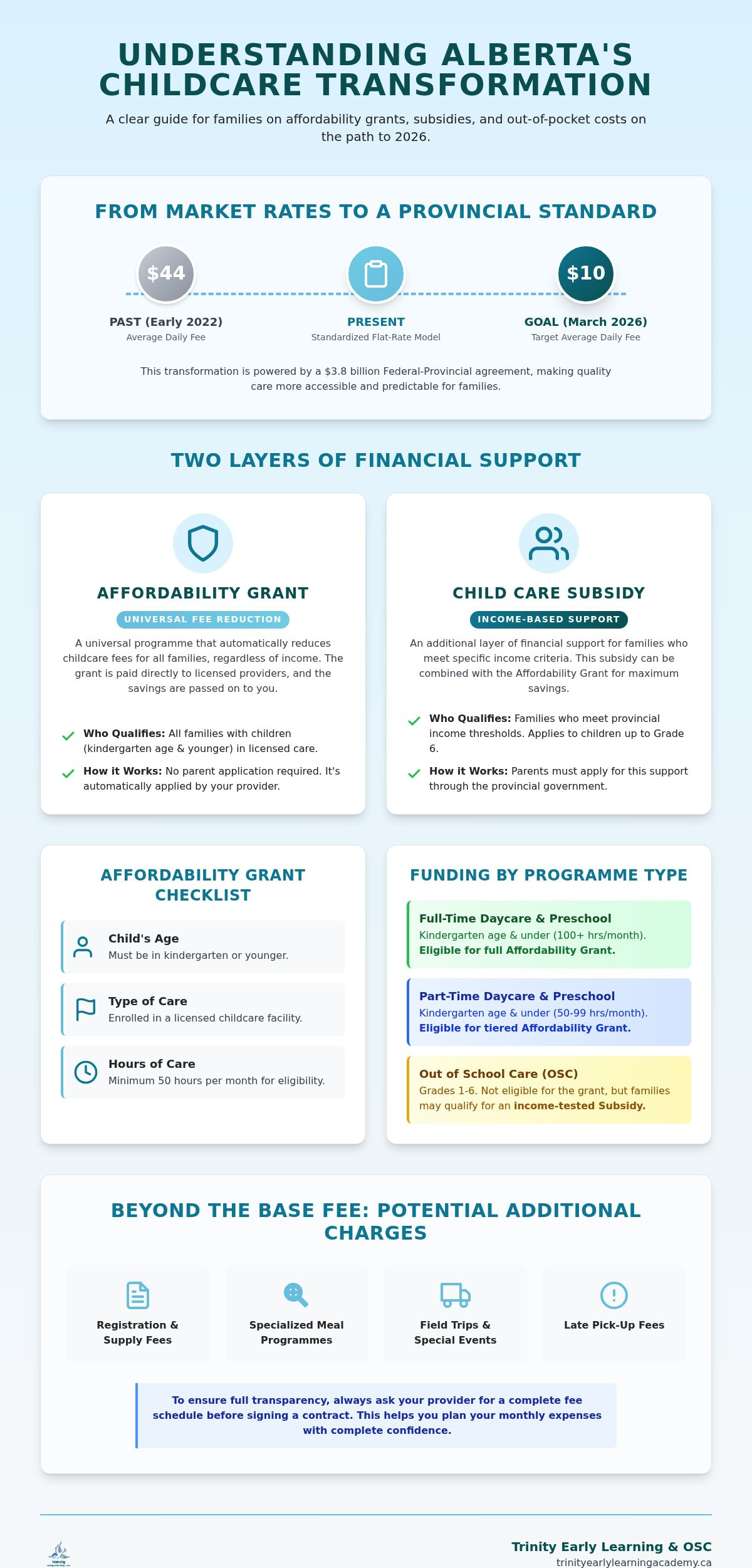
The landscape of early childhood education in Alberta has undergone a massive transformation. Only a few years ago, in early 2022, families often faced fees averaging $44 per day. Today, the provincial government has moved toward a standardized model that prioritizes accessibility and predictability. This evolution means that the average childcare costs Alberta 2026 are no longer determined by individual market rates alone. Instead, they're governed by a flat-rate system designed to reach a $10-a-day average by the end of March 2026. This shift helps parents budget with certainty, knowing that their out-of-pocket expenses are capped at a provincial baseline.
This change is driven by "Affordability Funding." This isn't a check mailed to parents. It's a grant paid directly to licensed childcare providers to reduce their operating costs, which in turn lowers the base fee you see on your monthly invoice. Licensed facilities, including Trinity Early Learning & OSC, utilize these grants to provide high-quality care at these provincial rates. Because the government handles this transition at the administrative level, parents don't need to apply for this specific grant. It creates a more stable environment where quality care becomes a right rather than a luxury for families across the province.
The Federal-Provincial Childcare Agreement
The foundation of this progress is a $3.8 billion investment into the provincial system. This funding is part of the larger Canada-wide Early Learning and Child Care (CWELCC) system, which aims to create a high-quality, inclusive, and affordable framework across the country. For families in St. Albert, this means that selecting a licensed facility is the most critical step in securing these reduced rates. Unlicensed providers operate outside this agreement and aren't eligible for the provincial funding that makes these lower fees possible. By choosing a licensed centre, you ensure your child benefits from regulated safety standards while you benefit from significant cost savings.
Who Qualifies for the Flat-Rate Fee?
Eligibility for the flat-rate fee is straightforward, but it does depend on specific criteria regarding the child's age and the volume of care provided. Understanding the average childcare costs Alberta 2026 requires looking at these specific tiers of care:
- Age Requirements: The flat-rate model applies to children who are in kindergarten or younger.
- Care Hours: To trigger the affordability funding, a child must attend a licensed program for at least 50 hours per month.
- Program Levels: Funding is tiered based on whether the child receives full-time care (100+ hours) or part-time care (50 to 99 hours).
It's important to recognize that school-age children, specifically those from Grade 1 through Grade 6, fall under a different structure. While they don't qualify for the flat-rate affordability grant, their families may still access support through income-tested subsidies for out of school care. This distinction ensures that the highest level of direct grant funding is focused on the critical early years of development, while still providing avenues for support as children grow.
The Role of Affordability Grants and Provincial Subsidies
Understanding the financial support available is the first step toward managing your family budget. In Alberta, childcare support is delivered through two distinct layers: the Affordability Grant and the Child Care Subsidy. While they sound similar, they serve very different purposes. The grant is a universal program for children up to kindergarten age that reduces fees for all families, regardless of their income. The subsidy, however, is an additional layer of support specifically for families who meet certain income thresholds. By combining these two, the average childcare costs Alberta 2026 become significantly more manageable for the modern family.
At Trinity Early Learning & OSC, we act as your administrative partner in this process. We handle the complexities of the Alberta's Childcare Affordability Grant directly with the provincial government. This means you don't have to fill out paperwork to receive the baseline discount. We apply the funding to our operating costs, and the savings are passed directly to you on your monthly statement. This transparent approach ensures you always know exactly what you're paying for and how much support you're receiving.
How the Affordability Grant Reduces Your Invoice
Your monthly invoice reflects the net cost of care, which is the total tuition minus the grant amount. Because the grant is paid directly to the centre, you aren't required to pay the full tuition upfront and wait for a reimbursement. This system provides immediate financial relief and helps stabilize your monthly cash flow. For a deeper look at the specific tiers and how they apply to different age groups, you can read our detailed guide on the Daycare Affordability Grant Alberta. If you're ready to see how this works in practice, view our licensed childcare programs to see how we prioritize affordability.
Applying for the Alberta Child Care Subsidy
While the grant is automatic, the Child Care Subsidy requires a separate application through the Alberta.ca online portal. This support is income-tested. For school-aged children in out of school care, families with a total household income under $90,000 are eligible for this additional help. To complete your application, you'll need several documents ready, including your most recent tax returns, proof of Alberta residency, and employment or school verification. The portal is designed to be user-friendly, but it's vital to ensure your information is accurate to avoid processing delays. Once approved, the subsidy amount is also paid directly to your chosen provider, further lowering your out-of-pocket expenses.
Cost Breakdowns by Program Type: Daycare, Preschool, and OSC
Different stages of childhood require different care environments. While the province works toward its long-term goals, the average childcare costs Alberta 2026 depend heavily on the specific program your child attends. For infants and toddlers in full-time licensed daycare, the parent fee is now standardized based on provincial caps for those attending over 100 hours per month. If your child requires part-time care between 50 and 99 hours, a separate flat-rate fee applies. These provincial rates provide a level of stability that was once impossible to find in the private market, where fees were often subject to sudden increases.
Choosing a licensed daycare in St. Albert offers more than just safety and a professional curriculum. It's the only way to access these provincial grants. Unlicensed dayhomes set their own rates and aren't eligible for the affordability funding that reduces your monthly bill. The transition to this flat-rate model has effectively reduced childcare fees by over 50% compared to the provincial averages seen in early 2022. This means that even if an unlicensed provider seems cheaper at first glance, the out-of-pocket cost for a licensed spot is often significantly lower once the grant is applied at the provider level.
Licensed Preschool Costs and Benefits
Preschool serves as a vital bridge between the home and the classroom. These programs focus on holistic growth and educational stimulation, preparing children for the social and academic demands of kindergarten. Pricing for Preschool Programs in St. Albert often follows a part-time structure, which typically aligns with the provincial flat-rate fee for licensed providers. This investment ensures your child develops necessary social foundations in a safe, nurturing environment while keeping your monthly budget predictable.
Out of School Care Budgeting
Budgeting for school-aged children requires a different approach because the universal affordability grant ends once a child enters Grade 1. For Out of School Care in St. Albert, costs are usually based on before and after school hours. It's important to account for professional development (PD) days and summer breaks, as these full-day care needs can change your monthly invoice. However, families with a household income under the $90,000 threshold can apply for subsidies that provide significant support, especially during the summer months when care hours increase. This dual system of grants and subsidies ensures the average childcare costs Alberta 2026 remain manageable as your child grows and their needs evolve.
Beyond the Base Fee: Identifying Hidden Costs and Optional Charges
While the provincial flat-rate fee covers the core of your care, the actual average childcare costs Alberta 2026 often include additional administrative and service-based line items. Transparency is vital for family budgeting. Most professional centres charge a one-time registration fee to secure your child’s spot and process the extensive licensing documentation required by the province. In the St. Albert area, you may also encounter waitlist fees. These are used to manage high demand and ensure that families on the list are genuinely seeking a placement.
Optional service fees are another factor that can influence your monthly invoice. Many centres provide enhanced amenities such as hot lunch programs, specialized healthy snacks, or dietary accommodations for children with allergies. While these services offer significant convenience, they are typically billed as separate charges. You might also see modest activity fees for field trips, guest speakers, or specialized learning equipment. These costs provide enriched experiences that go beyond the standard curriculum but aren't usually covered by provincial grants.
Professional centres operate on strict licensing ratios. Late pick-up penalties are common because staff must be compensated for working beyond their scheduled hours. To avoid these unexpected costs, it is best to build a 10-minute buffer into your daily commute. Establishing a reliable secondary contact for emergency pick-ups can also help ensure your child is collected on time without incurring extra fees. If you have questions about specific line items, you can contact our team for a transparent fee breakdown.
Mandatory vs. Optional Childcare Expenses
It is helpful to distinguish between what the government grant covers and what it doesn't. The Alberta Affordability Grant applies strictly to the base tuition for care. It does not subsidize registration fees, lunch programs, or optional "enhanced" programming like specialized music or art classes. When you review your monthly invoice, look for a clear separation between the subsidized tuition and these additional services. This level of transparency ensures you are only paying for the specific enhancements you have chosen for your child’s development.
Tax Deductions for Alberta Families
The silver lining to these extra costs is the Child Care Expense Deduction available at tax time. For the 2026 tax year, parents can typically claim up to $8,000 for each child under age 7 and $5,000 for each child aged 7 to 16. These deductions can significantly lower your taxable income. To maximize your return, keep every receipt for registration and activity fees, as many of these "hidden" costs are eligible. Choosing a licensed provider is essential here, as they provide the official tax receipts required by the Canada Revenue Agency, a benefit that unlicensed dayhomes often cannot offer.
Navigating the Enrollment Process for Affordable Care in St. Albert
Families in St. Albert often find that the search for quality care begins much earlier than expected. While the shift in the average childcare costs Alberta 2026 has made licensed spots more accessible, it has also increased demand across the community. To secure a placement that aligns with your needs, it is best to start your research 12 to 18 months before your required start date. Maintaining an organized list of potential centres and checking in periodically can help you stay ahead of long waitlists. During your initial inquiries, ask providers specifically about their current grant eligibility and their process for fee transparency to ensure your expectations align with their billing practices.
The final decision should involve more than just a review of the numbers. Visiting a safe daycare environment in person allows you to observe the daily rhythm and the interactions between educators and children. Look for organized, stimulating spaces and ask about the centre's safety protocols and emergency procedures. A professional facility will welcome these questions, acting as a knowledgeable advocate for your child’s well-being. Once you have selected a centre, the final steps involve securing your spot with a registration fee and setting up a clear payment schedule that reflects the provincial affordability supports.
Securing Your Spot in St. Albert
Researching licensed centres in our local community is the most effective way to ensure your child receives regulated, high-quality care. Many parents find that family-run centres offer a distinct advantage, providing personalized administrative support that larger chains might lack. At Trinity Early Learning & OSC, we pride ourselves on supporting families through the entire enrollment journey. We help you understand how provincial grants apply to your specific situation, ensuring that the administrative side of childcare feels as supportive and nurturing as the care your child receives in our classrooms.
Preparing Your Childcare Budget for 2026
To keep your family finances stable, it is helpful to create a final checklist of all monthly expenses. This should include the base fee after the affordability grant is applied, along with any optional services like hot lunch programs or specialized activity fees. The average childcare costs Alberta 2026 are much easier to manage when you have a predictable total. We recommend setting up a recurring payment system through your bank to avoid late penalties and ensure your focus remains on your child’s development. We invite you to contact Trinity Early Learning & OSC to discuss our current availability and learn more about our licensed programs.
Planning Your Family's Future with Confidence
Preparing for your child's early years is a significant milestone that requires both emotional readiness and financial clarity. By understanding the distinction between universal affordability grants and income-based subsidies, you can accurately project the average childcare costs Alberta 2026 for your household. Choosing a licensed centre remains the most effective way to ensure your child receives high-quality, regulated care while you benefit from the provincial funding that makes these rates possible.
Transparency regarding registration fees and optional services allows you to build a monthly budget that is both realistic and stable. Budgeting shouldn't be a source of stress. As a licensed provider in St. Albert, Trinity Early Learning & OSC is proud to participate in the Alberta Affordability Grant program, offering expert-led early childhood education and specialized OSC programs. We invite you to contact Trinity Early Learning & OSC to secure your 2026 childcare spot today. We look forward to welcoming your family into our nurturing community and supporting your child's growth with the highest standards of care.
Frequently Asked Questions
Is the $15-a-day childcare fee available for all families in Alberta?
Yes, the reduced fee is generally available to all families using licensed daycare or family day home programs for children up to kindergarten age. This initiative is part of a provincial agreement to make care more accessible across the province. Families don't need to apply for this specific grant, as it is handled directly between the government and the provider. However, it only applies to facilities that participate in the provincial affordability program and meet licensing standards.
What is the difference between a childcare grant and a subsidy?
The Affordability Grant is a universal payment made directly to licensed providers to lower base fees for all families. In contrast, the Child Care Subsidy is an income-tested benefit for families earning under $90,000 annually. While the grant is applied automatically, parents must apply for the subsidy through the Alberta government portal. This dual system helps manage the average childcare costs Alberta 2026 by providing both broad relief and targeted financial support for those who qualify.
Does the flat-rate fee apply to Out of School Care (OSC) programs?
No, the flat-rate affordability fee is specifically designed for children who have not yet entered Grade 1. Out of school care programs for school-aged children follow a different fee structure because they don't qualify for the universal grant. Instead, families with children in Grade 1 through Grade 6 can access financial relief through the provincial subsidy program. This support is based on household income and the total number of hours the child spends in care each month.
Are there hidden costs I should expect beyond the daily rate?
Parents should account for several standard expenses that fall outside the base daily rate. Common additions include one-time registration fees, waitlist deposits, and charges for optional services like hot lunch programs or specialized snacks. You might also see activity fees for field trips or guest speakers. Professional centres in St. Albert also enforce late pick-up penalties to cover staffing costs; it is important to review your contract for these specific administrative details before enrolling your child.
How do I know if a daycare in St. Albert is licensed and eligible for grants?
You can verify a provider’s status by using the Alberta Child Care Lookup tool on the provincial government website. Licensed facilities are required to display their current certification prominently within the centre. In St. Albert, choosing a licensed provider like Trinity Early Learning & OSC ensures the facility meets strict safety standards and participates in the Affordability Grant program. This participation is what allows the centre to offer the reduced rates mandated by the federal-provincial agreement.
Can I claim my 2026 childcare expenses on my Canadian tax return?
Yes, most childcare expenses are deductible on your Canadian tax return through the Child Care Expense Deduction. For the 2026 tax year, you can typically claim up to $8,000 for children under seven and $5,000 for those aged seven to sixteen. It is essential to keep all receipts from your licensed provider, as these documents are required to validate your claim. These deductions can significantly lower your taxable income and help offset the average childcare costs Alberta 2026.
What happens to my fees if my child is absent for a week?
Most licensed centres in Alberta operate on a monthly flat-rate basis, meaning fees are not typically pro-rated for short-term absences due to illness or vacation. Your monthly payment secures your child’s spot and covers the centre’s fixed operating costs, such as educator salaries and facility maintenance. It's best to check your specific provider's policy regarding extended absences. Maintaining a consistent payment schedule ensures your child’s placement remains secure throughout the year, regardless of occasional missed days.
How much are the average waitlist fees in St. Albert?
Waitlist fees in St. Albert vary between providers, but they generally serve as a commitment fee to manage high demand. Some centres may apply this amount toward your first month’s tuition, while others keep it as a non-refundable administrative charge. Because demand for affordable, licensed spots is high, these fees help centres maintain accurate lists of families actively seeking care. Always ask if the fee is refundable or transferable before paying to ensure you understand the provider's specific policies.


