

Your preschooler shares a toy, follows a bedtime routine, or tries something new. A calm, specific response can help them understand what went well and encourage them to try again. Positive reinforcement techniques for preschoolers don’t require prizes or praise for every small step. They work best when your child can connect your response to a behaviour they are practising.
It can be hard to stay consistent when a child is upset or a routine becomes a struggle. The goal isn’t to make every moment perfect. Choose a behaviour to encourage, notice it when it happens, and respond warmly while keeping clear boundaries. If your child doesn’t respond to praise, adjust the approach rather than assuming they are being difficult.
This guide shares practical phrases and everyday strategies for routines, sharing, and new experiences. You’ll learn how to recognize effort without overdoing praise, respond respectfully to setbacks, and encourage helpful behaviour without relying on constant rewards. These approaches can support children at home and in early learning settings, including preschool and childcare in St. Albert.
Key Takeaways
- Positive reinforcement describes what helps a behaviour happen again, not simply what an adult intends.
- Use positive reinforcement techniques for preschoolers by choosing one manageable behaviour, noticing it, and responding warmly.
- Encouragement doesn’t require a prize every time; clear expectations and calm boundaries still matter.
- If a child doesn’t respond to praise, consider whether the expectation is clear, realistic, and suited to the moment.
- Share simple, familiar language about routines and what comforts your child to support consistency between home and preschool.
What positive reinforcement means for preschoolers, and what it does not
Positive reinforcement means noticing a behaviour and responding in a way that makes it more likely to happen again. That response could be a few encouraging words, a smile, or shared attention. For example, when your preschooler puts toys away, you might say, “You put the blocks back in the basket. That helped tidy the room.” Your child hears which action you noticed, rather than receiving a general judgement about being “good.”
The word reinforcement describes the effect a response has on behaviour, not just what an adult hopes to achieve. A comment intended as praise may not encourage a particular action. By contrast, a child who enjoys helping with a familiar task may be more likely to join in again. The basic idea is explained in Reinforcement in behavioral psychology, where reinforcement is distinguished from punishment by its effect on behaviour.
In plain language, positive reinforcement is a warm response that helps a child want to repeat a helpful action. It doesn’t mean ignoring behaviour that needs guidance. You can acknowledge what went well and still hold a limit: “You put the toys away. The books stay on the shelf, so let’s return this one together.” Clear routines and follow-through help children understand what is expected as well as what they did well.
Positive reinforcement, praise, and rewards: how they differ
Descriptive praise names the behaviour: “You waited while Maya had a turn.” General approval is less specific, such as “Good job.” Both may feel encouraging, but descriptive feedback tells your child exactly what you noticed. A tangible reward is something concrete, such as a sticker or small treat. A reward may be useful in some situations, but it isn’t necessary for every helpful action.
Attention, a kind word, or an enjoyable activity can also encourage behaviour. If your child helps tidy, you might thank them and invite them to choose the next story. Keep the response genuine and connected to the moment. The aim of positive reinforcement techniques for preschoolers isn’t to turn everyday cooperation into a transaction. It’s to help children notice their efforts and understand how their actions support the people around them.
Why preschoolers benefit from clear, immediate feedback
A response given soon after an action can make the connection easier to understand. Your child puts away a toy, and you recognize that specific effort. If feedback comes much later or refers to several behaviours at once, a preschooler may not know what you mean. Keep your words brief, describe what happened, and use a calm tone. Children need repetition and practice, so don’t expect one response to make a behaviour happen every time.
Choose language that respects your child while keeping the boundary clear. “You tried again after the tower fell” recognizes persistence without demanding a perfect result. “It’s time to put the toys away. I’ll help you start” keeps the routine moving and offers support. In early learning and care, these small, clear responses fit naturally into everyday interactions.
How to use positive reinforcement techniques for preschoolers in everyday routines
Everyday routines give children regular chances to practise, whether they’re arriving, getting dressed, playing with others, or preparing to leave. Rather than trying to encourage everything at once, choose one small action to focus on. A clear target makes progress easier to notice and your response easier for your preschooler to understand.
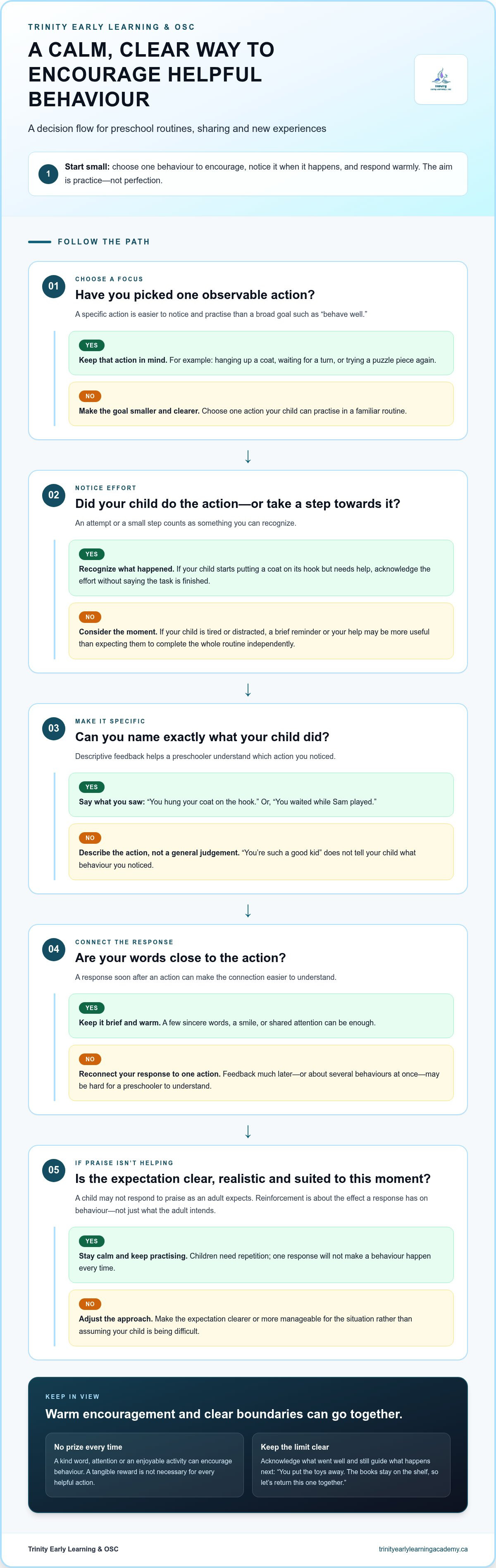
- Choose one observable behaviour. For example, focus on your child hanging up their coat after arriving, waiting for a turn with a toy, or trying a puzzle piece again after it doesn’t fit. Avoid broad goals such as “behave well” or “be perfect.” A specific action is easier to recognize and practise.
- Notice the action when it happens. Pay attention to what your child did, including an attempt or a small step towards the goal. If they start putting their coat on its hook but need help, recognize the effort without implying the task is finished.
- Describe what you saw. Use short, concrete words that name the behaviour. “You hung your coat on the hook” is clearer than “You’re such a good kid.” For turn-taking, try, “You waited while Sam played.”
- Respond warmly and naturally. Offer a smile, a few sincere words, or shared attention. Connect the action to its effect when that makes sense: “You waited for your turn, so now it’s your chance to choose a block.” Keep the response proportionate to the moment.
Choose a behaviour and describe what you notice
Choose a goal that fits a routine your child already knows. If arrivals are often rushed, focus on one manageable action, such as putting a lunch bag in its usual spot. Keep your words simple and adjust them to your child’s understanding and the situation. If they’re tired or distracted, a brief reminder or your help may be more useful than expecting them to complete the whole routine independently.
Respond promptly with specific encouragement
Recognize effort without making success the only thing that counts: “You tried that puzzle piece again, and you kept working at it.” Genuine feedback doesn’t need to be loud or elaborate. The American Academy of Pediatrics’ HealthyChildren.org discusses rewards in its guide to Positive Reinforcement Through Rewards. Everyday encouragement can also be as simple as noticing an action and responding with warmth.
Adapt positive reinforcement techniques for preschoolers as your child’s skills change. At home or in a St. Albert preschool setting, familiar phrases can make expectations easier to follow. Families exploring preschool and early learning in St. Albert can consider how everyday routines give children opportunities to practise new skills.
Do positive reinforcement techniques mean constant rewards or no boundaries?
No. Positive reinforcement doesn’t require a prize every time a child cooperates, and it doesn’t mean adults must accept every behaviour. A warm response can be simple: a smile, a brief thank-you, or specific words that show you noticed a helpful choice. Clear expectations still matter. Children can receive encouragement and hear “stop” or “not right now” when a limit is needed.
For example, if your child returns a toy after taking it from someone, recognize that they gave it back and guide them to ask before taking it next time. The focus is on supporting the behaviour you want to see, not overlooking what needs to change. That balance is central to using positive reinforcement techniques for preschoolers respectfully and consistently.
Encouragement without making every moment transactional
Material rewards are only one possible response. For everyday cooperation, your attention may be enough: “You brought your cup to the counter. Thanks for helping.” Your child might also enjoy continuing an activity with you. Avoid making every routine conditional on a treat or prize. There’s no single rule that rewards always help or always harm motivation. Consider your child, the behaviour, and whether the response fits the moment.
Generic praise such as “Amazing!” can convey warmth, but repeated use may not tell a child what you appreciated. Specific feedback makes the connection clearer: “You passed the crayons to your friend.” A short acknowledgement is enough; you don’t need to give a speech. Some children enjoy enthusiastic praise, while others prefer a quiet comment or a nod. Let your response fit the moment and the child.
Positive reinforcement alongside clear limits
Encouragement works alongside boundaries, not in place of them. If a child hits during play, move in calmly and stop the action: “I won’t let you hit. Hands need to be gentle.” If they then touch the other child gently or pause, acknowledge that choice: “You’re using gentle hands now.” Safety comes first, and the limit stays clear even as you recognize a safer action.
Your child may be angry about the limit. You can name the feeling without changing the boundary: “You’re upset because it’s time to leave. We’re going now, and I’ll help you get your shoes.” Acknowledging disappointment shows that you have heard your child; it doesn’t mean agreeing to every request. Calm repetition and follow-through make the expectation easier to understand.
Encouragement recognizes the behaviour you want to grow; consistent boundaries show what remains safe and expected. You don’t need to choose between warmth and firmness. A specific, kind response can sit beside a clear direction, including during a hard moment. If your child doesn’t respond as you hoped, adjust your words or offer more support while keeping the underlying limit steady.
What to do when a preschooler ignores praise or has a hard moment
If your child doesn’t respond to praise, it doesn’t mean they’re difficult or that you’ve failed. The words may not suit them, the behaviour may be too challenging right now, or something else may be getting in the way. Treat the response as information. Adjust positive reinforcement techniques for preschoolers to better match the child and the situation.
Pause and consider three questions: Is the expectation clear? Is it realistic for your child right now? Is this a good moment to ask? A preschooler who is hungry, tired, overwhelmed, or focused on something else may need support before they can follow a direction. Make the target smaller, offer a simple prompt, or help them get started. Instead of asking your child to tidy the whole play area, invite them to put away one toy with you.
If praise does not seem to change the behaviour
Notice what happens before and after the behaviour without assigning blame. Does the difficulty tend to come up during a transition, when a toy is out of reach, or when the room is busy? Pay attention to what your child does and how adults respond. These details can help you decide whether the request needs to be clearer, your child needs help, or the routine could be adjusted.
Try focusing on one smaller action and naming it plainly when it happens. If “get ready” isn’t working, break the direction into a step such as “put your boots by the door.” If your child doesn’t enjoy verbal praise, keep your response low-key or offer attention another way. Be consistent, but don’t expect the behaviour every time. The goal is to guide practice, not to label your child or demand instant change.
Responding to distress while holding a limit
During frustration or a difficult transition, connection and safety come first. Use brief, calm words: “You’re upset. It’s time to stop playing, and I’ll help you.” If a child is hitting or throwing, step in to prevent harm and state the boundary clearly: “I won’t let you throw that. I’m moving it away.” Don’t delay necessary support or safety measures while waiting for a behaviour you can praise.
Once your child is calmer, offer a manageable next step. They may accept help, move to a safe space, or use words to ask for something. Acknowledge that action without using praise to silence or dismiss their feelings: “You’re still disappointed, and you came with me to the door.” A child can be upset and still receive support. The limit can remain in place while you respond with care.
Families in St. Albert can explore Trinity’s preschool and childcare programs as part of their early learning journey.
How families and preschool educators can reinforce skills consistently
Children move between home and early learning settings, where routines and expectations may differ. Families and educators don’t need to use identical phrases or respond in exactly the same way. It can help to share a few simple cues for skills a child is practising, such as waiting for a turn, putting belongings away, or asking for help. Familiar language can make expectations easier to recognize across settings.
Consistency means communicating respectfully about what supports your child, not expecting them to behave perfectly everywhere. A phrase like “first coat, then play” may help with one transition, while another child may respond better to a visual reminder or a calm adult nearby. Keep the shared goal clear, then adapt your approach to the child and situation.
Share observations between home and preschool
Useful conversations focus on specific moments rather than labels. A family member might mention, “A few minutes’ warning helps with leaving the playground,” or an educator might share, “They joined the group after watching for a little while.” These observations help adults understand a child’s routines, strengths, and ways of finding comfort without defining them by a difficult moment.
Keep the exchange practical and focused on the child. Share what happened before the behaviour, what your child did, and what seemed to help. You might note that a quiet reminder supported a smoother arrival, or that your child accepted help after having time to finish an activity. Ask what the other adult has noticed, then agree on one small skill to encourage. Families exploring early childhood education in St. Albert can consider how communication between home and care settings supports everyday learning.
Build encouragement into a preschool learning environment
Play and familiar routines give children natural chances to practise effort and cooperation. During block play, an adult might acknowledge a child making space for a peer. At tidy-up time, they can recognize a child carrying materials to the shelf. These responses can be brief and specific, without interrupting play or turning each action into a formal lesson.
Adults can also help children practise a skill before expecting them to manage it independently. For instance, they might model how to ask for a turn, then notice when a child tries the phrase during play. Recognize useful steps as they happen, while keeping boundaries and support appropriate to the moment.
Families considering preschool programs in St. Albert can look at how daily play and routines give children opportunities to practise emerging skills. Positive reinforcement techniques for preschoolers can be part of those everyday interactions when adults share observations, set clear expectations, and respond with warmth. A thoughtful connection between home and preschool can help adults offer steadier support while respecting each child’s individual needs.
Keep building skills through everyday moments
Progress can begin with one small change: choose a behaviour to encourage, notice when your child makes an effort, and respond naturally. If a strategy doesn’t seem to fit, adjust your words or the expectation rather than judging your child. Over time, positive reinforcement techniques for preschoolers can make everyday interactions more intentional while leaving room for patience, practice, and individual needs.
Families in St. Albert can also consider how an early learning environment complements the guidance children receive at home. Trinity Early Learning & OSC provides licensed daycare and preschool services, along with early learning and out of school care for local families.
Explore Trinity Early Learning & OSC to learn more about its programs. Each encouraging response is a chance to help your preschooler keep learning, one step at a time.
Frequently Asked Questions
How often should I use positive reinforcement with a preschooler?
Look for natural opportunities throughout the day rather than aiming for a set number of comments. Positive reinforcement techniques for preschoolers can be useful during play, transitions, and familiar tasks, especially when a child is practising a particular skill. Keep your response genuine and suited to the moment. If you find yourself repeating praise automatically, pause and choose words that tell your child what you noticed, or simply offer a warm smile.
What should I do if my preschooler says they do not care about praise?
Accept your child’s response without trying to persuade them that they should enjoy praise. Some children prefer a quiet acknowledgement, a shared smile, or no comment at all. You might say, “Okay, I’ll give you space,” while still recognizing the action in a low-key way, such as with a nod. Notice whether practical support, like having materials ready, works better. Adjust your approach without making approval the focus.
Can positive reinforcement work when a child is learning a new routine?
Yes. Pair a predictable cue with a manageable step, then recognize progress as your child practises. For a handwashing routine, you might calmly point to the soap after your child turns on the tap, then acknowledge their next step. A simple picture sequence can also help a child remember what comes next. Keep the routine steady, but offer reminders or assistance while the skill is new.
Is it helpful to praise a preschooler for trying, even when the task is unfinished?
Yes, you can notice a genuine effort without suggesting the task is complete. If your child tries to zip a jacket but gets stuck, say, “You held the two sides together and tried the zip.” Then ask whether they’d like help. This recognizes a useful step and leaves room for support. Avoid making persistence a demand if your child is tired or becoming frustrated.
What happens if a child only behaves when a reward is offered?
If your child asks for a reward before cooperating, calmly restate the expectation and avoid negotiating in the heat of the moment. You might say, “The toys need to stay on the floor until we put them away; then we can choose a book.” Keep ordinary routines from becoming a series of bargains. If you’ve been using a reward plan, pair it with specific feedback and shift attention towards the skill itself.
Can I acknowledge a child’s feelings while still setting a firm limit?
Yes. Naming a feeling can show that you’ve heard your child without changing the boundary. If they want an item at a shop, you could say, “You really wanted that. We’re not buying it today.” Keep your voice calm and your message brief. If your child becomes distressed, stay close and offer comfort while holding the limit. Feelings are welcome; unsafe actions still need a clear response.
How can parents and preschool educators share what encouragement works for a child?
Share brief, factual observations during an appropriate check-in, focusing on what the child did and what seemed to help. For instance: “A quiet reminder helped with the transition after snack,” or “They joined the activity after watching first.” Invite the educator to share what they’ve noticed, too. Families in St. Albert can use these exchanges to connect a child’s experiences at home and in preschool, while recognizing that each setting may respond differently.


