

What if a child’s hardest moment is a chance to practise a new skill, not a reason to be sent away? Parents may wonder whether time-outs teach children what to do differently, especially when a child is overwhelmed or disrupting a group. The time-out alternatives used in modern daycares pair connection with clear limits, helping children feel supported while learning more helpful ways to respond.
It’s understandable to want a response that keeps everyone safe and makes expectations clear. Supportive guidance doesn’t mean ignoring challenging behaviour. An educator can stay nearby, name the limit calmly and help the child practise a next step, such as asking for a turn or taking a supported pause.
This article explains common alternatives and the social and emotional skills children can practise through them. You’ll see what age-aware guidance can look like in everyday situations, from a conflict over toys to a moment of frustration, and how families can use consistent language at home. For St. Albert families, a steady partnership between home and daycare can help children experience clear, respectful support across their day.
Key Takeaways
- Understand how time-out alternatives used in modern daycares can teach useful behaviour skills while keeping clear boundaries.
- Recognize how a calm adult can support a child through big feelings without accepting unsafe or hurtful actions.
- Explore supportive responses such as redirection, limited choices, calm spaces and repairing harm, and the skills each can encourage.
- Use a flexible response sequence that accounts for immediate safety, a child’s needs and the group setting.
- Share helpful context and consistent language with educators to support clearer expectations between home and daycare.
Time-Out Alternatives in Modern Daycares: What the Shift Means
When a child hits, grabs a toy or refuses to join an activity, parents may wonder what happens next. The response matters: an adult needs to keep children safe and help the child understand what to try instead. The phrase time-out alternatives used in modern daycares describes supportive guidance that combines safety and firm boundaries with opportunities to practise skills. It doesn’t mean overlooking behaviour or allowing hurtful actions to continue.
There isn’t one response that suits every child or situation. An educator may intervene immediately to prevent harm, then help the child settle and return to the activity when ready. The aim is not only to stop an action in the moment, but also to help the child practise communicating a need, waiting or handling frustration. The response can vary with the child’s age, the circumstances and what’s happening in the group.
A pause can still be part of supportive guidance. Its purpose and the adult’s presence make a difference. A child accompanied by a calm educator and supported in settling is in a different situation from a child sent away alone as punishment. A quiet moment should not become a way to shame or reject a child. The boundary stays clear while the adult focuses on safety and helping the child rejoin the activity when appropriate.
What does time-out mean in an early learning setting?
Practices vary between settings. “Time-out” might mean asking a child to sit apart from an activity, or it may refer to a short pause intended to interrupt unsafe behaviour. The key distinction is whether the pause is imposed as punishment or supported by an adult to help the child regain composure. A young child’s understanding, communication skills and immediate safety needs all shape what response is practical and supportive.
Why are daycares exploring other responses?
Stopping behaviour can address an immediate concern, but it doesn’t necessarily show a child what to do next. Distress, fatigue, a transition or an unmet need may be part of the situation. Noticing the context can help an educator choose a useful response without assuming the cause. Positive reinforcement means recognizing and encouraging behaviour a caregiver wants to see. The Positive Reinforcement overview offers background on the concept.
Supportive guidance pairs connection with clear limits, then helps a child practise a safer or more constructive response. For example, an adult might stop an unsafe action, state the boundary in simple language and coach an alternative the child can try. The limit remains in place. The child receives direction and support in learning what to do next, rather than experiencing only a consequence.
This approach can make behaviour guidance more useful in everyday early learning. Children are still learning to express strong feelings, manage changes and take part in a group. A steady adult response gives them opportunities to practise those abilities over time. For families in St. Albert, understanding the purpose behind a response can also make conversations with educators clearer and support a respectful childcare partnership.
How Co-Regulation Helps Children Manage Big Feelings
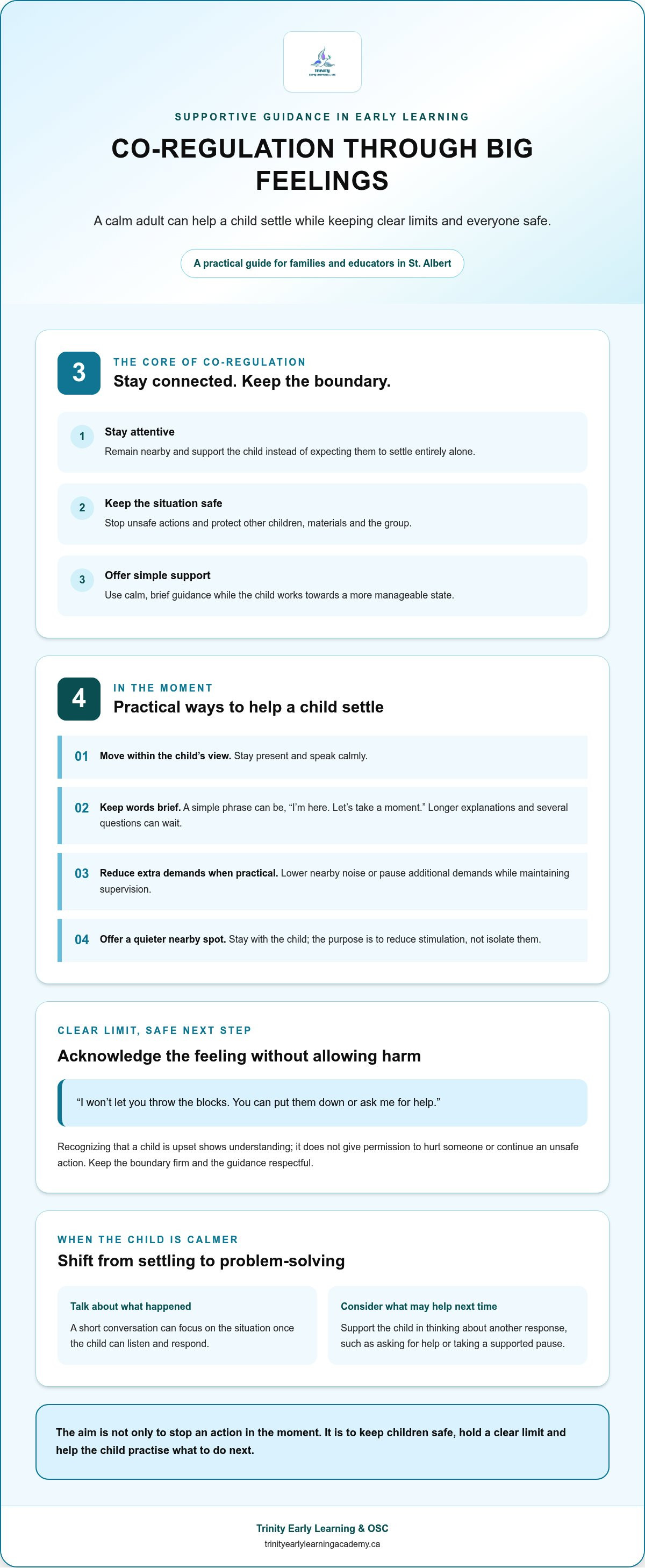
A child who is crying, shouting or struggling to follow a direction may not be ready to reason through a problem. Co-regulation is when a calm adult helps a child return to a more manageable state. The adult stays attentive, keeps the situation safe and offers simple support instead of expecting the child to settle entirely alone.
This support isn’t the same as approving unsafe behaviour. An educator can acknowledge that a child is upset while still stopping them from hurting someone or damaging materials. The boundary stays firm, and the tone and guidance remain respectful. Repeated opportunities to settle with help and try a different response give children practice with emotional regulation. Progress varies, so adults should avoid expecting a particular skill to appear on a fixed timeline.
What can an educator do when a child is overwhelmed?
A steady presence can help make a difficult moment more manageable. An educator might move within the child’s view, speak calmly and use brief phrases such as, “I’m here. Let’s take a moment.” Long explanations and several questions can wait. If practical, the adult can reduce nearby noise or pause extra demands while maintaining supervision and keeping other children safe.
For example, during a busy transition, an educator might guide a child to a quieter nearby spot and stay present. The goal is not to isolate the child, but to reduce stimulation enough to support settling. Once the child is calmer, a short conversation can focus on what happened and what might help next time. Problem-solving is often easier when the child can listen and respond.
How can adults set limits while staying connected?
Clear language makes expectations easier to understand. An educator can name both the limit and the safe action: “I won’t let you throw the blocks. You can put them down or ask me for help.” If a child is upset about waiting, the adult can recognize the feeling without changing the boundary or allowing the unsafe action to continue. Keep the words brief and consistent.
Recognizing a child’s feelings shows understanding; it doesn’t give permission to hurt someone. This distinction helps adults respond with warmth and firmness at the same time. In practice, time-out alternatives used in modern daycares can include staying close, guiding a child towards a calm pause and offering words or actions to try when they’re ready. The specific response depends on the child and what’s happening around them.
Families can use the same distinction at home: name the feeling, hold the safety limit and offer a simple next step. A steady childcare partnership can help children hear similar expectations across settings. St. Albert families can explore Trinity’s childcare programs while learning about local early learning options.
Time-Out Alternatives Compared: Match the Response to the Need
The right response depends on what happened, what the child can understand and what will keep everyone safe. A child who is restless during a transition may need help moving into the next activity. A child who has knocked over another child’s construction may need a chance to settle before helping restore it. The strategies below are options, not a single formula. Adults can adapt them to the child’s developmental stage and the situation.
These time-out alternatives used in modern daycares work best when the response matches the need. A choice can support participation, but it shouldn’t make a safety boundary optional. A calm space can give a child room to regroup, but it shouldn’t become forced isolation. Follow-up matters too: once the child is ready, an adult can help them practise the next step.
| Situation | Supportive response | Skill practised | Suitable follow-up |
|---|---|---|---|
| A child is using materials in an unsafe or disruptive way. | Redirect them towards a safe, engaging way to use the materials or another activity. | Shifting attention and using materials safely. | Notice and name the safe action they try. |
| A child resists joining a transition or waiting. | Offer two realistic choices within the expectation, such as walking to the next activity with a friend or carrying a book. | Making a choice and taking part in a routine. | Follow through calmly on the agreed option. |
| A child seems overwhelmed and needs a pause. | Offer a supervised calm space or a quieter moment with an adult nearby. | Recognizing a need to pause and settling with support. | Reconnect and return to play or the routine when ready. |
| A child’s actions have affected another person or the environment. | Support a repair that fits the child’s understanding, such as helping rebuild or checking on someone. | Noticing impact and contributing to repair. | Practise words or actions that could help next time. |
When are redirection and choices useful?
Redirection can help when another activity offers a clear, appropriate alternative. If a child is reaching for a peer’s materials, an educator might guide them towards a similar item and help them ask for a turn. Choices can help a child participate without removing the limit: “It’s time to tidy up. Would you like to put away the animals or the books?” Both options meet the expectation.
Keep choices genuine and manageable. If neither option is available, it isn’t a useful choice. A child who is too upset to choose may need support from a calm adult first. Redirection and choices may not be the first step when an action presents an immediate safety concern; the adult needs to address that concern before offering alternatives.
What is a supported calm space or repair conversation?
A calm space is an optional, supervised place to regroup, not somewhere a child is sent away alone. Repair can be simple and practical: helping pick up spilled materials, checking whether a peer is okay or practising “Can I have a turn?” with adult help. Keep the conversation private and suited to the child’s understanding. Repair should teach care and responsibility, not turn a mistake into public shame.
Notice how the child responds. If an approach isn’t helping, an educator can adjust the support while keeping expectations and safety clear.
A Practical Response Sequence for Educators
A simple sequence can help adults respond steadily when behaviour becomes challenging, while leaving room to change course if safety or the group’s needs require it. Treat it as a flexible guide, not a script that must be followed in the same order every time. A child’s age, communication skills, immediate risk and surroundings all matter.
The steps are to protect, connect, name the limit, guide an alternative and revisit later. In a licensed early learning setting in Alberta, the practical response will depend on the situation and the children involved. The purpose is to address what’s happening now and help the child understand a useful next action.
- Protect: Stop an unsafe action and create space between children or remove an object that could cause harm.
- Connect: Stay present and use a steady voice. A brief “I’m here” can reassure a child without delaying a safety response.
- Name the limit: State what must stop in simple, specific language, such as “I won’t let you hit.”
- Guide an alternative: Give the child something safe and understandable to do, such as putting the toy down or asking for a turn.
- Revisit later: Once the child is ready, briefly practise what they can try next time.
How should adults respond to unsafe behaviour?
Safety comes first. If a child is throwing a toy near others, an educator can move the toy out of reach, protect nearby children and say, “I won’t let you throw that. You can put it on the shelf.” Keep directions short. A lecture or a demand for an immediate apology may be too much for a child who is still distressed.
Some children need an adult to stay close through a reset, particularly if they’re still reaching, pushing or throwing. The educator can maintain a safe distance, limit extra conversation and keep the group in view. If the immediate risk changes, the response can change too. Connection doesn’t mean stepping back from supervision or allowing the unsafe action to continue.
How can adults help a child learn after the moment passes?
Wait until the child can listen and take part. Then describe what happened without labelling the child: “You wanted the truck, and you pushed. Next time, you can say, ‘Can I have a turn?’” Keep the conversation brief and give the child a chance to practise the words, ask for help or wait with support. If another person or materials were affected, a suitable repair can follow, based on the child’s understanding.
Teaching the next safe action gives a child something practical to practise, not just a behaviour to stop. The sequence behind time-out alternatives used in modern daycares can help families and educators use similar, neutral language without expecting every child to respond the same way.
St. Albert families can explore Trinity’s childcare programs as they consider an early learning partnership.
Building Consistent Behaviour Guidance With Families in St. Albert
Children benefit when the adults around them share clear expectations, but consistency doesn’t mean responding in exactly the same way at home and daycare. A busy early learning room and a familiar home routine are different settings. What can carry across both is a respectful approach: name the boundary, recognize the child’s feelings and show a safe or helpful next step.
Families and educators can agree on simple phrases that make expectations easier to recognize. For example, “Feet stay on the floor” or “You can tell me you need help” is more specific than calling a child naughty or difficult. Shared language gives adults a practical starting point while leaving room to adapt their response to the child and the moment.
What information can families and educators share?
Useful conversations focus on what adults observed, not labels or assumptions about a child’s intentions. A short account of what happened before, during and after a challenging moment can help identify context and useful supports. Include the child’s own words when they help explain what the child was trying to communicate.
- Before: Note relevant context, such as a change in routine, a transition, tiredness or a busy environment.
- During: Describe what the child did or said, and what adults did in response.
- After: Share what helped the child settle, reconnect or take part again.
Keep observations factual. “She covered her ears during the room change and asked to go outside” gives adults something specific to consider. “She was being difficult” doesn’t describe what happened or point towards useful support. Families can share strategies that help at home, while educators can explain which words or routines have been helpful in the early learning setting.
How does a supportive early learning partnership help?
Regular, respectful communication can help families and educators notice patterns without jumping to conclusions. If a child has had a recent sleep change, for instance, sharing that context may help adults understand why a familiar transition feels harder. That information doesn’t determine the response on its own, but it can inform thoughtful support and follow-up.
The aim is alignment, not identical scripts. A family may use one phrase at home and an educator another at daycare, as long as both communicate the same boundary and safe expectation. This kind of partnership supports children as they practise communication, emotional skills and relationships in everyday routines. The principles behind time-out alternatives used in modern daycares can be discussed in practical terms, without assuming one strategy will suit every child or situation.
Trinity Early Learning & OSC provides licensed daycare, preschool and out of school care in St. Albert. Families can explore Trinity’s St. Albert childcare programs as they consider an early learning partnership for their child.
Take the Next Step Toward a Shared Approach
Choose one small step to strengthen communication between home and daycare. You might share a phrase your child uses to ask for help, or mention a routine change that could be affecting their day. A brief, respectful exchange can help the adults around your child focus on what’s useful without expecting every setting to respond in exactly the same way.
The time-out alternatives used in modern daycares are part of a broader conversation about helping children feel supported as they learn. For families in St. Albert, a thoughtful childcare partnership can keep that conversation going as a child’s needs and skills change.
Explore Trinity’s licensed childcare and early learning programs and consider what kind of supportive setting can help your child feel secure, build skills and take part in each day with confidence.
Frequently Asked Questions
Are time-outs always harmful for young children?
Not necessarily, because people may use “time-out” to describe different responses. To understand what happened, consider whether the child was left without support, whether an adult explained the pause and how the child was invited back into the activity. These details are more useful than the label alone. If you’re discussing an incident, ask for a clear account of what the adult did and what the child experienced, without assuming blame.
Can a child use a calm-down space without it becoming a time-out?
Yes. A practical sign is whether the child can use the space as support rather than only being sent there after misbehaviour. Adults can explain its purpose in advance, keep it available without pressure and check that it remains suitable for the child. A family might also discuss what the child finds comforting, such as quiet or a familiar object, while recognizing that preferences can vary from day to day.
What happens if a child refuses a choice or redirection?
A refusal doesn’t mean the adult needs to keep adding options. State the expectation again, then make the next step clear: “It’s time to line up. I’ll walk beside you.” If the child is safe but not ready to respond, allow a brief pause before repeating the direction. If the situation is unsafe, focus first on preventing harm. Later, consider whether the choice was understandable and realistic for that child.
How can adults respond when a child hits another child?
After addressing immediate safety, keep the conversation with each child respectful and private where possible. The child who was hurt may need reassurance or a chance to describe what they need; the child who hit may need help communicating without being questioned repeatedly. Share observable details with the family, such as the activity underway and the words used. Avoid guessing at motives or promising that the behaviour won’t happen again.
At what age can children understand consequences?
There isn’t a fixed age that applies to every child or expectation. A child may understand a response more clearly when it is close to the event and directly connected to it. For instance, if paint is being used on the table, an adult can pause that activity and show where the paper is. A distant or unrelated consequence may be harder to connect with the action. Keep expectations simple and check understanding through the child’s response.
How can parents keep behaviour guidance consistent between home and daycare?
Try a brief, practical check-in about one current goal rather than reviewing every difficult moment. For example, families and educators might agree to notice when a child asks for help during play, then compare what they observe at home and daycare. If a phrase or support doesn’t seem useful, discuss a small adjustment and revisit it later. This keeps communication focused on the child’s needs instead of treating consistency as identical routines.


