

What if the clearest sign of inclusion isn’t a label, but whether a child can take part in play, routines and relationships in a way that works for them? Families exploring inclusive daycare programs Alberta offers may want to know what support looks like during an ordinary day, and how educators and families can work together around a child’s needs.
It’s understandable to look for a program that feels welcoming and safe. A warm environment and specific inclusion practices are related, but they aren’t the same thing. Alberta’s Inclusive Child Care Program provides resources and training to help licensed childcare programs build their capacity to include children with diverse needs.
This guide explains practical signs of inclusive care, outlines what the provincial program supports, and offers steps for exploring childcare in St. Albert. Trinity Early Learning & OSC provides licensed daycare, preschool and out of school care in the community, with affordability grant programs supporting accessible childcare. Use this local context as you consider what matters for your family.
Key Takeaways
- Inclusive daycare is about helping children participate and feel a sense of belonging, not simply using an inclusion label.
- Alberta’s Inclusive Child Care Program supports licensed programs with resources and educator learning to build capacity for inclusion.
- Consider how a program’s values, daily activities, communication and routines reflect an inclusive approach.
- Identify your family’s priorities and prepare information about your child’s routines and needs before exploring care.
- Trinity Early Learning & OSC offers licensed daycare, preschool and out of school care in St. Albert.
What Inclusive Daycare Programs in Alberta Mean for Children and Families
What does inclusion look like beyond a program label? For families considering inclusive daycare programs Alberta offers, the everyday experience matters: can a child take part in routines, play and relationships in ways that are meaningful to them? Inclusion is an approach to care that supports children’s participation and sense of belonging. It doesn’t mean every child receives the same support.
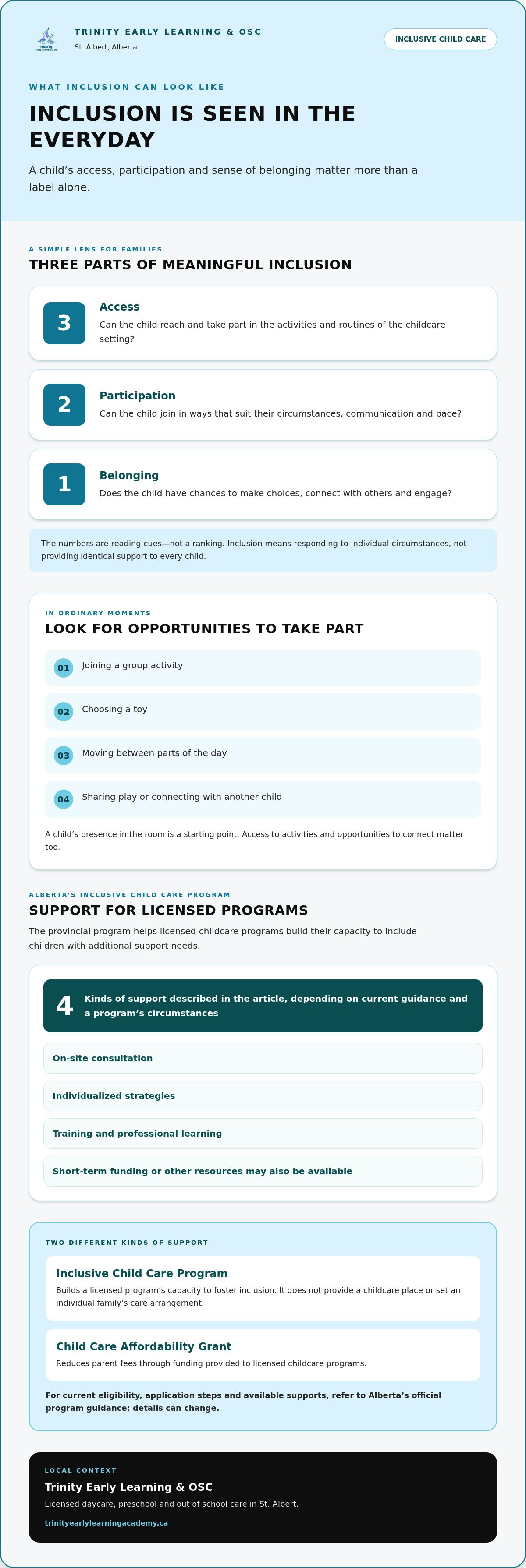
Inclusive daycare supports children’s access, participation and belonging by responding to their individual circumstances within the childcare environment. This idea connects with broader inclusive education principles, adapted to the relationships, routines and play of early childhood. A child’s presence in the room is a starting point. Access to activities and opportunities to connect with others matter too.
Identical treatment can leave some children facing barriers that others don’t encounter. A routine, activity or way of communicating may need to be approached differently so a child can participate. What helps depends on the child and the setting. Rather than applying one formula, inclusion means considering what supports each child’s engagement and belonging.
What meaningful participation can look like in childcare
Participation can happen in small, ordinary moments: joining a group activity, choosing a toy, moving between parts of the day or sharing play with another child. A child might take part in a familiar routine in a way that suits their communication or pace. When families consider these moments, they can ask how a program supports children’s involvement in its daily activities.
Belonging matters alongside access. A child may be physically present yet have few chances to make choices, connect or engage with what is happening. Thinking about both access and participation gives families a practical way to understand inclusion, beyond relying on a program’s wording alone.
Inclusive care and additional support needs
Additional support needs is a broad, respectful phrase for circumstances in which a child may benefit from support to participate in care and learning. It can describe different needs and situations; it doesn’t specify a diagnosis or imply that a diagnosis is required. Children’s needs are individual, so helpful support can differ from one child to another.
Families know their child’s experiences and routines, while educators see how the child engages in the childcare setting. Sharing relevant context can help both sides understand what participation means for that child. Inclusion is best understood as an ongoing, child-aware approach that considers a child’s circumstances and the childcare setting.
How Alberta’s Inclusive Child Care Program Supports Licensed Programs
Alberta’s Inclusive Child Care Program is designed to help licensed childcare programs build their capacity to include children with additional support needs. Its focus is on the program and the educators working with children. This distinction helps families understand what the initiative contributes, separate from a child’s enrolment, daily care arrangement or childcare fees.
The program supports a licensed program’s capacity to foster inclusion; it does not provide a childcare place or set an individual family’s care arrangement. It’s also different from Alberta’s Child Care Affordability Grant, which reduces parent fees through funding provided to licensed childcare programs. The initiatives support access in different ways.
What kinds of support may be available to childcare programs
Depending on current program guidance and a program’s circumstances, supports may include on-site consultation, individualized strategies, training and professional learning. These resources help educators consider how to adapt their inclusive practice and respond to children’s participation needs in a childcare setting. Short-term funding or other resources may also be available under the program. Current official information explains the forms of support and their terms.
The program is intended to build a childcare program’s ability to include children. For families, it provides useful context about how inclusion can be supported at the program level. The Alberta’s Inclusive Child Care Program page describes the province’s current supports and processes.
How families can understand program eligibility and applications
Eligibility, application steps and available supports are governed by current program guidance and can change. Review Alberta’s official information for the latest details, and distinguish program-level support from decisions about a child’s individual care.
For broader local context, families can also review this licensed daycare guide for St. Albert families. It places questions about inclusion within the wider process of exploring licensed childcare in the community.
Families considering care in St. Albert can explore Trinity’s licensed daycare, preschool and out of school care as part of their early learning search. Understanding the role of provincial supports can help families focus on the information that matters to their own care decisions.
How Families Can Recognize an Inclusive Daycare Approach
A program’s welcoming language can be a helpful starting point, but families may also want to understand how inclusion shows up in ordinary routines. When comparing inclusive daycare programs Alberta offers, look for clear explanations of how children can take part, how educators communicate with families, and how routines respond to different needs. These are useful topics to observe or discuss, not a pass-or-fail test.
Being present in care means sharing a space; being able to participate means having meaningful opportunities to engage with the people, play and routines in that space. No single feature proves that a program is inclusive. Look for consistency between its stated values and how educators describe supporting children throughout the day.
| Area | What families might observe or discuss |
|---|---|
| Stated values | Does the program speak respectfully about children’s strengths, needs and developing independence? Can educators describe belonging as part of everyday care? |
| Daily participation | How might children access play, group routines and opportunities to connect with peers? Are different ways of joining an activity considered? |
| Communication | How can families share context about a child’s routines, interests or support needs? How do educators and families exchange relevant observations? |
| Responsive routines | Can educators explain how they consider a child’s needs during transitions, play or other parts of the day? Are adjustments considered in relation to the individual child? |
Use the table as a conversation guide, not an audit. Responses can help you understand how a program thinks about participation, while the child’s individual circumstances shape what support is useful. Inclusion doesn’t require one specific activity, room arrangement or approach for every child.
Signs of participation, belonging and responsive routines
As you observe or discuss care, consider whether children have ways to access play, join group routines and build relationships with peers. Listen for language that recognizes children as individuals, rather than defining them only by a challenge or support need. A respectful discussion can include what a child enjoys, how they communicate and where they’re developing independence. These details give a fuller picture than a single physical feature or activity.
Communication between families and educators
Clear, ongoing communication helps families share useful context and educators describe what they notice in the childcare setting. You might explain routines that help your child feel settled, activities that hold their interest, or changes you’ve observed. The goal is a shared understanding, not a requirement that families provide a formal plan. Communication also gives both sides an opportunity to revisit what seems helpful as a child’s needs and experiences develop.
Preparing to Explore Inclusive Childcare in St. Albert
Exploring care is easier when you begin with what matters most to your family. In St. Albert, families considering licensed childcare can prepare a few notes, compare how programs describe their approach and review current Alberta resources. This helps make conversations focused and gives you a clear way to explain what your child may need to participate in care.
Use this simple sequence to get ready:
- Identify your priorities. Consider what helps your child feel comfortable, what they enjoy and what you hope they can take part in during the day.
- Prepare useful context. Note relevant routines, transitions, communication preferences and practical needs that may affect your child’s day.
- Compare approaches. Think about how each program describes children’s participation, family communication and responsive routines. Consider which explanations speak to your priorities.
- Review current resources. Check Alberta’s official information on inclusive childcare supports and consult its resource bank for current guidance and learning materials.
What information families may find helpful to prepare
A brief, practical summary can make it easier to describe your child beyond a diagnosis or support need. Include strengths and interests, such as a favourite type of play or an activity that helps them settle. You might also note what transitions are like, how your child communicates, and which parts of the day tend to go smoothly or feel more difficult.
Share only what feels relevant and comfortable. Personal or sensitive details are yours to manage, and families can decide what to share with educators as they explore care. You don’t need a perfect document or a complete account of every circumstance. A few clear observations can help start a useful conversation.
Where to find Alberta inclusion information
For families researching inclusive daycare programs Alberta supports, the Government of Alberta’s current program guidance and inclusive childcare resource bank are useful starting points. Program details, eligibility, application steps and participating agencies can change, so use the latest official information. Check local agency coverage against current guidance when researching formal supports in St. Albert.
Families can also build their understanding of local early learning options with Trinity’s early childhood education guide for St. Albert. To explore Trinity’s licensed daycare, preschool and out of school care, visit Trinity Early Learning & OSC.
Exploring Trinity’s Licensed Daycare and Early Learning Programs
Learning about inclusion can help families clarify what matters as they explore care. It’s also useful to understand local options. Trinity Early Learning & OSC provides licensed childcare in St. Albert, including daycare, preschool and out of school care. Consider these programs as part of your search for early learning and care, with your child’s routines, interests and support needs in mind.
Information about inclusive daycare programs Alberta supports provides helpful background on provincial resources. To compare childcare options, review each program’s information and consider how it fits your family’s needs. A program label alone doesn’t explain the details of a child’s daily care.
Which Trinity programs families can explore
Trinity’s licensed offerings in St. Albert include daycare, preschool and out of school care. These are daytime care and early learning options. Consider which type of program aligns with your child’s age, daily schedule and stage of learning, then review the information for that option.
Each child’s needs and circumstances are individual. The program names describe the care offerings. Families can use the inclusion considerations in this guide to identify what matters to their child and assess care information in that context.
Affordability and a reassuring next step
Affordability is another part of exploring care. Trinity uses affordability grant programs to support accessible childcare. Alberta’s grant funding is distinct from inclusion-focused supports for licensed programs, so understanding which type of support you’re reading about can make information easier to interpret. For an overview of the affordability grant, see the Alberta daycare affordability grant guide.
As you review options, keep your notes about routines, strengths, interests and practical needs nearby. They can help you connect program information to your family’s priorities. You don’t need to have every answer before exploring care; a clear sense of what matters most is a useful place to begin.
For a next step, explore Trinity’s programs in St. Albert and review the daycare, preschool and out of school care information for your family.
Take the Next Step at Your Family’s Pace
Choosing care is a personal decision, and you don’t need to resolve every question at once. As you consider inclusive daycare programs Alberta families can explore, focus on whether a setting’s approach aligns with your child’s routines, interests and ways of joining in. Reflecting on what you’ve learned can help clarify what you want your child’s days to include.
A useful next step is to review program information alongside the notes you’ve prepared about your child. This can move you from broad questions about inclusion to a clearer sense of what matters to your family.
Trinity Early Learning & OSC provides licensed daycare, preschool and out of school care for families in St. Albert. Explore Trinity’s licensed childcare programs in St. Albert and consider which option may suit your family’s next step.
With thoughtful questions and a clear sense of your child’s needs, you can approach the search with greater confidence.
Frequently Asked Questions
What does inclusive daycare mean in Alberta?
Inclusive daycare means arranging care with the aim of helping children take part and feel they belong, while recognizing that children may participate in different ways. For example, a family might describe how their child communicates or what helps them join a group activity. The term describes an approach, not a guaranteed outcome. Ask for practical examples that relate to your child’s day.
Is Alberta’s Inclusive Child Care Program for families or childcare providers?
Alberta’s Inclusive Child Care Program supports licensed childcare programs and educators as they build capacity for inclusion. It isn’t a direct childcare fee grant for families or a childcare placement service. If you’re looking for help with fees, explore Alberta’s affordability information separately. Keeping these purposes distinct can help you identify whether a resource relates to program practice or your family’s childcare costs.
Can a child attend inclusive daycare without a diagnosis?
A diagnosis isn’t what defines whether a childcare approach is inclusive. Families can describe support needs through everyday details, such as a child finding changes in routine difficult or communicating in a particular way. Access to specific supports or formal programs may follow separate current criteria. Avoid assuming that a diagnosis is always required, or that a particular support is automatically available; review the relevant guidance for your situation.
What support does Alberta provide to inclusive childcare programs?
Depending on current program guidance and a program’s circumstances, supports can include consultation, educator learning and strategies intended to strengthen inclusive practice. These supports help programs build capacity. Families can use the Government of Alberta’s current program information to understand the types of support described and whether details such as eligibility or application steps have changed.
How can families recognize an inclusive daycare approach?
Look for explanations that connect a program’s values to ordinary care. For instance, a useful discussion might describe how educators think about a child joining a group activity, moving between routines or connecting with peers. Consider whether the response is respectful and specific to your child, rather than relying only on a general statement about being welcoming. These conversations can inform your decision, but they aren’t a formal assessment.
Are inclusive daycare programs available in St. Albert?
St. Albert has licensed childcare options, including Trinity Early Learning & OSC’s daycare, preschool and out of school care. Families can use the practical considerations in this guide to understand a program’s approach and consult current Alberta resources about formal supports. Describing the kind of participation your child needs can make local care discussions more focused.
What should parents share when exploring childcare for a child with additional needs?
Share information that helps explain your child’s everyday experience: what they enjoy, familiar routines, communication preferences, transitions that may be challenging, and practical needs during the day. A brief example, such as what helps your child move from one activity to another, may be more useful than a broad label alone. You decide which personal details to share; focus on information that feels relevant to exploring care.


