

A child sees a classmate crying after a toy is taken, but isn’t sure what to do. In moments like this, teaching empathy in an early learning environment means helping children connect what someone may be feeling with a caring, age-appropriate response. It takes time, guidance and practice.
Young children may find it difficult to name their own feelings or notice another person’s. Peer conflicts can also leave educators wondering how to guide a child without blame or shame. These moments are opportunities to pause, offer simple words for feelings and help children consider what might make things better, while respecting that each child develops and experiences the world differently.
This article explains how educators can support empathy through everyday interactions, play and conversation. You’ll find ways to name feelings, model caring responses and guide children through disagreements respectfully. In St. Albert, early learning settings such as Trinity Early Learning & OSC give children opportunities to practise social skills alongside supportive adults. Empathy isn’t a fixed trait children either have or lack. It is a developing skill that can help create a more emotionally supportive environment.
Key Takeaways
- Empathy grows over time and can look different from one child or situation to another.
- Teaching empathy in an early learning environment can follow a flexible sequence: notice a cue, name a possible feeling, consider another perspective and choose a caring response.
- Listening and acknowledging feelings gives educators a practical way to model perspective-taking without assigning blame.
- During conflict, focus first on safety and listening. Sharing, agreeing or apologizing shouldn’t be forced as proof of empathy.
- St. Albert families can support continuity with low-pressure conversations with educators about children’s social experiences.
What does teaching empathy in an early learning environment mean?
Empathy develops over time, and it won’t look the same for every child, age or situation. A child might notice a friend is upset but not know what to say. Another might offer a toy one day, then need adult support to understand a peer’s feelings the next. These differences are part of learning, not evidence that a child lacks empathy.
Empathy is noticing and trying to understand another person’s feelings, then responding with care. The word “trying” matters: children don’t need to feel exactly what someone else feels or guess their thoughts correctly. They can learn to observe a cue, consider what the other person might be experiencing and decide how to respond. An educator can support this process with calm questions such as, “What do you notice?” or “What might help?”
Teaching empathy in an early learning environment is not the same as teaching children to obey an adult’s instruction. Sharing on demand may produce the action an adult asked for, but it doesn’t necessarily mean a child understands how a peer feels. Likewise, repeating “Are you okay?” after an adult says it isn’t proof of understanding on its own. Rather than expecting a particular response, educators can help children connect what they notice with possible feelings and thoughtful choices.
Empathy can be supported through planned experiences and everyday interactions. For example, the Roots of Empathy program is described as using guided observations of infants to help children consider feelings and responses. In daily early learning, careful observation can begin with a classmate’s expression, words or actions, followed by a gentle conversation instead of an assumption about what that child feels.
How is empathy different from kindness and sympathy?
Empathy means trying to understand another person’s feelings or point of view. It doesn’t require feeling the same way. Kindness is an action, such as offering help or making room in a game. It may follow empathy, but a child can act kindly without explaining another person’s feelings first. Sympathy expresses concern, such as “I’m sorry that happened,” but may not include an effort to understand the other person’s perspective. The ideas are related, but they aren’t interchangeable.
Why does empathy matter in early learning?
As children practise noticing feelings and expressing their own, they have more ways to communicate during shared play. A child might say, “I’m still using that,” or notice that a peer is waiting to join. These moments can support cooperation and help children feel that their feelings and relationships matter within the group. Empathy won’t prevent every disagreement, but it gives educators and children a respectful starting point for understanding one another and deciding what to do next.
How does empathy develop through everyday early learning experiences?
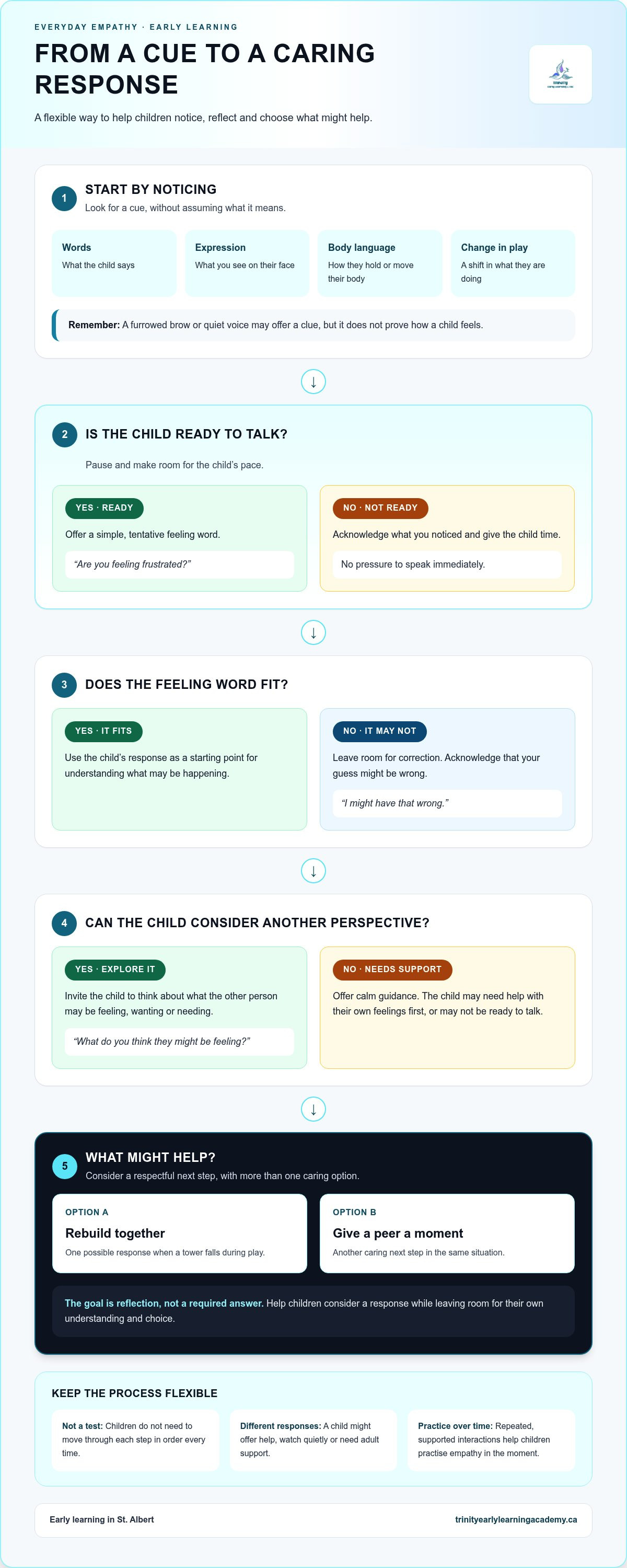
Empathy is practised in small moments, not taught as a single lesson with one expected result. Educators can support a flexible sequence: notice a cue, name a possible feeling, consider another perspective, then choose a response. Children may move through these steps in different ways. One child might offer help; another may watch quietly or need adult support to decide what to do. Adults can observe and guide without expecting every child to react alike.
Picture a tower falling while two children are playing. One child looks upset and turns away. An educator might pause and say, “I noticed you looked down when the tower fell. Are you feeling disappointed?” If the child agrees, the educator could ask the other child, “What do you think they might be feeling?” Together, they can consider a next step, such as rebuilding or giving their peer a moment. The adult is inviting reflection, not requiring a particular answer.
- Notice a cue. Pay attention to words, facial expressions, body language or a change in play.
- Name a possible feeling. Offer a simple, tentative word, such as “frustrated” or “excited.”
- Consider a perspective. Invite the child to think about what the other person may want or need.
- Choose a response. Help the child consider a respectful next step, while leaving room for more than one caring option.
These steps aren’t a test, and children don’t need to move through them in order every time. A child may interpret the moment differently, need help with their own feelings first or not be ready to talk. Teaching empathy in an early learning environment means offering guidance that fits the child and situation. Repeated, supported interactions give children chances to practise empathy in ways that make sense in the moment.
What can children learn from naming feelings?
Simple, non-judgmental words can help children describe what’s happening: “You’re holding your hands tightly. Are you feeling upset?” A furrowed brow or quiet voice may offer a clue, but it doesn’t prove how a child feels. Leave room for correction: “I might have that wrong.” If the child doesn’t want to speak, acknowledge what you’ve noticed and give them time. Naming a feeling can help a child communicate a need without pressure to talk immediately.
How do play, stories, and routines create practice?
Pretend play lets children explore what different characters might think or feel without needing to settle on one right answer. Stories offer a similar pause: “What might the character want now?” Everyday routines count, too. Taking turns with materials can invite children to notice who’s waiting, explain what they need and find a way to continue playing together. Families in St. Albert can find more context on local early childhood education in a guide to choosing an early learning setting.
When exploring early learning in St. Albert, families can consider settings where children practise social skills with supportive adults. Trinity’s early learning programs include daycare and preschool for local families.
Which educator practices help children understand another person's perspective?
Children learn from what adults do as well as what they say. An educator who listens without rushing, acknowledges a child’s feelings and responds steadily shows that emotions deserve attention. This doesn’t mean agreeing with every account or deciding immediately who was right. It means making space for each child to be heard, then helping them consider what another person might have experienced.
When teaching empathy in an early learning environment, educators can use open, tentative language rather than telling children what a peer must feel. For example, after a child reaches for a toy another child is holding, an educator might say, “I hear that you want a turn. I wonder how Maya feels about stopping her game. What could we do next?” This frames the moment as a shared problem to think about, not a reason to label or blame either child.
What can educators say to model empathy?
Calm prompts help children explore feelings without being told what to think: “What might the character be feeling?” or “Do you think your friend might feel disappointed?” Then pause and listen. If an adult’s guess is wrong, they can acknowledge it: “Thanks for telling me. I misunderstood. You’re feeling worried, not angry.” This models curiosity and shows that listening can change an initial interpretation.
Consistency matters, too. When educators respond respectfully to children’s feelings during ordinary interactions, children see that care isn’t reserved for one kind of emotion or one child. Adults can offer language and choices, but they should avoid turning a question into a test with a required answer. A child may need time to watch, think or communicate another way before joining the conversation.
How can educators support inclusion and belonging?
Perspective-taking starts with recognizing that children may express feelings and needs differently. A response that seems familiar to one adult may not mean the same thing to every child. Educators can stay curious about each family’s and child’s experiences instead of treating one communication style or response as universal.
Self-reflection can help educators notice whether they interpret similar behaviour differently between children. They might ask: Am I giving each child the same chance to explain? Am I assuming intent before listening? Does my response respect the child’s way of communicating? These questions can guide fairer, more thoughtful interactions without placing the burden of explaining a whole family or culture on one child.
Classroom books, play materials and conversations can also help children encounter varied families, identities and experiences. A story about a character who feels left out, for example, can open a discussion about different ways people seek connection. Educators can invite ideas without asking children to speak for a group or insisting that every child relates to the same story. For families considering preschool, Preschool Programs in St. Albert: Choosing the Right Foundation for 2026 offers related local context.
How should adults guide conflict without forcing empathy?
Conflict gives adults a chance to help children feel safe, understand what happened and consider how to move forward. It doesn’t mean a child must always share, agree with a peer or apologize immediately. Empathy isn’t compliance. A child can be supported to consider another person’s feelings while still expressing their own needs and boundaries.
Supported repair helps a child respond to what happened; compelled sharing or an apology asks for an action before the child is ready to understand it. An apology said under pressure may not reflect what a child is thinking or feeling. Repair can take different forms, and an adult can guide it without shame or punishment.
What steps can adults take during a disagreement?
Start with safety and calm. If children are grabbing, pushing or shouting, pause the interaction and create space as needed. Once everyone is safe, listen to each child’s account without labelling anyone as “bad” or “unkind.” A neutral opening, such as “Tell me what happened,” lets children share what they remember without being pushed towards an adult’s version of events.
- Pause and settle. Use a calm voice, keep children safe and allow time for strong feelings to ease.
- Listen to each child. Give both children a chance to describe what they wanted or experienced.
- Name feelings and needs. Offer possible words, such as “frustrated” or “You wanted a turn,” and let children correct you.
- Explore a next step. Depending on what happened, children might take turns, find another material or help restore what was disrupted.
For example, if two children reach for the same marker, an educator can set a boundary without deciding that either child is selfish: “You both want the blue marker. Let’s make sure everyone has space. What could help you keep drawing?” The focus is on safety, each child’s needs and a workable next step, not on making one child feel responsible for the other’s emotions.
Why shouldn't adults demand an apology?
A child who is overwhelmed may repeat “sorry” without understanding the effect of their actions or being ready to reconnect. An adult can acknowledge the impact while keeping the response practical: “The blocks fell when you ran through. Let’s check that everyone is okay. Would you like to help rebuild?” Checking in or helping repair the play space may fit the situation better than a forced apology.
Sometimes a child needs distance or time before revisiting the moment. Adults can return to the conversation when the child is calmer, offer words for what happened and support a respectful way forward. Teaching empathy in an early learning environment includes respecting a child’s pace while maintaining clear limits on unsafe behaviour.
Families considering early learning in St. Albert can explore Trinity’s daycare and preschool programs, where children can practise social skills with supportive adults.
How can St. Albert families connect empathy learning with early education?
Children’s social experiences don’t stop at the door of home or their early learning setting. A calm conversation between family members and educators can help adults understand what a child is practising, what feels difficult and which words or approaches may help. Keep these conversations specific and low-pressure. Sharing a small observation, such as “They said a friend looked sad during play,” gives adults a place to begin without expecting a child to have handled the moment perfectly.
Families in St. Albert can also consider how educators speak about emotions, differences and peer relationships. Respectful language avoids labelling a child as “a bully” or “too sensitive” and focuses instead on what happened, what the child may have needed and how the situation was handled. This communication can help families and educators work together while respecting each child’s experiences.
What can families look for in an early learning environment?
Notice whether adults listen to children before deciding what happened and guide disagreements calmly. Books, play materials and group routines can offer clues, too: do they make room for different families, experiences and ways of joining in? These observations can help families understand how daily interactions support social learning, alongside the broader local context in Licensed Daycare in St. Albert: The Complete Parent’s Guide to Quality Childcare.
Families don’t need to look for a perfect response in every moment. Instead, consider whether adults make time for children to express themselves, offer age-appropriate support and treat different feelings with respect. Teaching empathy in an early learning environment is supported by consistent, caring interactions, not by expecting every child to respond in the same way.
How can home and early learning reinforce one another?
Simple, familiar feeling words can create continuity between settings. If a child uses “disappointed” at home, for example, a family can share that word with educators as useful language, without expecting the child to use it every time. Open questions can also invite conversation without turning the day into a test: “Did you notice how someone was feeling?” or “Was there a time you worked something out together?” Children can answer in their own way, or may not be ready to talk yet.
Trinity Early Learning & OSC provides licensed daycare, preschool and out of school care in St. Albert. These early learning options give families a local setting where children can take part in social experiences with supportive adults. Explore Trinity’s early learning programs as you consider the right fit for your family.
Keep empathy growing through everyday partnership
As children move between home and early learning, a shared approach can make conversations about feelings more familiar. Families and educators can exchange simple observations, then agree on language that respects the child’s experience without expecting the same response every time. Over time, these small connections can help adults notice what support a child may need in new situations.
For families in St. Albert, choosing an early learning setting is also a chance to consider the respectful relationships they want around their child. Trinity Early Learning & OSC’s affordability grant programs support access for local families. Explore Trinity’s licensed daycare, preschool and out of school care in St. Albert to learn more about its early learning programs. With patient guidance at home and in early learning, teaching empathy in an early learning environment can remain a steady, caring practice as children grow.
Frequently Asked Questions
Is empathy something children are born with, or can they learn it?
Children may show early responses to another person’s distress, and empathy continues to develop through relationships and experience. Teaching empathy in an early learning environment can include noticing emotions during a familiar routine, such as asking whether a sibling might feel left out when a game starts without them. Adults can model care and use clear feeling words, while remembering that children may respond differently or need help understanding what someone else could be feeling.
Can toddlers understand how another child feels?
Toddlers are learning to recognize emotions and consider viewpoints beyond their own, so they may need adult support to interpret a peer’s distress. If a child cries after a toy is taken, an adult might say, “They were playing with that and now they’re upset.” Keep the prompt brief, offer a simple response such as bringing over a tissue, and follow the child’s cues. One moment alone doesn’t show the full extent of a child’s empathy.
Should I make a child apologize after hurting someone?
No. Demanding an apology isn’t the only way to respond. First check whether anyone needs help, then give each child a chance to explain in their own words or through gestures. If a child is still upset, a forced “sorry” may not show that they understand what happened. Later, you might invite them to ask if their peer is okay, help replace a knocked-over creation or take another suitable step towards repair.
What should an educator do if a child seems unconcerned after a peer gets hurt?
Respond to the situation without assuming the child lacks empathy. They may not have seen what happened, may be unsure how to help or may be focused on their own reaction. Make sure the hurt child is safe, explain what you observed in simple terms and offer a clear choice: “Would you like to get me, or give them some space?” Look at a child’s responses across different situations rather than drawing a conclusion from one incident.
Does teaching empathy mean children must share their toys?
No. A child can care about a peer’s feelings and still want to keep playing with a toy. Acknowledge both children’s needs, then help them find a workable plan, such as choosing a turn after the current activity or finding another item for the waiting child. Some belongings may be especially meaningful to a child, so consider the situation rather than treating immediate sharing as the only sign of consideration.
How can families encourage empathy at home?
Families can model attentive listening and use feeling words during ordinary moments, such as noticing that a character in a story looks lonely. Ask open questions like, “What do you think they might want?” and accept the child’s answer without correcting it into a required response. Pretend play can also help children explore different roles. After a difficult interaction, talk about what could help next time, once everyone has had time to settle.


