

What if a smoother daycare transition starts with a stretch, a pretend animal pose or one slow breath, rather than asking every child to sit still? Transitions, waiting and group routines can be challenging for young children, and not every child will want to copy a pose or join a quiet activity. That’s why yoga and calming exercises for kids in daycare work best when they’re brief, playful and offered as a choice.
These activities don’t need to be formal lessons. A simple invitation can help children notice how their bodies feel, explore breathing and take part in a familiar routine at their own pace. The goal is not to make children perform or stay perfectly still.
This article shares practical ideas for gentle movement, imaginative poses and quiet moments, plus ways to adapt them for different ages and abilities. You’ll also find suggestions for fitting short activities into everyday transitions in a daycare setting in St. Albert.
Key Takeaways
- Make yoga and calming exercises for kids in daycare brief, playful invitations rather than expecting perfect poses or quiet participation.
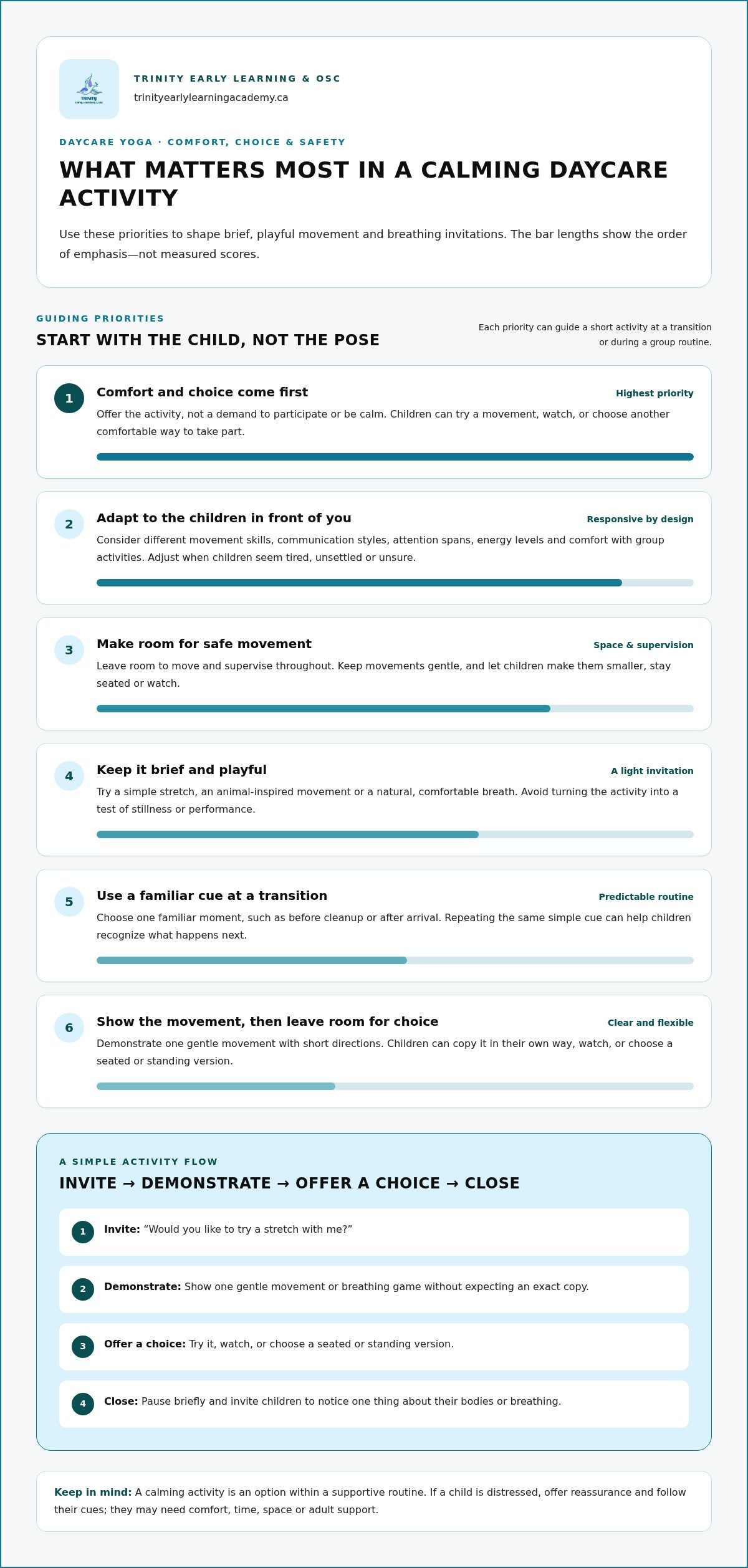
- Guide a simple activity by inviting children, demonstrating a movement, offering a choice and ending with a quiet moment to notice.
- Adapt movements to the children present, leave room to move and supervise throughout.
- Try one familiar transition and use the same simple cue so children know what to expect.
- Explore Trinity Early Learning & OSC’s licensed daycare, preschool and out of school care for families in St. Albert.
What yoga and calming exercises can offer children in daycare
A child-friendly yoga activity isn’t about achieving a perfect pose or holding still. It can combine gentle movement, simple breathing invitations and chances to notice the body. A child might stretch their arms like a tall tree, curl into a small seed or pause to feel one breath. Children can watch, try a movement or choose another comfortable way to take part.
During a busy daycare day, a brief, familiar practice can create a predictable pause before the next activity. That pause gives children a chance to notice how they feel and approach a transition, but it won’t prevent every upset or difficult feeling. A child may still need comfort, time, space or adult support. Offer the activity as an option, not a demand to be calm.
How mindfulness and yoga differ for young children
Mindfulness means noticing what’s happening right now, without needing to change it. A child might notice the feeling of their feet on the floor, listen to a nearby sound or observe a breath moving in and out. Yoga involves movement and may include breathing or a quiet pause. For a young child, the difference can be simple: notice one breath, then stretch like an animal.
The two approaches can overlap, but neither needs to become a formal lesson. A playful stretch can invite children to notice their bodies, while a quiet moment can help them pay attention to what they sense. For a general overview of the benefits of yoga for children, see the linked reference. In daycare, keep the focus on comfortable, age-aware participation.
Why short, playful practices suit group care
Familiar cues can help children understand what happens next. An educator might invite a stretch before cleanup or one slow breath after arrival. A short invitation is usually easier to follow than a long guided exercise, especially when children have different attention spans and energy levels. Repeating a simple routine can make its steps recognizable without requiring everyone to join in the same way.
Keep the experience light and responsive. Invite children to reach up like a tree, then ask whether their arms feel high or low. They can answer, show you, watch or continue playing. There’s no need to correct their movement or compare one child’s pose with another’s. Comfort and enjoyment matter more than performance.
These activities don’t replace responding to a child’s needs. If a child is distressed, offer reassurance and follow their cues rather than expecting a breathing exercise to resolve the feeling. As one option within a supportive routine, yoga and calming exercises for kids in daycare can make transitions more familiar while respecting each child’s comfort and choice.
How to lead simple yoga and calming exercises for kids
A clear sequence helps children understand what’s being invited, while leaving room for each child to take part in their own way. Keep your voice calm and directions short. Let children watch first; seeing an adult demonstrate can make a new movement easier to understand.
- Invite: Use a simple cue, such as “Would you like to try a stretch with me?”
- Demonstrate: Show one gentle movement or breathing game without expecting children to copy it exactly.
- Offer a choice: Children can try the movement, watch, or choose a seated or standing version.
- Close: Pause briefly and invite children to notice one thing about their bodies or breathing.
For example, say: “You can sit or stand. Smell an imaginary flower with a gentle breath in, then softly blow bubbles out. Let your breathing return to its usual pace. What do you notice?” This gives the activity a clear start and finish without promising that everyone will feel calm.
Try breathing games children can follow
Let breathing stay natural. Invite children to notice a comfortable breath rather than taking a deep breath or holding it. The flower-and-bubbles image gives the inhale and exhale a playful focus, but children don’t need to follow a set pace. If a child seems uncomfortable, stop the game and offer another choice, such as watching or returning to play.
Use gentle language and avoid treating the exercise as a test. Children may breathe through their nose, mouth or in their own way. An adult can model one easy breath, then leave space for each child to decide whether to join.
Add gentle poses and mindful movement
Choose simple movements that leave room to move, such as reaching up like a growing plant or taking slow, quiet steps like a cat. Children can make the movement smaller, stay seated or watch. Skip complicated pose names and comparisons. The point is to explore movement, not to see who can stretch the farthest or copy most closely.
Before or after moving, offer a brief noticing prompt: “How do your arms feel?” or “What do you notice in your body?” Children can answer with words, gestures or no response. Keep the invitation open, and let their comfort guide whether you continue.
As an optional part of a familiar routine, yoga and calming exercises for kids in daycare can give children a simple way to explore movement and breathing together. Families in St. Albert looking for an early learning setting can explore Trinity’s licensed daycare and preschool.
How to adapt daycare yoga for age, comfort, and safety
Children in the same daycare group may have different movement skills, communication styles, attention spans and comfort with group activities. Adapt the invitation to the children in front of you rather than expecting everyone to follow the same pose. Watch how the group responds, and adjust if children seem tired, unsettled or unsure.
“Comfort and choice take priority over completing a pose.” Keep movements gentle, leave enough room for children to move without bumping into one another, and supervise the whole activity. Choose simple movements that can be made smaller or done without changing position. If the space or group’s needs change, pause or end the activity.
Make activities accessible across ages and abilities
Use one-step directions and show the movement instead of relying on abstract explanations. For example, demonstrate a gentle reach, then invite children to try it in their own way. Make options available to everyone: children can sit, stand, watch or rest. Offering these choices to the group avoids singling out a child or making an accommodation feel like a special exception.
Adjust as you go. If the group is restless, simplify the movement. If children are finding it hard to follow, demonstrate again or finish with a quieter pause. Let children move within their comfort and ability.
Respond calmly when a child does not join
A child may prefer to observe, continue another activity or decline the invitation. Treat that response as a choice, not misbehaviour. Avoid asking the child to explain in front of peers. A calm “You can watch” makes room for participation without pressure, and the child can decide whether to join later.
Keep the group activity moving rather than waiting for everyone to take part. Belonging shouldn’t depend on copying a movement. If a child seems uncomfortable, stop directing attention towards them and continue with the group or offer a different activity when appropriate.
When adapting yoga and calming exercises for kids in daycare, consider the group’s needs before and during the activity:
- For different ages: Use familiar words and demonstrate one movement at a time.
- For varied mobility: Offer a seated or standing version, with watching as another valid choice.
- For changing energy: Make the activity smaller, simpler or shorter when children need a different pace.
- For safe movement: Leave space between children, supervise throughout and pause if the activity no longer feels comfortable.
These choices keep the activity responsive rather than prescriptive. Adults can offer a supportive structure while allowing each child to decide how, or whether, to take part.
Where calming exercises fit into a daycare routine
A calming activity is often easiest to introduce when it supports a familiar transition, rather than adding another scheduled block to an already full day. Choose one moment that regularly calls for a change of pace, then use the same simple cue so children can recognize what’s coming. For example, “Let’s pause and listen” can signal a brief listening moment before a quieter group activity.
Keep the regular routine and supervision in place. A breathing game can be offered while children wait for the next step, but it shouldn’t distract educators from attending to the group or replace the usual transition. If children need help, reassurance or a prompt to move on, respond to that need first.
Use brief practices around everyday transitions
Match the activity to the moment. After arrival, a gentle reach can offer a simple way to shift into the day. Before moving from play to another activity, invite children to pause and notice a sound. While waiting, an educator might model one comfortable breath and invite children to join if they wish. Keep the invitation short, then continue with the planned routine when it’s time.
A consistent cue can be a short phrase or familiar gesture. Use it in the same way each time so children know what to expect. The cue shouldn’t imply that children must become silent or still. A child can listen while sitting, standing or quietly watching.
Build a calm environment without forcing stillness
Choose a clear area where children have room to move without crowding one another. Use a steady voice and demonstrate the pace you’re inviting, while keeping the group in view and under supervision. Avoid waiting for every child to settle before continuing. Children can take part in different ways, and the activity can end when the group is ready to return to play or the planned routine.
Notice how the timing works for the group. Can children follow the cue? Does the activity fit naturally into the transition, or does it create extra waiting? Do children seem interested, or are they ready to move on? Use what you observe to decide whether to keep the activity, adjust the cue or choose a different moment. It doesn’t need to be part of every transition.
Keep the routine flexible. If children need something else, skip the activity or shorten it to a single cue. The aim of yoga and calming exercises for kids in daycare is to offer a supportive pause, not to interrupt care or insist on a particular response. Predictable routines can make everyday transitions more familiar for children and families.
For families exploring early learning and childcare in St. Albert, learn about Trinity’s daycare and preschool.
How Trinity Early Learning & OSC supports early learning in St. Albert
Children’s wellbeing is supported by more than one activity. Familiar routines, responsive care and opportunities to learn all contribute to a daycare day where children can take part at their own pace. The simple movement and breathing ideas in this article can be adapted by caregivers as optional activities within a child’s day.
Trinity Early Learning & OSC provides licensed daycare, preschool and out of school care in St. Albert, Alberta. Its preschool curriculum is integrated into early learning, and affordability grant options help make care more accessible for local families. For a broader overview of early learning and its role in children’s development, explore this early childhood education guide.
Connect everyday routines with early learning
Predictable, supportive routines can help children understand the flow of their day and take part in transitions. Consistency doesn’t mean every moment must follow a rigid script. It means children can come to recognize familiar patterns while adults remain attentive to what the group needs. This principle applies across early learning, whether a routine includes movement, a quiet moment or a transition to the next activity.
Families considering preschool can also read the preschool programs guide for another perspective on early learning at this stage. As you compare options, consider your child’s current interests and needs, the kind of care your family is looking for and how a program fits your daily routine.
Help St. Albert families explore childcare options
Choosing childcare involves considering the setting as a whole, including the type of care available and how it fits a family’s needs. Trinity’s licensed childcare and early education services in St. Albert include daycare, preschool and out of school care. Families thinking through safety considerations can also refer to this daycare safety checklist.
A thoughtful childcare choice is personal. Parents may weigh their child’s stage, their family’s routines and the learning environment they hope to find. Reading about early learning, preschool and safety can help organize those considerations. There’s no single routine or activity that suits every child, and supportive care leaves room for individual needs.
If you’re exploring childcare in St. Albert, explore Trinity’s childcare services and learn more about the centre.
Take one gentle step towards a supportive daycare day
Children don’t need to master a pose or sit quietly for a calming moment to be worthwhile. A small, optional pause can offer a chance to notice a breath, stretch or choose to watch. Let your child’s comfort guide the pace, and remember that yoga and calming exercises for kids in daycare are invitations, not expectations.
As you consider what helps your child feel secure and ready to learn, look for an early learning environment that values supportive care and individual needs. Trinity Early Learning & OSC provides licensed daycare, preschool and out of school care in St. Albert, Alberta.
Explore Trinity Early Learning & OSC in St. Albert to learn more about childcare options for your family.
Frequently Asked Questions
Can toddlers do yoga and calming exercises in daycare?
Yes, toddlers can try simple, age-appropriate movement and noticing activities with close adult supervision. Keep directions concrete, such as reaching up or touching hands together, and let children move within their comfort. Toddlers may shift attention quickly, so finish the activity or offer a different option if the group is ready to move on. There’s no need to expect them to follow a sequence independently.
How long should a daycare yoga or breathing activity last?
There’s no fixed length that suits every daycare group. Let the children’s attention and the transition guide you. A single stretch or breathing invitation may be enough. End while the activity still fits the group rather than extending it to meet a set time. If children are becoming restless or the regular routine needs to continue, wrap up and move on.
What if a child does not want to join a calming exercise?
Let the child decline without turning it into a group discussion. You might say, “You can watch, or carry on with your play,” then continue supporting the other children. A child doesn’t need to explain their choice or complete an activity to belong. If they show interest later, offer the invitation again without pressure. Their response may also help you decide whether the activity suits the moment.
Is yoga safe for young children in a daycare setting?
It can be a suitable activity when movements are gentle, appropriate for the children present and closely supervised. Make room for children to move, avoid asking them to stretch beyond what feels comfortable, and don’t ask them to hold their breath. Stop or change the activity if a child appears uncomfortable. Follow the daycare’s usual supervision and safety practices throughout.
Do children need yoga mats or special equipment for daycare exercises?
No, a yoga mat or special equipment isn’t necessary for simple movements and breathing games. Children can try a gentle reach or slow steps in a clear area with enough space to move comfortably. Keep the activity simple and avoid adding objects that distract from supervision or the group’s routine. If the floor or space isn’t suitable for movement, choose a seated noticing activity instead.
Can breathing games help children settle during a daycare transition?
A breathing game can offer a familiar cue during a transition, though it won’t settle every child or replace reassurance from an adult. For example, an educator might invite children to notice one comfortable breath before moving to the next activity. The phrase “Let’s pause for a breath, then we’ll get ready” connects the exercise to what happens next. Keep the regular routine and supervision in place.
How can educators introduce mindfulness to preschoolers who have never tried it?
Start with an everyday sensation and a simple question, such as “Can you hear a sound nearby?” or “How do your feet feel on the floor?” Give children time to notice, and accept a spoken answer, a gesture or no answer. In a St. Albert preschool setting, an educator can try one familiar prompt during a calm group moment, then return to the planned activity without expecting silence.


