

Children learn through relationships that feel safe, predictable and responsive. The impact of caregiver consistency on children shows in how familiar routines and attentive interactions help them feel secure enough to explore, communicate and build new skills. Consistency doesn’t mean every moment has to go to plan. It means children can count on caring adults to notice and respond to them.
It’s natural to wonder whether small, everyday interactions really make a difference. They do: a calm response, a familiar routine or a shared moment of play gives a child the chance to practise connection and learning in a supportive setting.
This article explains how predictable care supports infant learning, why responsive interactions matter as children grow, and how consistency can contribute to development without requiring caregivers to be perfect. You’ll also see how these ideas apply in childcare and preschool settings in St. Albert, and how caring relationships shape a child’s day.
Key Takeaways
- Predictable routines help infants feel secure and create dependable opportunities to learn through everyday interactions.
- Notice a child’s cues and respond with warmth to support connection, communication and shared problem-solving.
- When care arrangements change, familiar routines and responsive relationships can help children adjust.
- Children’s needs evolve as they grow, so choose care that supports their developmental stage and offers consistent, nurturing relationships.
Caregiver predictability and infant learning
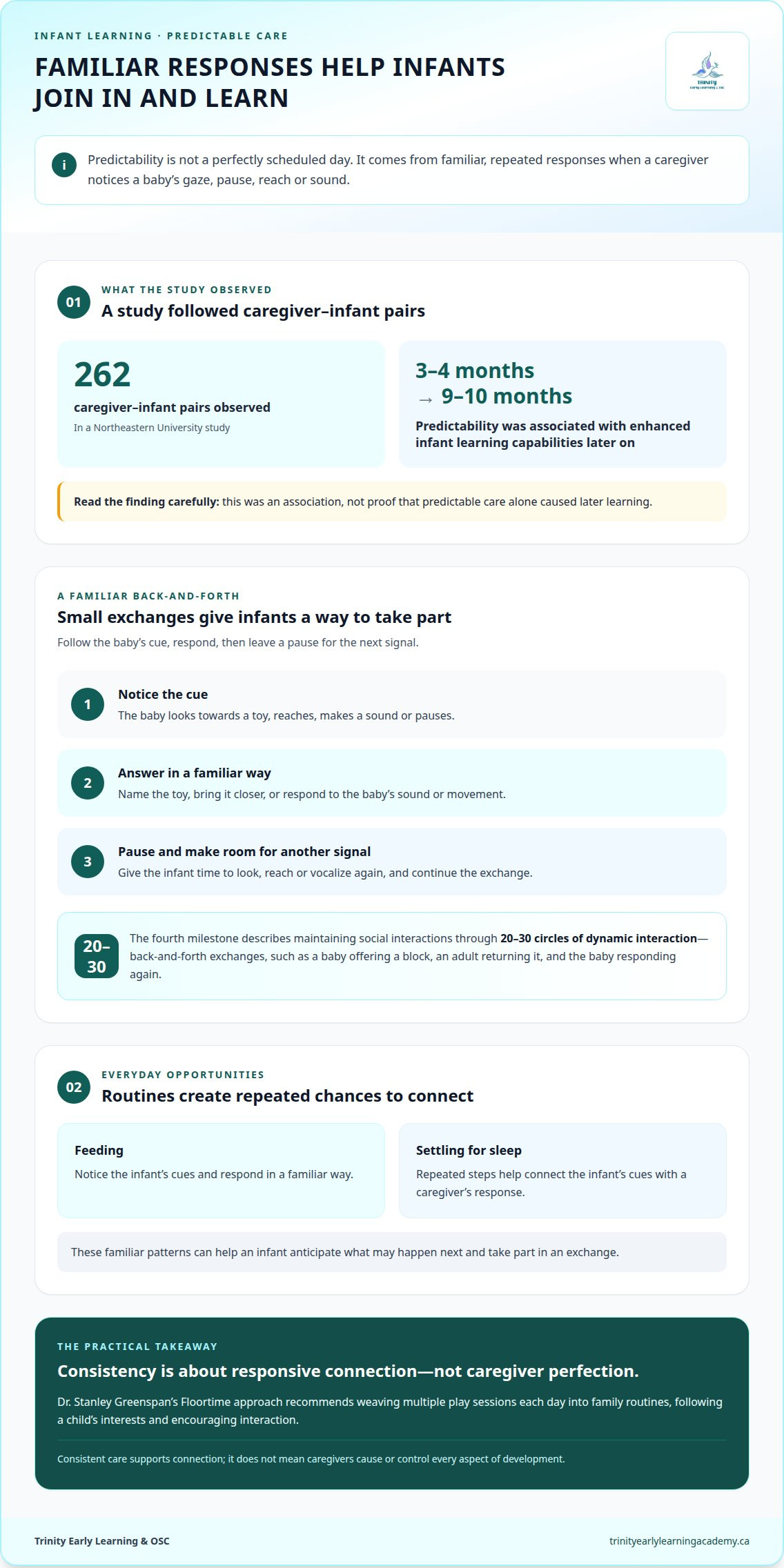
For an infant, predictability comes from familiar, repeated responses, not a perfectly scheduled day. A caregiver who notices a baby’s gaze, pause or reach can respond consistently. For example, when an infant looks towards a toy, the adult can name it, bring it closer and wait. This familiar pattern helps the infant anticipate what may happen next and take part in an exchange. Daily routines, such as feeding or settling for sleep, also give infants repeated opportunities to connect their cues with a caregiver’s response.
A Northeastern University study observed 262 caregiver-infant pairs. It found that caregiver predictability at 3-4 months was associated with enhanced infant learning capabilities at 9-10 months. The finding describes an association, not proof that predictable care alone caused later learning. Still, it highlights how early interactions can provide a stable context for infants to attend, explore and learn. A caregiver’s familiar response gives an infant a clearer opportunity to notice what changes when they vocalize, look or move.
By 9-10 months, infants should begin initiating interactions with caregivers. A baby might reach towards an adult, make a sound, or look back during play. The caregiver can follow the baby’s lead, respond, then leave a pause for another signal. The fourth milestone describes maintaining social interactions through 20-30 circles of dynamic interaction. In practice, these circles are back-and-forth exchanges, such as a baby offering a block, an adult returning it, and the baby responding again.
Dr. Stanley Greenspan pioneered early childhood development research in the 1970s while serving as Director of the Mental Health Study Center at the National Institute of Mental Health. In the late 1970s, he became the founding president of Zero to Three. His Floortime approach recommends weaving multiple sessions each day into family routines, using play to follow a child’s interests and encourage interaction. Greenspan also believed developmental challenges such as autism spectrum disorder are not caused by caregivers, but by multiple biological and environmental factors. Consistent care supports connection; it does not mean caregivers cause or control every aspect of development.
Responsive caregiver-child interactions
Responsive care means noticing a child’s signal and answering in a way they can understand. The impact of caregiver consistency on children is clear when familiar adults make interactions easier to follow and join.
Guidance on Caregiver Continuity
Caregiver continuity means children can build relationships with familiar adults who understand their routines and communication. In Canadian childcare and child-welfare settings, continuity is a practical consideration when planning care or a transition. For example, an adult who recognizes how a child usually asks for help can respond more clearly. Sharing observations between caregivers keeps the child’s preferences and needs in view when care arrangements change.
Consistency Across Developmental Stages
Responsive interactions can reflect how each child communicates, rather than relying on age alone. A child may respond with a gesture, a few words, a longer explanation or a pause. Caregivers can acknowledge what they notice, use clear language and allow time for the child to contribute. This respects different communication styles and helps adults avoid mistaking quietness or hesitation for a lack of interest.
Building Consistent Routines and Responses
Parents and childcare providers can build consistency by sharing practical details about a child’s cues, routines and preferred ways of communicating. They might agree on familiar words for asking for help or describe how the child indicates a need for space. This gives adults useful context across settings, while still leaving room to respond to what the child is expressing in the moment. Families in St. Albert can consider how quality childcare fits their child’s needs.
Support When Consistent Care Is Not Possible
When the same adult cannot always provide care, clear handovers help a new caregiver understand what matters to the child. A parent can share the child’s preferred name, communication cues and ways of showing discomfort, rather than expecting the child to explain everything. Adults can introduce themselves calmly, explain their role and give the child time to engage. Thoughtful communication between the adults around a child helps support consistency.
What does research say about the effects of changing caregivers or frequent childcare transitions on children?
Caregiver changes affect children differently, so consider what is changing and how adults support the transition. A new caregiver may bring a different voice, routine or way of responding. Even a familiar activity, such as getting ready for rest, can feel different to a child when the adult changes the sequence. The practical question is whether the child continues to receive clear, attentive responses during the adjustment.
Frequent transitions can involve moving between adults, rooms or care arrangements. Each change asks a child to learn new expectations, such as where to put a backpack or which adult helps at arrival. These adjustments can take attention away from play and conversation. Adults can make transitions easier to understand by keeping familiar steps in place, explaining what comes next and allowing time to settle into the new setting.
For children in foster care or after a placement change, continuity can be especially meaningful. A new home or caregiver may change daily routines and relationships all at once. A familiar comfort item, regular meal routine or trusted adult who explains the day can provide recognizable points of connection. Caregivers can share what helps the child feel settled, without assuming how quickly the child should respond.
To understand how a child is managing, notice specific behaviours during everyday moments. For example, observe whether arrival, meals or bedtime become more difficult after a change, and what response helps. Share these observations with the adults involved in care. A pattern can point to practical adjustments, such as using the same goodbye phrase or giving the child a clear handover before a new activity.
The key point is not that every caregiver change causes harm. Transitions call for attentive communication and familiar supports. A parent might tell a new caregiver that a child likes to hold a book during quiet time. The caregiver can continue that routine, watch the child’s cues and respond calmly. These practical steps help maintain connection as the child gets used to changed arrangements.
How do age and developmental stage affect children's need for caregiver consistency?
Consistency matters at every stage, but the support a child needs changes as communication and independence grow. An infant may rely on a caregiver noticing a cry, gaze or reach and responding calmly. A toddler may need the same adult to explain what happens next during a transition. These examples show that consistency is more than repeating a schedule: adults also adapt their responses to each child’s way of communicating.
For infants, familiar responses make it easier to connect a signal with what follows. If a baby turns away during play, a caregiver can pause rather than add more stimulation. As children begin using gestures or words, adults can respond to those attempts and leave room for the child to continue. This pattern respects the child’s changing communication while keeping the adult’s attention dependable.
Toddlers and preschool-age children often take a more active part in routines. A child getting ready to leave might resist putting on a coat because play is ending. A familiar caregiver can acknowledge the child’s frustration, explain the transition and offer a manageable choice, such as carrying a toy to the door. The response stays calm while reflecting the child’s growing ability to understand and participate.
School-age children can express preferences and understand more explanation, but they still benefit when adults follow through. If a caregiver changes the usual pick-up plan, telling the child what will happen and who will meet them can make the transition clearer. At every age, notice how a child communicates, handles change and seeks comfort. Share those observations between caregivers, then adjust routines without removing the familiar cues that help the child feel oriented.
Trinity Early Learning & OSC: Licensed Daycare Services
Trinity Early Learning & OSC is a licensed daycare in St. Albert, offering Childcare, Preschool programming, Kindergarten care and Out-of-school care. The centre’s warm, family-centred environment, low child-to-educator ratios and inclusive program support children’s everyday learning and relationships. Approved affordability grant funding helps lower childcare costs for families.
When exploring childcare, consider your child’s age, daily routine and response to transitions. Sharing these details can help you discuss the care that suits your family. Contact Trinity Early Learning & OSC to discuss its childcare programs or book a tour.
Make your child’s next care decision with confidence
Understanding the impact of caregiver consistency on children can help you focus on what matters in your family’s next care decision: how adults will respond to your child’s needs and support their learning. Consider which routines help your child feel settled, how they communicate and what makes transitions easier. Sharing these observations gives caregivers a practical starting point for building familiarity and connection.
As your child grows, their needs and ways of expressing themselves will change. Keep the conversation open with the adults who care for them, and revisit what is working as new routines emerge. Thoughtful choices that reflect your child’s individual needs can help create a supportive foundation for learning.
For information about childcare options in St. Albert, contact Trinity Early Learning & OSC. A caring next step can begin with a simple conversation about your family’s needs.
Frequently Asked Questions
Why do caregiver consistency and responsiveness matter so much in child development?
Consistent, responsive care gives children dependable relationships in which to practise communication, exploration and cooperation. A caregiver who listens to a child’s words, notices gestures and responds steadily helps make social exchanges easier to understand. For example, during block play, an adult can acknowledge a child’s request for help, then let them try again. This supports learning through participation, not just instruction.
How does caregiver consistency affect children's attachment and emotional security?
Children build trust when familiar adults respond reliably to their needs. For example, an adult who recognizes a child’s distress at drop-off can offer comfort and a familiar goodbye routine. Over time, dependable responses help the child understand that support is available. Attachment develops through ongoing relationships, not one difficult day or a single change in routine.
What is the impact of consistent caregiving on children's brain development and stress regulation?
Responsive caregiving gives children repeated opportunities to practise calming with an adult’s support. If a child becomes frustrated while drawing, a caregiver can stay close, acknowledge the feeling and help them choose whether to try again or pause. These exchanges show children how an adult responds during stress. Consistency supports predictable interactions, while a child’s development reflects many influences beyond caregiving alone.
How does caregiver consistency influence children's behaviour, social skills, and relationships?
Familiar responses help children learn to manage social moments and understand what to expect from others. During a disagreement over a toy, for instance, a caregiver can help each child describe what they want and guide them towards taking turns. Repeated, respectful support gives children examples of listening and problem-solving. Adults can also notice whether a child needs more help joining play or expressing frustration. For families seeking targeted guidance on emotional and social milestones, dedicated services like Firststep Psychology & Child Development Centre provide comprehensive support for children's growth and mental health.
Does caregiver consistency affect children's learning, language, or school readiness?
Yes, familiar interactions give children steady opportunities to listen, communicate and practise new skills. A caregiver might talk through setting the table, name objects and invite a child to follow a simple request. During play, pausing for a child’s reply encourages conversation rather than one-sided instruction. These everyday exchanges support language and participation, useful foundations for joining group activities and learning routines. Outside the classroom, structured one-on-one activities such as piano lessons Menlo Park similarly demonstrate how dependable encouragement and clear routines help young learners master complex new skills.
What Canadian childcare or child-welfare guidance addresses caregiver continuity and consistency?
In Canadian childcare and child-welfare settings, caregiver continuity is a practical consideration when planning care or a transition. Sharing observations about a child’s routines, communication and needs can help maintain continuity when arrangements change.


