

An authorized pick-up list for daycare names the people approved to collect a child on their enrollment form. Parents or guardians should provide each person’s name, relationship to the child and contact information, then keep the list current. Custody documents and protective orders can affect who may collect a child, so give staff clear instructions about them.
It’s reassuring to know who can step in when plans change, and unsettling to imagine a child being released to the wrong person. This article explains who to include on the list, how emergency contacts differ from authorized pickup people, and what staff should do if an unauthorized person arrives. It also covers sharing custody arrangements and special instructions so families and daycare staff have a clear, consistent plan.
Key Takeaways
- Give the daycare clear custody documents and pickup instructions so staff can follow the applicable arrangements.
- Update pickup permissions when family circumstances change, and make sure staff know how to respond if an unauthorized person arrives.
- Choose emergency contacts who are also approved to collect your child, and provide their relationship and contact details.
- Keep the list current and clear about who may take responsibility for your child at pickup.
Custody agreements and special pickup instructions
A custody agreement is a written arrangement describing how parents share care and pickup responsibilities. Give the daycare a copy when its terms affect who may collect your child. Staff can keep it with enrollment records and refer to its specific instructions during pickup. For example, note which days each parent is scheduled to collect the child. Clear written details help staff follow the arrangement instead of relying on conflicting verbal messages.
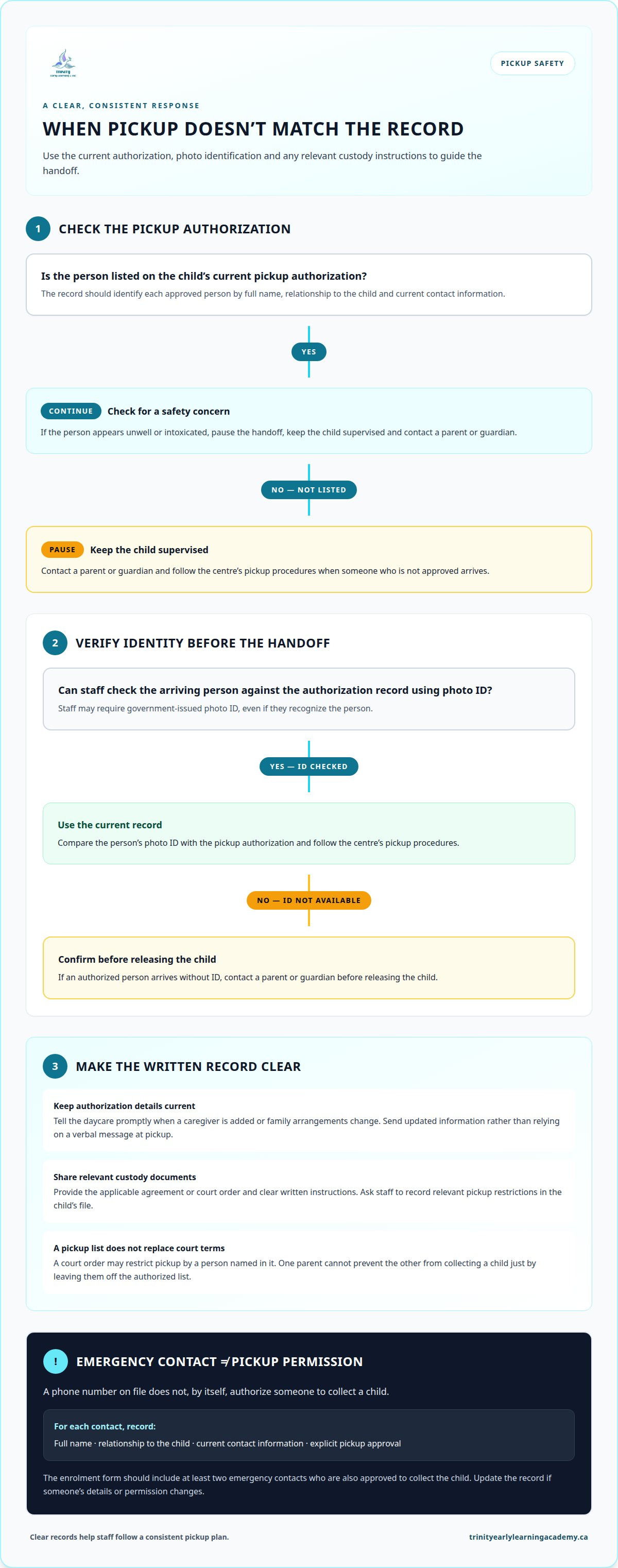
A custody order is a court document setting out legally binding parenting or contact terms. When a custody order or parental dispute affects pickup, staff need to review the document, record relevant restrictions and follow its directions. A biological parent or legal custodian may generally collect a child unless a court has removed that person’s rights. One parent cannot prevent the other from collecting a child just by leaving them off the authorized list. A court order may restrict pickup by a person named in it.
Special pickup instructions explain in writing how staff should apply custody terms at daycare. Provide the relevant order or agreement, then identify the person affected and the instruction staff should follow. If an order says a parent cannot collect the child, make that restriction clear and provide the supporting document. Ask staff to record the instruction in the child’s file so it is available to the person handling pickup.
A visitation schedule identifies when a child is in each parent’s care. Share the current schedule and any changes that affect daycare pickup, rather than asking staff to resolve a disagreement. For example, if the written schedule assigns Friday pickup to one parent, staff can follow that instruction unless a court document changes it. Update the file promptly when circumstances change. A pickup list does not replace custody terms or authorize staff to interpret an unclear order. Written instructions and relevant court documents give staff a practical reference when parents provide conflicting directions.
Responding to unauthorized pickup attempts
An unauthorized pickup attempt occurs when someone who is not approved arrives to collect a child. Staff should keep the child supervised, contact a parent or guardian, and follow the centre’s pickup procedures.
Names and Details of Authorized Pick-Up People
An authorized pickup person is someone listed on the child’s enrollment form and approved to collect them. Record each person’s full name, relationship to the child and contact information. For example, a parent might list a grandparent and an adult sibling. Use names that staff can compare with photo identification and the current authorization record. Clear details help staff distinguish an approved person from someone unfamiliar.
Updating Pickup Authorizations
A pickup authorization update changes who is permitted to collect a child. Parents or guardians should notify the daycare promptly when circumstances change, such as when a new caregiver is added or family arrangements change. The daycare can then update the record so staff have clear instructions. In Canada, parents or guardians can ask to add trusted adults, such as relatives or family friends, subject to relevant custody documents and court restrictions.
Review the list when family circumstances change, and send staff the updated information rather than relying on a verbal message at pickup.
Photo ID at Pickup
Photo ID lets staff compare the person arriving with the pickup authorization. Daycare staff may require government-issued photo ID, even when they recognize someone. If an authorized person arrives without ID, staff can contact the parent or guardian before releasing the child. This helps confirm identity when a different staff member is handling pickup.
If someone appears unwell or intoxicated, staff should pause the handoff, keep the child supervised and contact a parent or guardian. A late pickup fee is a charge set by the daycare’s written late-pickup policy. The policy should explain when a fee applies and how families are notified; staff should follow its terms consistently.
For families arranging care, the daycare enrolment process is a natural time to discuss pickup routines.
Emergency contacts authorized for pickup
An emergency contact is someone the daycare can reach if a parent cannot be contacted. To collect a child, that person must also be explicitly authorized for pickup. The enrollment form should include at least two emergency contacts approved to collect the child. This distinction matters: having someone’s phone number on file does not mean they have permission to take the child.
For each contact, provide their full name, relationship to the child and current contact information. For example, list a grandparent as both an emergency contact and an authorized pickup person, with a working phone number. Include another trusted adult as a backup in case the first person is unavailable. Clear entries help staff know whom they can call and who may collect the child.
Choose contacts who can respond to situations you expect, such as a parent being delayed or unreachable. Before adding someone, explain that the daycare may call them and that they may be asked to collect your child. Share practical details, including the daycare’s location and your child’s name. A prepared contact can help staff manage an unexpected change smoothly.
Keep the information accurate. If a contact changes phone numbers, moves away or is no longer authorized, send the daycare an updated record. Identify any replacement by name, relationship and current phone number, and clearly approve them for pickup. For example, if a neighbour replaces an unavailable relative, update both the emergency contact details and pickup permission. Staff can then rely on current information rather than an outdated entry.
Parents can clarify how staff should proceed if no listed contact answers. Provide current custody instructions that affect pickup, and make sure emergency contacts understand those restrictions. A contact’s willingness to help does not override court-ordered limits. Keeping contact details, pickup permission and relevant instructions together gives staff a practical reference when an emergency disrupts the usual collection plan.
Authorized pick-up list definition
An authorized pickup list is the enrollment record naming adults approved to collect a child. It distinguishes permission to pick up a child from being listed only as an emergency contact. Staff use the record to determine whether someone may take responsibility at dismissal. An authorized pick-up list for daycare should be clear, current and available to staff during pickup.
The record is a practical instruction, not just a collection of names. Each entry should identify the approved person and their relationship to the child. For example, “Jordan Lee, aunt” is more useful than “Auntie” when staff need to match a name to identification. Contact details help staff reach the right person if plans change. Signatures and dates help show when parents or guardians provided the information.
Daycare pickup rules can differ by province or territory because childcare requirements and centre procedures vary. Follow the centre’s written process for submitting permissions, updating names and sharing custody instructions. The goal is a record staff can apply consistently, rather than relying on a child’s verbal request or an adult’s claim of permission.
Photo identification helps staff compare the arriving adult with the authorized record. Pickup procedures may also include recording who collected the child and when. This creates a practical record if a family later needs to clarify who took responsibility. A clearly named list also helps when different staff members handle dismissal.
For families, the clearest takeaway is that permission must be recorded, not assumed. Tell the daycare who may collect your child, and provide changes through its required process. Keep custody documents aligned with those instructions, so staff have one usable reference. If you’re arranging care in St. Albert, discuss daycare enrolment and pickup procedures before care begins.
Trinity Early Learning & OSC: Licensed Daycare Services
Trinity Early Learning & OSC is a licensed daycare in St. Albert, providing childcare for local families. When arranging care, share pickup permissions and any relevant custody instructions during enrollment so staff understand who is authorized to collect your child.
Families in St. Albert can also explore preschool programming, kindergarten care and out-of-school care. Approved affordability grant funding helps lower childcare costs. The right program depends on your child’s age and care needs.
Contact Trinity Early Learning & OSC to discuss childcare and enrollment.
Make pickup plans part of your care routine
As your family’s schedule changes, treat pickup permissions as part of the childcare routine, not a form to complete once and forget. A new work shift, a different caregiver or a change in parenting arrangements can affect who collects your child. Keeping your authorized pick-up list for daycare aligned with daily plans gives staff a practical reference and helps prevent confusion at handoff.
Review the information whenever family circumstances change, then share relevant updates and documents through the daycare’s established process. Clear communication supports a smoother transition between home and care, especially when more than one adult helps with pickup.
If you’re planning childcare in St. Albert, Trinity Early Learning & OSC can be part of your next step. Contact Trinity Early Learning & OSC to discuss your family’s care needs and enrollment. A thoughtful plan can help make each pickup feel more familiar for your child.
Frequently Asked Questions
What is an authorized pick-up list for daycare?
It’s the daycare’s record of people permitted to collect a child. The list distinguishes pickup permission from other roles, such as being an emergency contact. For instance, a relative may be someone staff can call but not someone approved to take the child home. Make sure the written record clearly grants pickup permission to each intended person.
What information does a daycare need to add an authorized pick-up person?
Provide the person’s full name, relationship to the child and current contact information. Use the name they can show on photo identification, rather than a nickname, so staff can identify them at pickup. For example, enter “Morgan Chen” instead of “Momo.” Include any custody restriction that affects their permission so the record aligns with the family’s instructions.
How do parents update or remove someone from a daycare pick-up list?
Send the daycare a clear written update through its established authorization process. Identify the person being added or removed, the child, and when the change takes effect. Ask each parent or guardian to sign and date the updated form if the process requires it. A dated record helps staff distinguish current instructions from an older form or informal message.
What happens if someone not on the daycare pick-up list arrives?
Staff should not release a child to someone without pickup authorization. They can keep the child supervised and contact a parent or guardian to explain the situation. For example, a neighbour’s arrival does not establish permission, even if they know the family. The child remains in the daycare’s care until an approved adult takes responsibility.
Can a parent authorize a one-time pick-up by text, email, or phone?
Whether a text, email or phone call is accepted depends on the daycare’s authorization procedures. Use the centre’s stated process for one-time arrangements, and provide the adult’s full name and expected pickup date. Give staff time to confirm the instruction before collection. A clear process helps reduce confusion during dismissal.
What should parents do if an authorized person cannot pick up a child in an emergency?
Contact the daycare promptly and name an alternate adult who already has pickup permission. If no listed person is available, explain the situation and follow the centre’s instructions while staff continue supervising the child. For example, if a parent is delayed by a travel disruption, they can call an authorized relative and notify the daycare of the revised plan.


