

What happens when a childcare update reaches one parent but not the other? A note about a missed nap, a pickup change, or a new comfort routine can leave co-parents and educators working from different information. Clear co-parenting communication with childcare providers helps keep the focus on the child and makes everyday handoffs easier to manage.
It’s understandable to want your child’s care to feel steady across two homes, even when household routines differ or parents don’t agree on every detail. A practical communication plan can help both parents share relevant updates, clarify who will pass along information, and keep conversations respectful and child-focused.
This guide explains what information is useful to share, how co-parents and providers can support predictable routines, and how to handle differences without placing the child in the middle. For families in St. Albert, consistent communication can also support a positive early learning experience in licensed daycare, preschool, or out of school care.
Key Takeaways
- Agree on the essential care updates both parents need, so important information is less likely to be missed.
- Choose one practical method for routine updates while following the childcare provider’s established communication process.
- Compare messages, shared calendars, handoff notes, and scheduled conversations for clarity, timing, privacy, and ease of use.
- Keep handoff messages neutral and specific. Discuss disagreements between co-parents away from the childcare setting when possible.
- Make co-parenting communication with childcare providers more predictable by setting clear boundaries and reviewing the plan as your child’s needs change.
Co-Parenting Communication with Childcare Providers: Start with Shared Goals
Good co-parenting communication with childcare providers means sharing relevant information that helps staff support a child’s safety, comfort, care, and learning. It doesn’t require parents to run identical households. One home may have an earlier bedtime, while the other follows a different morning routine. What matters is giving the provider clear, consistent details that could affect the child’s day.
Co-parenting centres on working together to support a child’s wellbeing. In a childcare setting, that shared goal can guide decisions even when parents have different expectations or preferred ways to communicate. Consider the child’s daily experience: do they know who is picking them up, can staff respond to their care needs, and are important changes explained calmly?
What information should both parents share with the provider?
Share practical updates that could affect care, such as a schedule change, a change to an authorized pickup arrangement, or a care-related instruction. For example, if a St. Albert preschool child will be collected by a different approved person, clear and consistent information helps avoid confusion at the end of the day. Follow the provider’s established process for submitting updates.
Keep each message focused on what staff need to know. A change that affects the child’s attendance or comfort may be useful context; private details about a disagreement usually aren’t. Parents can agree on a simple format: state the update, say when it applies, and make sure the provider receives the same accurate information. This reduces the risk of conflicting instructions without requiring parents to share personal matters.
What is the childcare provider’s role in co-parenting?
A childcare provider’s focus is the child’s care, wellbeing, and learning while they’re in the program. Providers can share relevant observations, such as how a child settled into an activity or responded to a change in routine, without taking sides or carrying messages about a parental disagreement.
In shared-care communication, the provider supports the child’s day by sharing relevant care information, not by mediating between co-parents.
This boundary helps keep conversations practical and respectful. If parents have different routines, they can explain only the differences that affect care. A child in daycare, preschool, or out of school care in St. Albert may benefit from familiar cues or clear transitions, but each family’s needs are distinct. The aim isn’t to make every home the same. It’s to give the provider useful context so the child can feel supported in the setting.
Build a Reliable Co-Parent Communication Routine for Childcare
A dependable routine helps parents share care information without making the childcare provider responsible for coordinating between households. Keep the process straightforward: agree on the essentials, use a consistent channel for routine updates, share changes promptly, and review whether the approach is working. Use the provider’s established process for messages about the child’s care.
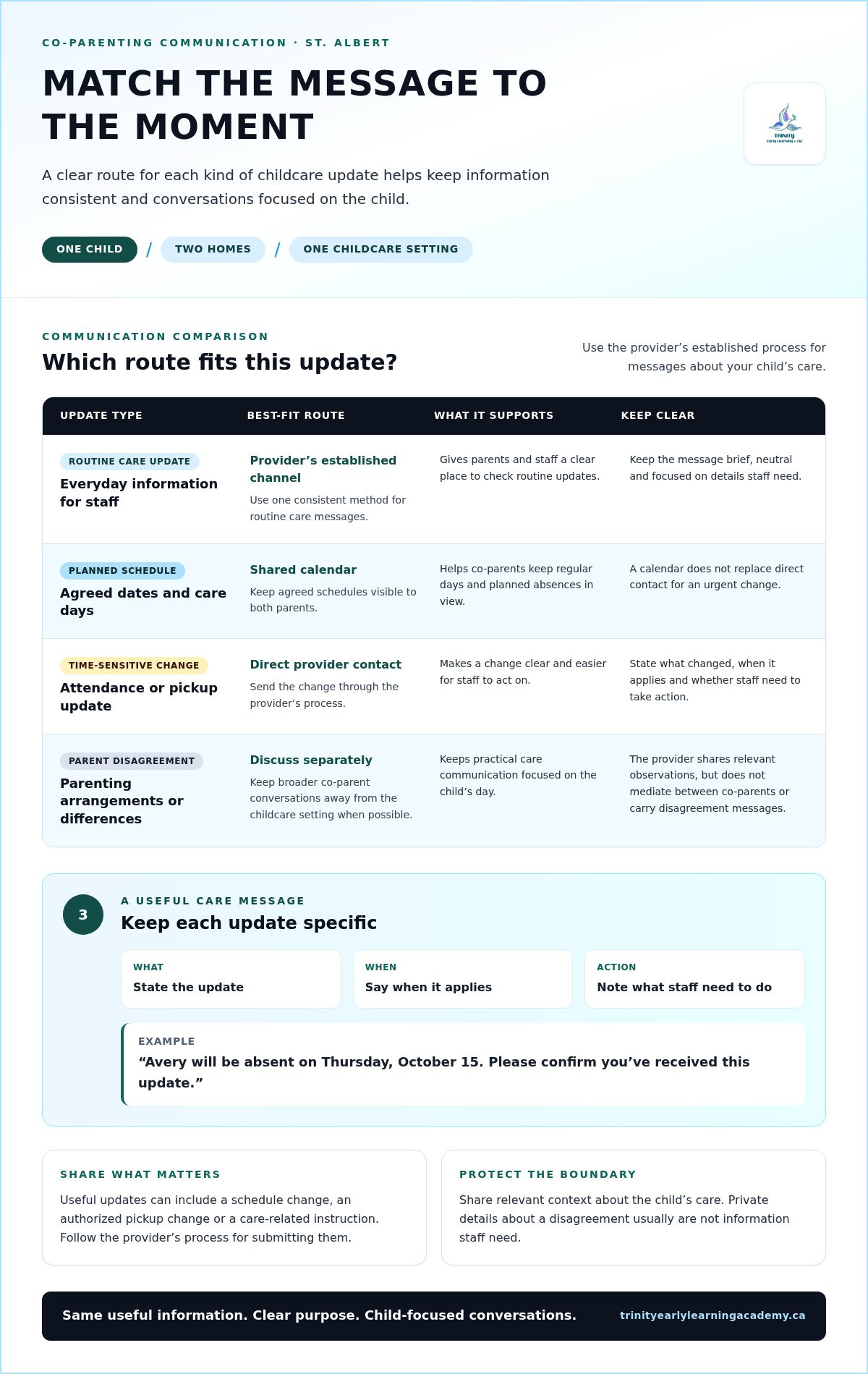
Routine messages and broader co-parent discussions serve different purposes. A time-sensitive update about attendance or pickup should be clear and easy to act on. Questions about parenting arrangements or disagreements are better handled separately, away from the childcare setting.
Agree on essential details before they become urgent
Align on the details that affect the child’s attendance and transitions, including regular days, planned absences, and pickup information. Write care instructions in plain language, adding specific dates when a change applies only on certain days. Decide how both parents will receive relevant provider updates, while avoiding duplicate messages that could make it unclear which information is current.
Choose communication channels that reduce confusion
Use the provider’s established method for messages about care. A shared calendar can help co-parents keep agreed schedules visible, but it shouldn’t replace direct contact for an urgent change. A consistent channel gives parents and staff a clear place to check for routine updates, reducing scattered messages, missed details, and uncertainty about whether a change was received.
Keep each message brief and neutral. State what has changed, when it applies, and whether the provider needs to take action. For example: “Avery will be absent on Thursday, October 15. Please confirm you’ve received this update.” Avoid combining a practical care note with a wider disagreement. If the issue isn’t time-sensitive, use the agreed routine rather than sending the message through several channels.
Review the arrangement periodically and after a meaningful schedule change. Consider whether both parents are receiving the information they need, whether messages reach the provider in time, and whether the process is simple to follow. Adjust the routine together if updates are being missed, while continuing to follow the provider’s communication process.
For families considering licensed daycare, preschool, or out of school care in St. Albert, Trinity’s St. Albert childcare programs are one option to explore as you plan your child’s care.
Compare Communication Methods for Two Homes and One Childcare Setting
Different tools suit different kinds of updates. A direct message can clarify a care change, while a calendar can keep planned dates visible to both parents. Co-parenting communication with childcare providers works best when each method has a clear purpose and doesn’t create extra work or conflicting records for staff. Choose options that fit your family’s needs and the provider’s established process.
When do shared calendars or written notes help?
A shared calendar can track agreed attendance, appointments, and known schedule changes. Decide who adds or edits entries and how corrections will be made, so parents aren’t relying on outdated information. Brief written notes can pass along relevant routine details between homes, such as a change in what helps a child settle. Keep notes focused on the child, and leave out private family information that doesn’t support their care.
When is a direct conversation the better choice?
A conversation can help address a recurring concern, clarify expectations, or discuss a sensitive care topic that may be misunderstood in a short message. Keep urgent safety or pickup changes within the provider’s designated contact process rather than relying on a calendar or a note that may not be seen in time. The comparison below can help co-parents choose a suitable method for each purpose.
| Method | Suitable use | Clarity, timing, privacy, and ease |
|---|---|---|
| Direct provider message | Care updates or a change that needs the provider’s attention | Can be timely and specific when sent through the established process. Keep it concise and limited to relevant care details. |
| Shared calendar | Planned attendance, appointments, and known schedule changes | Easy for both parents to check, but entries need clear ownership and timely corrections. It isn’t a substitute for urgent contact. |
| Written handoff note | A brief routine detail travelling between homes | Useful when the information is specific and easy to find. Keep sensitive details out and avoid relying on a note for time-critical updates. |
| Scheduled conversation | Recurring concerns, unclear expectations, or sensitive topics | Allows for questions and context, but takes coordination. Keep the discussion focused on the child and the care issue. |
Families can combine methods without using every option for every update. For example, record an agreed schedule in a calendar, use the provider’s process for care messages, and reserve conversations for topics that need discussion. A simple division of roles helps information stay clear while keeping communication manageable for everyone involved.
Handle Handoffs, Disagreements, and Sensitive Updates Calmly
Handoffs can feel more predictable for a child when adults keep information clear and calm. A short, factual update helps the provider understand what the child needs without bringing a co-parent disagreement into the childcare setting. This supports respectful co-parenting communication with childcare providers and keeps attention on the child’s day.
Describe the practical issue and its effect rather than assigning blame. For example, “Sam had a later bedtime last night and may be tired this morning” gives useful context without criticizing the other parent. A predictable goodbye, clear pickup plan, and familiar comfort item, if appropriate for the program, can also help a child move between home and care with less uncertainty.
What should parents do when they disagree about a care routine?
Start by identifying what needs to be decided and how it affects the child’s care today. If the difference can be discussed outside the childcare setting, do so privately rather than asking the provider to choose sides. Once you’ve reached an agreement, share one clear instruction through the provider’s established process.
Neutral wording can keep the conversation focused:
- Schedule change: “Jordan will be absent on Tuesday, October 20. Please note the change for that day.”
- Routine difference: “Jordan may ask for a quiet activity after drop-off. This has helped with the transition recently.”
- Clarification: “Could you clarify the usual arrival routine so we can prepare Jordan consistently?”
If you haven’t agreed on a change, avoid giving staff competing instructions. Discuss the immediate care question with your co-parent, then provide the provider with one practical update once you’ve reached a decision.
How can parents share sensitive information respectfully?
Share only details that affect the child’s care or immediate wellbeing. A private family matter doesn’t need to be included just because it relates to a household change. If information is sensitive, use an appropriate private channel rather than discussing it in a public handoff where others may overhear.
Don’t assume that every communication method offers the same privacy or that information will be handled in a particular way. Follow the provider’s established process and review applicable policies or requirements before sharing sensitive details. If the update affects an immediate safety or pickup matter, use the provider’s designated contact process so the information can be addressed appropriately.
Clear, calm communication supports a secure care experience. St. Albert families can explore Trinity’s childcare programs when considering a setting for their child’s daily learning and care.
Create a Child-Focused Partnership with Your St. Albert Childcare Provider
A workable communication plan doesn’t need to be complicated. Agree on the care details both parents should share, choose a consistent channel that fits the provider’s established process, keep personal disagreements separate from care updates, and review the approach as your child’s needs change. This gives everyone a clearer way to support the child’s daily routine without expecting the provider to manage communication between households.
Consistent, respectful co-parenting communication with childcare providers can help a child experience steadier transitions and a supportive early learning environment. Families comparing care options in the community can also read this licensed daycare guide for St. Albert families for another perspective on choosing childcare.
Review the communication plan as your child’s needs change
Family arrangements and care needs can shift, so revisit schedules, pickup details, and relevant contact information when changes occur. Check that both parents understand the current plan and that the provider has clear, consistent information. If pickup arrangements change, pass along the update through the provider’s established process. Clear pickup arrangements help support a smoother handoff.
Keep the next conversation constructive and specific
Before contacting the provider, prepare one clear question or update. Explain the child-related concern, describe the outcome you hope for, and allow the provider time to respond through the appropriate process. For example, you might ask, “What routine helps Maya settle after arrival? We’d like to support a comfortable transition.” A focused question is easier to answer than a message that combines several concerns or a disagreement between parents.
To keep the plan useful, revisit these points together:
- Shared essentials: Which schedule, pickup, and care details need to be consistent?
- One clear channel: What method will parents use for routine care updates?
- Respectful boundaries: Which discussions belong between co-parents rather than in the childcare setting?
- Periodic review: Does the plan still work for the child, both parents, and the provider?
Families in St. Albert can learn about Trinity Early Learning & OSC and its licensed daycare, preschool, and out of school care programs as they consider a setting for their child’s care and learning.
Keep Communication Clear and Child-Focused
Strong co-parenting communication with childcare providers starts with a shared focus on the child. Agree on the essential care information, use a consistent way to pass along updates, and keep messages neutral and practical. A clear plan for schedules, pickups, and handoffs can reduce uncertainty for children moving between home and childcare.
Choose communication methods that suit the information and respect the provider’s established process. Keep disagreements between co-parents, share sensitive details thoughtfully, and revisit the plan as your child’s needs or family arrangements change. Small, steady steps can help create a more predictable and supportive early learning experience.
St. Albert families can explore Trinity Early Learning & OSC’s licensed daycare, preschool, and out of school care programs. Affordability grant programs also support accessible childcare for local families. Explore Trinity Early Learning & OSC in St. Albert and take a positive next step in planning care that supports your child’s learning and wellbeing.
Frequently Asked Questions
How should co-parents communicate with a childcare provider?
Use a clear, respectful process for sharing information that affects the child’s care. Agree on the essential updates, follow the provider’s established communication method, and keep messages brief and specific. For example, state the date of an absence or pickup change and what action is needed. Keep broader parenting discussions separate from care updates so staff can focus on the child’s day.
Should a childcare provider communicate with both parents?
Parents can agree on how each will receive relevant updates and share that arrangement with the provider, while following the provider’s established process and any applicable parenting arrangements. Clear contact information can help reduce missed messages. Use the provider’s stated communication process and share only information needed to support the child’s care.
What information should co-parents share with daycare?
Share details that may affect attendance, pickup, safety, comfort, or the child’s routine. Examples include a planned absence, a change to an authorized pickup arrangement, or a relevant care instruction. Use plain language and include dates when needed. Private details that don’t affect the child’s day generally aren’t necessary. Consistent, focused co-parenting communication with childcare providers helps staff work from clear information.
How can parents avoid putting a childcare provider in the middle?
Keep disagreements between co-parents outside the childcare setting whenever possible. Don’t ask staff to take sides, carry messages about a dispute, or decide between conflicting parenting preferences. First identify the practical care issue and discuss it privately. Once you’ve agreed on an instruction, share one clear update with the provider. This keeps communication respectful and centred on the child.
Can separated parents use a shared calendar for childcare schedules?
Yes. A shared calendar can help parents track agreed attendance, appointments, and planned schedule changes. Decide who will update it and how corrections will be made, so both homes rely on current information. A calendar is best for planning, not urgent pickup or safety updates. Send time-sensitive messages through the provider’s designated contact process, including for childcare arrangements in St. Albert.
What happens if co-parents give a childcare provider conflicting instructions?
Conflicting instructions can leave staff unsure which information to follow. Contact your co-parent privately to clarify the immediate care issue, then provide one agreed update through the provider’s established process. If the matter affects an urgent safety or pickup arrangement, use the provider’s designated contact process and explain the situation factually. Don’t ask staff to resolve a disagreement between parents.
How can co-parents keep routines consistent between two homes?
Consistency doesn’t mean both homes must follow identical routines. Agree on practical details that affect childcare, such as attendance, pickup plans, and information that helps your child settle. Share relevant changes with the provider and use familiar, reassuring cues where they work for your child. Review the plan as needs change. A predictable handoff can support a smoother transition into care.


