

Home and daycare do not have to follow exactly the same rules for a child to feel supported. If you’re wondering how to manage different parenting styles with your daycare, start with the goals you share: helping your child feel safe, cared for, and ready to take part in the day.
It’s understandable to worry that different expectations could confuse your child, or that raising a concern might sound like criticism. A respectful conversation can help you explain what matters to your family and understand how educators support your child during the day. The aim is not to make every approach match. It is to give your child clear, caring guidance in both settings.
This article offers practical ways to share family preferences, decide which routines and values are useful to discuss, and agree on steps your child can recognize. It also explains when to revisit an approach as your child’s needs change. For families in St. Albert, open communication can help build a positive partnership around a child’s early learning and care, including at Trinity Early Learning & OSC, which provides daycare and preschool programs.
Key Takeaways
- Different home and daycare routines do not automatically undermine a child’s sense of security. Shared goals and calm, predictable responses can support transitions.
- Notice how your child responds to routines and boundaries without treating ordinary adjustment as a problem.
- To learn how to manage different parenting styles with your daycare, prepare a specific example, explain your preference, listen to the educator’s perspective, and agree on a practical next step.
- Focus conversations on what helps your child, such as comfort, independence, or transitions, rather than broad labels for parenting approaches.
- Keep communication open and revisit the plan as your child’s needs change. St. Albert families can explore local early learning and care at Trinity Early Learning & OSC.
Why parenting styles can feel different at home and daycare
Families and educators can share the same hopes for a child while taking different approaches to everyday care. One adult may offer extra help getting dressed; another may encourage the child to try first. A family might follow a familiar sequence before rest, while daycare follows the flow of the group. These differences do not automatically mean a child is confused or unsupported. They often reflect the needs and routines of each setting.
Parenting styles are broad descriptions of how adults balance warmth, boundaries, guidance, and independence. They can be a useful starting point, but they do not fully describe a family or educator. A neutral overview of parenting styles can provide context. For a useful conversation, focus on the specific choices your child experiences. That is a practical first step in learning how to manage different parenting styles with your daycare.
What counts as a difference in parenting approach?
Differences can show up at mealtimes, during transitions, at rest time, or when a child wants to do something independently. At home, you might give your child time to try a task before helping. In care, an educator may offer help sooner as the group moves to its next activity. Neither approach is automatically right for every situation. A family preference, such as a familiar comfort routine, is also different from a concern about safety or care. Describe what you have noticed and why it matters to your child rather than assuming the difference is a problem.
Why do children experience different routines?
Home and group care have different rhythms. At home, a routine can often follow one child’s cues. In a group setting, transitions and shared activities shape the day. Predictable expectations help children recognize what comes next, even when the details are not identical. For example, the steps before rest may differ, but a calm reminder that rest time is starting can help a child understand the transition.
Children may respond differently as they move between settings, and that variation alone does not mean they are struggling. When adults explain expectations calmly and respond consistently within each setting, children have cues to help them adjust. The shared aim is not identical rules. It is supportive care that respects a child’s needs while recognizing the routines of home and daycare.
How different expectations affect a child’s day-to-day experience
A child may need time to get used to the cues and expectations in a care setting. They might be quiet at drop-off, seek extra reassurance, or need reminders before joining an activity. They may also settle in readily and talk about the day at home. Responses vary with the child, the situation, and changes in routine. One behaviour on its own does not tell you whether a child feels confused or unsupported.
Calm, predictable responses help children know what to expect from the adults around them. If home and daycare handle a moment differently, a steady explanation can make the next step easier to follow. For example, one adult might give a child time to attempt a task independently, while another offers a choice of ways to begin. The details do not have to match perfectly if expectations are clear and adults respond with care.
Which differences are usually manageable?
Different approaches to choosing a play activity, tidying up, or comforting an upset child may coexist. A family might offer a quiet moment before the child rejoins an activity; in care, an educator may guide the child towards a familiar group routine. It helps to clarify the shared goal, such as supporting the child to feel secure and participate at a comfortable pace. Children’s responses can change as they grow, so an approach that works well now may need adjusting later.
When should parents raise a concern?
Consider a conversation if the same concern keeps coming up, a change continues beyond the initial adjustment, or your child’s response is affecting their comfort or participation. Note what happened, when it tends to happen, and what seemed to help. Share relevant context, such as a recent change at home, rather than assuming the cause or drawing conclusions from one difficult day.
Choose a private, timely moment instead of trying to resolve a concern during a rushed handoff. A calm, specific opening can keep the discussion collaborative: “I’ve noticed drop-off has felt harder this week. What have you observed?” Guidance on communicating with daycare providers also recommends clear, respectful messages and taking concerns seriously. If you’re considering how to manage different parenting styles with your daycare, begin with what you have observed and invite the educator’s perspective. St. Albert families can learn more about Trinity’s daycare and preschool as they explore local early learning and care.
Does daycare need to follow your parenting style exactly?
No. Your child’s daycare does not need to reproduce every home routine for your child to feel secure. What matters is that the adults share key goals, communicate clearly, and provide respectful care. Children can learn that different settings have different expectations, just as they learn that home and community spaces have their own routines.
Making every detail identical may not be practical. A daycare day includes group activities and shared transitions, while home routines can follow one child’s pace. Flexibility is part of working together, not a reason to dismiss a family’s concerns. If something affects your child’s safety, comfort, or ability to participate, raise it directly and discuss what could help.
What is worth aligning between home and daycare?
Share information that helps educators understand your child’s needs and provide safe, respectful care. Explain relevant health or dietary needs, what helps your child feel comforted, and any family routine that strongly affects their wellbeing. Be specific: “A quiet reminder helps my child get ready to leave the playground” gives a clearer picture than “We prefer gentle transitions.”
It can also help to explain the reason behind a preference. If your family encourages independence, you might say that your child is practising putting on their own coat and benefits from a chance to try before receiving help. Educators can then understand the goal and discuss how it could fit into the care setting.
Where can different approaches coexist?
Some differences are part of the setting. A family might have a flexible evening schedule, while daycare follows a sequence of group activities. At home, a child may choose freely among toys; in care, choices may be shaped by the activity or shared space. These approaches can coexist when expectations are explained in a way the child can understand and adults respond with care.
If you are unsure about a routine, ask how it works in that setting and what it supports. For example: “I’ve noticed rest time looks different from our routine at home. How does the group approach help children settle?” This invites discussion without assuming either approach is wrong. You can then identify what needs to align and where a difference is reasonable.
Learning how to manage different parenting styles with your daycare means looking for shared priorities, not a perfect match. Keep safety, respectful treatment, and open communication at the centre of the conversation. If a concern remains after you have discussed it, describe the specific situation and work together on a clear next step.
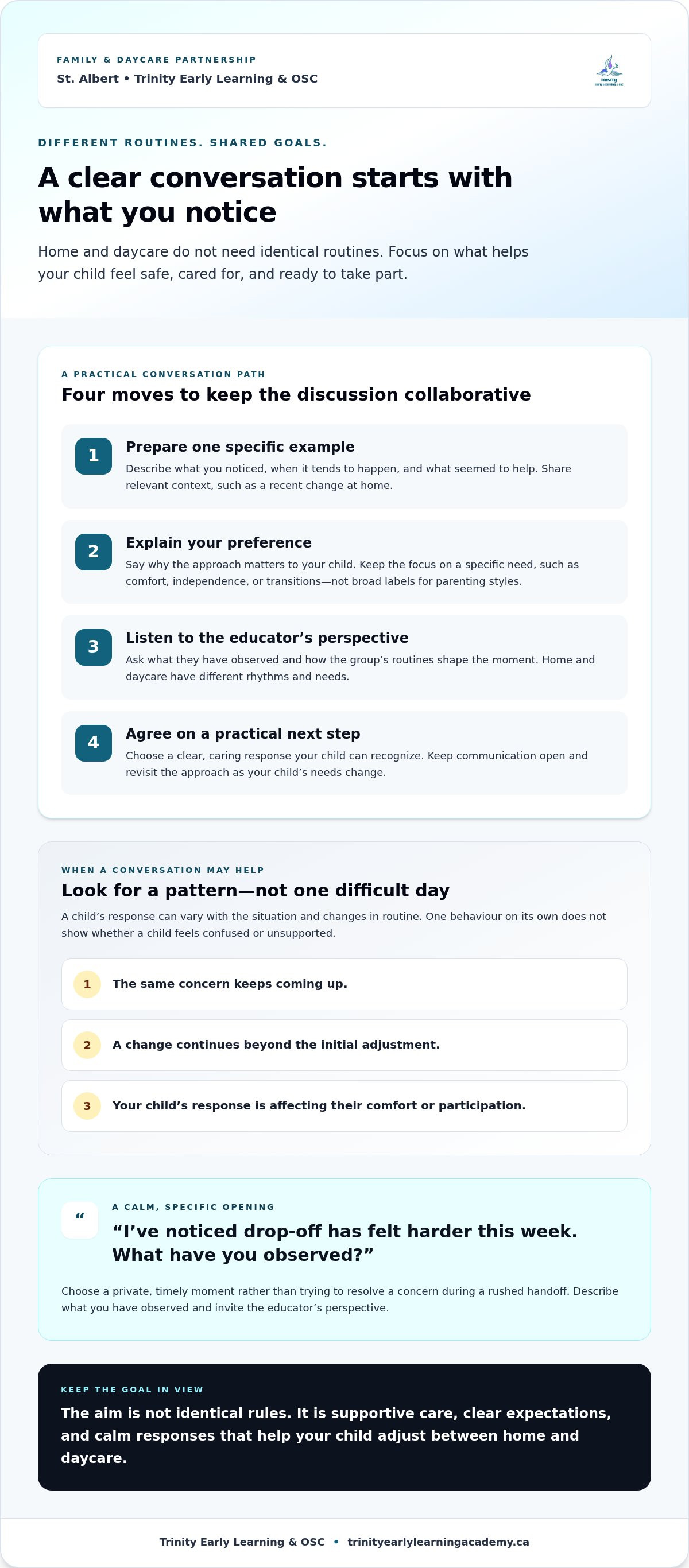
How to discuss different parenting styles with daycare
A constructive conversation starts with what you want for your child, not with a label for your parenting approach or the educator’s. When deciding how to manage different parenting styles with your daycare, focus on a specific moment, explain what you have noticed, and invite the educator to share their perspective. This keeps the discussion practical and makes room for both family knowledge and the realities of the care setting.
How can you raise a difference without sounding critical?
Try opening with a shared goal: “I’d like us to help Sam feel more comfortable during transitions.” Then describe what you have observed without assuming why it is happening. For example: “At home, a reminder before we leave helps Sam get ready. What do you notice during the transition here?” A calm, curious question lets educators share their observations before you discuss whether a change could help.
Before the conversation, sort your preferences into three groups: essential needs that affect safety, care, or your child’s wellbeing; flexible preferences where a different approach can work; and points that are open to discussion. This helps you identify where to be clear and where you can work together on an option that fits the daycare routine.
What should a shared plan include?
Keep the plan focused on one concern at a time. Agree on the routine you are addressing, the response adults will try, and a point to check in about how it is working for your child. For example, the plan might say that adults will give a clear transition cue and offer a brief reminder. Keep the wording simple so everyone involved can understand and follow the agreed approach.
- Prepare: Choose one situation and note what you have observed, including when it happens and what seems to help.
- Describe: Share the example and explain why it matters to your child or family.
- Listen: Ask what the educator has noticed and how the routine works in the care setting.
- Agree: Choose one practical response to try, while clarifying what is essential and what can stay flexible.
- Follow up: Set a reasonable time to discuss what each adult has observed and whether the plan needs adjustment.
A simple plan does not need to make home and daycare identical. It gives adults a clear way to communicate, try a shared next step, and review it as the child’s needs change. For other factors families may weigh when choosing care, read this licensed daycare guide. Trinity Early Learning & OSC offers daycare and preschool programs in St. Albert.
Building a supportive parent-daycare partnership in St. Albert
A supportive partnership grows through regular, respectful communication, not a single conversation. Families know their child’s preferences, routines, and experiences at home. Educators see how the child responds in the care setting. Sharing these perspectives helps adults stay focused on the child’s needs, even when their approaches differ.
How can families keep communication consistent?
For an ongoing concern, choose a suitable time and communication channel so there is room to talk without rushing. Brief handoff updates can share timely information, while a more involved topic may need a separate conversation. Keep the details focused: what changed, what you have noticed, and what you would like to understand.
Relevant changes at home, such as a new routine or a recent transition, may help educators understand how a child is feeling during the day. Share what seems useful, then make room for the educator’s observations. Revisit an agreed approach if the child’s needs or routines change. A plan should support the child now, not become a fixed rule that no longer fits.
What can St. Albert families explore next?
As you consider childcare and early learning, reflect on what matters most to your family: your child’s daily needs, the kind of learning environment you are seeking, and how you want to communicate with educators. Trinity Early Learning & OSC provides licensed daycare, preschool, and out of school care in St. Albert. Affordability grant programs support accessible childcare for local families. Families looking for background on early learning can explore this early childhood education guide. If preschool is part of your plans, the St. Albert preschool programs guide offers related information.
Learning how to manage different parenting styles with your daycare is an ongoing process of sharing priorities, asking questions, and adjusting as your child grows. Keep your child’s comfort and wellbeing at the centre of each discussion. To learn more about local care options, explore Trinity’s childcare programs.
Build a Consistent, Caring Partnership
Home and daycare do not need to follow identical routines for a child to feel supported. Shared priorities, calm communication, and clear expectations can help adults provide steady care across settings. When a difference concerns your child’s wellbeing, describe what you have observed, listen to the educator’s perspective, and agree on a practical next step.
Learning how to manage different parenting styles with your daycare is an ongoing conversation. Revisit the approach as your child grows and their needs change. Keeping their comfort and development at the centre can help families and educators work together with respect.
Trinity Early Learning & OSC provides licensed daycare, preschool, and out of school care in St. Albert. Affordability grant programs support accessible childcare for local families. Explore Trinity Early Learning & OSC’s childcare programs in St. Albert.
Frequently Asked Questions
Can a child have different rules at home and daycare?
Yes. Children can learn that expectations differ between home and daycare, such as helping tidy up at care while following a different routine at home. Clear, calm explanations help them understand what happens in each setting. Adults do not need to make every rule identical. Focus on shared priorities, including safety, respectful care, and predictable guidance. Talk with educators if a particular difference is affecting your child’s comfort or wellbeing.
How do I talk to daycare about a parenting disagreement?
Choose a suitable time to talk and describe the specific situation you have noticed. For example, explain what happens during a transition and what helps your child at home, then ask what the educator observes. Use neutral language and listen before proposing a change. You might say, “I’d like to understand how this routine works here and share what we’ve noticed.” Agree on a practical next step together.
Should daycare follow my parenting style?
Daycare does not need to copy your parenting style or reproduce every home routine. A group setting has its own rhythms, and approaches can differ while adults still share goals for the child’s safety, comfort, and development. To manage different parenting styles with your daycare, focus on specific needs and respectful discussion rather than expecting every preference to be applied identically in both settings.
What if my child behaves differently at daycare than at home?
Different behaviour in different settings can be part of how a child responds to different people, routines, and surroundings. Ask educators what they observe, including when the behaviour occurs and what happens before or after it. Share relevant context from home, too. Look for repeated patterns rather than drawing conclusions from one incident. If a behaviour continues to concern you or affects your child’s wellbeing, discuss it with the educator.
How can parents and daycare educators create consistent routines?
Choose one routine to discuss, such as drop-off or getting ready for rest. Share what your child is used to at home, learn how the routine works in care, and agree on a simple cue or response that fits that setting. Consistency does not require identical schedules. It means adults communicate clearly and follow the agreed approach where practical, then check whether it is meeting the child’s needs.
Is it normal for a child to need time to adjust to daycare routines?
Yes. A child may need time to become familiar with new people, activities, and expectations. Their response can vary from day to day, so one difficult transition does not necessarily mean something is wrong. Calm reassurance and predictable cues can help. If you notice a repeated concern or a change in your child’s comfort, share specific observations with the educator and discuss what each of you sees.
What should I share with daycare about my family’s routines and expectations?
Share details that help educators care for and understand your child, such as important comfort routines, relevant health or dietary needs, and approaches that support independence or transitions. Explain what is essential for your family and what can be flexible. St. Albert families considering licensed daycare, preschool, or out of school care can bring these priorities into conversations with local providers such as Trinity Early Learning & OSC.


