

What if a tearful drop-off is part of a difficult adjustment, but a recurring pattern points to a lasting mismatch? It can be hard to know when to switch daycares, especially when you’re weighing your child’s distress against concerns about safety, communication, care quality, or changing family needs. One tough day alone may not tell the whole story, but ongoing concerns deserve attention.
This child-focused checklist will help you look for patterns, assess whether your child’s needs are being met, and decide what to do next without rushing a major change. You’ll find practical ways to raise concerns with your current daycare and assess whether the response addresses them.
We’ll cover signs that call for closer attention, questions to help distinguish an adjustment from a persistent mismatch, and steps for planning a thoughtful transition if you decide to move on. For families in St. Albert, the goal is to find care that supports your child and fits your family’s circumstances.
Key Takeaways
- Learn how to spot recurring signs that your child’s needs may not be met, while keeping one difficult day in perspective.
- Use specific examples and a constructive conversation to raise concerns and agree on practical next steps.
- Assess when to switch daycares by comparing your child’s wellbeing, routines, learning needs, communication, and your family’s logistics.
- Plan a change thoughtfully by coordinating dates, preparing routines, and helping your child feel supported through the transition.
- Explore how licensed daycare, preschool, and out of school care in St. Albert may fit your family’s needs.
When to switch daycares: signs your child’s needs may not be met
It’s understandable to question a daycare arrangement when your child seems unhappy or something feels wrong. A difficult drop-off or one unsettled day doesn’t, by itself, show that the setting is a poor fit. Look for patterns over time and consider what else may be affecting your child. Daycare is one form of child care, and your child’s experience includes more than time spent in the room: routines, relationships, early learning, and communication all matter.
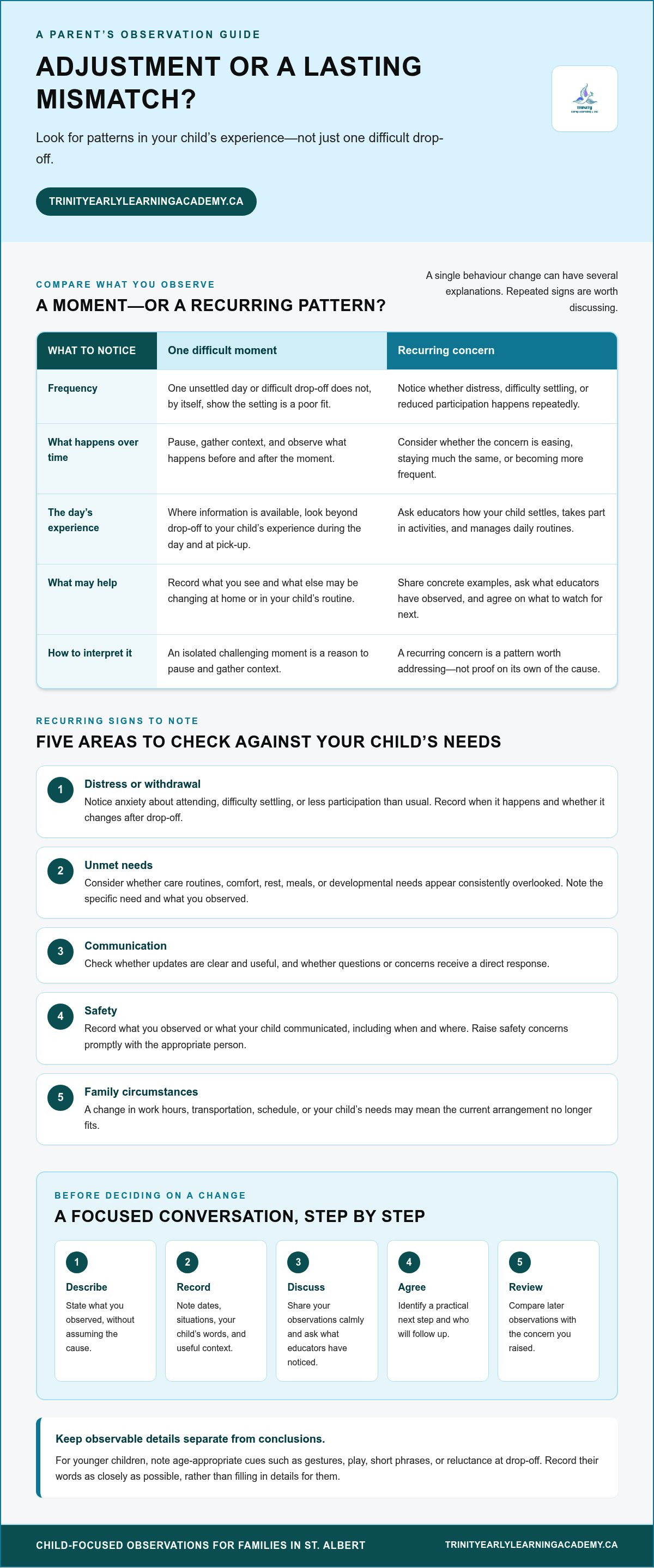
As you consider when to switch daycares, use this checklist to focus on recurring concerns rather than a single moment:
- Distress or withdrawal: Notice whether your child regularly seems anxious about attending, has difficulty settling, or participates less than usual. Record when it happens and whether it changes after drop-off.
- Unmet needs: Consider whether care routines, comfort, rest, meals, or developmental needs appear to be consistently overlooked. Note the specific need and what you observed.
- Communication: Ask whether you receive clear, useful updates and whether your questions and concerns get a direct response.
- Safety: Take concerns seriously. Record what you observed or what your child communicated, including when and where it occurred, and raise the matter promptly with the appropriate person.
- Family circumstances: A change in work hours, transportation, schedule, or your child’s needs may mean the current arrangement no longer fits.
Changes in mood, sleep, appetite, or behaviour can have many causes. They aren’t proof of poor care or a reason to diagnose your child. Note what you see, when it happens, and what else is changing at home or in your child’s routine. For younger children, pay attention to age-appropriate cues such as gestures, play, short phrases, or reluctance at drop-off. Record their words as closely as possible rather than filling in details for them.
Which recurring concerns deserve a closer look?
Observe comfort, participation, and daily routines across multiple days. Does your child settle after drop-off, join activities, or seem increasingly reluctant to attend? Write down concrete details, such as what happened before the distress, how long it lasted if you know, and what helped. Record any safety concern without guessing at the cause. A single behaviour change can have several explanations, but repeated signs are worth discussing with educators.
How can you distinguish a hard adjustment from a mismatch?
Consider when the concern began, how often it occurs, and whether it’s easing, staying much the same, or becoming more frequent. Where information is available, compare drop-off, your child’s experience during the day, and pick-up. Ask educators what they’ve observed, including how your child settles and takes part in the day. Share your notes calmly and agree on what to watch for next. Their perspective can add context and help you assess whether support is making a difference.
A recurring concern is a pattern worth addressing; an isolated challenging moment is a reason to pause, gather context, and observe.
Before switching daycares, understand the concern and discuss possible solutions
Once you’ve noticed a pattern, a focused conversation can help you understand what’s happening and whether a practical change could help. This doesn’t mean dismissing your concern or assuming the daycare is at fault. It means gathering useful information before deciding when to switch daycares, unless there’s an urgent safety issue that needs prompt attention.
Use a simple sequence to keep the discussion focused:
- Describe the concern: State what you’ve observed, such as your child repeatedly arriving home distressed or saying they aren’t joining an activity.
- Record examples: Note dates, situations, your child’s words, and any context that may help explain the pattern.
- Speak with educators: Share your observations calmly and ask what they’ve noticed during the day.
- Agree on next steps: Identify a practical change or information that could help, and decide who will follow up.
- Review what changes: Compare later observations with the concern you raised and consider whether it’s improving.
Keep observable details separate from conclusions. “My child cried at drop-off on several mornings this week” gives educators something specific to discuss. “The staff don’t care” assumes a cause and can make it harder to work out what your child needs. Specific examples turn a difficult conversation into a shared effort to understand your child’s experience and identify practical next steps.
What should parents prepare before a daycare conversation?
Bring concise notes: dates, what happened, questions you want answered, and your child’s words as closely as you can recall them. Avoid presenting interpretations as facts. Consider what information would help you understand the situation, such as a clearer update about a routine or more context about how your child settles. Keep the focus on your child and possible next steps.
If your concern involves immediate safety, raise it promptly rather than waiting for a routine meeting or review. Record what you observed, when it happened, and any response you received. Stick to factual details and take the steps you believe are needed to protect your child.
How can you assess whether the concern is improving?
Agree on what progress would look like in everyday terms. Depending on the concern, that could mean clearer communication about a particular routine or a change in how your child settles. Revisit your notes after an appropriate period for the situation; there’s no single timeline for every child or issue. For local context, read this licensed daycare guide for St. Albert. Families considering a change can also explore licensed daycare and early learning in St. Albert.
Compare daycare options by your child’s needs, not by one difficult week
A change isn’t automatically harmful, and it isn’t a guaranteed solution. A new setting may better match your child’s needs, but it also brings new relationships, routines, and family logistics. To judge whether a move could help, compare the current experience with a realistic alternative using the same priorities, rather than deciding based on one difficult week.
Choose what matters most for your child and family, then compare each care arrangement against those needs. For each point, note what you know, what you still need to understand, and how it would affect your day-to-day routine:
Child wellbeing: In the current setting, when does your child seem comfortable and engaged? In another setting, what would help them feel secure and take part?
Daily routines: How well do meals, rest, transitions, and the start and end of the day fit your child? Would a different routine suit them better?
Communication: Are updates from the current daycare clear and useful? What information would help you feel informed, and how often do you need it?
Learning needs: Does the current experience offer appropriate early learning for your child’s age and interests? What would you hope to find in another program?
Family logistics: Consider commute, care schedule, and how each option fits your family’s usual St. Albert routines. A setting that looks suitable on paper may be difficult to manage day to day.
Compare what you know with what you can reasonably learn about another option. Avoid assuming a different setting will resolve every concern. Some needs may be addressed through clearer communication or practical adjustments, while others may remain unmet. Keep confirmed safety or wellbeing concerns separate from preferences, such as a more convenient commute. Give safety questions focused attention as you compare. This St. Albert daycare safety checklist can help you consider that part of the decision.
Which care qualities matter most to your family?
Rank your priorities instead of expecting one option to excel in every area. You might place supportive relationships and consistent routines first, then consider early learning and schedule fit. Your child’s age, communication style, interests, and individual needs can shape those priorities. A young child may need you to interpret their experience through behaviour and routines; an older child may be able to share more directly.
How do you weigh the benefits and disruption of a change?
List the improvements you hope for alongside the work a move would involve, such as adjusting drop-off routines, building new relationships, and coordinating transportation. Invite your child’s perspective in an age-appropriate way, without making them responsible for the decision. When deciding when to switch daycares, give unresolved safety or wellbeing concerns more weight than preferences or convenience, while considering the full impact on your family.
Use this St. Albert daycare transition checklist to plan a change
Once you’ve decided a change is right for your family, planning can make the handover clearer for you and your child. Review your current care arrangements, including any notice or end-date details you’ve agreed to, and communicate respectfully with the current daycare. You don’t need to settle every detail at once. Focus first on coordinating care and helping your child know what to expect.
- Confirm the change: Make sure the new care arrangement and start date are settled before finalizing your child’s last day in the current setting.
- Coordinate dates: Compare the final day and new start date to avoid preventable gaps in care. Check how the timing fits with work and school schedules.
- Prepare practical details: Organize the information, contact details, belongings, and routine notes relevant to your child’s care. Share useful context about communication, comfort, and everyday habits.
- Plan for the new routine: Consider how drop-off, pick-up, transportation, and the commute will fit into your family’s regular St. Albert schedule.
- Support your child: Explain the change in simple, reassuring language and leave room for questions or mixed feelings.
There’s no single transition timeline that suits every child or family. The pace may depend on the arrangements, your child’s response, and practical factors such as work and school. Keep familiar home routines where possible, including the usual steps around bedtime or getting ready in the morning. Predictability at home can give your child something familiar as other routines change.
What should families organize before the first day?
Before the start date, gather the practical items and information your child will need, such as their belongings, relevant care details, and the right contact information. Confirm the final day with the current daycare and coordinate it with the new start date. In St. Albert, account for commute time, school commitments, and work schedules so the plan works beyond the first morning. Keep communication courteous and direct.
How can you help your child settle into a new routine?
Use short, consistent explanations suited to your child’s age. For example, you might say, “You’ll be going to a new daycare, and I’ll pick you up after your day.” Answer questions honestly without promising that every part will feel easy. Observe how your child responds over time, and share relevant context with educators so they understand what helps your child feel comfortable.
Thoughtful planning can make a change more manageable, even though adjustment may take time. If you’re exploring licensed daycare or early learning in St. Albert, explore Trinity Early Learning & OSC.
Explore licensed daycare and early learning options in St. Albert
A considered change can be a practical response when a persistent mismatch remains after you’ve reviewed your child’s needs and the current arrangement. The goal isn’t to find a perfect setting, but to identify care that better fits your child’s wellbeing, learning needs, and your family’s day-to-day life.
In St. Albert, Trinity Early Learning & OSC provides licensed daycare, preschool, and out of school care. These programs can suit different family routines. Daycare may fit families looking for care during the workday, while preschool may be relevant when early learning is part of the decision. For children who attend school, out of school care may fit the hours surrounding the school day. The right option depends on your child’s needs and your family’s practical schedule.
What local care options may fit a changing family situation?
Consider which type of care aligns with your child’s stage and your weekly routine, then compare it with the priorities you identified earlier. If early learning is a key consideration, explore these preschool programs in St. Albert. If your family needs care around school hours, read about out of school care in St. Albert. Trinity also offers affordability grant options for local families. Consider these as you compare arrangements, keeping in mind that eligibility and fees depend on individual circumstances.
What is a calm next step for parents considering a switch?
Use your checklist to make the decision manageable: identify the concern, decide which needs matter most, and consider how a different care arrangement may fit your child and family. Keep questions about unresolved safety or wellbeing concerns distinct from preferences such as commute or convenience. A clear comparison can help you explore alternatives without expecting a change to resolve every difficulty automatically.
If licensed daycare, preschool, or out of school care in St. Albert could suit your family, explore Trinity’s local childcare programs as you consider your next step.
Choose a care setting that fits your family now
Deciding when to switch daycares is easier when you look beyond one hard day. Notice whether concerns form a pattern, raise them with educators using specific examples, and compare care options against your child’s wellbeing, learning needs, routines, and your family’s schedule. If a change feels appropriate, a thoughtful plan can make the transition more manageable.
For St. Albert families, Trinity Early Learning & OSC provides licensed daycare, preschool, and out of school care. Affordability grant options are also available as families consider local childcare. The right fit depends on your child and your practical needs, so take time to compare the type of care with your family’s routine.
Explore Trinity’s childcare and early learning programs to learn about local options for your family. Take this decision one step at a time, with your child’s needs at the centre.
Frequently Asked Questions
How do I know when to switch daycares?
Look for concerns that recur, affect your child’s comfort or daily experience, and remain unresolved after clear communication. Write down specific examples, such as repeated difficulty settling or a routine need that isn’t being met, and consider what else may be happening in your child’s life. One difficult drop-off alone may not show a lasting mismatch. If you have an urgent safety concern, address it promptly rather than waiting for a routine review.
Is my child’s distress at drop-off a reason to change daycares?
Not necessarily. Distress at drop-off can have different causes, and it doesn’t show on its own how your child is doing for the rest of the day. Notice whether it continues, ask educators what they observe after you leave, and consider recent changes to routines at home or in care. If distress persists or appears alongside serious concerns about your child’s wellbeing, record the details and give the pattern careful attention.
Can changes in my child’s behaviour mean their daycare is not a good fit?
A behaviour change is a reason to pay attention, but it doesn’t establish what caused it. Consider when it began, whether it appears at home and in other settings, and what your child can communicate in an age-appropriate way. Note specific observations rather than drawing conclusions. Share those details with educators and ask what they’ve noticed. The wider context can help you decide whether the care arrangement may need to change.
How long should I give a new daycare before deciding it is not working?
There’s no single timeline that fits every child or situation. Consider the concern’s nature and frequency, how your child’s experience changes over time, and whether communication leads to helpful adjustments. Review your observations regularly instead of relying on a fixed settling-in period. Don’t use extra time to dismiss an urgent safety concern. Your decision should reflect what you’re seeing and your child’s circumstances, not an arbitrary deadline.
What should I do before switching daycares?
First, clarify what concerns you and record specific examples. If it’s appropriate, discuss your observations with educators and review whether practical changes address the issue. Then compare your child’s needs and your family’s routines with realistic care options in St. Albert. If you decide to move, coordinate the final day and new start date, prepare familiar items and routines, and explain the change calmly in language your child can understand.
How can I make switching daycares easier for my child?
Keep your explanation simple, calm, and consistent, and answer questions honestly. Where possible, preserve familiar home routines and organize practical items before the change. Your child may have mixed feelings, so listen without expecting them to feel excited or reassured right away. Notice how the new routine is going, and share relevant information with educators, such as what helps your child feel comfortable or what changes you’ve observed.
Should I tell my current daycare that I am planning to switch?
When it’s appropriate and safe, respectful communication can help coordinate dates and make practical arrangements clearer. Keep the conversation factual and focused on the transition rather than blame. Review any care arrangements you’ve made so you can plan the final day thoughtfully. If your decision is related to an urgent safety concern, prioritize your child’s wellbeing and take timely steps. Don’t delay action just to have a routine conversation first.


