
What if a milestone checklist were a guide, not a pass-or-fail test? Developmental milestones for 3-year-olds can help you notice new skills, but children develop at different rates. One difference on its own doesn’t tell the whole story. It’s understandable to feel uncertain when checklists don’t agree or you’re wondering whether to ask for help.
This guide covers common examples of development at age three and how to observe your child’s communication, movement, thinking, and social-emotional skills. You’ll also find practical ways to encourage learning through play and daily routines, along with advice for sharing a concern with a healthcare professional.
Milestones are most useful when considered alongside your child’s interests, experiences, and progress over time. We’ll look at skills children may be learning at this age, when to seek guidance from a family doctor or public health nurse, and how early learning settings in St. Albert can give children opportunities to practise skills through play and everyday routines.
Key Takeaways
- Use developmental milestones for 3-year-olds as guideposts, not a pass-or-fail test.
- Consider communication, social-emotional, thinking, physical, and self-help skills together.
- Support learning through shared reading, conversation, play, and familiar routines.
- If you have a concern, note what you’ve observed and discuss it with a healthcare professional.
- Early learning settings in St. Albert can give children everyday opportunities to practise skills, and educators can share observations with families.
Developmental milestones for 3-year-olds: what this checklist can tell you
Milestones are guideposts, not a test every child must pass on a particular day. Children develop skills at different times. A checklist is most useful when it helps you notice your child’s growth, rather than compare them with someone else.
Developmental milestones are skills that many children develop by a certain age, across areas such as communication, movement, thinking, and social interaction. They offer a general picture of development, not a strict timetable. Early childhood involves ongoing changes in how children think, communicate, relate to others, and explore their surroundings. For broader background, see Early childhood development.
Use developmental milestones for 3-year-olds as prompts for noticing patterns. A checklist can help you consider what your child is learning and prepare questions. It can’t diagnose a developmental delay or explain why a skill is emerging differently.
How to use a 3-year-old milestone checklist
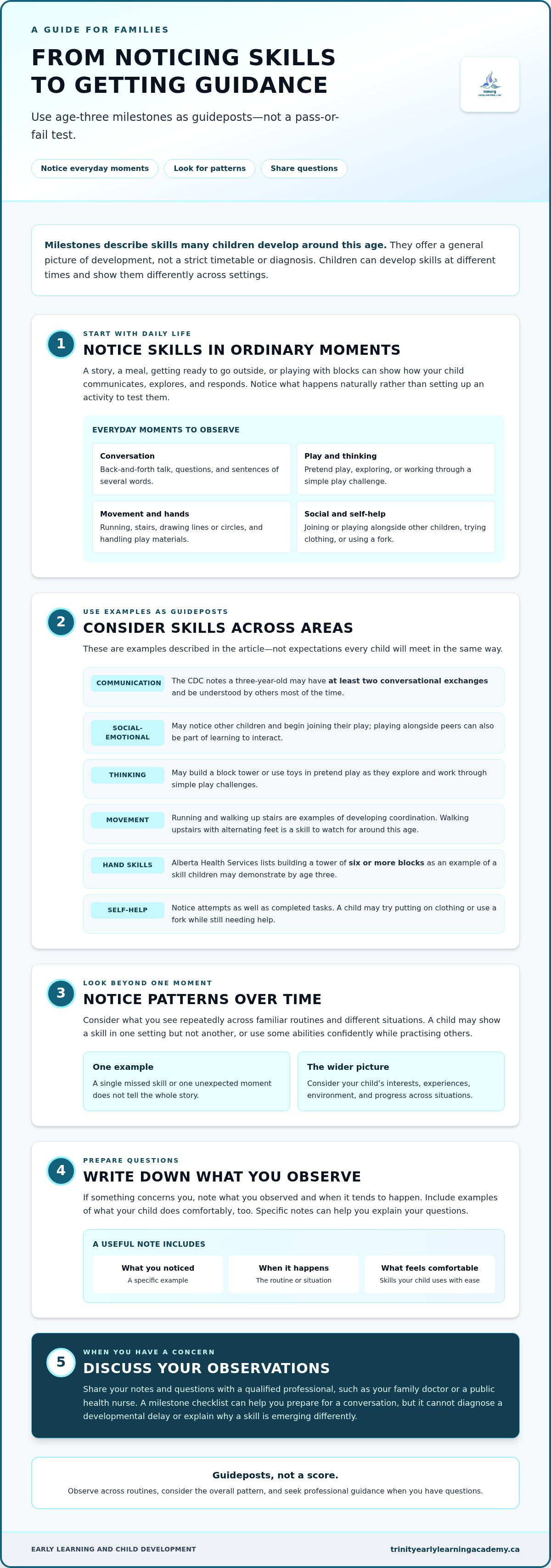
Notice skills during ordinary moments instead of setting up an activity to “test” your child. A story, a meal, getting ready to go outside, or playing with blocks can show how your child communicates, explores, and responds. One missed example alone doesn’t establish a developmental condition.
If something concerns you, write down what you observed and when it tends to happen. Include examples of what your child does comfortably, too. Specific notes can help you explain your questions to a qualified professional, such as your family doctor or a public health nurse.
Why development can look different from child to child
Skills emerge over time, and not every child follows the same sequence or pace. A child might show a skill in one setting but not another, or be practising some abilities while using others with confidence. Consider the overall pattern rather than drawing conclusions from one moment.
Language, experience, health, and environment can all shape what caregivers observe. Children may have different opportunities to talk, play, and try everyday tasks. Avoid ranking children or treating comparisons as a measure of progress. Your observations over time, paired with professional guidance when needed, offer a more useful picture.
A 3-year-old developmental milestones checklist by skill area
At age three, children build skills in several areas at once. The examples below draw on guidance from Alberta Health Services, the Canadian Paediatric Society, and the CDC's milestones for 3-year-olds. They describe behaviours to look for in daily life, not a clinical assessment or expectations every child will meet in the same way.
Communication, social-emotional, and thinking skills
- Communication: Your child may take part in short back-and-forth conversations, ask questions such as “who,” “what,” or “where,” and speak in sentences of several words. The CDC notes that a three-year-old may have at least two conversational exchanges and be understood by others most of the time.
- Social-emotional: Your child may notice other children and begin joining their play. Playing alongside peers can also be part of learning to interact. Children may show a range of emotions as they practise expressing feelings and responding to others.
- Thinking: Notice how your child explores and works through simple play challenges. They may build a block tower or use toys in pretend play. These moments can show curiosity and emerging problem-solving, but one activity doesn’t measure overall development.
Movement, hand skills, and everyday independence
- Large movements: Running and walking up stairs are examples of developing coordination. The Canadian Paediatric Society describes walking upstairs with alternating feet as a skill to watch for around this age.
- Hand skills: Your child may draw lines or circles and handle familiar play materials. Alberta Health Services also lists building a tower of six or more blocks as an example of a skill children may demonstrate by age three.
- Self-help: Notice attempts as well as completed tasks. A child may try putting on some clothing or use a fork at a meal, while still needing help with parts of the task. Independence develops through practice and can vary by activity and setting.
Use these examples to guide your observations across routines, not to score your child’s abilities. For further context, Alberta Health Services and the Canadian Paediatric Society offer Canadian developmental guidance. Families in St. Albert can also learn about Trinity’s early learning programs, where play and everyday routines give children opportunities to practise developing skills.
When a 3-year-old’s milestones vary: what is typical and what merits a conversation?
Children don’t develop every skill at the same pace. A child may communicate confidently but need more support with physical tasks, or show a skill at home that’s less visible in a new setting. Consider differences in context instead of comparing children or relying on a checklist score.
Developmental milestones for 3-year-olds describe skills many children demonstrate around this age. They can help caregivers notice patterns and prepare questions, but they can’t diagnose a developmental delay. A single missed example, or one moment when a child doesn’t respond as expected, isn’t enough to draw a conclusion.
How to interpret differences without comparing children
Consider what you see repeatedly, across familiar routines and different situations. For example, a child might use more words during a favourite game than with unfamiliar people. A new environment, fatigue, or how an activity is presented may also affect what you observe. These details add context; they aren’t proof for or against a developmental concern.
Focus on your child’s progress over time rather than how they compare with siblings or classmates. Note which skills are emerging, where your child seems comfortable, and where they often need support. The overall pattern across areas gives a healthcare professional a clearer starting point than a checklist tally.
When should parents raise a developmental concern?
You don’t need to wait until you’re certain there’s a problem. If a concern persists, affects everyday activities, or you’re unsure how your child is progressing, discuss it with a qualified healthcare professional. In St. Albert, start with your child’s healthcare provider or ask a public health nurse for guidance. Alberta Health Services also provides developmental information for families.
Contact a healthcare professional if your child loses a skill they previously used, such as words, gestures, or movement abilities. Share what changed and when you first noticed it. This is a reason to seek advice, not a diagnosis.
Before a conversation, write down a few specific examples: what happened, where it happened, and whether you’ve noticed it more than once. Mention what your child does well and any questions you have. A professional can consider your observations alongside your child’s broader development and advise on appropriate next steps.
Simple ways to support developmental milestones for 3-year-olds
Children practise new skills through connection and everyday experiences. You don’t need a formal lesson or a perfect activity plan. Conversation, play, movement, and participation in familiar routines give your child chances to explore and try things at their own pace.
Use play and conversation to create learning opportunities
Shared reading is a natural way to practise listening and expressing ideas. Pause to ask open questions such as “What do you think happens next?” or “What do you notice?” Give your child time to respond and follow their interests instead of expecting a particular answer. At meals or while getting ready, invite them to talk about what they’re doing or choosing.
Pretend play can encourage imagination and turn-taking. Take turns serving pretend food, caring for a toy, or adding to a story together. Let your child lead, then join in with a comment or simple question. This keeps play enjoyable while creating chances to share ideas and practise taking turns.
Stay responsive. If your child is absorbed in building or drawing, sit nearby and show interest. A warm response and a little conversation can support engagement without turning play into a test.
Build movement and independence into everyday routines
Offer manageable ways to practise physical and hand skills throughout the day. A walk outdoors can make room to move, notice things, and talk about what you see. At home, drawing with crayons, stacking blocks, or helping carry a light item can involve coordination and hand control. Choose activities that suit your child and keep safety in mind.
Daily routines also offer chances to try self-help tasks. Invite your child to help put on a coat, choose between two clothing items, use a fork, or put toys away. Let them try the parts they can manage, and help when needed. The goal is participation and practice, not completing every task independently.
- Follow their interest: Build an activity around what captures your child’s attention.
- Offer a small next step: Make the task manageable, then allow time to try.
- Encourage effort: Notice participation and curiosity rather than praising only a finished result.
Everyday opportunities can support the skills described in developmental milestones for 3-year-olds without drills or pressure. For families in St. Albert, learn about Trinity’s early learning programs, where play and familiar routines offer children opportunities to practise communication, movement, and independence.
How early learning in St. Albert can support a 3-year-old’s growth
A preschool or daycare setting gives children chances to practise communication, play, and everyday routines alongside other children. Listening to a story, joining group play, and moving through familiar parts of the day all create opportunities to use developing skills. These experiences complement what children learn at home; they aren’t a test of whether a child has reached every milestone.
For families exploring local options, this guide to early childhood education in St. Albert offers more context. Preschool provides opportunities to learn through play and shared routines, while daycare includes everyday moments to practise communication, independence, and interacting with peers.
What families and early childhood educators can share
Families know what their child is like at home, while educators may observe the child during play and routines in an early learning setting. Sharing specific examples can build a fuller picture. Mention what your child enjoys, skills they’re beginning to try, and situations where they may need more support.
These conversations can focus on strengths, emerging skills, and questions you’d like to discuss. Educators can share observations and support learning, but they don’t replace healthcare professionals or diagnose developmental conditions. If you have an ongoing concern, bring it to your child’s healthcare provider.
Finding an early learning fit in St. Albert
Consider what kind of setting may suit your family and give your child comfortable opportunities to take part. Predictable routines, play, and time with peers provide a context for practising skills described in developmental milestones for 3-year-olds. Learn more about preschool programs in St. Albert or read this licensed daycare guide for St. Albert for information to support your family’s decision.
Trinity Early Learning & OSC provides licensed daycare and preschool programs in St. Albert, with early learning experiences designed to support children’s development. If you’re considering a local setting for your child, explore Trinity Early Learning & OSC to learn more.
Keep noticing, supporting, and celebrating your child’s growth
Developmental milestones for 3-year-olds are guideposts, not a scorecard. Children develop at different rates, so look at patterns across communication, play, movement, and daily routines rather than focusing on one skill in isolation. If a concern persists or your child loses a skill they once used, share your observations with a healthcare professional.
Small, responsive moments matter. Reading together, talking during familiar routines, and making time for play give your child opportunities to practise new skills without pressure. An early learning setting can offer further chances to explore, interact, and build confidence through everyday experiences.
Trinity Early Learning & OSC provides licensed daycare and preschool services in St. Albert, with early learning programs designed to support children’s development. Explore Trinity Early Learning & OSC to learn about local early learning options.
Frequently Asked Questions
Is it normal for a 3-year-old to miss some developmental milestones?
Yes. A child may not show every skill on a milestone checklist at the same time. Milestones describe abilities commonly seen around an age, not a pass-or-fail test. Notice your child’s progress across different skills and situations over time instead of drawing conclusions from one missed example. If a concern continues or you’re unsure about your child’s development, discuss your observations with a healthcare professional.
What should a 3-year-old be able to say?
There isn’t one phrase or word count that fully describes a child’s communication development. Notice how your child communicates during everyday activities. Alberta Health Services notes that children around age three may speak in sentences of four to five words, while the CDC describes back-and-forth conversation and being understood most of the time. These are examples, not diagnostic rules. Ask a healthcare professional if you have concerns.
Can a 3-year-old’s development vary from one skill area to another?
Yes. A child may be developing communication skills while still needing support with movement, social play, or everyday independence. Skills can emerge unevenly, and a child may act differently in familiar and unfamiliar settings. Consider what you observe across routines and over time instead of expecting all abilities to appear together. If a pattern continues to concern you, share specific examples with your child’s healthcare professional.
When should I talk to a doctor about my 3-year-old’s development?
Talk with your child’s healthcare professional whenever you have an ongoing concern or need help understanding a skill. You don’t have to wait until several milestones seem delayed. Note what you’ve observed, when it happens, and whether it occurs in different situations. In St. Albert, families can speak with their child’s healthcare provider or a public health nurse, and consult Alberta Health Services developmental information.
How can I support my 3-year-old’s developmental milestones at home?
Everyday routines and play offer natural chances to practise skills. Read together and pause to talk about the story, invite your child into pretend play, and make time for outdoor movement or drawing. You can also offer manageable self-help tasks, such as trying to put on a coat, with patient support. Follow your child’s interests and encourage participation rather than turning activities into tests. Ask a qualified professional for guidance if needed.
Do daycare and preschool help with a 3-year-old’s development?
Daycare and preschool can offer opportunities for play, conversation, familiar routines, and interaction with other children. Educators may share observations with families, adding context to what caregivers notice at home. These settings support learning but don’t replace healthcare advice or developmental assessment. St. Albert families can explore Trinity Early Learning & OSC’s licensed daycare and preschool programs, which support children’s development through early learning experiences.
What should I do if my 3-year-old stops doing a skill they used to do?
Contact a healthcare professional if your child loses a skill they previously used. Describe the skill, when you last noticed it, and any changes in routines or health that may provide context. For example, note whether the change involves words, gestures, movement, or another familiar ability. An online checklist can’t identify the cause. A professional can discuss your observations and advise on appropriate next steps.


