

What makes a playground check useful is not only spotting a hazard, but knowing what to do next. A playground safety checklist for daycares gives staff a consistent way to check outdoor areas before children play, respond when something needs attention and record what happens. That matters when staff members across shifts share the inspection routine.
In St. Albert, changing weather can affect play surfaces and equipment. Snow, ice, water or heat may call for a closer look before outdoor play begins. Staff also need clear guidance on when children should stay away from an area until a concern is addressed.
This guide outlines a repeatable routine for checking equipment, surfacing and the surrounding play area, along with steps for documenting hazards and follow-up. It also offers questions families can ask about how a daycare checks its outdoor space and communicates concerns. Clear checks and records help providers support safer outdoor play in an organized way.
Key Takeaways
- Use a brief visual check before children enter the play area, while recognizing that inspections can’t remove every risk.
- Use a playground safety checklist for daycares to prompt checks of equipment, surfacing and the surrounding area.
- Recheck outdoor conditions after changing St. Albert weather, since surfaces and equipment may be affected.
- When staff spot a concern, manage access as needed, report it, document the response and recheck before reopening the area.
- Ask a daycare how staff report playground hazards and let families know when outdoor-play plans change.
Playground Safety Checklist for Daycares: What to Check Before Play
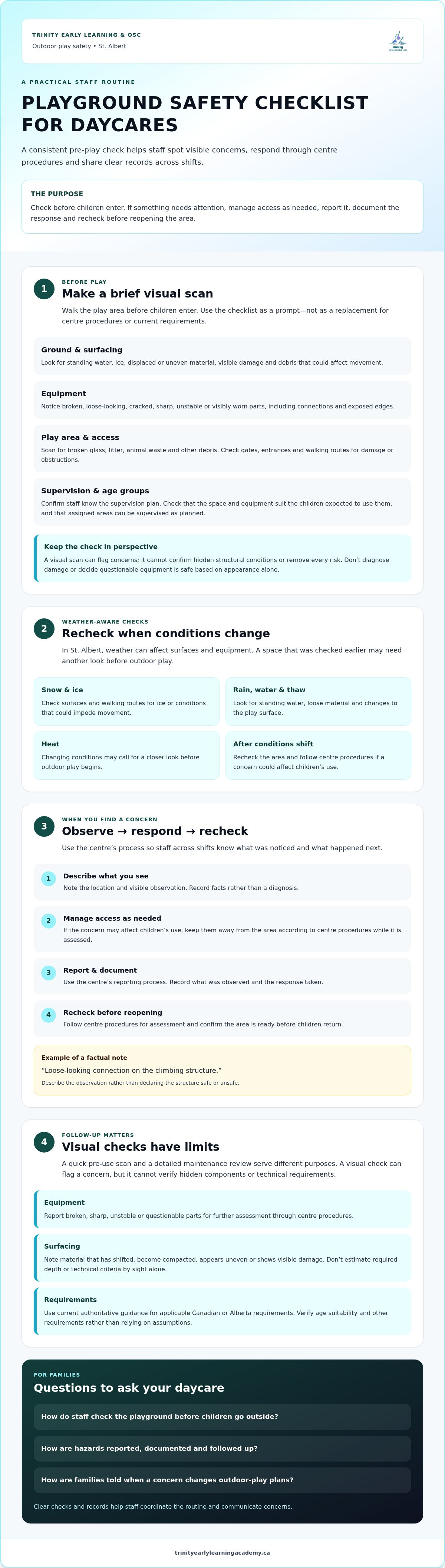
Regular checks can help staff spot preventable hazards, but no inspection can remove every risk from outdoor play. A pre-use check is a brief visual review of the play area before children enter. A clear routine helps staff notice changes, follow the centre’s procedures and act consistently across shifts.
A pre-use playground inspection is a brief visual review of the play area to identify hazards before children begin outdoor play. Use the playground safety checklist for daycares as a prompt, not as a substitute for centre procedures or current requirements that apply to the program. For background on common playground components and safety considerations, see this Playground safety overview.
- Hazards: Look for broken glass, litter, animal waste and other visible debris.
- Equipment: Notice broken, loose, cracked or visibly damaged parts, along with sharp edges or anything that appears out of place.
- Surfacing: Scan for standing water, ice, displaced or uneven material, and debris that could affect movement.
- Access: Check gates, entrances and walking routes for obstructions, damage or conditions that could impede safe passage.
- Supervision: Confirm staff know the centre’s supervision plan and can maintain appropriate awareness of the play area.
What should staff scan first?
Start with the ground and the routes children will use. In St. Albert, conditions can change after rain, snow, freezing temperatures or a thaw, so check for water, ice and loose material even if the area was inspected earlier. Then scan equipment and access points. If a concern could affect children’s safe use of an area, follow the centre’s process for addressing it before play proceeds there.
How should the checklist work for different age groups?
Check that the space and equipment suit the children expected to use them. Consider whether younger and older children can use their assigned areas without avoidable conflicts, and whether staff can supervise those spaces as planned. Age suitability can depend on the equipment and applicable guidance, so verify current requirements rather than relying on assumptions or applying one rule to every playground.
Keep the checklist practical: record what you observed, then follow centre procedures if a check raises a concern. A consistent pre-play scan gives staff a shared starting point. Applicable requirements and professional guidance should inform the centre’s full inspection and maintenance practices.
Equipment and Playground Surfaces: Daycare Safety Checks That Matter
A quick visual check before play and a more detailed maintenance review serve different purposes. Staff can spot visible changes during a pre-use scan, but they shouldn’t try to diagnose structural damage or decide that questionable equipment is safe. This distinction keeps the playground safety checklist for daycares practical: observe, record and report, then follow the centre’s procedures for further assessment.
Which equipment warning signs should staff notice?
Scan equipment for loose, broken, sharp, unstable or visibly worn parts. Look closely at connections and contact points for exposed edges, protruding hardware or components that appear damaged or out of place. A visual check can flag a concern, but it can’t confirm the condition of hidden or internal parts.
Record the equipment’s location and what you observed, using a clear description rather than a conclusion. For example, note “loose-looking connection on the climbing structure” instead of declaring the structure unsafe. Report the observation through the centre’s process. If the concern may affect children’s use, manage access according to centre procedures while it’s assessed.
What should a daycare check on playground surfacing?
Look for impact-absorbing material that has shifted, become compacted, appears uneven or shows visible damage. Also note trip hazards and changes around areas where children use equipment. Don’t estimate whether surfacing meets a required depth or other technical criteria by sight alone. Verify applicable surfacing requirements using current authoritative guidance.
The U.S. CPSC Public Playground Safety Handbook offers reference material on playground equipment, surfacing and maintenance. It’s a U.S. publication, so use it as supplementary information, not as a replacement for current Canadian or Alberta requirements that apply to the centre.
| Routine visual check | Concern needing follow-up |
|---|---|
| Notice visible wear, loose-looking parts or a change in how a component sits. | Report broken, sharp, unstable or questionable equipment. Restrict access as directed by centre procedures while the concern is reviewed. |
| Scan surfacing for displacement, compaction, uneven areas or visible damage. | Escalate concerns about surfacing condition or suitability for assessment against current guidance. |
| Check surrounding routes and equipment-use areas for debris or trip hazards. | Address immediate obstructions under centre procedures, and record repairs or further review needed. |
This comparison supports a consistent routine, but it isn’t a technical inspection standard. Staff should document what they see and pass concerns to the appropriate person through the centre’s reporting process. Families considering licensed daycare or preschool in St. Albert can learn more about Trinity’s childcare and preschool programs and ask how outdoor-area concerns are handled.
Seasonal Playground Safety Checks for Daycares in St. Albert
A playground that looked clear during a scheduled inspection can change after a snowfall, thaw, rainstorm or strong wind. In St. Albert, seasonal weather can affect access routes, play surfaces and nearby trees. An additional check helps staff respond to current conditions instead of assuming yesterday’s conditions still apply.
Weather changes can alter outdoor conditions between scheduled inspections, so an additional visual check can help staff identify hazards before children use the affected area. This check doesn’t replace the centre’s regular inspection or maintenance process. It gives staff another opportunity to notice changes and decide what action is needed under site-specific procedures.
What should staff look for after changing weather?
Focus on conditions that may affect access or movement. After a freeze or thaw, look for ice, pooled water, snow and mud on walking routes and play surfaces. Following wind or rain, scan for branches and other debris near equipment or entrances. If you spot a concern, follow the centre’s procedures for managing access, report what you observed and record any action taken.
Keep observations factual. “Ice on the path beside the play area” describes what staff can see. Avoid assuming a route is safe because it was clear earlier, or that a surface is unsafe based only on the season. If conditions are unclear, ask a supervisor how to proceed before children use the affected area.
How can teams adjust checks through the year?
Use one consistent checklist across staff and shifts, with prompts that reflect conditions observed at the site. A prompt to check for ice, for example, may be relevant after a freeze, while a check for branches may be useful after wind. The goal is to keep the core routine familiar while helping staff notice current conditions, not to assume the same seasonal hazard is present every day.
Supervisors can clarify when local conditions call for an additional check, a report or restricted access. Staff should also confirm any seasonal inspection schedule against current Alberta guidance and their centre’s procedures. Don’t treat an informal calendar as a substitute for applicable requirements. Confirm what applies to the program.
Record the affected area, the observed condition and the action taken, then recheck it before children use that space. This gives the next staff member useful context and supports consistent follow-up. A playground safety checklist for daycares works best when it helps teams respond to real site conditions while keeping the inspection routine clear and repeatable.
Documenting Inspections and Responding to Hazards
A useful inspection record shows what staff noticed and what happened next. The goal isn’t to write a lengthy report for every routine observation. It’s to make concerns clear enough that another staff member or supervisor can understand the status and continue follow-up without guesswork.
Use a consistent sequence: observe, manage access, report, document and recheck. The response depends on the concern. A minor maintenance issue that doesn’t affect children’s use may be reported for routine follow-up under centre procedures. A suspected hazard that could pose an immediate risk may require staff to keep children away from the affected area while the concern is assessed. Follow the centre’s process rather than deciding independently that damaged or questionable equipment is ready for use.
What belongs in a playground inspection record?
Use practical fields that capture the observation and its follow-up. For each concern, record:
- Date and time: When the check or follow-up took place.
- Area: The specific location or equipment involved.
- Observation: A brief, factual description of what staff saw.
- Action: Steps taken, such as reporting the concern or managing access under centre procedures.
- Responsible person: Who was notified or assigned to follow up.
- Status: Whether the concern remains open, has been addressed or needs another check.
Describe what’s visible, not an unverified diagnosis. For example, “surface material displaced beside the slide” is more useful than “surface doesn’t meet requirements.” Clear wording helps the person assigned to follow up understand what needs review.
What should staff do when they find a hazard?
First, follow the centre’s procedure to keep children away from a suspected hazard. Notify the appropriate supervisor promptly, then document the location, observation and action taken. If the concern needs repair or further assessment, record who will follow up and how its status will be checked. Before an affected area reopens, confirm it’s ready for use according to centre procedures.
This recordkeeping approach supports consistent communication across staff and shifts, but it doesn’t replace current licensing requirements or centre policy. The playground safety checklist for daycares should fit within the program’s established inspection, reporting and maintenance process.
St. Albert families comparing providers can explore licensed daycare services and ask how concerns about outdoor play areas are reported and followed through.
Questions Families Can Ask About Daycare Playground Safety
A conversation with a childcare provider is a chance to understand how outdoor play is managed, not to expect a promise that every risk can be removed. Ask how staff check the play area, respond to concerns and let families know if outdoor plans change. These questions can help you understand whether the provider’s process is clear and consistent.
If you’re comparing several aspects of care, this daycare safety checklist for St. Albert families can help you prepare questions beyond the playground.
What should parents ask about daily outdoor checks?
Ask the provider to describe its routine in practical terms. You might ask when staff check the play area, what they do if they notice a concern and how they decide whether a space should remain out of use. Families can also ask how weather-related changes affect outdoor play and how staff share restrictions or changes in plans.
- When do staff check outdoor areas before children use them?
- How are hazards reported, and who follows up?
- How will families hear about a change to outdoor-play plans?
- What happens if weather affects access or play conditions?
Every site is different, so ask about the specific provider and outdoor area you’re considering. A clear answer should explain the process without making unsupported claims about equipment or inspection practices.
How can families assess a provider’s answers?
Listen for a straightforward explanation of who receives reports, how follow-up is tracked and how families are informed. You can ask staff to describe how they respond when outdoor conditions change. The playground safety checklist for daycares is a useful prompt for discussion, but a checklist alone doesn’t prove that a play area is hazard-free or replace the provider’s applicable procedures.
It’s reasonable to ask a follow-up if an answer is unclear. For example, if a provider says staff report concerns, ask how the team knows whether the issue has been addressed before the affected area is used again. A calm, specific explanation can help you understand the provider’s approach without expecting a guarantee of risk-free play.
Families exploring care options can read this guide to licensed daycare services in St. Albert and use these questions as part of a conversation with a provider.
Make Outdoor Safety a Shared Routine
A clear playground safety checklist for daycares helps staff check for visible concerns before play, notice weather-related changes and follow centre procedures when something needs attention. Consistent records can also make it easier to track who was notified, what action was taken and whether follow-up is complete.
Families can ask providers how outdoor areas are checked, how hazards are managed and how changes to outdoor play are communicated. A checklist supports a repeatable routine, but it can’t promise a hazard-free space or replace current requirements and centre policies.
Choosing childcare is a personal decision, and clear conversations can help you understand a provider’s approach. Explore Trinity Early Learning & OSC in St. Albert to learn about its licensed daycare, preschool and out of school care. Thoughtful questions and steady routines can support outdoor play that feels safer and more reassuring for everyone.
Frequently Asked Questions
What should a daycare playground safety checklist include?
A playground safety checklist for daycares should prompt staff to scan equipment, surfacing, access routes and the surrounding area before children use the space. Include visible concerns such as broken or loose parts, sharp edges, displaced surfacing, standing water, ice, debris and blocked entrances. The checklist should also remind staff to follow centre procedures for supervision, reporting concerns, managing access and recording follow-up.
How often should daycare staff inspect a playground?
Staff should complete a brief visual check before children enter the play area, then follow the centre’s schedule for more detailed inspections and maintenance. Weather or other changes can make an additional check appropriate between scheduled reviews. The schedule should be guided by current requirements that apply to the program, relevant authoritative guidance and centre procedures. Ask the provider how checks are assigned across staff and shifts.
What should staff do if they find a hazard on the playground?
Staff should follow the centre’s process to keep children away from a suspected hazard, notify the appropriate supervisor and record what they observed. The record should identify the location, action taken, person responsible for follow-up and current status. Before the affected area is used again, staff should confirm it’s ready under centre procedures. A concern that seems minor should still be reported if the process requires it.
Are daycare playgrounds required to meet Alberta safety standards?
Licensed daycare programs in Alberta must meet applicable provincial licensing requirements. The precise requirements relevant to an outdoor play area should be confirmed using current Alberta government guidance and the rules that apply to that program. Playground standards may also inform design, installation, maintenance or inspections, but don’t assume every standard applies in the same way to every site. Ask the provider which requirements and guidance it follows.
What should daycare staff check after snow, rain or freezing weather?
Staff should check for conditions that may affect access or movement, including ice, pooled water, snow, mud and loose debris. After wind or rain, they can also look for branches or other material near equipment and walking routes. Recheck affected areas before use, follow centre procedures if access needs to be managed, and record any action taken. Conditions at the site, not the season alone, should guide the response.
How should a daycare document playground inspections?
A useful record notes when the check took place, who completed it, the area inspected and any concern observed in clear, factual language. For follow-up, add the action taken, the person responsible and whether the issue remains open or has been resolved. For example, record “ice on the entrance path” rather than an assumption about its cause. Follow the centre’s recordkeeping procedures and applicable requirements.
What questions should parents ask about daycare playground safety?
Ask when staff check outdoor areas, what they do when they find a concern and how they confirm follow-up is complete. You can also ask how weather-related changes or limits on outdoor play are shared with families. Clear answers should explain the provider’s reporting and communication process without promising a hazard-free space. For a St. Albert provider, raise questions about the specific outdoor area and procedures directly with the centre.


